
PHYS-499 · Lesson 4 of 12 · 21 min
The literature review: searching, synthesizing and citing
▶ Video coming soon A video version of this lesson is on the way.
Every honors thesis contains a literature review, usually as part of the introduction or as a background chapter. Its purpose is not to prove that you have read a lot. It is to show the reader what is already known about the question, how it is known, where the gaps are, and how your project fills one of them. A good review is selective, organized by ideas rather than by paper, and honest about disagreements in the literature. This lesson covers how to search systematically, how to turn a pile of papers into a structured argument, and how to cite correctly so that every claim can be traced to its source.
Search tools for physics
Physics has unusually good search tools, and knowing which to use for which question saves a great deal of time. For high-energy, nuclear and gravitational physics the standard database is INSPIRE, run jointly by CERN, DESY, Fermilab, IHEP and SLAC and descended from the SPIRES database that SLAC began in the 1970s. It indexes papers, preprints, theses and conference contributions, links them to their citations, and records author identifiers. For astronomy and astrophysics the standard tool has been NASA's Astrophysics Data System, run from the Center for Astrophysics in Cambridge, Massachusetts. Since its launch announcement in September 2025 it has been evolving into the Science Explorer, called SciX, which extends the same search and citation tools to Earth, planetary, heliophysics and other space sciences while keeping astrophysics as a central focus.
For the rest of physics, including condensed matter, optics, electromagnetism and physics education, the general citation databases do most of the work. Web of Science and Scopus are curated commercial indexes available through university libraries; they are reliable for citation counts and forward searches. Google Scholar is free, broad and good at finding obscure items such as theses, but it is less precise and includes duplicates and errors. The arXiv's own search and listings are useful for the newest work. Publishers' sites, such as those of the American Physical Society, the Institute of Physics and the American Association of Physics Teachers, let you search within their journals. Your university library can arrange interlibrary loans for anything you cannot reach directly, and a subject librarian can be one of the most useful people you meet during the project.
Searching systematically
A systematic search has three parts. First, a keyword search in two or three databases with a deliberate list of terms, including synonyms and older vocabulary. For Maya the terms included eddy current, magnetic braking, Lenz's law, falling magnet, conducting tube and magnetic drag, combined with pipe or tube. Second, a backward search: for each key paper, read its reference list and follow the relevant items. Third, a forward search: use a citation database to find later papers that cite each key paper. Repeat backward and forward searches from the new papers until they keep returning items you have already seen. That saturation is the signal that you have found the core of the literature.
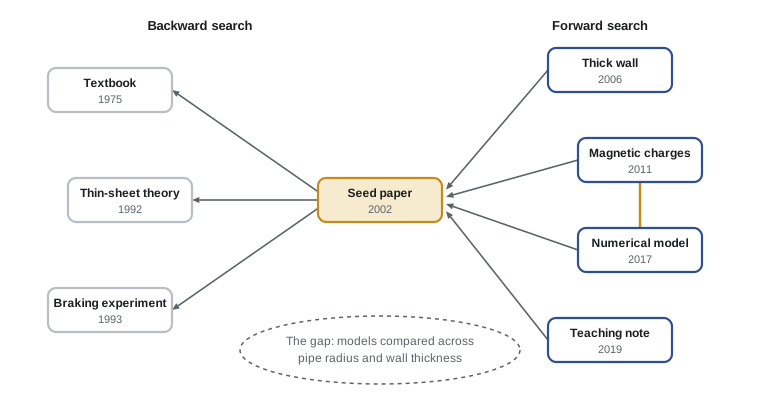
Citation trails can be followed by hand, but it helps to think of them as a graph: papers are nodes, citations are directed edges, and a search explores outward from seed papers in breadth-first order until no new relevant papers appear. The code below runs that procedure on a small citation graph like Maya's and stops at saturation. Real searches are messier, because relevance is a judgment, but the structure is the same.
from collections import deque
cites = {   # paper -> papers it cites (backward edges)
    "AJP2002": ["Jackson", "Saslow1992", "MacLatchy1993"],
    "EJP2006": ["AJP2002", "Saslow1992"],
    "AJP2011": ["AJP2002", "EJP2006"],
    "EJP2017": ["AJP2011", "AJP2002", "Jackson"],
    "TPT2019": ["AJP2002"],
    "Saslow1992": ["Jackson"],
    "MacLatchy1993": ["Saslow1992"],
    "Jackson": [],
    "IEEE2009": ["Jackson"],            # magnetic levitation, not relevant
}
relevant = {p for p in cites if p != "IEEE2009"}
cited_by = {p: [q for q, refs in cites.items() if p in refs] for p in cites}
def search(seed):
    seen, order, queue = {seed}, [], deque([seed])
    while queue:
        p = queue.popleft(); order.append(p)
        for q in cites[p] + cited_by[p]:          # backward and forward
            if q not in seen and q in relevant:
                seen.add(q); queue.append(q)
    return order
found = search("AJP2002")
print("found in breadth-first order:", found)
print("relevant papers found:", len(found), "of", len(relevant))found in breadth-first order: ['AJP2002', 'Jackson', 'Saslow1992', 'MacLatchy1993', 'EJP2006', 'AJP2011', 'EJP2017', 'TPT2019'] relevant papers found: 8 of 8
From a pile of papers to an argument
Once the core literature is found, the hard part begins: turning it into a review. The most common weakness of student reviews is that they are organized by paper: "Smith (2002) showed this. Jones (2006) showed that." A reader learns what each paper did but not what the field knows. A better review is organized by ideas. Group the literature into themes, state what is established in each, show how it was established, and identify where results disagree or where nothing has been done. Each paragraph should make a point, and the citations should support the point.
A synthesis matrix makes this easier. List the key papers as rows and the themes or questions as columns, and fill each cell with a short note of what the paper says on that theme. For Maya the columns were: the model of the magnet (point dipole, magnetic charges, current loops), the treatment of the wall (thin, thick), the comparison with experiment (how many pipes, what agreement), and the stated limitations. Reading down a column shows the state of knowledge on one theme; reading across the matrix shows the gap. In her matrix, every paper had compared a model with one or two pipes, and none had tested the radius and wall-thickness dependence of the drag across several pipes with independently measured moment and conductivity. That empty region was her project.
The synthesis matrix also helps with tone. A literature review should be fair: describe each approach in terms its authors would recognize, note its strengths before its limitations, and avoid sweeping claims such as "nobody has studied this", which are almost always false and easily refuted. Prefer specific, checkable statements: "previous comparisons used one or two pipes, and none varied the wall thickness with the magnet and pipe material held fixed." That sentence is both a fair summary and a precise statement of the gap.
Citing correctly
Citations serve three purposes: they give credit, they let readers check claims, and they show where your work begins and others' ends. The rules are simple to state. Cite the source of every idea, result, equation, figure, data set or piece of code that is not your own or common knowledge in the field. Cite the original source where you can, and the review or textbook where you learned it if that helped. Cite what you have actually read; if you know a paper only through another paper's description, say so, for example "as summarized in". Never copy a reference list from another paper without checking the items, because errors propagate. And distinguish quotation from paraphrase: quoted words go in quotation marks with a citation, paraphrased ideas still need a citation.
Physics uses mostly numbered citation styles, such as the style of the American Physical Society and the American Institute of Physics, in which references are numbered in order of first appearance. Some journals and departments use author and year styles instead. Your department will specify one; follow it consistently. In practice almost all physics theses are written in LaTeX, and references are managed with BibTeX or its successor BibLaTeX: you keep a database of entries in a .bib file, cite them by key in the text, and the software formats the list. The entries must be accurate, which means checking authors, titles, volumes, pages, years and DOIs against the published versions rather than trusting whatever a search engine exports.
refs = [
    dict(key="pointdipole2002", type="article", author="A. Author and B. Writer",
         title="Magnetic braking of a falling magnet", journal="Am. J. Phys.", volume="70",
         pages="412--418", year="2002", doi="10.0000/example.2002"),
    dict(key="desjardins2027", type="thesis", author="M. Desjardins",
         title="Predicting eddy-current drag on a magnet falling through a conducting pipe",
         school="HSM University", year="2027", note="Honours thesis"),
]
L, R = chr(123), chr(125)
def bibtex(r):
    lines = [f"@{r['type']}{L}{r['key']},"]           # @thesis is the BibLaTeX type
    for field in ("author", "title", "journal", "volume", "pages", "year", "school", "note", "doi"):
        if field in r:
            lines.append(f"  {field:8s}= {L}{r[field]}{R},")
    lines.append(R)
    return "\n".join(lines)
def check(r):
    need = {"article": ["author", "title", "journal", "volume", "pages", "year"], "thesis": ["author", "title", "school", "year"]}[r["type"]]
    return [f for f in need if f not in r] or "complete"
for r in refs:
print(bibtex(r)); print(" check:", check(r))@article{pointdipole2002,
author = {A. Author and B. Writer},
title = {Magnetic braking of a falling magnet},
journal = {Am. J. Phys.},
volume = {70},
pages = {412--418},
year = {2002},
doi = {10.0000/example.2002},
}
check: complete
@thesis{desjardins2027,
author = {M. Desjardins},
title = {Predicting eddy-current drag on a magnet falling through a conducting pipe},
year = {2027},
school = {HSM University},
note = {Honors thesis},
}
check: completeConsider what the checking function can and cannot do. It can confirm that required fields are present. It cannot confirm that they are correct, which only comparison with the published source can do. Students are sometimes caught out by references produced by chat-based AI tools, which can invent plausible titles, authors and DOIs for papers that do not exist. Whatever tool helped you find a reference, open the actual paper, check the details and read at least the parts you cite. A nonexistent reference in a thesis is a serious integrity problem, not a typographical error.
Writing the review
A good review section for an honors thesis is typically four to eight pages and might follow this outline: the phenomenon and why it matters; the basic theory as established in textbooks; the main modeling approaches and what each assumes; the experimental comparisons so far and their agreement; the open question; and how this thesis addresses it. Each part should be grounded in specific references, and each paragraph should do one job. Write it early, in rough form, during the first two months, and revise it at the end when you know what your results are. The final revision usually tightens the review around the specific gap your results address, which is the version examiners want to read.
Worked problem
Turning a paper-by-paper list into a synthesis
A draft reads: Paper A modeled the magnet as a dipole and found 10 per 100 agreement in one pipe. Paper B used two magnetic charges and found better agreement. Paper C did a numerical simulation. Rewrite it as a synthesis.
Show solution
- Identify the theme: models of the magnet differ in how they treat its finite size.
- State what is established: the point-dipole model agrees to about 10 per 100 in a single pipe [A]; replacing the dipole by two magnetic charges improves agreement [B], though the charge separation was chosen to fit.
- State the gap: numerical models with realistic magnet geometry exist [C] but have not been compared with measurements across pipes of different radii and wall thicknesses.
- Link to the project: this thesis makes that comparison with independently measured inputs.
Answer: A paragraph organized around the treatment of finite size, ending with the specific gap the project fills.
Common mistakes
MistakeOrganizing the review paper by paper.
InsteadOrganize by ideas or themes, and use papers as evidence for each point.
MistakeSearching only by keyword in one database.
InsteadCombine keyword searches in two or three tools with backward and forward citation searches until saturation.
MistakeCopying reference lists or trusting exported or AI-generated citations.
InsteadCheck every reference against the actual published source.
MistakeClaiming that nobody has studied a topic.
InsteadMake specific, checkable statements about what previous work did and did not do.
MistakeCiting only ideas but not data, figures or code.
InsteadCite the source of every result, figure, data set and piece of code you use.
Summary and key terms
- A literature review shows what is known, how it is known and where the gap lies, and explains how the thesis fills it.
- Use INSPIRE for high-energy and related fields, ADS and SciX for astrophysics and space sciences, and general databases for the rest of physics.
- Search systematically with keywords, backward searches and forward searches until new items stop appearing.
- A synthesis matrix of papers against themes turns a pile of papers into an argument and reveals the gap.
- Cite every idea, result, figure, data set and code you use; check every reference against the original; manage references with BibTeX.
- Backward search
- Following the references of a key paper to older work.
- Forward search
- Finding later papers that cite a key paper.
- Saturation
- The point at which further searches return only items already found.
- Synthesis matrix
- A table of papers against themes used to organize a literature review.
- BibTeX
- The bibliography tool used with LaTeX to store and format references.
Practice problems
Work each problem on paper first, then reveal the answer to check.
Which search tool would Jae-won use first, and why?
Show answer
INSPIRE, which covers gravitational-wave physics, with ADS and SciX as a second source for the astrophysical side.
List four search terms for Olivia’s muon-lifetime project.
Show answer
For example: muon lifetime, cosmic-ray muons, stopped muon decay, scintillator detector, undergraduate laboratory.
In the citation-search code, which relevant paper is never reached from the seed, and why?
Show answer
None: all eight relevant papers are found, while the levitation paper is excluded because it was judged not relevant.
What is wrong with citing a paper you have only seen described in another paper, without saying so?
Show answer
You are vouching for a source you have not checked; write "as summarized in" and cite both.
What should the last paragraph of a literature review do?
Show answer
State the open question precisely and explain how this thesis addresses it.
Lesson quiz · 5 questions
Score 60% or more to complete this lesson.
Create a free account to save your progress, take quizzes and earn a certificate.