
PHYS-499 · Lesson 1 of 12 · 25 min
What an honors thesis in physics is: from coursework to research
▶ Video coming soon A video version of this lesson is on the way.
For most of a physics degree, problems arrive with their edges already trimmed. A textbook chapter introduces a principle, the exercises at the end apply it, and the numbers have been chosen so that a careful student finishes in an evening with an answer that can be checked against the back of the book. Laboratory courses are similar: the apparatus is set up, the procedure is written, and the expected result is known to within a few parts in a hundred. An honors thesis reverses almost all of this. You help to choose the question. Nobody, including your supervisor, knows exactly what the answer will be. The apparatus may not exist yet, the code has not been written, and the main difficulty is often discovering which part of the problem is actually hard. The deliverable is not a solved problem set but a document, a talk and an oral defense in which you explain what you did, why you believe it, and how sure you are. This course is about making that transition well.
What counts as an honors thesis
Departments differ in the details, but an honors thesis in physics is usually a supervised project lasting two terms, worth the equivalent of one or two courses, and assessed on a written thesis of about 30 to 60 pages, a public talk and an oral examination. The thesis is read by the supervisor and by at least one second reader from another research group. The standard expected is that of a careful, correct and honest scientific document whose author understands every equation, every figure and every number in it. A new result is welcome and happens more often than students expect, because many good projects sit in corners that professional researchers have not had time to explore. But originality is not the defining requirement. What is required is that you carry a real question through the full cycle of research: framing it, finding out what is already known, designing a way to answer it, getting data or results, analyzing them with honest uncertainties, comparing with theory, and communicating the outcome.
Physics projects come in three broad kinds, and many good projects mix them. An experimental project builds or adapts apparatus, calibrates it and measures something. A computational project builds and validates a numerical model or analyses large data sets, often public ones. A theoretical project derives results, checks limiting cases and compares the predictions with published measurements. The skills overlap more than the labels suggest. Experimentalists write analysis code; computational physicists design numerical experiments with controls; theorists check their algebra with computer algebra and their approximations with numerics. Whatever the kind, the thesis is judged on the same questions: was the question clear, was the method sound, are the results correct and are the uncertainties honest.
Coursework and research compared
The contrast with coursework is worth stating plainly, because many of the habits that served you well in courses will not be enough on their own. In a course, the question is set by someone else; in research, choosing and sharpening the question is a large part of the work. In a course, the method is the one just taught; in research, you must choose among methods and justify the choice. In a course, a wrong answer is marked wrong and the term moves on; in research, a wrong result is often the most informative thing that happens, because it tells you that something in your apparatus, code or understanding is not what you thought. In a course, uncertainty is often an afterthought; in research, a result without an honest uncertainty is not a result at all, because nobody can tell whether it agrees with anything.
Time works differently too. A course divides a term into weekly assignments with deadlines. A thesis gives you eight months and a handful of milestones, and the danger is not one hard week but a slow drift in which the apparatus is nearly working for three months. Lesson 5 is about planning so that this does not happen. Finally, the audience changes. Assignments are read by a grader who knows the answer. A thesis is read by examiners who may know the field better than you do but who did not watch you work. They can only judge what is on the page and what you say in the defense. Writing so that a critical expert can follow and check your reasoning is a skill that this course treats as seriously as any calculation.
The research cycle
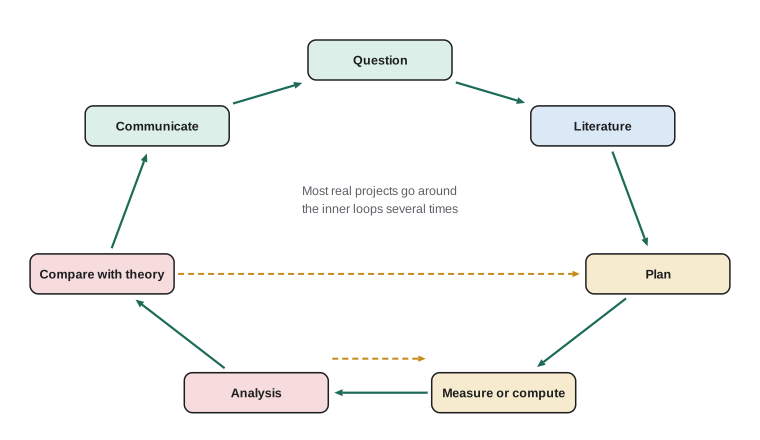
Research is often drawn as a straight line from question to answer. It is better drawn as a loop with inner shortcuts. You begin with a question and read enough to know what is known. You plan a measurement or calculation, carry it out, and analyze the result. Then you compare with theory, and very often the comparison fails in an interesting way: the data disagree with the model by more than the uncertainties allow. That failure sends you back, either to measure more carefully, to improve the model, or to rethink the question. Only when the comparison is understood, whether it agrees or disagrees, are you ready to communicate. Expect to go around the inner loops several times. A thesis that went straight through on the first attempt usually means the question was too easy, or that a problem was not noticed.
The model project that runs through this course
To make the ideas concrete, the course follows one honors student, Maya Desjardins, through a complete project, and checks in with four classmates whose projects illustrate other kinds of work. Maya's question begins with a classic demonstration. Drop a strong neodymium magnet down a vertical copper pipe and it falls astonishingly slowly, taking many seconds to cross a meter, even though copper is not magnetic. The explanation is eddy currents. As the magnet falls, the magnetic flux through each ring of the pipe wall changes, which by Faraday's law drives circulating currents in the copper. By Lenz's law those currents produce a magnetic field that opposes the change, which means they push up on the magnet below them and pull up on it from above. The result is a drag force that grows with speed, so the magnet quickly reaches a constant terminal speed at which the drag balances its weight.
Most textbooks stop at this qualitative story. Maya's supervisor, Professor Kwame Asante, an experimental physicist who works on magnetic materials, suggested a sharper question: how well can a first-principles model predict the terminal speed, with no adjustable parameters, and what limits the agreement? That question has everything a good honors project needs. The physics is within reach of PHYS-381 and PHYS-382. The apparatus is cheap: pipes, magnets, a Hall probe and two light gates. A numerical model is needed, because the simple formula assumes an infinitely small magnet and a thin pipe wall, neither of which is true. And the answer is not known in advance, because the comparison depends on details of her magnet and pipes that nobody has measured before.
Before committing, Maya made the kind of rough estimate that every project should begin with. Lesson 7 derives the full result; here she used a formula from a review article for a point dipole of moment \(m\) falling at speed \(v\) through a thin pipe of radius \(a\), wall thickness \(w\) and conductivity \(\sigma\). The drag force is \(F = k v\), with
where \(M\) is the mass of the magnet, \(v_t\) its terminal speed and \(\tau\) the time it takes to approach that speed. The strong dependence on \(a\), as the inverse fourth power, already warns that the pipe radius must be known precisely and that a magnet nearly filling the pipe will strain the point-dipole picture. Her estimate used a magnet 12.7 mm in diameter and 12.7 mm long, with a mass of 12.1 g and a dipole moment of about 1.6 A m² from the manufacturer's grade, and a standard half-inch copper water pipe.
import math
MU0 = 4e-7*math.pi
G = 9.81

def ellip(k):
    """Complete elliptic integrals K(k) and E(k) by the arithmetic-geometric mean."""
    a, b, c = 1.0, math.sqrt(1 - k*k), k
    tot, n = 0.5*c*c, 0
    while abs(c) > 1e-15:
        a, b, c = (a + b)/2, math.sqrt(a*b), (a - b)/2
        n += 1
        tot += 2**(n - 1)*c*c
    K = math.pi/(2*a)
    return K, K*(1 - tot)

def loop_br(I, R, r, z):
    """Radial field of a circular current loop (radius R, current I) at radius r, height z."""
    q = (R + r)**2 + z*z
    K, E = ellip(math.sqrt(4*R*r/q))
    return MU0*I/(2*math.pi)*z/(r*math.sqrt(q))*(-K + (R*R + r*r + z*z)/((R - r)**2 + z*z)*E)

def dipole_br(m, r, z):
    """Radial field of a point dipole m on the axis."""
    return MU0*m/(4*math.pi)*3*r*z/(r*r + z*z)**2.5

def cylinder_br(m, Rm, Lm, r, z, n=24):
    """Uniformly magnetized cylinder treated as n stacked current loops."""
    M = m/(math.pi*Rm*Rm*Lm); dz = Lm/n
    return sum(loop_br(M*dz, Rm, r, z - (-Lm/2 + (i + 0.5)*dz)) for i in range(n))

def drag_k(br, sigma, a, b, nr=6, zmax=0.10, nz=300):
    """Drag coefficient k = sigma * integral of 2 pi r Br^2 over the wall, so that F = k v."""
    tot, h = 0.0, 2*zmax/nz
    for i in range(nr):
        r = a + (i + 0.5)*(b - a)/nr
        s = sum(br(r, -zmax + (j + 0.5)*h)**2 for j in range(nz))*h
        tot += 2*math.pi*r*sigma*s*(b - a)/nr
    return tot

def k_thin(m, sigma, a, b):
    """Point dipole, thin wall at the mean radius: k = 45 mu0^2 m^2 sigma w / (1024 abar^4)."""
    w, abar = b - a, (a + b)/2
    return 45*MU0**2*m*m*sigma*w/(1024*abar**4)

def k_thick(m, sigma, a, b):
    """Point dipole, wall integrated from a to b exactly."""
    return 45*MU0**2*m*m*sigma*(a**-3 - b**-3)/(3*1024)
# Maya's magnet and pipes (lengths in m)
MASS, RM, LM = 12.10e-3, 6.35e-3, 12.70e-3        # magnet mass (kg), radius, length
PIPES = [  # name, inner radius, outer radius, conductivity (S/m)
    ("Cu M 1/2", 7.228e-3, 7.938e-3, 4.95e7),
    ("Cu L 1/2", 6.918e-3, 7.938e-3, 4.95e7),
    ("Cu K 1/2", 6.698e-3, 7.938e-3, 4.95e7),
    ("Al 1/2",   6.698e-3, 7.938e-3, 2.50e7),
    ("Cu L 3/4", 9.973e-3, 11.113e-3, 4.95e7),
]

m = 1.6                                   # estimated dipole moment, A m^2
name, a, b, sigma = PIPES[1]              # half-inch type L copper pipe
k = k_thin(m, sigma, a, b)
vt = MASS*G/k
print(f"pipe: {name}, inner radius {a*1e3:.2f} mm, wall {(b-a)*1e3:.2f} mm")
print(f"drag coefficient k = {k:.2f} kg/s")
print(f"terminal speed v_t = {vt*100:.2f} cm/s")
print(f"time to cross 1 m  = {1/vt:.0f} s")
print(f"approach time tau = {vt/G*1e3:.2f} ms (terminal speed within {vt*vt/G*1e3*5:.2f} mm of entry)")pipe: Cu L 1/2, inner radius 6.92 mm, wall 1.02 mm drag coefficient k = 2.95 kg/s terminal speed v_t = 4.03 cm/s time to cross 1 m = 25 s approach time tau = 4.11 ms (terminal speed within 0.83 mm of entry)
Three things in the output shaped the project. First, the predicted transit time of about 25 seconds per meter is long enough to time by hand, but light gates will be needed for precision. Second, the approach time of a few milliseconds means the magnet reaches terminal speed within a few millimeters of entering the pipe, so the timing can start well below the top. Third, the estimate is so sensitive to the moment, the radius and the conductivity that each must be measured, not assumed. Within a week Maya had a list of the measurements the project needed, which is exactly what a first estimate is for. When she later dropped her first magnet down a pipe from a hardware store, it took about 19 seconds rather than 25. That disagreement, about a quarter, became the heart of her thesis.
Four classmates, four kinds of project
Maya's cohort shows the range of honors work. Samir Rahman is analyzing public light curves from the TESS space telescope to measure the radius and orbit of a transiting hot Jupiter, a computational project that depends on careful treatment of noise and of the star's own variability. Jae-won Park is searching the public LIGO data release around GW150914 with a matched filter he wrote himself, testing whether he can recover the published chirp mass. Olivia Chen is building a tabletop detector from plastic scintillator and photomultiplier tubes to measure the lifetime of cosmic-ray muons, an experiment with a known answer whose value lies in the systematic errors. Ravi Iyer is extending the Ising simulation from PHYS-234 to estimate critical exponents by finite-size scaling, a project where the main challenge is showing that his error bars are honest. Each of these projects will appear in later lessons where it illustrates something Maya's does not.
What examiners look for
It helps to know from the start how a thesis is judged. Marking schemes vary, but almost all of them reward the same things. Examiners want a clear statement of the question and of why it matters. They want evidence that you know the relevant literature and can place your work in it. They want a method that is described well enough to be repeated, with its limitations stated. They want results with uncertainties that have been estimated honestly, not merely calculated. They want an honest comparison with theory or previous work, including disagreements. And they want clear writing and figures, and a defense in which you can explain any step on request. Look at what is not on the list: a spectacular result. A careful thesis that finds a modest discrepancy and explains it convincingly will always beat a careless one that claims something remarkable.
Integrity runs through all of these criteria. Every number in a thesis should be traceable to raw data or a documented calculation. Every figure should be reproducible from saved data and code. Help from your supervisor, classmates and technicians should be acknowledged. Text and ideas from others should be cited. Lesson 9 treats research ethics in detail, but the principle can be stated now: the purpose of a thesis is to show what you did and what you learned, and anything that obscures that, from a selectively chosen data point to an uncited paragraph, defeats the purpose.
Worked problem
Is this a sensible honors question?
A student proposes: measure the speed of light. Is this a good honors project, and how could it be sharpened?
Show solution
- As stated, the answer is known exactly: since 1983 the speed of light is defined to be 299 792 458 m/s, and the meter is defined from it. A measurement cannot improve on a definition.
- The value of a project lies in the method and its systematic errors. A sharper question would be: how accurately can a rotating-mirror apparatus of Foucault's design, built from parts costing under a few hundred dollars, measure \(c\), and what limits it?
- That version has a clear deliverable (an uncertainty budget), a known answer to test against, and room for original work in identifying the dominant systematic effect.
- It also has a floor (any measurement within 10 parts per hundred), a target (within 1) and a stretch goal (within 0.1), which lesson 2 shows how to set.
Answer: Not as stated, but the sharpened version, focused on the limits of a specific method, is a good experimental project.
Common mistakes
MistakeTreating the thesis as a long lab report.
InsteadA lab report follows a set procedure to a known answer; a thesis frames its own question, justifies its method and judges its own uncertainties.
MistakeWaiting for the apparatus or code to be finished before writing anything.
InsteadStart a running document in the first week: the question, the estimate, the plan. Most of the thesis can grow from it.
MistakeBelieving a project fails if the result disagrees with theory.
InsteadA well-understood disagreement is often the best result a project can have; an unexplained agreement can hide errors.
MistakeSkipping the first rough estimate.
InsteadA ten-minute estimate tells you which quantities matter most and must be measured carefully.
Summary and key terms
- An honors thesis carries a real question through the full research cycle: question, literature, plan, data or results, analysis, comparison with theory and communication.
- Projects may be experimental, computational, theoretical or mixed; all are judged on clarity, soundness, correctness and honest uncertainties.
- Research loops: disagreements between data and model send you back to measure, model or rethink, and that is where most learning happens.
- The model project asks how well a first-principles model predicts the terminal speed of a magnet falling through a conducting pipe; a first estimate already shows that the moment, radius and conductivity must be measured.
- Examiners reward clear questions, sound methods, honest uncertainties and clear communication, not spectacular claims.
- Honors thesis
- A supervised research project of about two terms, assessed on a written thesis, a talk and an oral defense.
- Eddy currents
- Circulating currents induced in a conductor by a changing magnetic flux.
- Terminal speed
- The constant speed at which a drag force balances the weight of a falling body.
- Order-of-magnitude estimate
- A rough calculation that identifies the scale of a result and the quantities it depends on most.
- Second reader
- An examiner from outside the supervising group who reads and assesses the thesis.
Practice problems
Work each problem on paper first, then reveal the answer to check.
Using the formula above, by what factor does the drag change if the pipe radius increases by 10 parts per hundred, other things equal?
Show answer
\(k \propto a^{-4}\), so \(k\) falls to \(1.1^{-4} = 0.68\) of its value and the magnet falls about 1.46 times faster.
Why does the magnet reach terminal speed so quickly?
Show answer
The approach time is \(\tau = v_t/g\); with \(v_t\) of a few centimeters per second, \(\tau\) is a few milliseconds, so the drag balances the weight almost immediately.
Give one way Olivia’s muon-lifetime project differs from Maya’s.
Show answer
The answer (about 2.2 microseconds) is known precisely; the research value lies entirely in her apparatus and systematic errors, whereas Maya is testing how well a model predicts an unknown speed.
Sharpen the question: "study the Ising model".
Show answer
For example: estimate the critical exponent of the magnetization of the two-dimensional Ising model by finite-size scaling, and compare the uncertainty with the exact value 1/8.
Maya’s first measured transit time was about 19 s per meter, against an estimate of 25 s. List three possible reasons.
Show answer
The point-dipole model may overestimate the drag for a magnet nearly filling the pipe; the dipole moment or the conductivity may differ from the assumed values; the radius or wall thickness may differ from the nominal size.
Lesson quiz · 5 questions
Score 60% or more to complete this lesson.
Create a free account to save your progress, take quizzes and earn a certificate.