
PHYS-499 · Lesson 2 of 12 · 21 min
Choosing a project and a supervisor
▶ Video coming soon A video version of this lesson is on the way.
The single most important decision in an honors thesis is made in the first few weeks: which project, and with whom. A good choice makes the next eight months demanding but productive. A poor one, a project too large, too vague or badly matched to the people and equipment available, can absorb the whole year without producing a result. This lesson is about making the choice deliberately. It covers where project ideas come from, how to judge whether a question is the right size, how to find and work with a supervisor, and how to write the short proposal that most departments require before the project formally begins.
Where project ideas come from
Most honors projects in physics start from one of four sources. The most common is a supervisor's own research: a faculty member has a side question, a calibration that needs doing, a simulation that would test an idea, or a piece of apparatus that a student could build. These projects come with expertise, equipment and a clear connection to current research, but you must make sure the question is yours to answer and not simply a task in someone else's program. The second source is a published result that invites checking or extending, for example a recent paper whose analysis could be repeated with public data. The third is a phenomenon that caught your attention in a course or a demonstration, as the falling magnet caught Maya's. The fourth is a computational or theoretical question that grows out of a course, such as Ravi's decision to push the Ising simulation from PHYS-234 to the point where critical exponents can be estimated.
Whatever the source, a good project idea has a recognizable shape. There is a quantity to determine, a model to test or a method to evaluate. There is a reason to care about the answer, even if the reason is modest. There is a credible path from the start to some answer within the available time and equipment. And there is room for judgment: choices that you, not your supervisor, will have to make and defend. Ideas that lack one of these features can often be repaired. "Study eddy currents" has no quantity and no test. "Predict the terminal speed of a magnet in a pipe from first principles, with no adjustable parameters, and identify what limits the agreement" has all four.
Sizing the question: floor, target and stretch
Research questions are notoriously hard to size, because the difficulty only becomes clear once you are working on them. A useful defense is to define three levels of success before you start. The floor is a result you are confident of reaching even if most things go wrong: it guarantees a thesis. The target is what you expect to achieve if the project goes about as planned. The stretch goal is what you would do with extra time or luck. A project whose floor is already uncertain is too risky; one whose stretch goal is easy is too small.
Writing the three levels down has a second benefit: it makes the conversation with a supervisor concrete. If a supervisor's idea of the floor is your idea of the stretch goal, you have found a mismatch in expectations early, when it is cheap to fix. It also gives you a way to decide, in March, whether to push for the stretch goal or to write up the target.
Choosing among candidate projects
Most students have two to four realistic options. A weighted decision matrix will not make the choice for you, but it forces you to say what matters and to notice when your instinct disagrees with your stated priorities. List the criteria, give each a weight, score each project from 1 to 5, and compute weighted totals. Typical criteria are your interest in the question, the fit with the supervisor and research group, whether you have the background, whether the scope fits the time, and access to equipment, data or computing.
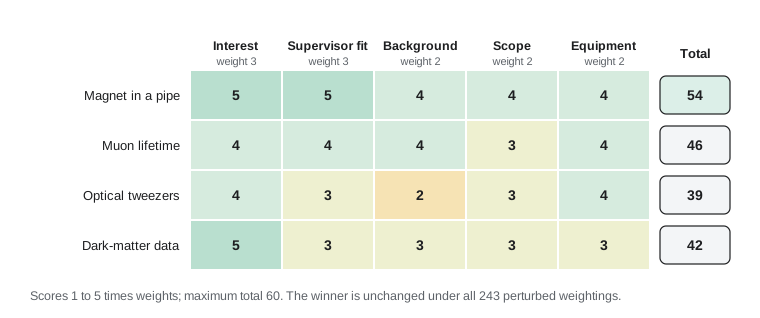
Maya considered four options: the magnet project with Professor Asante, a muon-lifetime experiment (which Olivia eventually took), an optical tweezers project in a biophysics lab, and an analysis of public direct-detection data for dark matter. The calculation below reproduces her matrix and then asks how robust the ranking is. Changing the weights by small amounts and seeing whether the winner changes is a quick sensitivity analysis, the same idea that lesson 8 applies to uncertainties.
import itertools
criteria = ["interest", "supervisor fit", "background", "scope", "equipment"]
weights  = [3, 3, 2, 2, 2]
scores = {
    "magnet in a pipe":      [5, 5, 4, 4, 4],
    "muon lifetime":         [4, 4, 4, 3, 4],
    "optical tweezers":      [4, 3, 2, 3, 4],
    "dark-matter data":      [5, 3, 3, 3, 3],
}
def total(w):
    return {p: sum(a*b for a, b in zip(s, w)) for p, s in scores.items()}
t = total(weights)
for p, v in sorted(t.items(), key=lambda kv: -kv[1]):
    print(f"{p:20s} {v:3d}  of {5*sum(weights)}")
# sensitivity: change each weight by -1, 0 or +1 (staying at least 1) and count winners
wins = {}
for d in itertools.product((-1, 0, 1), repeat=len(weights)):
    w = [max(1, a + b) for a, b in zip(weights, d)]
    best = max(total(w).items(), key=lambda kv: kv[1])[0]
    wins[best] = wins.get(best, 0) + 1
print("winner across", 3**len(weights), "perturbed weightings:", wins)magnet in a pipe 54 of 60
muon lifetime 46 of 60
dark-matter data 42 of 60
optical tweezers 39 of 60
winner across 243 perturbed weightings: {'magnet in a pipe': 243}The magnet project wins under every perturbed weighting, so the ranking does not depend on fine choices of weights. Had the winner changed often, that would have been a sign that two projects were genuinely close, and the right move would have been to talk to both supervisors again rather than to trust the arithmetic. Maya's instinct agreed with the matrix, which is reassuring. When instinct and matrix disagree, the useful question is which criterion your instinct is weighting differently. Sometimes the honest answer is that you care about the question more than your scores admit, and that is a legitimate reason to choose it.
Finding and working with a supervisor
The supervisor is the most important resource in an honors project. A good supervisor helps sharpen the question, points you to the right literature, provides or arranges equipment, catches errors early and teaches you the unwritten habits of the field. Supervisors differ in style. Some meet weekly and want to see every plot; others meet monthly and expect you to work independently. Some are close to the bench; others lead large groups in which day-to-day help comes from graduate students and postdoctoral researchers. None of these styles is wrong, but you should know which one you are choosing.
Before agreeing to a project, ask the supervisor directly how often you will meet, who you can ask when they are away, what equipment and computing you will have, what a typical honors student in their group achieves, and what happened to their last few honors students. Talk to those students if you can. Ask how authorship would be handled if the work led to a conference poster or a paper. None of these questions is rude; a good supervisor will welcome them, because they show that you are taking the project seriously.
Once the project starts, the most useful habits are simple. Arrive at each meeting with a short written update: what you did, what you found, what is blocking you, and what you plan next. Bring plots, not just descriptions. Write down decisions and send a brief summary afterwards. Ask for help early when you are stuck; a week lost to a problem your supervisor could solve in five minutes is a week the project cannot get back. And remember that the thesis is yours. Your supervisor advises, but you must understand and be able to defend every choice.
Timelines and milestones
Honors projects usually run from September to April, with a proposal in late September or October, an interim report or presentation in December, a full draft in March, and the thesis, talk and defense in April. Many departments also encourage students to present at a conference. In Canada the main venue is the Canadian Undergraduate Physics Conference, organized each October with the Canadian Association of Physicists and held since 1965; in 2026 it took place at McMaster University in Hamilton from 15 to 18 October. In the United States the American Physical Society's large spring meeting has an undergraduate program, and the Conferences for Undergraduate Women in Physics run at several sites each January. A conference deadline is a powerful motivator: an abstract due in August or January forces you to have preliminary results.
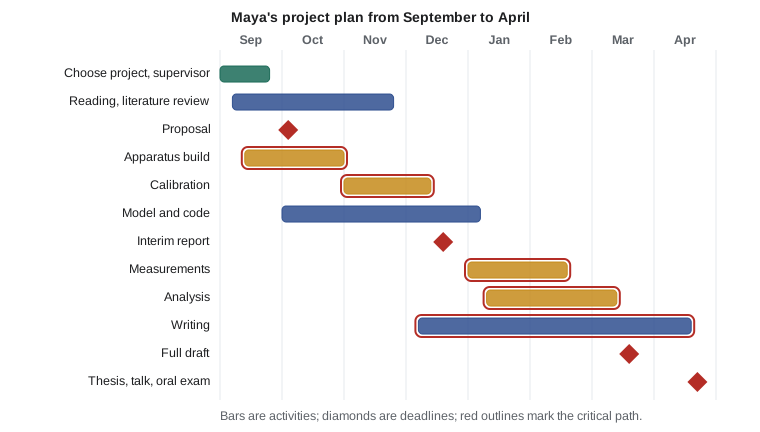
A Gantt chart, named after the engineer Henry Gantt who popularized it in the 1910s, shows activities as bars against time. Its most useful feature is the critical path: the chain of tasks, each depending on the last, that determines the earliest finishing date. In an experimental project the critical path almost always runs through the apparatus, because nothing can be measured until it works. In Maya's plan the model and code are off the critical path; they can slip by several weeks without delaying the thesis. The apparatus cannot. Lesson 5 shows how to compute the critical path and how to plan backward from the deadline.
Writing the proposal
Most departments ask for a one- or two-page proposal within the first month. It is a contract between you, your supervisor and the course coordinator, and it is also the first draft of your thesis introduction. A good proposal states the question in one or two sentences, explains why it matters, summarizes what is already known with a few key references, describes the method, lists the floor, target and stretch goals, sets out a timeline, and notes the main risks. Maya's proposal began: "The slow fall of a magnet through a conducting pipe is a standard demonstration of eddy-current braking, and simple models predict its terminal speed from the magnet's dipole moment and the pipe's conductivity and dimensions. This project will test how well such models predict measured terminal speeds with no adjustable parameters, and will identify the physical effects that limit the agreement." Those two sentences survived, almost unchanged, into her final abstract.
Worked problem
Turning an interest into a proposal
Samir is interested in exoplanets. Turn this into a two-sentence proposal statement with a floor, target and stretch goal.
Show solution
- Pick a concrete object and quantity: the planet-to-star radius ratio and orbital inclination of a known hot Jupiter observed by TESS.
- Statement: the project will fit a transit model to public TESS light curves of the target and compare the derived radius ratio and inclination with published values, testing how detrending of stellar variability affects the results.
- Floor: a phase-folded light curve with a transit depth and duration measured with uncertainties.
- Target: a full fit with limb darkening and a comparison of two detrending methods. Stretch: a search for transit-timing variations across sectors.
Answer: A specific target, a specific quantity, a method and a test, with three levels of success.
Common mistakes
MistakeChoosing a project because the topic sounds exciting, without asking about equipment, data or supervision.
InsteadAsk how the work will actually be done, by whom and with what; a modest topic with good support usually beats a glamorous one without it.
MistakeAccepting a project whose floor is already uncertain.
InsteadInsist on a floor you are confident of reaching; it is the insurance policy for the whole year.
MistakeGoing to supervisor meetings without notes or plots.
InsteadBring a short written update and the key figures; meetings become shorter and far more useful.
MistakeTreating the proposal as a formality.
InsteadThe proposal is the first draft of the introduction and the basis for later decisions about scope.
Summary and key terms
- Good project ideas have a quantity to determine or a model to test, a reason to care, a credible path in the time available and room for your own judgment.
- Define floor, target and stretch goals before starting; they size the question and align expectations with your supervisor.
- A weighted decision matrix, with a sensitivity check on the weights, structures the choice among projects without making it.
- Ask prospective supervisors about meetings, equipment, support and past students; arrive at every meeting with a written update and plots.
- Plan against milestones, identify the critical path, and write a proposal that states the question, method, goals, timeline and risks.
- Floor goal
- The result you are confident of reaching even if much goes wrong.
- Stretch goal
- An ambitious extension pursued only if time and results allow.
- Decision matrix
- A table of options scored against weighted criteria.
- Critical path
- The chain of dependent tasks that determines the earliest possible finish.
- Proposal
- A short document stating the question, method, goals, timeline and risks of a project.
Practice problems
Work each problem on paper first, then reveal the answer to check.
Rewrite "investigate superconductivity" as a sharp honors question.
Show answer
For example: measure the critical temperature of a YBCO sample by four-point resistance and by the onset of magnetic levitation, and explain any difference between the two values.
In the matrix code, what happens if the weight on equipment is raised to 5 and all others kept?
Show answer
Totals become 66, 58, 51 and 51; the magnet project still wins.
Give two questions you would ask a supervisor who leads a large group.
Show answer
Who will help day to day when the supervisor is away, and how often will I meet the supervisor personally?
Why is the apparatus usually on the critical path of an experimental project?
Show answer
Calibration, measurement and analysis all depend on it; any delay in the apparatus delays everything after it.
Write a floor goal for Olivia’s muon-lifetime project.
Show answer
Detect stopped muons and measure their decay-time distribution with enough events to fit a lifetime with an uncertainty of about 10 per 100.
Lesson quiz · 5 questions
Score 60% or more to complete this lesson.
Create a free account to save your progress, take quizzes and earn a certificate.