
PHYS-460 · Lesson 6 of 12 · 24 min
Laser types: gas, solid-state, fiber and semiconductor lasers
▶ Video coming soon A video version of this lesson is on the way.
The principles of lessons 2 to 5 apply to every laser, but real lasers differ enormously. Their wavelengths run from the vacuum ultraviolet to the far infrared, their powers from microwatts to megawatts of continuous output and petawatts in short pulses, and their sizes from a semiconductor chip smaller than a grain of salt to a building that houses 192 beams. This lesson surveys the main families: gas lasers, solid-state lasers, fiber lasers and semiconductor lasers. For each we ask what the gain medium is, how it is pumped, what limits its efficiency, and what it is used for. A recurring theme is the quantum defect, the energy lost as heat each time a pump photon is converted into a laser photon.
Gas lasers
Gas lasers were the first continuous lasers and remain useful where a beam of excellent quality is needed at a particular wavelength. The gas is excited by an electric discharge, in which electrons accelerated by the field collide with atoms or molecules.
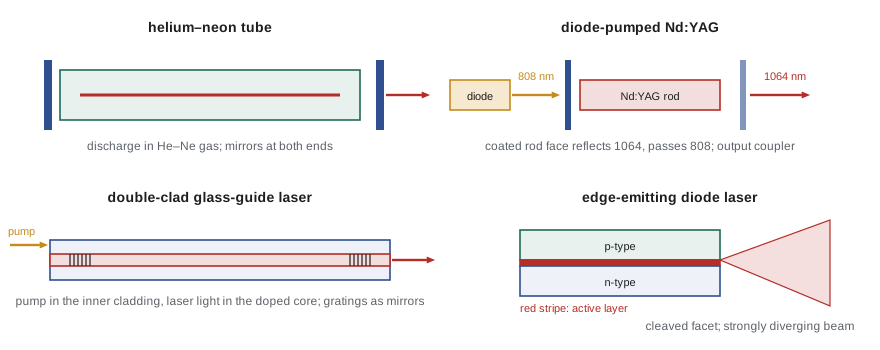
The helium–neon laser, introduced by Javan, Bennett and Herriott in 1960, works on transitions of neon, most famously at 632.8 nm. Helium does the pumping: electrons excite helium atoms to long-lived metastable states, and because these lie at almost the same energy as certain neon levels, collisions transfer the energy efficiently to neon, building an inversion. The lower laser level empties to a level that in turn empties by collisions with the walls of the narrow discharge tube, which is why helium–neon tubes are thin. Typical output is a few milliwatts with a wall-plug efficiency of about one part in a thousand, but the beam is a near-perfect Gaussian and the wavelength is stable. Helium–neon lasers were the standard for alignment, interferometry and supermarket scanners for decades; diode lasers have now replaced them in most applications.
The argon-ion laser uses transitions of singly ionized argon at 488 and 514.5 nm. It needs a very intense discharge to ionize and then excite the gas, so its efficiency is even lower, around one part in two thousand, and a laser giving a few watts of visible light may draw tens of kilowatts and require water cooling. It was once the main source of visible light for laboratories and light shows, and like the helium–neon laser has largely been replaced by diode-pumped solid-state lasers.
The carbon dioxide laser, invented by Kumar Patel at Bell Laboratories in 1964, is the outstanding gas laser for power. It works on vibrational transitions of the CO₂ molecule near 10.6 µm in the mid-infrared. Nitrogen molecules, excited by the discharge, transfer energy to the upper vibrational level of CO₂, and helium helps empty the lower level and cool the gas. Because the photon energy is small compared with the energy needed to excite the molecules, the quantum efficiency is about 0.4, and wall-plug efficiencies of 0.1 to 0.2 are routine. Continuous CO₂ lasers of several kilowatts cut steel, wood and plastics, and the 10.6 µm wavelength is strongly absorbed by water, which makes CO₂ lasers useful in surgery.
Excimer lasers use molecules such as argon fluoride or krypton fluoride that are bound only in an excited state. The lower state immediately falls apart, which guarantees an inversion. Excimer lasers produce intense ultraviolet pulses at 193 nm (ArF) and 248 nm (KrF); they are used in eye surgery that reshapes the cornea and, crucially, in photolithography, where 193 nm light has printed the patterns of computer chips for more than two decades. The newest chip factories use extreme ultraviolet light at 13.5 nm, produced not by a laser medium but by a plasma created when a powerful CO₂ laser strikes droplets of tin.
Solid-state lasers
In a solid-state laser the active ions, usually rare earths or transition metals, are doped into a crystal or glass host. The most important is neodymium, which has a strong four-level transition near 1064 nm. In yttrium aluminum garnet (Nd:YAG) the upper level lives 230 µs and the cross section is moderate, a combination well suited to both continuous operation and energy storage for Q-switched pulses (lesson 8). Ruby, the material of the first laser, is a three-level system of chromium ions in sapphire, now of mainly historical interest.
Early solid-state lasers were pumped by flashlamps, which emit a broad spectrum of which only a small part is absorbed; most of the rest heats the rod, and overall efficiencies were a few parts in a hundred. Diode pumping transformed the field. A semiconductor laser at 808 nm, tuned to a strong absorption line of neodymium, puts most of its power exactly where it is useful. Diode-pumped Nd:YAG lasers reach wall-plug efficiencies above 0.1, run for tens of thousands of hours and fit in a shoebox. Frequency-doubling the 1064 nm output in a nonlinear crystal (lesson 10) gives the 532 nm green light of many laser pointers and laboratory lasers.
Ytterbium ions, in YAG or in glass, have an even simpler level structure: just two manifolds, so the pump and laser wavelengths lie close together, near 940 or 976 nm for pumping and 1030 to 1080 nm for lasing. The small quantum defect means very little heat per photon, which allows extremely high powers. Titanium-doped sapphire (Ti:sapphire), pumped in the green, has a vibronic transition broadened by coupling to the lattice over an enormous range, from about 650 to 1100 nm. This makes it tunable and, as lesson 8 explains, the workhorse for femtosecond pulses. Erbium, with its transition near 1.55 µm, is the basis of optical communications amplifiers (lesson 9).
Heat is the main enemy of high-power solid-state lasers. Absorbed pump power that does not become laser light warms the crystal, creating temperature gradients that act as a lens (thermal lensing), distort the beam and can fracture the crystal. Engineers fight this with geometry: thin disks cooled through a large face, slabs, and long thin fibers.
Fiber lasers
A fiber laser is a solid-state laser whose gain medium is the core of an optical fiber doped with rare-earth ions, usually ytterbium or erbium. The pump light is launched into a larger inner cladding surrounding the core, a double-clad design, so that powerful but poor-quality diode light can be absorbed gradually along a fiber several meters long. The laser light is confined in the small single-mode core, so the output beam is close to a perfect Gaussian. The long, thin geometry has an enormous surface area for its volume, which makes cooling easy. The resonator mirrors are usually fiber Bragg gratings, periodic changes of refractive index written into the core with ultraviolet light, which reflect a narrow band of wavelengths.
Ytterbium fiber lasers reach wall-plug efficiencies of 0.3 to 0.5 and powers from watts to many kilowatts in a single mode, and tens of kilowatts with several combined. Since the 2000s they have taken over much of industrial cutting, welding and marking from CO₂ and lamp-pumped lasers. Their 1 µm wavelength is absorbed by metals much better than 10.6 µm light, and it can be delivered by flexible fiber to a robot arm.
Semiconductor lasers
The semiconductor laser, or diode laser, is by far the most numerous laser. Its gain medium is a p–n junction of the kind described in PHYS-410, made of direct-gap compounds such as gallium arsenide, indium phosphide or gallium nitride. A forward current injects electrons into the conduction band and holes into the valence band of a thin active layer. When the injected carrier density is high enough, the electron and hole quasi-Fermi levels separate by more than the band gap, and photons with energies between the gap and that separation are amplified: the semiconductor version of a population inversion.
Modern diode lasers use a double heterostructure, invented in the 1960s by Herbert Kroemer and Zhores Alferov, who shared the 2000 Nobel Prize in Physics. A thin layer of lower band gap is sandwiched between layers of higher band gap. The step in band edges traps the carriers in the active layer, and the step in refractive index, higher in the middle, guides the light along it. Most active layers are now quantum wells only a few nanometers thick, in which electrons are confined in one direction and the density of states becomes step-like. Thresholds fell from tens of thousands of amperes per square centimeter in the first homojunction lasers to a few hundred today.
In the simplest edge-emitting laser, the cleaved faces of the chip act as mirrors, each reflecting about a third of the light because of the high refractive index of the semiconductor. The chip is typically 0.3 to 2 mm long. Because the active region is thin, the output diverges strongly and asymmetrically, tens of degrees in one direction. For telecommunications, distributed-feedback (DFB) lasers include a grating along the active region that selects a single longitudinal mode. Vertical-cavity surface-emitting lasers (VCSELs) emit perpendicular to the wafer through a cavity only about a wavelength long between stacks of quarter-wave mirrors; they produce circular beams, can be tested on the wafer, and are made by the billion for data links, computer mice and the face-recognition sensors in phones.
For a diode laser, the output power above threshold is
where \(\eta_d\) is the differential quantum efficiency, the fraction of injected electrons above threshold that produce output photons. The voltage across the diode is slightly more than the photon energy in electronvolts, so the conversion from electrical to optical power can be very efficient: high-power diode bars reach wall-plug efficiencies of 0.6 to 0.7, the highest of any laser.
Comparing efficiencies
The program compares the quantum defects of six optically pumped lasers, lists typical wall-plug efficiencies of seven kinds of laser, and models the light–current curve of an 808 nm pump diode.
h, c, e = 6.62607015e-34, 2.99792458e8, 1.602176634e-19
# quantum defect: the fraction of each pump photon's energy that cannot appear in the laser photon
print(f"{'laser':22s}{'pump (nm)':>10s}{'laser (nm)':>11s}{'quantum limit':>14s}{'heat fraction':>14s}")
for name, lp, ll in [('Nd:YAG, diode-pumped', 808, 1064), ('Yb:YAG, diode-pumped', 940, 1030),
                     ('Yb-doped glass guide', 976, 1070), ('Er-doped amplifier', 980, 1550),
                     ('Ti:sapphire', 532, 800), ('ruby, flashlamp', 550, 694)]:
    q = lp / ll
    print(f"{name:22s}{lp:10d}{ll:11d}{q:14.3f}{1-q:14.3f}")
# typical wall-plug efficiency (electrical power in to light out), rough values
print()
for name, eff in [('HeNe', 0.001), ('argon ion', 0.0005), ('CO2', 0.15), ('flashlamp Nd:YAG', 0.02),
                  ('diode-pumped Nd:YAG', 0.15), ('Yb glass-guide laser', 0.40), ('diode laser bar', 0.60)]:
    print(f"{name:22s} wall-plug efficiency about {eff:.4f}  ->  {1/eff:7.1f} W of input per W of light")
# diode laser: light-current curve P = eta_d (h nu / e) (I - I_th)
lam, I_th, eta_d = 808e-9, 0.40, 0.70
slope = eta_d * h * c / (lam * e)
print()
print(f"808 nm diode: slope = {slope:.3f} W/A")
for I in (0.2, 0.4, 1.0, 2.0, 3.0):
    P = max(0.0, slope * (I - I_th)); V = 1.6 + 0.10 * I
    print(f"  I = {I:.1f} A: P = {P:.3f} W, wall-plug = {P/(V*I):.3f}")
# threshold current density of a double-heterostructure edge emitter
J_th, w, Lc = 400e4, 100e-6, 1e-3       # A/m^2, stripe width, cavity length
print(f"threshold current for J_th = 400 A/cm^2, 100 um x 1 mm stripe: {J_th*w*Lc:.2f} A")laser pump (nm) laser (nm) quantum limit heat fraction Nd:YAG, diode-pumped 808 1064 0.759 0.241 Yb:YAG, diode-pumped 940 1030 0.913 0.087 Yb-doped glass guide 976 1070 0.912 0.088 Er-doped amplifier 980 1550 0.632 0.368 Ti:sapphire 532 800 0.665 0.335 ruby, flashlamp 550 694 0.793 0.207 HeNe wall-plug efficiency about 0.0010 -> 1000.0 W of input per W of light argon ion wall-plug efficiency about 0.0005 -> 2000.0 W of input per W of light CO2 wall-plug efficiency about 0.1500 -> 6.7 W of input per W of light flashlamp Nd:YAG wall-plug efficiency about 0.0200 -> 50.0 W of input per W of light diode-pumped Nd:YAG wall-plug efficiency about 0.1500 -> 6.7 W of input per W of light Yb glass-guide laser wall-plug efficiency about 0.4000 -> 2.5 W of input per W of light diode laser bar wall-plug efficiency about 0.6000 -> 1.7 W of input per W of light 808 nm diode: slope = 1.074 W/A I = 0.2 A: P = 0.000 W, wall-plug = 0.000 I = 0.4 A: P = 0.000 W, wall-plug = 0.000 I = 1.0 A: P = 0.644 W, wall-plug = 0.379 I = 2.0 A: P = 1.719 W, wall-plug = 0.477 I = 3.0 A: P = 2.793 W, wall-plug = 0.490 threshold current for J_th = 400 A/cm^2, 100 um x 1 mm stripe: 0.40 A
The quantum defect alone fixes a lower bound on the heat deposited. In a diode-pumped Nd:YAG laser at least 0.24 of the absorbed pump power becomes heat; in an ytterbium laser pumped at 940 or 976 nm, only about 0.09. That difference, by itself, lets ytterbium lasers handle almost three times the power for the same thermal load, and it is the main reason ytterbium fiber and thin-disk lasers dominate high-power applications. The erbium amplifier pumped at 980 nm loses 0.37 of each pump photon's energy, an acceptable price in a telecom amplifier where only milliwatts are involved.
The wall-plug efficiencies span three orders of magnitude. A helium–neon laser needs about 1 kW of electrical power for every watt of light, while a diode laser bar needs less than 2 W. The 808 nm diode in the program has a slope of 1.07 W/A and a wall-plug efficiency approaching one half at a few amperes; it is efficient because each electron above threshold produces nearly one photon with an energy, 1.53 eV, close to the 1.6 to 1.9 V across the junction. The threshold current density of 400 A/cm² for a 100 µm by 1 mm stripe corresponds to 0.4 A, matching the light–current curve.
Worked problem
Heat in a fiber laser
An ytterbium fiber laser converts 2.0 kW of absorbed 976 nm pump into 1.7 kW of output at 1070 nm. How much heat is deposited, and how much of it is the quantum defect?
Show solution
- Heat \(= 2.0 - 1.7 = 0.30\) kW.
- Quantum-defect heat: \((1 - 976/1070) \times 2.0 = 0.088 \times 2.0 = 0.18\) kW.
- The other 0.12 kW comes from pump light absorbed by ions that decay without contributing to the laser, background absorption and other losses.
Answer: 0.30 kW of heat, of which about 0.18 kW is the unavoidable quantum defect. Spread along several meters of fiber, this is only tens of watts per meter, easy to remove.
Worked problem
Diode laser output
A 980 nm pump diode has threshold 50 mA and differential efficiency 0.80. What power does it emit at 500 mA?
Show solution
- \(h\nu/e = 1239.84/980 = 1.265\) V.
- \(P = 0.80 \times 1.265 \times (0.500 - 0.050) = 0.455\) W.
Answer: About 0.46 W, typical of a single-mode pump diode for an erbium amplifier.
Common mistakes
MistakeAssuming gas lasers are obsolete.
InsteadCO₂ and excimer lasers remain essential for cutting, surgery and lithography.
MistakeIgnoring the quantum defect when estimating heat.
InsteadAt least \(1 - \lambda_p/\lambda_l\) of the absorbed pump power becomes heat.
MistakeThinking a fiber laser's beam quality comes from the pump.
InsteadThe pump can be poor; the single-mode core sets the output beam quality.
MistakeExpecting a simple diode laser to have a round, low-divergence beam.
InsteadEdge emitters diverge strongly and asymmetrically; VCSELs give round beams.
MistakeConfusing slope efficiency with wall-plug efficiency.
InsteadWall-plug efficiency counts all electrical input, including the power below threshold and supply losses.
Summary and key terms
- Gas lasers: helium–neon (632.8 nm), argon ion (488, 514.5 nm), CO₂ (10.6 µm, high power), excimer (193, 248 nm).
- Solid-state lasers use rare-earth or transition-metal ions in crystals; diode pumping made them efficient and compact.
- Ytterbium's small quantum defect and fiber geometry's easy cooling enable multi-kilowatt single-mode fiber lasers.
- Semiconductor lasers use injected carriers in double-heterostructure quantum wells; output is \(\eta_d(h\nu/e)(I - I_{th})\).
- Wall-plug efficiencies range from about 0.001 (helium–neon) to 0.6 or more (diode bars).
- Quantum defect
- The fraction \(1 - \nu_{laser}/\nu_{pump}\) of each pump photon's energy that becomes heat.
- Double heterostructure
- A thin low-gap layer between higher-gap layers that confines both carriers and light.
- Double-clad fiber
- A fiber with a doped core for the laser light inside a larger cladding that carries the pump.
- Distributed-feedback laser
- A diode laser with a grating along its length that selects one longitudinal mode.
- Wall-plug efficiency
- Optical output power divided by total electrical input power.
Practice problems
Work each problem on paper first, then reveal the answer to check.
What is the quantum defect for Nd:YAG pumped at 885 nm and lasing at 1064 nm?
Show answer
\(1 - 885/1064 = 0.168\), lower than with 808 nm pumping.
Estimate the facet reflectivity of GaAs with \(n = 3.6\).
Show answer
\(R = ((n - 1)/(n + 1))^2 = (2.6/4.6)^2 = 0.32\).
Why are helium–neon discharge tubes narrow?
Show answer
The lower levels empty partly through collisions with the walls; a narrow bore speeds this and keeps the inversion.
A CO₂ laser gives 2 kW with wall-plug efficiency 0.15. What electrical power does it draw?
Show answer
\(2/0.15 = 13\) kW.
Why is Ti:sapphire tunable over hundreds of nanometers?
Show answer
Its transition is vibronic: coupling to lattice vibrations spreads the gain over a very wide band.
Lesson quiz · 5 questions
Score 60% or more to complete this lesson.
Create a free account to save your progress, take quizzes and earn a certificate.