
PHYS-460 · Lesson 10 of 12 · 23 min
Nonlinear optics: harmonic generation, phase matching and the Kerr effect
▶ Video coming soon A video version of this lesson is on the way.
In ordinary optics, light does not affect the medium it passes through in any way that changes the light itself. Two beams cross without interacting, the frequency of light never changes in a passive material, and the refractive index is a property of the material alone. These rules hold only because ordinary light is weak. The electric field inside an atom is about \(5 \times 10^{11}\) V/m; sunlight has a field of about \(10^3\) V/m, but a focused laser pulse can approach the atomic field. When it does, the response of matter becomes nonlinear, and light can change color, mix with other light and alter its own refractive index. Nonlinear optics began in 1961, a year after the first laser, when Peter Franken and colleagues at the University of Michigan focused a ruby laser into quartz and detected a faint ultraviolet signal at twice the frequency.
The nonlinear polarization
In linear optics, the polarization of a medium, its dipole moment per unit volume, is proportional to the field: \(P = \varepsilon_0\chi^{(1)}E\). For stronger fields we expand in powers of \(E\):
The coefficients \(\chi^{(2)}\) and \(\chi^{(3)}\) are the second- and third-order susceptibilities. Each term is smaller than the previous one by roughly the ratio of the applied field to the atomic field, so nonlinear effects need intense light. The quadratic term has a striking symmetry property: in a medium with inversion symmetry, such as a glass, a liquid or a centrosymmetric crystal, reversing \(E\) must reverse \(P\), which forbids even powers. Second-order effects therefore occur only in non-centrosymmetric crystals, such as potassium dihydrogen phosphate (KDP), beta barium borate (BBO) and lithium niobate. Third-order effects occur in every material, including the glass of optical fibers.
To see what the quadratic term does, take a field oscillating at one frequency, \(E = E_0\cos\omega t\). Then
so the polarization contains a constant part, called optical rectification, and a part oscillating at \(2\omega\). An oscillating polarization radiates, so the medium emits light at twice the frequency: second-harmonic generation (SHG). With two input frequencies \(\omega_1\) and \(\omega_2\), the quadratic term produces \(2\omega_1\), \(2\omega_2\), the sum frequency \(\omega_1 + \omega_2\) and the difference frequency \(\omega_1 - \omega_2\). Run in reverse, a strong pump at \(\omega_3\) can amplify a weak signal at \(\omega_1\) while generating an idler at \(\omega_3 - \omega_1\); this optical parametric amplification is the basis of widely tunable optical parametric oscillators. In the quantum picture, two photons of energy \(\hbar\omega\) are annihilated and one of energy \(2\hbar\omega\) is created, conserving energy.
Phase matching
Generating the second harmonic efficiently over a long crystal requires more than a large \(\chi^{(2)}\). The polarization at \(2\omega\) is driven by the fundamental wave and so travels with wave vector \(2k_\omega = 2n_\omega\omega/c\), while the harmonic light it radiates travels freely with wave vector \(k_{2\omega} = 2n_{2\omega}\omega/c\). Because of dispersion, \(n_{2\omega} \neq n_\omega\), and the two drift out of step. Harmonic light generated in one part of the crystal then interferes destructively with harmonic light generated further on. In the undepleted-pump approximation the coupled-amplitude equations give a second-harmonic power
where \(d_{\rm eff}\) is the effective nonlinear coefficient (half of \(\chi^{(2)}\) for the relevant orientation), \(A\) the beam area, \(L\) the crystal length and \(\mathrm{sinc}\,x = \sin x/x\). When \(\Delta k = 0\), the efficiency grows as \(L^2\). When \(\Delta k \neq 0\), the harmonic grows only over the coherence length \(L_c = \pi/\Delta k\) and then shrinks again, oscillating as the crystal gets longer. Typical coherence lengths are a few micrometers, so without phase matching SHG is hopelessly weak.
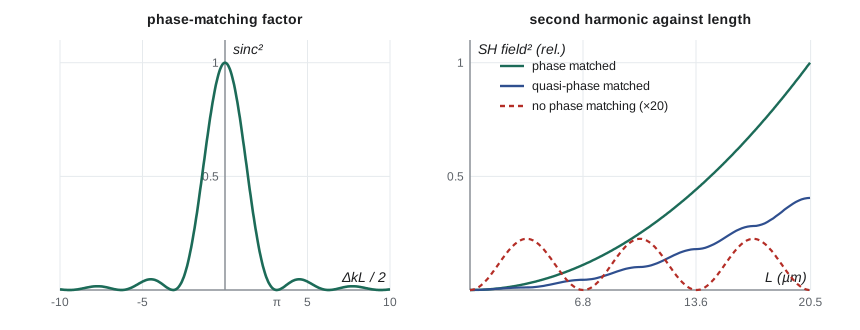
There are two main ways to achieve phase matching. Birefringent phase matching uses a crystal in which the refractive index depends on polarization. If the fundamental travels as an ordinary wave and the harmonic as an extraordinary wave, the angle of propagation relative to the optic axis can be chosen so that \(n_e(2\omega, \theta) = n_o(\omega)\). BBO and KDP are used this way for frequency doubling and tripling. Quasi-phase matching, proposed by Armstrong, Bloembergen and colleagues in 1962 and made practical in the 1990s, flips the sign of the nonlinear coefficient every coherence length by periodically reversing the crystal's ferroelectric domains with an electric field. Each time the harmonic is about to start decreasing, the reversal makes it grow again. The efficiency is reduced by a factor \((2/\pi)^2\) compared with perfect phase matching, but any wavelength can be phase matched by choosing the period, and the largest coefficient of the crystal can be used. Periodically poled lithium niobate (PPLN) is the standard material.
The Kerr effect and self-phase modulation
The third-order term gives an intensity-dependent refractive index,
the optical Kerr effect. For fused silica, \(n_2 \approx 2.6 \times 10^{-20}\ \mathrm{m^2/W}\), tiny, but in a fiber the intensity is high and the interaction length is long, so the effect accumulates. A pulse traveling through a length \(L\) acquires a nonlinear phase
where \(A_{\rm eff}\) is the effective area of the mode. Because the phase follows the intensity, it varies across the pulse, and a time-varying phase is a shift of frequency: the leading edge is shifted to lower frequencies and the trailing edge to higher ones. This self-phase modulation broadens the spectrum of the pulse. In a beam, the Kerr effect is stronger in the center than at the edges, so an intense beam focuses itself, the Kerr lens used for mode-locking in lesson 8 and the cause of the damage that chirped pulse amplification avoids. Other third-order effects include four-wave mixing, which transfers energy between wavelength channels in fiber systems, and stimulated Raman and Brillouin scattering, in which light scatters from molecular vibrations and sound waves.
When self-phase modulation acts on a pulse in a fiber with anomalous dispersion (\(D > 0\), as in standard fiber at 1.55 µm), the two effects can balance exactly. Dispersion makes the low frequencies travel faster than the high ones, while self-phase modulation puts the low frequencies at the front; the combination can leave the pulse shape unchanged as it propagates. This is an optical soliton, predicted by Akira Hasegawa and Frederick Tappert in 1973 and observed by Linn Mollenauer and colleagues at Bell Labs in 1980. The fundamental soliton has a hyperbolic secant shape and needs a peak power
where \(T_0\) is the pulse width parameter and \(\beta_2\) the group-velocity dispersion. Solitons are central to supercontinuum generation, in which a femtosecond pulse in a specially designed fiber spreads into a spectrum spanning an octave or more, and to the frequency combs that measure optical frequencies precisely, for which John Hall and Theodor Hänsch shared half of the 2005 Nobel Prize in Physics.
Computing nonlinear interactions
The program evaluates the phase-matched SHG efficiency of a focused 1 W beam in periodically poled lithium niobate, computes the coherence length and quasi-phase-matching period for 1064 nm doubling from the extraordinary refractive indices, shows the oscillation of the mismatched harmonic, and turns to the Kerr effect: the nonlinear phase in silica fiber at three combinations of power and length, the nonlinear coefficient \(\gamma\), and the peak powers of fundamental solitons.
import math
c, eps0 = 2.99792458e8, 8.8541878128e-12
# second-harmonic generation in the undepleted-pump limit:
#   P2 = (8 pi^2 d^2 L^2 / (eps0 c n^3 lam^2)) * P1^2 / A * sinc^2(dk L / 2)
def shg_eff(P1, d, L, A, lam, n, dk=0.0):
    x = dk * L / 2
    s = 1.0 if x == 0 else (math.sin(x) / x) ** 2
    return 8 * math.pi**2 * d**2 * L**2 * P1 / (eps0 * c * n**3 * lam**2 * A) * s
lam, n, d = 1064e-9, 2.2, 14e-12            # lithium niobate, effective d (m/V) with quasi-phase matching
A = math.pi * (30e-6) ** 2                  # focused beam area
print("SHG efficiency P2/P1 for a 1 W, 1064 nm beam, 30 um radius, d_eff = 14 pm/V:")
for L_mm in (1, 5, 10, 20):
    print(f"   L = {L_mm:2d} mm: {shg_eff(1.0, d, L_mm*1e-3, A, lam, n):.4f} (phase matched)")
# coherence length without phase matching: n(omega) = 2.156, n(2 omega) = 2.234 (extraordinary, LiNbO3)
n1, n2 = 2.156, 2.234
dk = 4 * math.pi / lam * (n2 - n1)
Lc = math.pi / dk
print()
print(f"phase mismatch dk = {dk:.3e} 1/m, coherence length = {Lc*1e6:.2f} um")
print(f"quasi-phase-matching period 2 Lc = {2*Lc*1e6:.2f} um")
print(f"{'L (um)':>8s}{'mismatched / matched at same L':>32s}")
for L_um in (1, 3.4, 6.8, 10, 13.6):
    L = L_um * 1e-6
    r = shg_eff(1, d, L, A, lam, n, dk) / shg_eff(1, d, L, A, lam, n, 0.0)
    print(f"{L_um:8.1f}{r:32.3f}")
# with QPM the effective d is reduced by 2/pi but it grows as L^2
print(f"QPM factor (2/pi)^2 = {(2/math.pi)**2:.3f}")
# Kerr effect: n = n0 + n2 I, self-phase modulation phase phi = (2 pi / lam) n2 I L
n2_si = 2.6e-20     # silica, m^2/W
Aeff = 80e-12       # effective area of a single-mode guide, m^2
for P, L_km in [(0.01, 80), (1.0, 1), (1000.0, 0.001)]:
    I = P / Aeff
    phi = 2 * math.pi / 1550e-9 * n2_si * I * L_km * 1e3
    print(f"P = {P:7.2f} W over {L_km:6.3f} km of silica guide: nonlinear phase = {phi:.3f} rad")
gamma = 2 * math.pi * n2_si / (1550e-9 * Aeff)
print(f"nonlinear coefficient gamma = {gamma*1e3:.2f} per W per km")
# fundamental soliton: P0 = |beta2| / (gamma T0^2), beta2 = -D lam^2 / (2 pi c)
D = 17e-6           # s/m^2 = 17 ps/(nm km)
beta2 = -D * (1550e-9) ** 2 / (2 * math.pi * c)
for T0 in (1e-12, 5e-12):
    P0 = abs(beta2) / (gamma * T0**2)
print(f"soliton with T0 = {T0*1e12:.0f} ps: peak power {P0:.2f} W (beta2 = {beta2*1e27:.1f} ps^2/km)")SHG efficiency P2/P1 for a 1 W, 1064 nm beam, 30 um radius, d_eff = 14 pm/V:
L = 1 mm: 0.0002 (phase matched)
L = 5 mm: 0.0043 (phase matched)
L = 10 mm: 0.0171 (phase matched)
L = 20 mm: 0.0684 (phase matched)
phase mismatch dk = 9.212e+05 1/m, coherence length = 3.41 um
quasi-phase-matching period 2 Lc = 6.82 um
L (um) mismatched / matched at same L
1.0 0.931
3.4 0.408
6.8 0.000
10.0 0.047
13.6 0.000
QPM factor (2/pi)^2 = 0.405
P = 0.01 W over 80.000 km of silica guide: nonlinear phase = 1.054 rad
P = 1.00 W over 1.000 km of silica guide: nonlinear phase = 1.317 rad
P = 1000.00 W over 0.001 km of silica guide: nonlinear phase = 1.317 rad
nonlinear coefficient gamma = 1.32 per W per km
soliton with T0 = 1 ps: peak power 16.46 W (beta2 = -21.7 ps^2/km)
soliton with T0 = 5 ps: peak power 0.66 W (beta2 = -21.7 ps^2/km)With perfect phase matching, a 1 W continuous beam focused to 30 µm converts only 0.17 parts in a hundred of its power in a 1 cm crystal; the efficiency grows as \(L^2\) and as the input power, so pulsed lasers with kilowatt to megawatt peak powers convert tens of parts in a hundred and more. In the undepleted-pump model the formula would eventually exceed one; in reality the fundamental is depleted and the conversion saturates.
Without phase matching, the indices of 2.156 and 2.234 give a coherence length of only 3.4 µm. Over 6.8 µm, twice the coherence length, the harmonic generated in the first half is completely canceled by that generated in the second, and the program confirms the ratio falls to zero. Quasi-phase matching with a poling period of 6.8 µm recovers growth with length at a cost of the factor 0.405.
In silica fiber the nonlinear coefficient is about 1.3 per watt per kilometer. A 10 mW signal accumulates about a radian of nonlinear phase over 80 km, the same as 1 W over 1 km or 1 kW over a meter. This is why fiber nonlinearity limits the launched power in long-haul systems, and why multi-kilowatt fiber lasers must keep their fibers short and their cores large. A 1 ps soliton at 1550 nm in standard fiber needs about 16 W of peak power; a 5 ps soliton needs only 0.66 W, since \(P_0\) scales as \(1/T_0^2\).
Worked problem
Coherence length in BBO without phase matching
For 800 nm light in a crystal where \(n_\omega = 1.660\) and \(n_{2\omega} = 1.693\) for the same polarization, find the coherence length.
Show solution
- \(\Delta k = (4\pi/\lambda)(n_{2\omega} - n_\omega) = (4\pi/8.0 \times 10^{-7}) \times 0.033 = 5.18 \times 10^5\ \mathrm{m^{-1}}\).
- \(L_c = \pi/\Delta k = 6.1 \times 10^{-6}\) m.
Answer: About 6 µm. Birefringent phase matching uses an extraordinary harmonic at a chosen angle so that \(\Delta k = 0\) over millimeters instead.
Worked problem
Nonlinear phase in a fiber amplifier
A pulse with 2 kW peak power travels 2 m through a fiber amplifier with an effective area of 300 µm² at 1064 nm. Find the nonlinear phase.
Show solution
- \(\gamma = 2\pi n_2/(\lambda A_{\rm eff}) = 2\pi \times 2.6 \times 10^{-20}/(1.064 \times 10^{-6} \times 3 \times 10^{-10}) = 5.1 \times 10^{-4}\ \mathrm{W^{-1}m^{-1}}\).
- \(\phi_{NL} = \gamma PL = 5.1 \times 10^{-4} \times 2000 \times 2 = 2.0\) rad.
Answer: About 2 radians, enough to broaden the spectrum noticeably. Engineers keep \(\phi_{NL}\) below a few radians or use chirped pulse amplification to lower the peak power.
Common mistakes
MistakeExpecting second-harmonic generation in glass.
Instead\(\chi^{(2)}\) vanishes in media with inversion symmetry; SHG needs non-centrosymmetric crystals.
MistakeIgnoring phase matching.
InsteadWithout it the harmonic grows only over a coherence length of micrometers.
MistakeUsing the SHG formula at high conversion.
InsteadThe undepleted-pump result fails when the fundamental is depleted; efficiency saturates below one.
MistakeThinking nonlinear effects need exotic materials.
InsteadThird-order effects occur in every material; long fibers make them important even at milliwatts.
MistakeExpecting solitons in normal dispersion.
InsteadBright solitons need anomalous dispersion, \(D > 0\), so that dispersion and self-phase modulation can balance.
Summary and key terms
- \(P = \varepsilon_0(\chi^{(1)}E + \chi^{(2)}E^2 + \chi^{(3)}E^3 + \cdots)\); \(\chi^{(2)}\) requires a non-centrosymmetric medium.
- \(\chi^{(2)}\) gives second-harmonic, sum- and difference-frequency generation and parametric amplification.
- SHG efficiency \(\propto d_{\rm eff}^2L^2 P/A\cdot\mathrm{sinc}^2(\Delta kL/2)\); phase matching by birefringence or periodic poling is essential.
- The Kerr effect \(n = n_0 + n_2I\) gives self-phase modulation \(\phi_{NL} = \gamma PL\) and self-focusing.
- In anomalous dispersion, self-phase modulation and dispersion balance in optical solitons with \(P_0 = |\beta_2|/(\gamma T_0^2)\).
- Nonlinear susceptibility
- The coefficients \(\chi^{(2)}, \chi^{(3)}, \ldots\) of the higher powers of the field in the polarization.
- Phase matching
- Making the driving polarization and the generated wave travel in step, \(\Delta k = 0\).
- Quasi-phase matching
- Reversing the sign of \(\chi^{(2)}\) every coherence length to keep the generated wave growing.
- Kerr effect
- The intensity dependence of the refractive index, \(n = n_0 + n_2I\).
- Optical soliton
- A pulse whose shape is preserved by a balance of dispersion and self-phase modulation.
Practice problems
Work each problem on paper first, then reveal the answer to check.
What wavelength results from doubling 1550 nm light?
Show answer
775 nm.
Mixing 1064 nm and 532 nm in a \(\chi^{(2)}\) crystal produces which sum-frequency wavelength?
Show answer
\(1/\lambda = 1/1064 + 1/532\), so \(\lambda = 354.7\) nm, the third harmonic of 1064 nm.
By what factor does SHG power change if the input power doubles?
Show answer
It quadruples, because \(P_{2\omega} \propto P_\omega^2\).
If \(\Delta k = 10^5\ \mathrm{m^{-1}}\), what is the coherence length?
Show answer
\(\pi/10^5 = 31\) µm.
Why does doubling the core area reduce nonlinear effects in a fiber?
Show answer
\(\gamma \propto 1/A_{\rm eff}\), so the nonlinear phase halves at the same power.
Lesson quiz · 5 questions
Score 60% or more to complete this lesson.
Create a free account to save your progress, take quizzes and earn a certificate.