
PHYS-230 · Lesson 9 of 12 · 26 min
Interference: thin films and interferometers
Interference is the signature of waves. When two waves from the same source arrive at a point by different paths, their amplitudes add with a phase difference set by the path difference, and the result can be brighter or darker than either alone. This lesson turns that principle into working tools. We look first at the conditions for light to interfere at all, which brings in coherence. Then come Young's two slits, the hues of soap bubbles and oil films, anti-reflection coatings on lenses, Newton's rings, the Michelson interferometer that killed the ether in 1887 and detected gravitational waves in 2015, and the Fabry–Pérot etalon that makes the sharpest spectral filters. Throughout, the rule is the one from lesson 1: add amplitudes as phasors, then square.
Two-beam interference
Let two waves of the same frequency and polarization reach a point with complex amplitudes \(E_1\) and \(E_2e^{i\delta}\), where \(\delta\) is their phase difference. The intensity, proportional to \(|E_1 + E_2e^{i\delta}|^2\), is
The last term is the interference term. For equal beams, \(I = 2I_0(1 + \cos\delta) = 4I_0\cos^2(\delta/2)\), ranging from 0 to \(4I_0\). A phase difference arises from a difference in optical path length \(\Delta\), the geometric path multiplied by the refractive index, through \(\delta = 2\pi\Delta/\lambda\), plus any phase jumps on reflection. Bright fringes occur where \(\Delta\) is a whole number of wavelengths and dark ones where it is a half-odd number. The visibility of the pattern, \((I_{\max} - I_{\min})/(I_{\max} + I_{\min}) = 2\sqrt{I_1I_2}/(I_1 + I_2)\), is 1 for equal beams and falls when one beam is weaker.
Coherence
Two separate light bulbs never produce visible fringes. An ordinary source emits light in short, independent wave trains, so the phase of the light from two independent sources wanders randomly in a few femtoseconds to nanoseconds, and \(\cos\delta\) averages to zero during any measurement. Interference needs coherence: the beams must come from the same source, split and recombined. Even then, if the path difference exceeds the length of a single wave train, the two copies that meet came from different trains and are again unrelated. The coherence length \(\ell_c\) is roughly the length of a wave train, and by the bandwidth theorem of lesson 7 it is related to the spectral width by
White light, with \(\Delta\lambda \approx \lambda\), has a coherence length of about one wavelength, which is why white-light fringes appear only near zero path difference and why only thin films show colors. A sodium lamp line with \(\Delta\lambda = 0.02\ \mathrm{nm}\) gives \(\ell_c \approx 17\ \mathrm{mm}\). A stabilized laser with a linewidth of 1 kHz gives about 300 km. Spatial coherence is the analogous requirement across the beam: light from a source of finite size \(s\) at distance \(L\) is coherent across a width of about \(\lambda L/s\), which is why Young passed sunlight through a pinhole before his slits, and how Albert Michelson measured the diameter of the star Betelgeuse in 1920 from the loss of fringe visibility as he widened his interferometer.
Young's two slits
Light of wavelength \(\lambda\) passes through two narrow slits a distance \(d\) apart and falls on a screen a distance \(L \gg d\) away. At an angle \(\theta\) from the axis the path difference is \(d\sin\theta\), so bright fringes occur at \(d\sin\theta = m\lambda\) and the intensity is
For small angles \(\sin\theta \approx y/L\), and the fringes on the screen are equally spaced with spacing \(\Delta y = \lambda L/d\). With \(d = 0.25\ \mathrm{mm}\), \(L = 1.0\ \mathrm{m}\) and red light at 650 nm, \(\Delta y = 2.6\ \mathrm{mm}\), easy to see. The slits' finite width modulates this pattern with a diffraction envelope, a refinement for lesson 10. Young's experiment works with single photons and with electrons, atoms and even large molecules sent through one at a time; the fringes build up particle by particle, which is the central puzzle of quantum mechanics.
Thin films
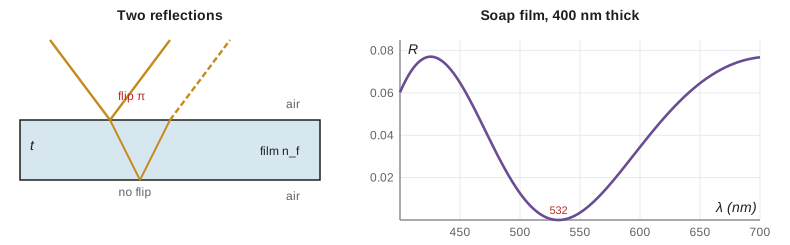
A soap bubble, an oil slick on a wet road and the blue-purple sheen of a camera lens all owe their hues to interference between light reflected from the two surfaces of a thin film. Take a film of index \(n_f\) and thickness \(t\), viewed at near-normal incidence. The ray reflected from the back surface travels an extra optical path \(2n_ft\). In addition, reflection from a medium of higher index flips the sign of the amplitude, a phase shift of \(\pi\), as the formula \(r = (n_1 - n_2)/(n_1 + n_2)\) of lesson 8 shows; reflection from a lower index does not. For a soap film in air, the front reflection is from higher index (flip) and the back from lower (no flip), so the net extra phase is \(\pi\) and
A film much thinner than the wavelength reflects almost nothing, because the two reflections cancel: the top of a draining soap film, thinned to a few nanometers, looks black. As the thickness grows, different wavelengths are reinforced in turn, producing the familiar sequence of hues. Only films up to a micrometer or so show them, because thicker films reinforce many wavelengths across the visible at once and the mixture looks white, the coherence argument above.
Worked problem
The hue of a soap film
A soap film of index 1.33 is 400 nm thick. Which visible wavelengths are strongly reflected at normal incidence, and which are missing?
Show solution
- \(2n_ft = 2(1.33)(400) = 1064\ \mathrm{nm}\).
- Bright when \(\lambda = 1064/(m + \tfrac12)\): \(m = 1\) gives 709 nm, \(m = 2\) gives 426 nm. Both are near the ends of the visible.
- Dark when \(\lambda = 1064/m\): \(m = 2\) gives 532 nm, in the green.
Answer: Green near 532 nm is missing and red and violet are reinforced, so the film looks magenta. The exact reflectance including multiple reflections, computed below, shows broad maxima near these wavelengths.
Anti-reflection coatings
An uncoated glass surface reflects about 4 parts in a hundred of normally incident light, and a camera lens with a dozen surfaces would lose a third of its light and suffer flare from stray reflections. A single coating of index \(n_c\) and optical thickness \(\lambda/4\) cancels the reflection at one design wavelength. Both reflections now occur at increasing index, so both flip, and the extra round trip of \(\lambda/2\) puts them in antiphase. Complete cancellation also needs equal amplitudes, which requires
For glass of index 1.52 the ideal is 1.23. Magnesium fluoride, with \(n = 1.38\), is the usual compromise: a quarter-wave layer cuts the reflectance at 550 nm from 4.3 to about 1.3 parts in a hundred, and the residual reflection is strongest at the ends of the spectrum, giving coated lenses their faint purple tint. Multilayer coatings of alternating high and low index reduce reflection below 0.5 parts in a hundred across the visible. The same principle used the other way, with stacks of quarter-wave layers, makes dielectric mirrors that reflect 99.99 parts in a hundred of laser light, better than any metal.
Newton's rings and wedges
Place a convex lens of radius of curvature \(R\) on a flat glass plate. The air gap at distance \(r\) from the contact point has thickness \(t \approx r^2/2R\). Viewed in reflected light, the reflection from the lens surface (glass to air, no flip) and from the plate (air to glass, flip) differ by \(2t\) in path plus a phase \(\pi\). Dark rings occur where \(2t = m\lambda\), so their radii are
with a dark spot at the center. Isaac Newton studied these rings carefully, though he interpreted them with his particle theory; Young later explained them as interference. The rings are a precise test of lens surfaces: an optician's test plate laid on a newly polished lens shows ring patterns, and any irregularity of a fraction of a wavelength distorts them. A thin wedge of air between two flat plates gives straight, equally spaced fringes; counting them measures the thickness of a hair or a sheet of paper placed under one edge.
The Michelson interferometer
Albert Michelson's interferometer of 1881 splits a beam with a half-silvered mirror into two perpendicular arms, reflects each from a mirror and recombines them. If one mirror moves by \(d\), the round-trip path changes by \(2d\), and the fringe at the detector cycles once for every \(\lambda/2\) of motion. Counting fringes therefore measures distance in units of half wavelengths, and Michelson used it in 1892–93 to measure the international meter bar in wavelengths of cadmium light. Inserting a gas cell into one arm and counting fringes as it fills measures the refractive index of the gas. With a white-light source, fringes appear only within a coherence length of equal arm lengths, which locates zero path difference to a fraction of a micrometer.
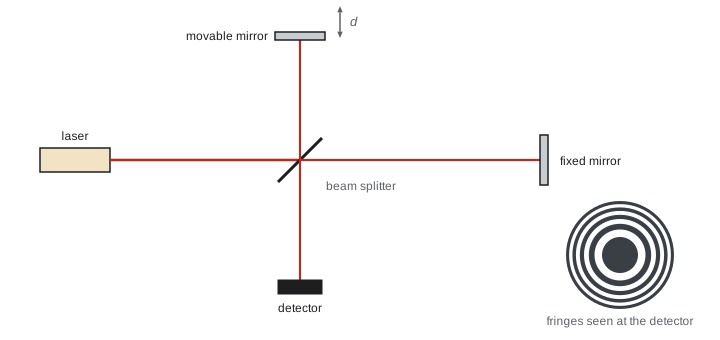
In 1887 Michelson and Edward Morley built an interferometer on a stone slab floating in mercury, with arms folded to an effective length of 11 m, to detect the motion of Earth through the supposed luminiferous ether. Rotating the apparatus should have shifted the fringes by about 0.4 of a fringe; they saw less than a twentieth of that. The null result was one of the observations Einstein's special relativity of 1905 explained: there is no ether, and the speed of light is the same in every inertial frame. A century later, the Laser Interferometer Gravitational-Wave Observatory (LIGO) used Michelson interferometers with 4 km arms, enhanced by Fabry–Pérot cavities in each arm and high laser power, to detect the gravitational waves from two merging black holes on 14 September 2015. The passing wave changed the arm lengths by a strain of about \(10^{-21}\), a few thousandths of a proton diameter. Rainer Weiss, Barry Barish and Kip Thorne shared the 2017 Nobel Prize in Physics for the detection.
Worked problem
Counting fringes
A Michelson interferometer uses a 632.8 nm laser. As one mirror moves, 2000 bright fringes pass the detector. How far did it move? A 5.0 cm gas cell in one arm is then filled from vacuum to atmospheric pressure and 43 fringes pass. Find the refractive index of the gas.
Show solution
- Each fringe is \(\lambda/2\) of mirror motion: \(d = 2000 \times 316.4\ \mathrm{nm} = 0.633\ \mathrm{mm}\).
- The cell is traversed twice, so the optical path changes by \(2L(n - 1)\), and \(2L(n - 1) = N\lambda\).
- \(n - 1 = 43 \times 632.8\times10^{-9}/(2 \times 0.050) = 2.72\times10^{-4}\).
Answer: The mirror moved 0.633 mm, and the gas has \(n = 1.000272\), very close to the value for air.
Multiple-beam interference
Two highly reflecting parallel mirrors form a Fabry–Pérot etalon, built by Charles Fabry and Alfred Pérot in 1899. Light bounces back and forth many times, and the transmitted beams add as a geometric series of phasors. The result is the Airy transmission function
where \(R\) is the mirror reflectance and \(\delta = 4\pi n t\cos\theta/\lambda\) the round-trip phase. For high \(R\), transmission is near zero except in very narrow peaks where \(\delta\) is a multiple of \(2\pi\). The ratio of peak spacing to peak width, the finesse, is \(\pi\sqrt F/2 = \pi\sqrt R/(1 - R)\), about 30 for \(R = 0.9\) and 300 for \(R = 0.99\). An etalon is therefore a very sharp filter, used to resolve close spectral lines and, as the resonator of a laser, to select its frequency. The same Airy formula, with the much smaller reflectance of bare surfaces, gives the exact reflectance of the soap film above.
Computing interference
The program computes the exact reflectance of a thin film including all multiple reflections, using the Airy sum for a single layer, and applies it to the soap film and to a magnesium fluoride coating. It then lists Newton's ring radii, checks the Michelson worked example and evaluates the finesse of etalons.
import math, cmath

def film_reflectance(n0, n1, n2, t, lam):
    """Normal-incidence reflectance of a layer n1 of thickness t between n0 and n2 (all reflections)."""
    r01 = (n0 - n1) / (n0 + n1)
    r12 = (n1 - n2) / (n1 + n2)
    phase = cmath.exp(2j * 2 * math.pi * n1 * t / lam)
    r = (r01 + r12 * phase) / (1 + r01 * r12 * phase)
    return abs(r) ** 2

print("soap film n = 1.33, t = 400 nm, in air:")
for lam in (400, 426, 450, 500, 532, 550, 600, 650, 700):
    print(f"  {lam} nm: R = {film_reflectance(1, 1.33, 1, 400e-9, lam*1e-9):.4f}")

ng = 1.52
for name, n1 in (("MgF2", 1.38), ("ideal", math.sqrt(ng))):
    t = 550e-9 / (4 * n1)
    vals = ", ".join(f"{lam}: {100*film_reflectance(1, n1, ng, t, lam*1e-9):.2f}" for lam in (450, 550, 650))
    print(f"\n{name} quarter-wave coat (t = {t*1e9:.1f} nm), reflectance per 100 at 450/550/650 nm: {vals}")
print(f"bare glass: {100*((ng-1)/(ng+1))**2:.2f} per 100")

lam, R = 589e-9, 1.00
print("\nNewton's dark rings for R = 1.00 m, 589 nm (mm):", ", ".join(f"{1000*math.sqrt(m*lam*R):.3f}" for m in range(1, 6)))

lam = 632.8e-9
print(f"\nMichelson: 2000 fringes = {2000*lam/2*1000:.4f} mm; n - 1 = {43*lam/(2*0.050):.3e}")
for Rm in (0.5, 0.9, 0.99):
    F = 4 * Rm / (1 - Rm) ** 2
print(f"etalon R = {Rm}: coefficient F = {F:8.1f}, finesse = {math.pi*math.sqrt(Rm)/(1-Rm):6.1f}")soap film n = 1.33, t = 400 nm, in air: 400 nm: R = 0.0603 426 nm: R = 0.0771 450 nm: R = 0.0648 500 nm: R = 0.0126 532 nm: R = 0.0000 550 nm: R = 0.0035 600 nm: R = 0.0344 650 nm: R = 0.0646 700 nm: R = 0.0768 MgF2 quarter-wave coat (t = 99.6 nm), reflectance per 100 at 450/550/650 nm: 450: 1.62, 550: 1.26, 650: 1.44 ideal quarter-wave coat (t = 111.5 nm), reflectance per 100 at 450/550/650 nm: 450: 0.52, 550: 0.00, 650: 0.25 bare glass: 4.26 per 100 Newton's dark rings for R = 1.00 m, 589 nm (mm): 0.767, 1.085, 1.329, 1.535, 1.716 Michelson: 2000 fringes = 0.6328 mm; n - 1 = 2.721e-04 etalon R = 0.5: coefficient F = 8.0, finesse = 4.4 etalon R = 0.9: coefficient F = 360.0, finesse = 29.8 etalon R = 0.99: coefficient F = 39600.0, finesse = 312.6
The soap-film reflectance is near zero at 532 nm and largest toward the violet and red ends, confirming the magenta of the worked example. The magnesium fluoride coating cuts the reflectance at its design wavelength from 4.26 to about 1.26 parts in a hundred, and the ideal index 1.233 removes it entirely at 550 nm while leaving a little at the ends of the spectrum. Newton's rings grow as \(\sqrt m\), so they crowd together outward. The etalon finesse rises steeply as the mirror reflectance approaches 1.
Common mistakes
MistakeExpecting interference between two independent light sources.
InsteadIndependent sources are mutually incoherent; fringes need beams split from one source and a path difference within the coherence length.
MistakeForgetting the phase flip on reflection from a higher index.
InsteadReflection from higher index adds \(\pi\); count flips at each surface before writing the bright condition.
MistakeUsing the geometric thickness instead of the optical path.
InsteadPath differences inside a medium are multiplied by its index: \(2n_ft\).
MistakeThinking each fringe in a Michelson interferometer is one wavelength of mirror motion.
InsteadThe light travels the arm twice, so one fringe is \(\lambda/2\) of mirror motion.
MistakeThinking an anti-reflection coating destroys light energy.
InsteadCanceled reflection means more transmitted light; energy is redistributed, not lost.
Summary and key terms
- Two beams give \(I = I_1 + I_2 + 2\sqrt{I_1I_2}\cos\delta\), with \(\delta = 2\pi\Delta/\lambda\) plus reflection phases.
- Interference needs coherence; the coherence length is about \(\lambda^2/\Delta\lambda\).
- Young's slits give fringes \(\lambda L/d\) apart; thin films reinforce wavelengths with \(2n_ft = (m + \tfrac12)\lambda\) when one surface flips.
- A quarter-wave coating of index \(\sqrt{n_g}\) cancels reflection; Newton's rings have \(r_m = \sqrt{m\lambda R}\).
- A Michelson interferometer shifts one fringe per \(\lambda/2\) of mirror motion; Fabry–Pérot etalons give sharp peaks with finesse \(\pi\sqrt R/(1 - R)\).
- coherence length
- The path difference over which light remains able to interfere with itself.
- fringe visibility
- The contrast of an interference pattern, (I max minus I min) over (I max plus I min).
- optical path length
- Geometric path length multiplied by refractive index.
- anti-reflection coating
- A thin layer whose two reflections cancel at a design wavelength.
- Michelson interferometer
- An instrument that splits a beam into two arms and recombines it to measure path changes.
- finesse
- The ratio of peak spacing to peak width for a Fabry–Pérot etalon.
Practice problems
Work each problem on paper first, then reveal the answer to check.
Two slits 0.15 mm apart are lit with 589 nm light. Find the fringe spacing on a screen 2.0 m away.
Show answer
\(\Delta y = \lambda L/d = 589\times10^{-9}(2.0)/1.5\times10^{-4} = 7.9\ \mathrm{mm}\).
A film of oil (\(n = 1.45\)) floats on water (\(n = 1.33\)). What is the thinnest film that strongly reflects 600 nm light?
Show answer
Top flips, bottom does not: bright when \(2n_ft = \lambda/2\), so \(t = 600/(4 \times 1.45) = 103\ \mathrm{nm}\).
Find the thickness of a quarter-wave MgF₂ coating for 550 nm.
Show answer
\(t = \lambda/4n = 550/(4 \times 1.38) = 99.6\ \mathrm{nm}\).
The tenth dark Newton's ring has diameter 6.0 mm with 589 nm light. Find the lens radius of curvature.
Show answer
\(r_{10} = 3.0\ \mathrm{mm}\), so \(R = r^2/m\lambda = (3.0\times10^{-3})^2/(10 \times 589\times10^{-9}) = 1.53\ \mathrm{m}\).
A laser line has a width of 1.0 GHz. Estimate its coherence length.
Show answer
\(\ell_c \approx c/\Delta f = 0.30\ \mathrm{m}\).
A hair placed under one edge of two flat plates 10 cm long produces 120 dark fringes in 589 nm light. Find its thickness.
Show answer
Each fringe is \(\lambda/2\) of gap: \(120 \times 294.5\ \mathrm{nm} = 35\ \mathrm{\mu m}\).
Lesson quiz · 5 questions
Score 60% or more to complete this lesson.
Create a free account to save your progress, take quizzes and earn a certificate.