
PHYS-230 · Lesson 12 of 12 · 28 min
Capstone: optical instruments from the eye to modern photonics
This capstone puts the whole course to work. An optical instrument is designed with geometrical optics, the ray matrices and imaging equations of lesson 11, but its ultimate performance is set by wave optics: diffraction limits its resolution, interference makes its coatings and filters, and the coherence and spectrum of the light decide what it can measure. We analyze five instruments in turn: the human eye, the camera, the microscope, the telescope and the optical fiber, and then look at the laser and at three recent advances in photonics recognized by Nobel Prizes. Each analysis ends with numbers you can check in the program at the end of the lesson.
The eye
The eye is a two-element optical system. The cornea, a curved surface between air and the aqueous humor (\(n = 1.336\)), supplies about 43 diopters of power, two thirds of the total. The crystalline lens behind it adds about 15 to 20 diopters and can change shape: the ciliary muscle relaxes to flatten it for distant vision and contracts to let it bulge for near vision, the process of accommodation. The total power of about 60 diopters focuses images on the retina about 17 mm behind the optical center. The iris adjusts the pupil from about 2 to 8 mm, controlling brightness and depth of field, and the retina's densest region, the fovea, has cone spacing of about 2.5 μm, matched to the diffraction limit of a pupil of a few millimeters that lesson 10 computed as about one minute of arc.
The near point, the closest distance of comfortable focus, is about 25 cm for a young adult, and by convention 25 cm is used to define angular magnification. The range of accommodation shrinks with age, from about 10 diopters at 20 to about 1 at 60, the condition called presbyopia, which is why reading glasses become necessary in middle age. In myopia, or short sight, the eye is too powerful for its length and distant objects focus in front of the retina; a diverging lens whose focal point lies at the eye's far point corrects it. In hyperopia the eye is too weak and a converging lens helps. Astigmatism, an unequal curvature of the cornea in different directions, is corrected by a cylindrical component in the prescription.
Worked problem
Correcting myopia
A myopic eye can focus nothing farther than 50 cm. What spectacle lens, worn 1.5 cm in front of the eye, lets it see distant objects?
Show solution
- The lens must form a virtual image of a distant object at the far point, 50 cm from the eye, which is \(50 - 1.5 = 48.5\ \mathrm{cm}\) from the lens.
- With \(s = \infty\), \(1/s' = 1/f\) and \(s' = -48.5\ \mathrm{cm}\), so \(f = -48.5\ \mathrm{cm}\).
- Power \(P = 1/f = -2.06\ \mathrm{D}\).
Answer: A diverging lens of about \(-2.1\) diopters. A contact lens sits on the cornea, so it needs exactly \(-1/0.50 = -2.0\ \mathrm{D}\); the difference matters for strong prescriptions.
The camera
A camera lens of focal length \(f\) forms a real image on a sensor. The f-number \(N = f/D\), where \(D\) is the diameter of the aperture, controls exposure: the light per unit area of the image is proportional to \(D^2/f^2 = 1/N^2\), so each standard stop, f/2, f/2.8, f/4, f/5.6, f/8 and so on, differs by a factor \(\sqrt2\) in \(N\) and halves the light. The f-number also sets two things in opposite directions. Depth of field, the range of distances acceptably sharp, grows as \(N\) increases, because the cone of rays from each point narrows. Diffraction blur grows too: the Airy disc on the sensor has diameter \(2.44\lambda N\), about \(5.4\ \mathrm{\mu m}\) at f/4 and \(21\ \mathrm{\mu m}\) at f/16 in green light. On a sensor with 4 μm pixels, stopping down beyond about f/5.6 trades sharpness for depth. Photographers call this diffraction softening, and it is a direct consequence of lesson 10.
For a subject at distance \(s\) much larger than \(f\), the depth of field is approximately \(2Ncs^2/f^2\), where \(c\) is the acceptable blur diameter on the sensor, often taken as about 0.03 mm for a full-frame sensor. A 50 mm lens at f/8 focused at 4 m gives about 3.5 m of depth, while the same lens at f/1.8 gives under 0.7 m, the shallow focus favored for portraits. Smartphone cameras have tiny focal lengths, about 4 to 7 mm, so their depth of field is enormous and their background blur is mostly simulated by software.
The magnifier and the microscope
A simple magnifier of focal length \(f\) held close to the eye, with the object at its focal point, sends parallel rays into the relaxed eye. The object subtends \(h/f\) instead of the \(h/25\ \mathrm{cm}\) it would subtend at the near point, so the angular magnification is \(M = 25\ \mathrm{cm}/f\). A lens of 5 cm focal length gives \(5\times\). Higher powers need very short focal lengths and suffer aberrations, so for more magnification we use two stages.
A compound microscope has an objective of short focal length \(f_o\) that forms a real, magnified image, which an eyepiece of focal length \(f_e\) then views as a magnifier. With the intermediate image a tube length \(L\) beyond the objective's focal point, typically 160 mm in classic designs, the total magnification is
A 4 mm objective and a 25 mm eyepiece give about \(-40 \times 10 = -400\). But magnification is not resolution. Ernst Abbe showed in 1873 that a microscope cannot resolve details finer than about
where \(\theta\) is the half-angle of the cone of light the objective accepts and \(n\) the index of the medium between objective and specimen. His argument is Fourier optics: a periodic specimen of spacing \(d\) diffracts light into orders at \(\sin\theta = \lambda/d\), and the image can only reproduce the spacing if the objective collects at least two orders. Dry objectives reach \(\mathrm{NA} \approx 0.95\); oil-immersion objectives with \(n = 1.52\) reach about 1.4, giving \(d \approx 200\ \mathrm{nm}\) in green light. Magnification beyond about 500 to 1000 times the NA is empty magnification: the image gets bigger but no new detail appears. Electron microscopes beat the limit by using electrons with wavelengths of picometres. Light microscopy itself was pushed past Abbe's limit by super-resolved fluorescence microscopy, which switches fluorescent molecules on and off so that their positions can be located one at a time; Eric Betzig, Stefan Hell and William Moerner shared the 2014 Nobel Prize in Chemistry for it.
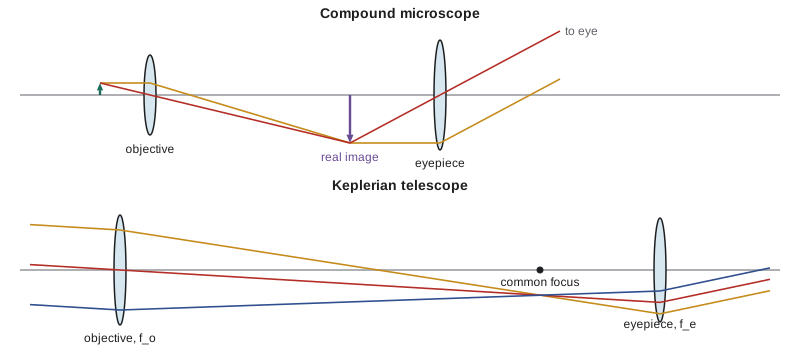
The telescope
A telescope views distant objects, so the objective, of long focal length \(f_o\), forms a real image at its focal plane, and an eyepiece of focal length \(f_e\) placed with its focal point at the same plane sends parallel rays to the eye. This is the Keplerian arrangement; the system is afocal, with ray matrix \(C = 0\) when the separation is \(f_o + f_e\), and the angular magnification is
The image is inverted, which matters little for astronomy. Galileo's telescope of 1609 used a diverging eyepiece placed before the focus to give an upright image with a short tube. Three properties matter more than magnification. Light grasp scales as the aperture area \(D^2\): a 200 mm telescope collects about \((200/7)^2 \approx 800\) times as much light as a dark-adapted 7 mm pupil, so it shows stars about 7 magnitudes fainter. Resolution is limited by diffraction to \(1.22\lambda/D\), about 0.7 seconds of arc for 200 mm in green light. And the useful magnification runs from about \(D/7\ \mathrm{mm}\), below which the exit beam is wider than the pupil and light is wasted, to about twice the aperture in millimeters, beyond which the image only gets bigger and dimmer.
Isaac Newton built the first practical reflecting telescope in 1668, partly to avoid the chromatic aberration of lenses. Every large telescope since the 1900s has been a reflector, because a mirror can be supported across its whole back while a lens can only be held at its edge. On the ground, atmospheric turbulence limits resolution to about one second of arc whatever the aperture, unless adaptive optics measures the distortion hundreds of times a second and corrects it with a deformable mirror, which large observatories now do routinely. In space there is no atmosphere: the James Webb Space Telescope has a segmented 6.5 m mirror of 18 gold-coated beryllium hexagons, unfolded and aligned in space in 2022 to a fraction of a wavelength using wavefront sensing, the interference techniques of lesson 9 applied to the largest mirror ever flown.
Worked problem
A backyard telescope
A reflector has a 150 mm mirror of focal length 1200 mm. Find the magnification with a 25 mm eyepiece and with a 6 mm eyepiece, the exit pupil in each case, and the theoretical resolution at 550 nm.
Show solution
- \(M = 1200/25 = 48\times\) and \(1200/6 = 200\times\).
- The exit pupil is \(D/M\): \(150/48 = 3.1\ \mathrm{mm}\) and \(150/200 = 0.75\ \mathrm{mm}\).
- \(\theta = 1.22(550\times10^{-9})/0.150 = 4.5\times10^{-6}\ \mathrm{rad} = 0.92''\).
Answer: 48 and 200 times, exit pupils of 3.1 and 0.75 mm, and a resolution of about 0.9 seconds of arc. At 200 times the image is near the useful maximum (about 300 times for 150 mm), and on most nights turbulence limits it first.
Optical fibers
An optical fiber guides light in a glass core, typically 9 μm across for single-mode fiber, surrounded by a cladding of slightly lower index. Rays striking the boundary beyond the critical angle are totally internally reflected, so light entering within a cone of half-angle \(\theta_a\) is trapped, with numerical aperture
A core of 1.4500 and cladding of 1.4450 gives \(\mathrm{NA} = 0.12\). In a thick multimode fiber, rays at different angles travel different path lengths, so a short pulse spreads, modal dispersion, which limits bandwidth. Single-mode fiber, with a core small enough that the wave description of lesson 8 allows only one guided mode, removes it. The remaining spreading comes from the group-velocity dispersion of lesson 7. Charles Kao and George Hockham argued in 1966 that glass purified enough could carry light with losses below 20 decibels per kilometer, then thought absurd; Corning made such fiber in 1970, and today's fiber loses about 0.2 dB per kilometer near 1550 nm, so a signal keeps half its power after 15 km. Erbium-doped fiber amplifiers boost the light every 80 km or so without converting it to electricity, and wavelength-division multiplexing sends many wavelengths down one fiber, so a single fiber pair carries tens of terabits per second across an ocean. Kao shared the 2009 Nobel Prize in Physics.
Lasers and modern photonics
A laser is an optical oscillator, a direct application of lessons 3 and 9. A gain medium amplifies light by stimulated emission, a process Einstein described in 1917, inside a Fabry–Pérot cavity that feeds the light back. Oscillation starts when the round-trip gain exceeds the losses, and the cavity's narrow resonances, with \(Q\) values of millions or more, select the frequency. The output is highly coherent, directional and, for many lasers, nearly diffraction limited, with a beam divergence of order \(\lambda/w\) for a beam of radius \(w\). Theodore Maiman operated the first laser, a pulsed ruby laser, on 16 May 1960. Within a few years came the helium-neon laser, the semiconductor diode laser and the carbon dioxide laser; today diode lasers in fiber networks, barcode scanners and laser printers outnumber all other kinds.
Three recent Nobel Prizes in Physics grew from the wave optics of this course. In 2018, Arthur Ashkin shared the prize for optical tweezers, which trap particles with the momentum of light from lesson 8, and Gérard Mourou and Donna Strickland for chirped pulse amplification, which they demonstrated in 1985: a short pulse is stretched in time by dispersion, amplified safely while long, and recompressed by the opposite dispersion, the group-velocity physics of lesson 7, producing the most intense light pulses ever made, now used in eye surgery. In 2023, Pierre Agostini, Ferenc Krausz and Anne L'Huillier shared it for generating attosecond pulses, bursts of light lasting about \(10^{-16}\) to \(10^{-17}\ \mathrm{s}\), short enough to follow electrons moving in atoms. By the bandwidth theorem, such pulses must span an enormous range of frequencies, and they are made in the extreme ultraviolet by driving gas atoms with intense infrared lasers. And the interferometer that detected gravitational waves in 2015, met in lesson 9, combines almost every idea here: a stabilized laser, Fabry–Pérot arm cavities, mirrors with dielectric coatings reflecting all but a few parts per million, and a measurement of length to \(10^{-21}\) of the arm.
Designing with numbers
The program checks the worked examples and the figures quoted in this lesson: the spectacle correction, camera depth of field and diffraction blur, microscope magnification and the Abbe limit, the telescope's magnification, exit pupil, resolution and light grasp, and the numerical aperture and loss budget of an optical fiber.
import math

# eye: far point 50 cm, spectacles 1.5 cm in front
f_spec = -(0.50 - 0.015)
print(f"myopia correction: spectacles {1/f_spec:+.2f} D, contact lens {1/-0.50:+.2f} D")

# camera: 50 mm lens, subject at 4 m, blur circle 0.03 mm, green light
f, s, c, lam = 50e-3, 4.0, 0.03e-3, 550e-9
for N in (1.8, 4, 8, 16):
    near = s * f * f / (f * f + N * c * (s - f))
    far = s * f * f / (f * f - N * c * (s - f)) if f * f > N * c * (s - f) else float('inf')
    airy = 2.44 * lam * N
    print(f"f/{N:<4}: depth of field {near:.2f} m to {far:.2f} m ({far - near:.2f} m), Airy disc {airy*1e6:.1f} um")

# microscope: 4 mm objective, 25 mm eyepiece, 160 mm tube
fo, fe, Lt = 4.0, 25.0, 160.0
print(f"\nmicroscope magnification {-(Lt/fo)*(250/fe):.0f}")
for NA in (0.25, 0.65, 0.95, 1.40):
    print(f"  NA {NA:.2f}: Abbe limit {550/(2*NA):.0f} nm, useful magnification up to about {1000*NA:.0f}")

# telescope: 150 mm aperture, 1200 mm focal length
D, F = 150.0, 1200.0
for fe in (25.0, 6.0):
    M = F / fe
    print(f"\ntelescope with {fe:.0f} mm eyepiece: {M:.0f}x, exit pupil {D/M:.2f} mm")
theta = 1.22 * 550e-9 / (D / 1000)
print(f"resolution {theta:.2e} rad = {math.degrees(theta)*3600:.2f} arcsec")
gain = (D / 7.0) ** 2
print(f"light grasp vs 7 mm pupil: {gain:.0f}x = {2.5*math.log10(gain):.1f} magnitudes")

# optical guide: core and cladding
n1, n2 = 1.4500, 1.4450
NA = math.sqrt(n1*n1 - n2*n2)
print(f"\nstep-index guide NA = {NA:.3f}, acceptance half-angle {math.degrees(math.asin(NA)):.1f} deg")
# multimode spread over 1 km: axial ray vs ray at the critical angle, step-index estimate
L = 1000.0; cvac = 2.998e8
dt = L * n1 / cvac * (n1 / n2 - 1)
print(f"modal pulse spread over 1 km of step-index multimode guide: {dt*1e9:.1f} ns")
for km in (15, 80, 100):
print(f"loss after {km:3d} km at 0.2 dB/km: {0.2*km:.0f} dB, power fraction {10**(-0.02*km):.4f}")myopia correction: spectacles -2.06 D, contact lens -2.00 D f/1.8 : depth of field 3.69 m to 4.37 m (0.69 m), Airy disc 2.4 um f/4 : depth of field 3.36 m to 4.94 m (1.57 m), Airy disc 5.4 um f/8 : depth of field 2.90 m to 6.44 m (3.54 m), Airy disc 10.7 um f/16 : depth of field 2.27 m to 16.56 m (14.28 m), Airy disc 21.5 um microscope magnification -400 NA 0.25: Abbe limit 1100 nm, useful magnification up to about 250 NA 0.65: Abbe limit 423 nm, useful magnification up to about 650 NA 0.95: Abbe limit 289 nm, useful magnification up to about 950 NA 1.40: Abbe limit 196 nm, useful magnification up to about 1400 telescope with 25 mm eyepiece: 48x, exit pupil 3.12 mm telescope with 6 mm eyepiece: 200x, exit pupil 0.75 mm resolution 4.47e-06 rad = 0.92 arcsec light grasp vs 7 mm pupil: 459x = 6.7 magnitudes step-index guide NA = 0.120, acceptance half-angle 6.9 deg modal pulse spread over 1 km of step-index multimode guide: 16.7 ns loss after 15 km at 0.2 dB/km: 3 dB, power fraction 0.5012 loss after 80 km at 0.2 dB/km: 16 dB, power fraction 0.0251 loss after 100 km at 0.2 dB/km: 20 dB, power fraction 0.0100
The output confirms the numbers in the text. At f/8 the 50 mm lens holds focus from about 2.9 to 6.4 m, while at f/1.8 the range shrinks to well under a meter; the Airy disc grows from 2.4 to 21 μm as the lens stops down. The microscope's 400 times is well within the useful range of a 0.65 NA objective, while the Abbe limit falls to about 200 nm for oil immersion. The 150 mm telescope collects about 460 times as much light as the eye, a gain of nearly 7 magnitudes. The fiber accepts light within about \(7^\circ\), modal spreading in step-index multimode fiber is about 17 ns per kilometer, which is why long links use single-mode fiber, and the loss budget shows half the power left after 15 km and about a hundredth after 100 km, the reason amplifiers are spaced every 80 km or so.
Looking back
The course began with a single pendulum and the remark that every smooth equilibrium is harmonic for small motions. That one idea, joined to superposition, produced normal modes, the wave equation, the harmonic series of musical instruments, Fourier analysis and the bandwidth theorem, and then, with Maxwell's equations, the whole of optics: polarization, interference, diffraction and the limits of every instrument. When you meet waves in later courses, in quantum mechanics, in signal processing, in seismology or in electromagnetic engineering, the same mathematics will be waiting.
Common mistakes
MistakeAssuming more magnification always shows more detail.
InsteadResolution is limited by diffraction: \(\lambda/2\mathrm{NA}\) in a microscope and \(1.22\lambda/D\) in a telescope. Beyond that, magnification is empty.
MistakeThinking a smaller f-number gives a darker image.
InsteadExposure goes as \(1/N^2\): f/2 lets in four times as much light as f/4.
MistakeStopping a lens down indefinitely for sharpness.
InsteadDepth of field grows, but the Airy disc \(2.44\lambda N\) eventually exceeds the pixel size.
MistakeUsing telescope magnification as its main figure of merit.
InsteadAperture sets light grasp and resolution; useful magnification is limited to about twice the aperture in millimeters.
MistakeExpecting a multimode fiber to carry short pulses over long distances without spreading.
InsteadDifferent ray paths cause modal dispersion; long-haul links use single-mode fiber.
Summary and key terms
- The eye focuses with about 60 D, two thirds from the cornea; myopia is corrected with diverging lenses and hyperopia with converging ones.
- Camera exposure goes as \(1/N^2\); depth of field grows with \(N\) but diffraction blur \(2.44\lambda N\) does too.
- A microscope magnifies by about \((L/f_o)(25\ \mathrm{cm}/f_e)\) but resolves only \(\lambda/2\mathrm{NA}\), Abbe's limit.
- A telescope magnifies by \(f_o/f_e\); its light grasp goes as \(D^2\) and its resolution is \(1.22\lambda/D\).
- Fibers guide light with \(\mathrm{NA} = \sqrt{n_1^2 - n_2^2}\) and about 0.2 dB/km loss; lasers, chirped pulse amplification and attosecond pulses apply the wave optics of this course.
- accommodation
- The change in shape of the eye's lens to focus at different distances.
- f-number
- The ratio of focal length to aperture diameter, which sets exposure and depth of field.
- numerical aperture
- n sin theta, the light-gathering angle of an objective or fiber.
- Abbe limit
- The smallest resolvable spacing in a microscope, about lambda over twice the numerical aperture.
- exit pupil
- The image of the aperture formed by an eyepiece, through which all the light leaves an instrument.
- chirped pulse amplification
- Stretching, amplifying and recompressing a laser pulse to reach very high peak power.
Practice problems
Work each problem on paper first, then reveal the answer to check.
A hyperopic person's near point is 75 cm. What contact lens lets them read at 25 cm?
Show answer
The lens must image an object at 25 cm to a virtual image at 75 cm: \(1/f = 1/0.25 - 1/0.75 = 2.67\ \mathrm{D}\).
A photographer changes from f/8 at 1/125 s to f/4. What shutter speed gives the same exposure?
Show answer
f/4 admits four times the light, so 1/500 s.
What is the angular magnification of a magnifier with \(f = 2.5\ \mathrm{cm}\)?
Show answer
\(25/2.5 = 10\times\).
Find the Abbe limit of an oil objective with NA 1.30 in blue light at 450 nm.
Show answer
\(d = 450/(2 \times 1.30) = 173\ \mathrm{nm}\).
A refractor has \(f_o = 900\ \mathrm{mm}\) and aperture 90 mm. What eyepiece gives an exit pupil of 2 mm?
Show answer
\(M = 90/2 = 45\), so \(f_e = 900/45 = 20\ \mathrm{mm}\).
A fiber link of 60 km at 0.20 dB/km has 2 dB of connector loss. What fraction of the launched power arrives?
Show answer
Total \(14\ \mathrm{dB}\), so \(10^{-1.4} = 0.040\).
Lesson quiz · 5 questions
Score 60% or more to complete this lesson.
Create a free account to save your progress, take quizzes and earn a certificate.