
PHYS-230 · Lesson 4 of 12 · 26 min
Coupled oscillators and normal modes
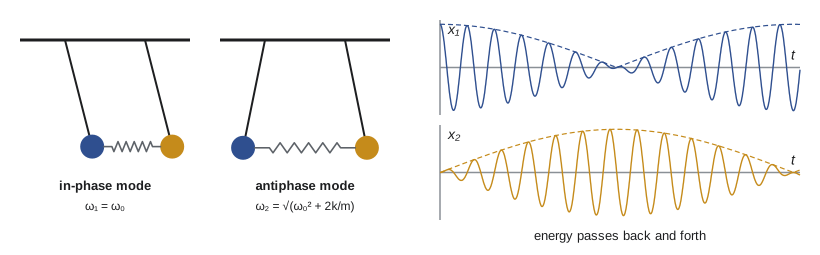
Hang two identical pendulums side by side and join them with a weak spring. Pull one aside and let go. It swings, but its swings slowly die away while the other pendulum, at first motionless, starts swinging more and more. After a while the first pendulum is still and the second is swinging fully; then the energy flows back. This slow exchange looks complicated, but it is the sum of two very simple motions, the normal modes, in which both pendulums swing at a single common frequency. This lesson shows how to find normal modes for any set of coupled oscillators, why every small motion is a superposition of them, and how a long chain of coupled masses turns into a continuous string with a wave equation. Normal modes are the bridge from oscillations to waves, and the same mathematics describes molecular vibrations, the tones of a drum and the sound modes of a crystal.
Two coupled pendulums
Let each pendulum have mass \(m\) and length \(\ell\), so on its own it has \(\omega_0^2 = g/\ell\). Join the bobs with a spring of stiffness \(k\), unstretched when both hang vertically, and use the horizontal displacements \(x_1, x_2\) as coordinates. For small swings the gravitational restoring force on each bob is \(-m\omega_0^2 x\), and the spring is stretched by \(x_2 - x_1\), pulling bob 1 toward bob 2 with force \(k(x_2 - x_1)\). So
The equations are coupled: each acceleration depends on both coordinates. Add and subtract them. With \(q_1 = (x_1 + x_2)/2\) and \(q_2 = (x_1 - x_2)/2\), and writing \(\kappa = k/m\),
In these normal coordinates the equations decouple into two independent harmonic oscillators. The first mode, \(q_2 = 0\), has \(x_1 = x_2\): the pendulums swing together, the spring never stretches, and the frequency is \(\omega_1 = \omega_0\). The second mode, \(q_1 = 0\), has \(x_1 = -x_2\): the pendulums swing in opposite directions, the spring is stretched by twice the displacement of each, and the frequency is \(\omega_2 = \sqrt{\omega_0^2 + 2\kappa}\), higher because the spring adds stiffness. Every motion of the system is a combination \(x_1 = q_1 + q_2\), \(x_2 = q_1 - q_2\) of the two modes with arbitrary amplitudes and phases.
Energy exchange as beating
Start with \(x_1 = A\), \(x_2 = 0\) and both at rest. Then \(q_1 = q_2 = A/2\) initially, so each mode is excited with amplitude \(A/2\) and
For weak coupling, \(\omega_2 - \omega_1\) is small, so each pendulum swings at nearly \(\omega_0\) inside a slowly varying envelope. The envelope of \(x_1\) falls to zero just as that of \(x_2\) reaches its maximum, after a time \(\pi/(\omega_2 - \omega_1)\). For \(\kappa \ll \omega_0^2\), \(\omega_2 - \omega_1 \approx \kappa/\omega_0\), so the transfer time is about \(\pi\omega_0/\kappa\): the weaker the spring, the slower the exchange. The same beating appears in sound when two tuning forks of slightly different pitch sound together, and in quantum mechanics as the oscillation of an electron between two coupled wells.
Worked problem
Transfer time for coupled pendulums
Two 0.50 kg pendulums 1.00 m long are coupled by a spring with \(k = 0.20\ \mathrm{N/m}\). Find the mode frequencies and the time for the energy to pass completely from one to the other.
Show solution
- \(\omega_0 = \sqrt{9.81/1.00} = 3.132\ \mathrm{rad/s}\) and \(\kappa = 0.20/0.50 = 0.40\ \mathrm{s^{-2}}\).
- \(\omega_2 = \sqrt{9.81 + 0.80} = 3.257\ \mathrm{rad/s}\), so \(\omega_2 - \omega_1 = 0.125\ \mathrm{rad/s}\).
- The transfer time is \(\pi/0.125 \approx 25\ \mathrm{s}\), about 12.5 periods of either pendulum.
Answer: Mode frequencies 3.13 and 3.26 rad/s, and complete transfer in about 25 s. The estimate \(\pi\omega_0/\kappa = 24.6\ \mathrm{s}\) agrees well.
The general method
For any number of coupled oscillators near equilibrium, the kinetic and potential energies are quadratic forms, \(T = \tfrac12\dot{\mathbf x}^{\mathsf T}M\dot{\mathbf x}\) and \(U = \tfrac12\mathbf x^{\mathsf T}K\mathbf x\), with a symmetric positive-definite mass matrix \(M\) and a symmetric stiffness matrix \(K\). The equations of motion are \(M\ddot{\mathbf x} = -K\mathbf x\). Look for a normal mode, a motion in which every coordinate oscillates at the same frequency with fixed relative amplitudes, \(\mathbf x = \mathbf a\cos(\omega t + \phi)\). Substituting gives the generalized eigenvalue problem
The determinant is a polynomial of degree \(n\) in \(\omega^2\), so there are \(n\) values \(\omega_j^2\), each with a mode shape \(\mathbf a_j\). Because \(M\) and \(K\) are symmetric and \(M\) is positive definite, the eigenvalues are real, and if \(K\) is positive definite they are positive. The modes are orthogonal in the sense \(\mathbf a_i^{\mathsf T}M\mathbf a_j = 0\) for \(i \ne j\). To prove it, write \(K\mathbf a_i = \omega_i^2 M\mathbf a_i\) and \(K\mathbf a_j = \omega_j^2 M\mathbf a_j\). Multiply the first on the left by \(\mathbf a_j^{\mathsf T}\) and the second by \(\mathbf a_i^{\mathsf T}\), and subtract. By symmetry the left sides are equal, so \((\omega_i^2 - \omega_j^2)\mathbf a_j^{\mathsf T}M\mathbf a_i = 0\), and distinct frequencies force the product to vanish. Orthogonality is what lets any initial condition be decomposed uniquely into modes, just as the Fourier series of lesson 7 decomposes any shape of a string.
Worked problem
Three masses between walls
Three equal masses \(m\) are joined in a line by four equal springs \(k\), the outer springs attached to fixed walls. Find the normal modes.
Show solution
- With \(\omega_s^2 = k/m\), the equations are \(\ddot x_1 = \omega_s^2(-2x_1 + x_2)\), \(\ddot x_2 = \omega_s^2(x_1 - 2x_2 + x_3)\), \(\ddot x_3 = \omega_s^2(x_2 - 2x_3)\).
- With \(\lambda = \omega^2/\omega_s^2\), the determinant of \(\begin{pmatrix} 2 - \lambda & -1 & 0 \\ -1 & 2 - \lambda & -1 \\ 0 & -1 & 2 - \lambda \end{pmatrix}\) is \((2 - \lambda)[(2 - \lambda)^2 - 2] = 0\).
- So \(\lambda = 2 - \sqrt2,\ 2,\ 2 + \sqrt2\), giving \(\omega = 0.765\,\omega_s,\ 1.414\,\omega_s,\ 1.848\,\omega_s\).
- The mode shapes are \((1, \sqrt2, 1)\), \((1, 0, -1)\) and \((1, -\sqrt2, 1)\): all in step, outer masses opposite with the middle still, and alternating.
Answer: Frequencies \(0.765\), \(1.414\) and \(1.848\) times \(\sqrt{k/m}\). The mode shapes are samples of \(\sin(n\pi j/4)\) for \(n = 1, 2, 3\) at \(j = 1, 2, 3\), a pattern the next section explains.
A chain of N masses
Generalize to \(N\) equal masses joined by \(N + 1\) springs between fixed walls, with spacing \(a\). Mass \(j\) obeys \(m\ddot x_j = k(x_{j+1} - 2x_j + x_{j-1})\), with \(x_0 = x_{N+1} = 0\). Try a mode in which the amplitudes vary sinusoidally along the chain, \(x_j = \sin(j\theta)\cos\omega t\). Using \(\sin((j+1)\theta) + \sin((j-1)\theta) = 2\sin(j\theta)\cos\theta\), the equation becomes \(-m\omega^2 = k(2\cos\theta - 2)\), so
The wall condition \(x_{N+1} = 0\) requires \(\sin((N+1)\theta) = 0\), so \(\theta = n\pi/(N+1)\) for \(n = 1, \ldots, N\). These are the \(N\) normal modes, with frequencies \(\omega_n = 2\sqrt{k/m}\,\sin(n\pi/2(N+1))\). For \(N = 3\) this gives \(2\sin(22.5^\circ) = 0.765\), \(2\sin(45^\circ) = 1.414\) and \(2\sin(67.5^\circ) = 1.848\), matching the worked example.
Write \(\theta = \kappa_w a\), so that \(x_j = \sin(\kappa_w \cdot ja)\) is a sinusoid in the position \(ja\) with wavenumber \(\kappa_w\). The frequency formula \(\omega = 2\sqrt{k/m}\,|\sin(\kappa_w a/2)|\) is a dispersion relation: it says how frequency depends on wavenumber. For long wavelengths, \(\kappa_w a \ll 1\), the sine is approximately its argument and \(\omega \approx \sqrt{k/m}\,a\,\kappa_w\), proportional to \(\kappa_w\), which is the behavior of a nondispersive wave with speed \(v = a\sqrt{k/m}\). At short wavelengths the chain is dispersive, and there is a maximum frequency \(2\sqrt{k/m}\) above which no wave propagates. A crystal behaves like this: its atoms form a lattice, sound is the long-wavelength limit of its vibrations, and the maximum frequency is a few terahertz.
The continuum limit
Now let the number of masses grow while the total length \(L = (N + 1)a\) stays fixed. Each mass \(m = \mu a\) for a linear density \(\mu\), and each spring under tension behaves, for transverse motion, like \(k = T/a\) with tension \(T\). Then \(v = a\sqrt{k/m} = \sqrt{T/\mu}\), independent of \(a\). The difference equation becomes
because the bracket is the standard finite-difference approximation to the second derivative. This is the wave equation for a string, derived directly in lesson 5. The lowest modes of the chain become the modes of the string, \(y_n = \sin(n\pi x/L)\cos\omega_n t\) with \(\omega_n = n\pi v/L\), a harmonic series. Only the highest modes, whose wavelengths are comparable to the spacing \(a\), remember the discreteness. The program checks how quickly the chain frequencies approach the string frequencies.
Normal modes in nature
A molecule with \(n\) atoms has \(3n\) coordinates and so \(3n\) modes, of which six for a nonlinear molecule (five for a linear one) are rigid translations and rotations with zero frequency. The remaining vibrational modes have frequencies in the infrared, and each absorbs light at its own frequency, which is how infrared spectroscopy identifies molecules. Carbon dioxide, a linear molecule with three atoms, has four vibrational modes: a symmetric stretch near \(1340\ \mathrm{cm^{-1}}\) in the units spectroscopists use, an antisymmetric stretch near \(2350\ \mathrm{cm^{-1}}\), and two degenerate bending modes near \(667\ \mathrm{cm^{-1}}\). The bending modes absorb strongly in the thermal infrared that Earth radiates, which is the physical basis of the greenhouse effect of carbon dioxide. Engineering structures have modes too, and a structural engineer's first job with a new tower or bridge deck is to find its lowest few natural frequencies and keep them away from those of wind, footsteps and machinery.
Computing normal modes
The program solves the generalized eigenvalue problem with a small Jacobi rotation routine written from scratch, checks the three-mass result, confirms the \(N\)-mass formula, and compares the lowest chain frequencies with the continuous string as \(N\) grows.
import math

def jacobi_eigen(A, tol=1e-12):
    """Eigenvalues and eigenvectors of a symmetric matrix by Jacobi rotations."""
    n = len(A); A = [row[:] for row in A]
    V = [[1.0 if i == j else 0.0 for j in range(n)] for i in range(n)]
    while True:
        p, q, big = 0, 1, 0.0
        for i in range(n):
            for j in range(i + 1, n):
                if abs(A[i][j]) > big: p, q, big = i, j, abs(A[i][j])
        if big < tol: break
        th = 0.5 * math.atan2(2 * A[p][q], A[q][q] - A[p][p])
        c, s = math.cos(th), math.sin(th)
        for k in range(n):
            akp, akq = A[k][p], A[k][q]
            A[k][p], A[k][q] = c*akp - s*akq, s*akp + c*akq
        for k in range(n):
            apk, aqk = A[p][k], A[q][k]
            A[p][k], A[q][k] = c*apk - s*aqk, s*apk + c*aqk
        for k in range(n):
            vkp, vkq = V[k][p], V[k][q]
            V[k][p], V[k][q] = c*vkp - s*vkq, s*vkp + c*vkq
    vals = [A[i][i] for i in range(n)]
    order = sorted(range(n), key=lambda i: vals[i])
    return [vals[i] for i in order], [[V[k][i] for k in range(n)] for i in order]

def chain(N):            # stiffness matrix for N unit masses, unit springs, fixed ends
    return [[2.0 if i == j else (-1.0 if abs(i - j) == 1 else 0.0) for j in range(N)] for i in range(N)]

vals, vecs = jacobi_eigen(chain(3))
print("three masses: omega / omega_s =", [round(math.sqrt(v), 4) for v in vals])
for v in vecs:
    s = v[0] if abs(v[0]) > 1e-9 else 1.0
    print("  mode shape", [round(c / s, 4) + 0.0 for c in v])

N = 8
vals, _ = jacobi_eigen(chain(N))
formula = [2 * math.sin(n * math.pi / (2 * (N + 1))) for n in range(1, N + 1)]
print(f"\nN = {N}: largest difference from the formula = {max(abs(math.sqrt(a) - b) for a, b in zip(vals, formula)):.2e}")

# continuum limit: string of length 1, wave speed 1, so omega_n = n pi
print("\nlowest three chain frequencies (string limit pi, 2pi, 3pi):")
for N in (3, 10, 30, 100):
    a = 1.0 / (N + 1)
    w = [2 / a * math.sin(n * math.pi * a / 2) for n in (1, 2, 3)]
    print(f"N = {N:3d}: " + ", ".join(f"{x:.4f}" for x in w))

# coupled pendulums of the worked example
w0, kap = math.sqrt(9.81), 0.40
w2 = math.sqrt(w0*w0 + 2*kap)
print(f"\ncoupled pendulums: w1 = {w0:.4f}, w2 = {w2:.4f}, transfer time = {math.pi/(w2 - w0):.2f} s")three masses: omega / omega_s = [0.7654, 1.4142, 1.8478] mode shape [1.0, 1.4142, 1.0] mode shape [1.0, 0.0, -1.0] mode shape [1.0, -1.4142, 1.0] N = 8: largest difference from the formula = 1.11e-15 lowest three chain frequencies (string limit pi, 2pi, 3pi): N = 3: 3.0615, 5.6569, 7.3910 N = 10: 3.1309, 6.1981, 9.1391 N = 30: 3.1402, 6.2724, 9.3885 N = 100: 3.1415, 6.2822, 9.4214 coupled pendulums: w1 = 3.1321, w2 = 3.2573, transfer time = 25.09 s
The Jacobi routine reproduces the three frequencies and mode shapes of the worked example and agrees with the \(N\)-mass formula to rounding error. In the continuum check the chain frequencies, scaled to a string of unit length and unit wave speed, approach \(\pi\), \(2\pi\) and \(3\pi\) as \(N\) grows. Already at \(N = 30\) the fundamental is within a small fraction of a part in a hundred, while the higher modes converge more slowly because their wavelengths are closer to the spacing.
Common mistakes
MistakeAssuming coupled oscillators each keep their own frequency.
InsteadOnly the normal modes have definite frequencies; individual coordinates are mixtures and can beat.
MistakeForgetting that the spring force acts on both masses with opposite signs.
InsteadWrite \(k(x_2 - x_1)\) on mass 1 and \(-k(x_2 - x_1)\) on mass 2.
MistakeTaking \(\det(K - \omega M) = 0\) instead of \(\det(K - \omega^2 M) = 0\).
InsteadThe eigenvalue is \(\omega^2\); take square roots at the end.
MistakeThinking the transfer time between weakly coupled pendulums is one period.
InsteadIt is \(\pi/(\omega_2 - \omega_1)\), many periods when the coupling is weak.
MistakeExpecting a discrete chain to be nondispersive at all wavelengths.
InsteadOnly long waves travel at \(a\sqrt{k/m}\); short ones are slower and there is a cutoff frequency.
Summary and key terms
- Coupled linear oscillators have normal modes in which all coordinates oscillate at one frequency with fixed shape.
- Two coupled pendulums have an in-phase mode at \(\omega_0\) and an antiphase mode at \(\sqrt{\omega_0^2 + 2k/m}\); their beating exchanges energy.
- In general \(\det(K - \omega^2M) = 0\); modes are \(M\)-orthogonal and any motion is a superposition of them.
- A chain of \(N\) masses has \(\omega_n = 2\sqrt{k/m}\sin(n\pi/2(N+1))\), a dispersion relation with a cutoff.
- As \(N \to \infty\) the chain becomes a string obeying the wave equation with \(v = \sqrt{T/\mu}\).
- normal mode
- A motion in which every part of a system oscillates at the same frequency with fixed relative amplitude.
- normal coordinate
- A combination of coordinates that evolves as an independent harmonic oscillator.
- mass matrix
- The symmetric matrix M in the kinetic energy one half x dot transpose M x dot.
- stiffness matrix
- The symmetric matrix K in the potential energy one half x transpose K x.
- dispersion relation
- The relation between frequency and wavenumber for waves in a medium.
- degenerate modes
- Distinct modes that share the same frequency.
Practice problems
Work each problem on paper first, then reveal the answer to check.
Two 0.20 kg carts on a frictionless track are joined to walls and to each other by three springs of 50 N/m. Find the mode frequencies.
Show answer
\(\omega_1 = \sqrt{k/m} = 15.8\ \mathrm{rad/s}\) (in step) and \(\omega_2 = \sqrt{3k/m} = 27.4\ \mathrm{rad/s}\) (opposite).
In the coupled pendulums of the worked example, pendulum 1 starts at 10 cm. What is the amplitude of pendulum 2 after 12.5 s?
Show answer
Its envelope is \(A|\sin((\omega_2 - \omega_1)t/2)| = 10|\sin(0.78)| \approx 7.0\ \mathrm{cm}\).
Verify that \((1, \sqrt2, 1)\) and \((1, -\sqrt2, 1)\) are orthogonal.
Show answer
\(1 - 2 + 1 = 0\). With equal masses, \(M\)-orthogonality is ordinary orthogonality.
A chain of atoms has spacing 0.30 nm, mass \(4.0\times10^{-26}\ \mathrm{kg}\) and \(k = 20\ \mathrm{N/m}\). Find the long-wavelength sound speed and the maximum frequency.
Show answer
\(v = a\sqrt{k/m} = 0.30\times10^{-9}\sqrt{5\times10^{26}} \approx 6.7\ \mathrm{km/s}\); \(\omega_{\max} = 2\sqrt{k/m} = 4.5\times10^{13}\ \mathrm{rad/s}\), about 7 THz.
How many vibrational modes does a water molecule have?
Show answer
Three atoms give 9 coordinates; it is nonlinear, so subtract 6: three vibrational modes (symmetric stretch, antisymmetric stretch and bend).
For \(N = 2\) masses between walls, find the modes from the chain formula.
Show answer
\(\omega_n = 2\sqrt{k/m}\sin(n\pi/6)\): \(\sqrt{k/m}\) and \(\sqrt3\sqrt{k/m}\), matching problem 1.
Lesson quiz · 5 questions
Score 60% or more to complete this lesson.
Create a free account to save your progress, take quizzes and earn a certificate.