
PHYS-230 · Lesson 5 of 12 · 26 min
Mechanical waves and the wave equation
Lesson 4 reached the wave equation as the limit of a chain of masses. This lesson derives it directly for a stretched string, solves it in general with d'Alembert's formula, and uses it to answer the practical questions about waves: how fast they travel in strings, air, water and solids, how much energy and power they carry, and what happens when a wave meets a boundary or a change of medium. The key new idea is impedance, a single property of a medium that decides how a wave is shared between reflection and transmission. The same rule tells an engineer how to join two cables, why an ultrasound probe needs gel on the skin and why a horn makes a trumpet louder.
The wave equation for a string
Consider a string with tension \(T\) and mass per unit length \(\mu\), displaced transversely by a small amount \(y(x, t)\). Take a short element between \(x\) and \(x + \Delta x\). The tension pulls along the string at each end; at a point where the string makes a small angle \(\theta\) with the axis, the transverse component of the tension is \(T\sin\theta \approx T\tan\theta = T\,\partial y/\partial x\). The net transverse force on the element is the difference between its two ends,
Its mass is \(\mu\Delta x\) and its acceleration is \(\partial^2 y/\partial t^2\). Newton's law, after dividing by \(\Delta x\), gives
Three approximations went in: the slope is small so \(\sin\theta \approx \tan\theta\), the tension is the same everywhere because the stretching is second order in the slope, and there is no gravity, stiffness or damping. Within them the equation is linear, so solutions can be added, which is the principle of superposition used throughout the course. A steel guitar string with \(T = 70\ \mathrm{N}\) and \(\mu = 0.40\ \mathrm{g/m}\) has \(v = \sqrt{70/0.0004} \approx 420\ \mathrm{m/s}\).
D'Alembert's solution
Jean le Rond d'Alembert found the general solution in 1747. Change variables to \(\xi = x - vt\) and \(\eta = x + vt\). By the chain rule, \(\partial_x = \partial_\xi + \partial_\eta\) and \(\partial_t = -v\partial_\xi + v\partial_\eta\), so the wave equation becomes \(\partial^2 y/\partial\xi\,\partial\eta = 0\). Integrating once in \(\eta\) shows \(\partial y/\partial\xi\) depends only on \(\xi\), and integrating again gives
for arbitrary twice-differentiable functions \(f\) and \(g\). The first term is a shape that moves to the right at speed \(v\) without changing, since \(f(x - vt)\) at time \(t\) is the shape \(f(x)\) shifted by \(vt\). The second moves left. Every solution on an infinite string is such a pair. Given the initial displacement \(y(x, 0) = y_0(x)\) and velocity \(\partial_t y(x, 0) = u_0(x)\), fitting \(f\) and \(g\) yields d'Alembert's formula
A string plucked into a bump and released from rest splits into two half-height copies that run apart. A string struck so that it starts flat but moving produces a spreading plateau. The formula also shows that the displacement at \((x, t)\) depends only on the initial data between \(x - vt\) and \(x + vt\): disturbances travel no faster than \(v\), a finite domain of dependence.
Sinusoidal waves
The most important special case is the harmonic wave \(y = A\cos(kx - \omega t + \phi)\). It satisfies the wave equation when \(\omega^2 = v^2k^2\), the dispersion relation \(\omega = vk\) of a nondispersive medium, so the wavelength and frequency are tied by \(v = f\lambda\). At any fixed point the string performs simple harmonic motion at \(\omega\); at any instant it is a sinusoid in space with period \(\lambda\). The transverse velocity of a point, \(\partial_t y = A\omega\sin(kx - \omega t + \phi)\), must not be confused with the wave speed \(v\): the first is the speed of the string, up to \(A\omega\), and the second is the speed of the pattern. For a small slope, \(A\omega/v = Ak \ll 1\), so the string moves slowly compared with the wave.
Speeds of mechanical waves
The structure \(v = \sqrt{\text{stiffness}/\text{inertia}}\) appears in every medium. For longitudinal sound in a gas, the stiffness is the adiabatic bulk modulus \(\gamma_a P\), where \(\gamma_a\) is the ratio of heat capacities and \(P\) the pressure, so \(v = \sqrt{\gamma_a P/\rho} = \sqrt{\gamma_a RT/M}\). Newton first estimated the speed of sound assuming isothermal compression and got a value about 15 parts in a hundred too low; Laplace corrected it in 1816 by recognizing that sound compressions are too fast for heat to flow, so they are adiabatic. For air at \(20^\circ\mathrm{C}\), with \(\gamma_a = 1.40\) and \(M = 0.0290\ \mathrm{kg/mol}\), \(v = \sqrt{1.40 \times 8.314 \times 293/0.0290} \approx 343\ \mathrm{m/s}\). In a thin solid rod the stiffness is Young's modulus, \(v = \sqrt{Y/\rho}\), about \(5.1\ \mathrm{km/s}\) for steel. In bulk solids there are both longitudinal and slower transverse waves, which seismologists call P and S waves; the arrival delay between them tells how far away an earthquake was.
| Medium | Wave | Speed formula | Typical speed |
|---|---|---|---|
| Guitar string | transverse | square root of T over mu | 100 to 450 m/s |
| Air at 20 C | longitudinal sound | square root of gamma P over rho | 343 m/s |
| Water | longitudinal sound | square root of B over rho | about 1480 m/s |
| Steel rod | longitudinal | square root of Y over rho | about 5100 m/s |
| Granite, P wave | longitudinal | bulk and shear moduli | about 6 km/s |
| Deep water, 100 m wavelength | surface gravity wave | square root of g lambda over 2 pi | about 12.5 m/s |
Energy and power
A wave on a string carries kinetic energy density \(\tfrac12\mu(\partial_t y)^2\) and potential energy density \(\tfrac12 T(\partial_x y)^2\), the second coming from the extra length of the stretched string. For a traveling wave \(f(x - vt)\), \(\partial_t y = -v f'\) and \(\partial_x y = f'\), so the two densities are equal, since \(\mu v^2 = T\). For a harmonic wave the total energy per unit length averages to \(\tfrac12\mu\omega^2A^2\), and since this energy moves at speed \(v\), the average power transmitted is
The same result comes from the work done by the string on its neighbor: the transverse force at a point is \(-T\,\partial_x y\), and multiplying by the velocity \(\partial_t y\) and averaging gives \(\tfrac12 T k\omega A^2 = \tfrac12\mu v\omega^2A^2\). The quantity \(Z = \sqrt{T\mu}\) is the characteristic impedance of the string. For a right-moving wave the transverse force is exactly \(Z\) times the transverse velocity, \(-T\partial_x y = Z\,\partial_t y\), just as the voltage across a resistor is \(R\) times the current. A string behaves to the source driving it like a pure resistance.
Worked problem
Power on a string
A string with \(\mu = 5.0\ \mathrm{g/m}\) under 80 N tension carries a 60 Hz wave of amplitude 6.0 mm. Find the wave speed, wavelength, impedance and power.
Show solution
- \(v = \sqrt{80/0.0050} = 126.5\ \mathrm{m/s}\), and \(\lambda = v/f = 2.11\ \mathrm{m}\).
- \(Z = \sqrt{T\mu} = \sqrt{80 \times 0.0050} = 0.632\ \mathrm{kg/s}\).
- \(\omega = 2\pi(60) = 377\ \mathrm{rad/s}\), so \(\langle P\rangle = \tfrac12(0.632)(377)^2(0.0060)^2 \approx 1.62\ \mathrm{W}\).
Answer: \(v \approx 126\ \mathrm{m/s}\), \(\lambda \approx 2.1\ \mathrm{m}\), \(Z \approx 0.63\ \mathrm{kg/s}\), and the wave carries about 1.6 W. Doubling the amplitude or the frequency would quadruple the power.
Reflection and transmission
Join a string of impedance \(Z_1\) at \(x = 0\) to one of impedance \(Z_2\), with the same tension but different densities. An incident wave \(A_I\cos(\omega t - k_1x)\) from the left produces a reflected wave \(A_R\cos(\omega t + k_1x)\) and a transmitted wave \(A_T\cos(\omega t - k_2x)\). The frequency is the same on both sides, because the junction moves as one point, but the wavelength changes with the speed. Two conditions hold at the junction: the string is continuous, so \(A_I + A_R = A_T\), and the massless junction has no net force, so the slope is continuous, \(k_1(A_I - A_R) = k_2A_T\). Since \(k = \omega/v\) and \(Z = T/v\) with the same tension, \(k\) is proportional to \(Z\), and solving gives the amplitude reflection and transmission coefficients
The limits are instructive. If \(Z_2 = Z_1\), \(r = 0\) and \(t = 1\): the wave passes as if nothing were there. If \(Z_2 \to \infty\), a fixed end, \(r = -1\): the wave reflects inverted with the same amplitude. If \(Z_2 \to 0\), a free end such as a ring sliding on a frictionless rod, \(r = +1\): it reflects upright. Energy is conserved, since the reflected power fraction \(r^2\) and the transmitted fraction \((Z_2/Z_1)t^2\) add to 1, which you can check by algebra. The transmitted amplitude can exceed the incident amplitude when the second string is lighter, but the transmitted power never exceeds the incident power.
These formulas apply to any one-dimensional wave once the right impedance is identified. For sound, \(Z = \rho v\), the acoustic impedance. Air has \(Z \approx 415\ \mathrm{kg\,m^{-2}s^{-1}}\) and soft tissue about \(1.6\times10^6\), so ultrasound crossing from air to skin would reflect all but about one part in a thousand of its energy. A water-based gel between probe and skin removes the air layer, and the probe face carries a matching layer of intermediate impedance. For electrical cables the impedance is \(\sqrt{L'/C'}\) per unit length, 50 or 75 ohms for coaxial cable, and terminating a line with a resistor equal to its impedance prevents reflections that would otherwise corrupt high-speed signals.
Worked problem
Ultrasound through gel
Find the fraction of ultrasound intensity transmitted from a probe (\(Z = 30\times10^6\)) into tissue (\(Z = 1.6\times10^6\)) directly, and through a matching layer of impedance \(\sqrt{30\times1.6}\times10^6\), ignoring reflections inside the layer.
Show solution
- The intensity transmission coefficient is \(1 - r^2 = 4Z_1Z_2/(Z_1 + Z_2)^2\).
- Directly: \(4(30)(1.6)/(31.6)^2 = 0.192\).
- The geometric-mean layer has \(Z_m = 6.93\times10^6\). Each interface transmits \(4(30)(6.93)/(36.93)^2 = 0.610\) and \(4(6.93)(1.6)/(8.53)^2 = 0.610\), a total of 0.372.
Answer: About 19 parts in a hundred directly and about 37 through one matching layer. A layer a quarter wavelength thick does even better, because the reflections from its two faces cancel, a trick lesson 9 explains for optical coatings.
Simulating a string
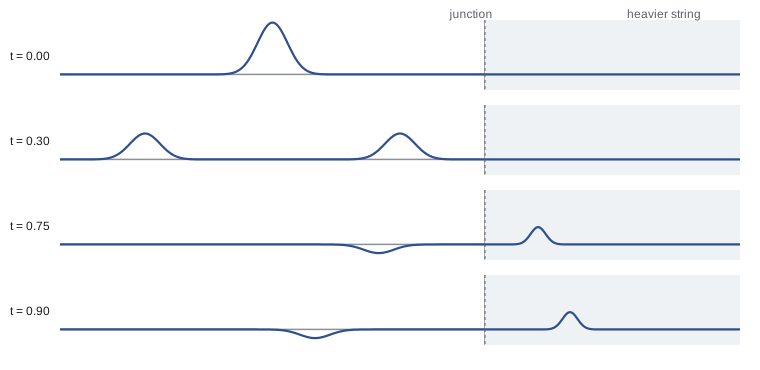
The program solves the wave equation by finite differences. With grid spacing \(\Delta x\) and time step \(\Delta t\), the update is \(y_j^{n+1} = 2y_j^n - y_j^{n-1} + C^2(y_{j+1}^n - 2y_j^n + y_{j-1}^n)\) with Courant number \(C = v\Delta t/\Delta x\). The scheme is stable for \(C \le 1\), and on a uniform string with \(C = 1\) it is exact for d'Alembert solutions. The program sends a Gaussian pulse toward a junction with a string four times as heavy, so \(Z_2 = 2Z_1\) and \(v_2 = v_1/2\), measures the reflected and transmitted peaks, and compares them with \(r = -1/3\) and \(t = 2/3\).
import math

# string from x = -1 to x = 1, junction at 0; tension 1, mu = 1 on the left, 4 on the right
nx = 2000
dx = 2.0 / nx
xs = [-1 + i * dx for i in range(nx + 1)]
mu = [1.0 if x < 0 else 4.0 for x in xs]
T = 1.0
v_left = math.sqrt(T / 1.0)
dt = 0.5 * dx / v_left                        # Courant number 0.5 on the left, 0.25 on the right
pulse = lambda x: math.exp(-((x + 0.5) / 0.05) ** 2)
y_old = [pulse(x) for x in xs]
y = [pulse(x - v_left * dt) for x in xs]       # pulse moving right
y[0] = y[-1] = 0.0

def step(y, y_old):
    new = [0.0] * len(y)
    for j in range(1, len(y) - 1):
        # (T y_x)_x with tension constant
        lap = (y[j+1] - 2*y[j] + y[j-1]) / (dx * dx)
        new[j] = 2*y[j] - y_old[j] + (dt * dt) * T * lap / mu[j]
    return new, y

t = dt
while t < 0.9:                                  # incident peak reaches 0 at t = 0.5
    y, y_old = step(y, y_old)
    t += dt
left = [(yy, x) for yy, x in zip(y, xs) if x < -0.05]
right = [(yy, x) for yy, x in zip(y, xs) if x > 0.05]
r_peak = min(left)          # reflected pulse is inverted
t_peak = max(right)
print(f"time {t:.3f}")
print(f"reflected peak {r_peak[0]:+.4f} at x = {r_peak[1]:+.3f}  (theory r = {-1/3:+.4f} at x = -0.400)")
print(f"transmitted peak {t_peak[0]:+.4f} at x = {t_peak[1]:+.3f}  (theory t = {2/3:+.4f} at x = +0.200)")

# energy bookkeeping from the impedance formulas (Z2 = 2 Z1)
r, tr, zr = -1/3, 2/3, 2.0
print(f"power fractions: reflected r^2 = {r*r:.4f}, transmitted (Z2/Z1) t^2 = {zr*tr*tr:.4f}, sum = {r*r + zr*tr*tr:.4f}")time 0.900 reflected peak -0.3334 at x = -0.401 (theory r = -0.3333 at x = -0.400) transmitted peak +0.6667 at x = +0.200 (theory t = +0.6667 at x = +0.200) power fractions: reflected r^2 = 0.1111, transmitted (Z2/Z1) t^2 = 0.8889, sum = 1.0000
The measured reflected peak is close to \(-1/3\) and lies at \(x = -0.4\), and the transmitted peak is close to \(2/3\) at \(x = +0.2\), where a pulse moving at half speed should be after 0.4 time units past the junction. The small differences come from the finite grid. The energy fractions \(r^2 = 1/9\) and \((Z_2/Z_1)t^2 = 8/9\) add to one.
Common mistakes
MistakeConfusing the speed of the wave with the speed of the string.
InsteadThe pattern moves at \(v = \sqrt{T/\mu}\); each point oscillates with peak speed \(A\omega\), usually much smaller.
MistakeChanging the frequency when a wave enters a new medium.
InsteadThe frequency stays the same; the speed and wavelength change.
MistakeExpecting a fixed end to reflect a pulse upright.
InsteadA fixed end gives \(r = -1\), an inverted pulse; only a free end reflects upright.
MistakeUsing the isothermal bulk modulus for sound in a gas.
InsteadSound is adiabatic: \(v = \sqrt{\gamma_a P/\rho}\), as Laplace showed.
MistakeThinking a transmitted amplitude larger than the incident one violates energy conservation.
InsteadPower depends on impedance too: the transmitted power is \((Z_2/Z_1)t^2\) times incident, never more than 1.
Summary and key terms
- A small-slope string obeys \(\partial_t^2y = v^2\partial_x^2y\) with \(v = \sqrt{T/\mu}\); the equation is linear, so superposition holds.
- D'Alembert: every solution is \(f(x - vt) + g(x + vt)\), fixed by the initial displacement and velocity.
- Harmonic waves obey \(\omega = vk\), \(v = f\lambda\); sound in a gas has \(v = \sqrt{\gamma_aRT/M}\), 343 m/s in air.
- A harmonic wave carries power \(\tfrac12 Z\omega^2A^2\) with impedance \(Z = \sqrt{T\mu} = \mu v\).
- At a junction \(r = (Z_1 - Z_2)/(Z_1 + Z_2)\) and \(t = 2Z_1/(Z_1 + Z_2)\); matching impedances eliminates reflection.
- wave equation
- The partial differential equation y tt equals v squared y xx for nondispersive waves.
- d'Alembert solution
- The general solution as a sum of right-moving and left-moving shapes.
- characteristic impedance
- The ratio of transverse force to transverse velocity for a traveling wave, the square root of T mu.
- acoustic impedance
- The product of density and sound speed, rho v, for a medium carrying sound.
- reflection coefficient
- The ratio of reflected to incident amplitude at a boundary.
- Courant number
- The ratio v delta t over delta x that controls the stability of a wave simulation.
Practice problems
Work each problem on paper first, then reveal the answer to check.
A 65 cm guitar string of mass 2.6 g is under 90 N tension. Find the wave speed.
Show answer
\(\mu = 0.0026/0.65 = 0.0040\ \mathrm{kg/m}\), \(v = \sqrt{90/0.0040} = 150\ \mathrm{m/s}\).
Show that \(y = A e^{-(x - vt)^2/w^2}\) satisfies the wave equation.
Show answer
It has the form \(f(x - vt)\): \(\partial_t^2 y = v^2f''\) and \(\partial_x^2 y = f''\).
Find the speed of sound in helium at \(20^\circ\mathrm{C}\) (\(\gamma_a = 5/3\), \(M = 0.0040\ \mathrm{kg/mol}\)).
Show answer
\(v = \sqrt{(5/3)(8.314)(293)/0.0040} \approx 1.01\ \mathrm{km/s}\), about three times that in air.
A wave passes from a string with \(\mu = 1\ \mathrm{g/m}\) to one with \(\mu = 9\ \mathrm{g/m}\) at equal tension. Find \(r\), \(t\) and the power fractions.
Show answer
\(Z_2/Z_1 = 3\), so \(r = -1/2\), \(t = 1/2\); reflected power \(1/4\), transmitted \(3 \times 1/4 = 3/4\).
What fraction of sound intensity crosses from air (\(Z = 415\)) into water (\(Z = 1.48\times10^6\))?
Show answer
\(4Z_1Z_2/(Z_1 + Z_2)^2 \approx 4(415)/1.48\times10^6 \approx 1.1\times10^{-3}\): about one part in a thousand.
An earthquake's S waves arrive 20 s after its P waves. With speeds 6.0 and 3.5 km/s, how far away was it?
Show answer
\(d(1/3.5 - 1/6.0) = 20\), so \(d = 20/0.119 \approx 168\ \mathrm{km}\).
Lesson quiz · 5 questions
Score 60% or more to complete this lesson.
Create a free account to save your progress, take quizzes and earn a certificate.