
PHOT-401 · Lesson 9 of 12 · 30 min
Sequencing and the photobook as artwork
Once you have edited a series, you must decide the order in which viewers will meet the images. Sequencing turns a set of pictures into an experience with a beginning, a middle and an end, with pace, pauses and turns. In a gallery, sequencing shapes how people walk through the room; in a book, it shapes how they turn the pages; online, it shapes how they scroll. This lesson explains the principles of sequencing, introduces simple tools for analyzing rhythm, and looks at the photobook as an artwork in its own right. It gives an overview only: PHOT-430 covers photobook design, production and publishing in depth.
Why sequence matters
The same twenty images in two different orders can tell two different stories. Placing a portrait of a child after an image of an empty playground suggests absence or memory; placing it before suggests anticipation. Sequence creates meaning through juxtaposition (what two adjacent images do together), progression (how the series develops) and rhythm (how the pace varies). Sequencing is therefore a continuation of editing, and decisions often flow back: a gap in the sequence may reveal a missing image, and an image that will not fit anywhere may need to go.
Models of sequence
Photographers draw on several broad models, often in combination.
- Narrative: images follow events in time or a story, as in many documentary projects. Viewers expect cause and effect.
- Typological: images of similar subjects are arranged to invite comparison, with order based on a system such as size, date, location or visual similarity.
- Poetic or associative: images are linked by visual rhymes, moods, colors or ideas rather than story. Meaning emerges from juxtaposition and is often open.
- Cyclical: the sequence returns to its opening image or idea, suggesting repetition or continuity.
- Fragmented or collage: images are deliberately interrupted with text, archival material or different visual registers.
| Model | Organizing principle | Typical effect |
|---|---|---|
| Narrative | Time or story | Clarity, momentum, cause and effect |
| Typological | System and comparison | Analysis, pattern recognition, distance |
| Poetic | Visual and emotional links | Openness, mood, active interpretation |
| Cyclical | Return to the opening | Continuity, repetition, closure |
| Fragmented | Interruption and contrast | Complexity, multiple voices, tension |
Openings, middles and endings
Openings set expectations. Many photographers open with an image that establishes the visual language and the world of the work without giving everything away; a strong but slightly mysterious image often works better than the most dramatic one. Middles carry the work's development; they need variation in scale, density and intensity so that attention does not fade. Endings shape what viewers carry away. An ending can resolve, return to the beginning, open a question or offer a quiet image that lets the series settle. Avoid ending on an image chosen only because it is technically strong.
Pairs and spreads
In books and on gallery walls, images are often seen in pairs. A pair can rhyme (similar shapes, colors or gestures), contrast (light and dark, near and far, crowded and empty) or create a third meaning that neither image has alone. In books, a spread may pair two images, set one image against a blank page, or run an image across the gutter. The blank page is a powerful tool: it slows the reader and gives the facing image weight.
Rhythm and pacing
Rhythm describes how intensity and character change through a sequence. Like music, a sequence needs variation: a series in which every image has the same scale, density and emotional intensity becomes monotonous, while a series that changes constantly can feel chaotic. One way to plan rhythm is to give each image a simple score for a quality such as intensity, density or scale, then look at how the scores change from image to image.
Worked problem
Scoring the rhythm of a sequence
You score twelve images for intensity from 1 (quiet) to 5 (intense) in your current order: 3, 3, 3, 4, 4, 4, 2, 2, 5, 5, 5, 1. Calculate the total change between consecutive images, count the runs of three or more equal scores, and suggest an improvement.
Show solution
- Differences between consecutive scores: 0, 0, 1, 0, 0, 2, 0, 3, 0, 0, 4.
- Total change: \( 0 + 0 + 1 + 0 + 0 + 2 + 0 + 3 + 0 + 0 + 4 = 10 \).
- Runs of three or more equal scores: positions 1 to 3 (score 3), 4 to 6 (score 4) and 9 to 11 (score 5), so three runs.
- Eleven transitions with six of them showing no change suggests a blocky sequence with long plateaus.
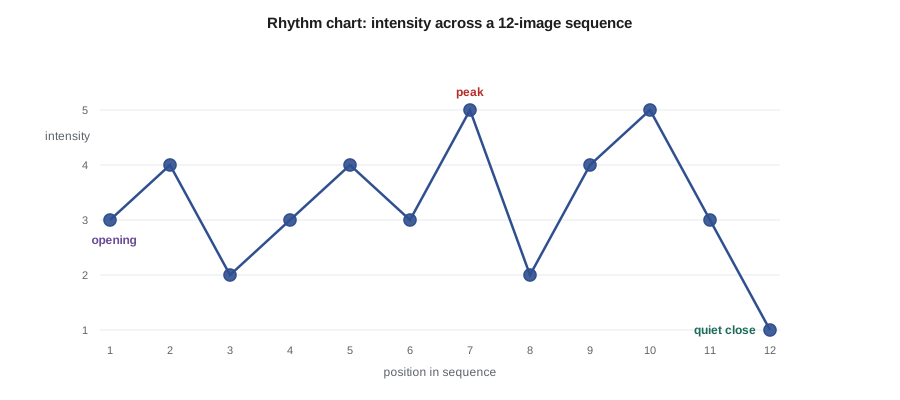
Answer: The total change is 10 with three long plateaus. Interleaving images, for example 3, 4, 2, 3, 4, 3, 5, 2, 4, 5, 3, 1, keeps variety while building to a peak and a quiet ending.
Worked problem
Comparing two sequences
Calculate the total change for the revised order 3, 4, 2, 3, 4, 3, 5, 2, 4, 5, 3, 1, and the average change per transition for both orders.
Show solution
- Differences: 1, 2, 1, 1, 1, 2, 3, 2, 1, 2, 2.
- Total change: \( 1 + 2 + 1 + 1 + 1 + 2 + 3 + 2 + 1 + 2 + 2 = 18 \).
- Average per transition: original \( 10 / 11 \approx 0.91 \); revised \( 18 / 11 \approx 1.64 \).
Answer: The revised sequence has more frequent but moderate changes and no plateaus. A higher number is not automatically better: a sequence that jumps from 1 to 5 every time would score very high and feel jarring. Use the numbers to spot problems, then judge by looking.
Visual links between images
Beyond intensity, sequences are held together by visual links. Common links include repeated shapes (circles, lines, grids), color carried from one image to the next, direction of movement or gaze, scale shifts from wide to close, and subject echoes such as hands appearing in successive images. Strong links let a viewer move smoothly; deliberate breaks mark a new section. Some photographers map links on a chart, listing each image and the links it shares with its neighbors, to check that transitions are either intended or intentionally abrupt.
Practical sequencing methods
Sequencing is easiest with physical prints. Make small work prints, roughly postcard size, and lay them out on a large table or pin them to a wall. Move them freely, photograph each arrangement for reference, and leave the sequence overnight before judging. Try different openings and endings. Try reversing the whole order. Ask a reader to sequence the same prints independently and compare, as you did with editing in lesson 8.
Worked problem
Planning a wall for work prints
You want to pin 24 work prints in a grid of 4 rows of 6. Each print is 6 inches wide and 4 inches high, with 2-inch gaps between prints and around the edges. What wall area do you need?
Show solution
- Width: \( 6 \times 6 + 7 \times 2 = 36 + 14 = 50 \) inches.
- Height: \( 4 \times 4 + 5 \times 2 = 16 + 10 = 26 \) inches.
Answer: You need about 50 by 26 inches of wall, a size most studios or bedrooms can accommodate on a single pinboard or a sheet of foam board.
Sequencing in different settings
A sequence that works in a book may not work on a wall. In a book, the reader controls pace and sees mostly one spread at a time, so pairs and page turns matter. On a gallery wall, viewers can see several images at once, may enter from either direction and may skip around; groupings, spacing and sightlines matter more than strict order. Online, sequences are often seen in a scrolling column or a grid that shows many images at once. Plan your sequence for its primary setting, then adapt it for others. Lesson 10 covers hanging; lesson 12 covers exhibitions.
The photobook as artwork
For many photographers, the book is the primary form of a project rather than a catalog of it. A photobook combines sequence, design, paper, binding, size, typography and text into a single object experienced in time. Important photobooks are often discussed as artworks in their own right, and festivals, awards and fairs dedicated to photobooks are a major part of the photography world in Canada, the United States and internationally.
Key decisions include format and size (an intimate small book or a large, immersive one), paper (matte or gloss, white or warm), binding (sewn, perfect bound, Japanese stab binding, loose sheets in a box), the relationship of text to image, and edition size. Self-publishing, small presses and print-on-demand services have made books more accessible, but production quality and distribution vary greatly.
Making a dummy, a handmade or printed mock-up of the book, is the standard way to test a sequence and design. Even a simple dummy with inkjet prints folded and stapled reveals problems with pace and pairing that no screen can show. PHOT-430 covers dummies, design software, printing, costing and distribution.
Worked problem
Page count for a photobook dummy
Your sequence has 36 images. You want each image on a right-hand page with a blank left-hand page, plus 8 pages for a title page, text and colophon. Book pages are printed in signatures of 16 pages. How many pages will the book have?
Show solution
- Image spreads: \( 36 \times 2 = 72 \) pages.
- Plus front and back matter: \( 72 + 8 = 80 \) pages.
- Signatures: \( 80 / 16 = 5 \), a whole number, so no blank pages are needed.
Answer: The book will have 80 pages in five 16-page signatures. If you added one more image, you would reach 82 pages and need to round up to 96, so you would either add content or cut an image.
Testing a sequence with viewers
Once you have a sequence you like, test it on viewers who have not seen the work. Ask one or two people to look through the prints or dummy at their own pace while you watch silently. Watch for where they slow down, where they flip quickly, where they turn back to an earlier image and where they seem confused. Afterwards, ask them to describe what happened in the series and which images they remember. Their responses show whether your rhythm and links work as intended. If several viewers rush through the same section, it may be too repetitive; if they keep turning back at one point, a juxtaposition may be especially strong or unclear. Revise, then test again with new viewers, since people who have seen an earlier version cannot see the sequence freshly.
Sequence and meaning across a career
Sequencing skills extend beyond a single project. Many photographers revisit older work and resequence it for retrospectives, books or new exhibitions, discovering connections between projects made years apart. Keeping well-organized archives and records of past sequences makes this possible and can reveal the long arcs in a practice.
Common mistakes
MistakeOpening with the most dramatic image by default
InsteadOpen with an image that establishes the world and visual language of the work.
MistakeKeeping a sequence with long runs of similar images
InsteadScore rhythm and interleave images to create variation.
MistakePlanning a sequence only on a screen
InsteadUse small physical prints and dummies to test order and pairing.
MistakeAssuming a book sequence will work on a wall
InsteadAdapt the sequence to each setting's viewing conditions.
MistakeTreating the photobook as a catalog of prints
InsteadConsider the book as an artwork with its own form, materials and pace.
Summary and key terms
- Sequencing creates meaning through juxtaposition, progression and rhythm.
- Common models are narrative, typological, poetic, cyclical and fragmented.
- Openings, middles and endings each have different jobs in a sequence.
- Scoring intensity and calculating the change between images helps reveal plateaus and abrupt jumps.
- Visual links such as shape, color, direction and scale connect images; breaks mark sections.
- Physical work prints and dummies are the most reliable way to test a sequence.
- The photobook is an artwork in its own right; PHOT-430 covers it in depth.
- Sequence
- The order in which viewers encounter the images in a series.
- Juxtaposition
- Placing two images together so they create meaning.
- Rhythm
- The pattern of change in intensity and character through a sequence.
- Plateau
- A run of consecutive images with the same character or intensity.
- Visual link
- A shared element, such as shape or color, connecting adjacent images.
- Spread
- Two facing pages in a book.
- Gutter
- The inner margin where facing pages meet at the binding.
- Dummy
- A mock-up of a book used to test sequence and design.
- Signature
- A group of pages printed on one sheet and folded, often 16 pages.
- Colophon
- A note in a book giving production details.
Practice problems
Work each problem on paper first, then reveal the answer to check.
Name three models of sequence.
Show answer
Narrative, typological, poetic, cyclical or fragmented.
Scores 2, 4, 4, 1 give what total change?
Show answer
\( 2 + 0 + 3 = 5 \).
Why is a very high total change not always good?
Show answer
Constant large jumps can feel chaotic and jarring.
What job does an opening image usually do?
Show answer
Establishes the world and visual language of the work.
Name three kinds of visual link.
Show answer
Shape, color, direction, scale or subject echo.
20 work prints, each 3 units wide, sit in 5 columns with 1-unit gaps between and around them. How wide is the layout?
Show answer
\( 5 \times 3 + 6 \times 1 = 21 \) units.
A book has 30 images, each with a blank facing page, plus 4 extra pages. How many pages?
Show answer
\( 60 + 4 = 64 \) pages.
How many 16-page signatures make 64 pages?
Show answer
4.
Why does a blank facing page give an image weight?
Show answer
It slows the reader and isolates the image.
Which course covers photobook production in depth?
Show answer
PHOT-430.
Lesson quiz · 5 questions
Score 60% or more to complete this lesson.
Create a free account to save your progress, take quizzes and earn a certificate.