
PHOT-401 · Lesson 1 of 12 · 29 min
What fine art photography is
Fine art photography is photography made primarily to express an idea, ask a question or create an experience, rather than to fulfill a client's brief or to report the news. The same camera, the same light and sometimes even the same subject can produce a product shot, a news photograph or a work of art. What changes is the intention behind the picture, the way it is made into a body of work, and the context in which it is shown and read. This course is about that intention and that context. It asks you to develop a sustained project of your own, to talk and write about it clearly, and to take part in the habit that sits at the center of every art school and studio: critique.
Earlier courses gave you the tools. PHOT-230 covered photographing people and places in public; PHOT-240 covered the darkroom and alternative processes; VIS-210 traced the history and theory of photography; and VIS-410 covers portfolios, grants and the business of a creative career. This course draws on all of them but focuses on the work itself: how an idea becomes a project, how a project becomes a coherent series, and how a series meets an audience.
Three purposes, one medium
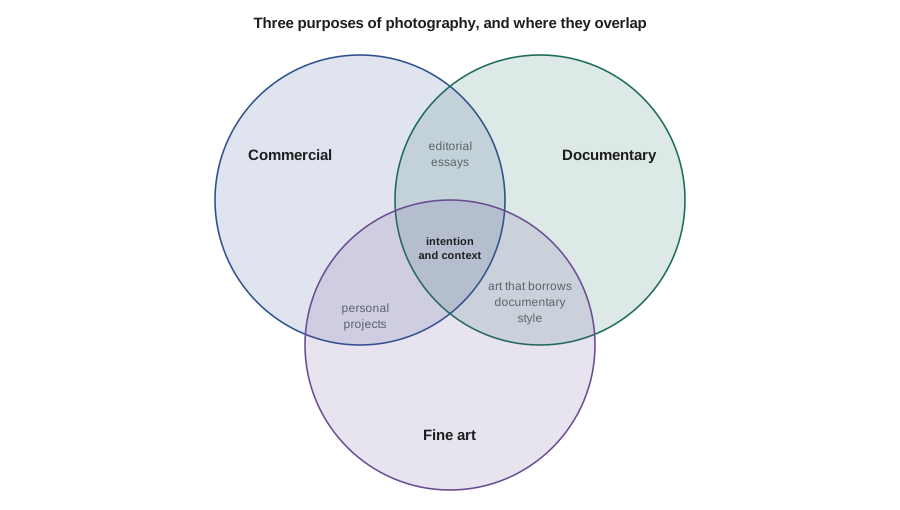
It helps to start with a simple comparison. Most photographs are made for one of three broad purposes, and each purpose brings its own measures of success.
- Commercial photography serves a client. Success means meeting the brief, on time and on budget, so that the image sells a product, a service or an idea. The client usually controls how the image is used.
- Documentary and journalistic photography serves the public record. Success means accuracy, fairness and timeliness; the photographer is bound by codes of ethics that forbid staging and misleading edits (PHOT-320).
- Fine art photography serves the artist's own inquiry and the viewer's experience. Success means that the work is original, coherent and meaningful, and that it rewards sustained looking. The artist controls the meaning and presentation.
These categories overlap constantly. Many documentary photographers exhibit their work in galleries and publish photobooks; many artists borrow the look of documentary or advertising images on purpose; many commercial photographers keep personal projects that later become exhibitions. The useful question is not "which box does this belong in?" but "what is this work trying to do, and is it doing it well?"
| Purpose | Who decides meaning | Main measure of success | Typical outcome |
|---|---|---|---|
| Commercial | The client and brief | Meets the brief and sells | Advertising, catalogs, websites |
| Documentary and editorial | The facts and the editor | Accurate, fair, timely | Newspapers, magazines, archives |
| Fine art | The artist, then the viewer | Original, coherent, meaningful | Exhibitions, photobooks, collections |
Intention, series and context
Three features distinguish most fine art photography. The first is intention: the work begins with something the artist wants to explore. That might be a question about memory, a place that matters, a community, the nature of photography itself, or a visual problem such as how light changes a familiar room through a day. Intention does not have to be fixed at the start; many artists discover what a project is about by making it. But by the time the work is shown, the artist can say why it exists.
The second feature is the series. A single strong photograph can be powerful, but most fine art photography is made, shown and understood as a group of related images. The series lets the artist build meaning through repetition and variation. Ten portraits of different people in the same pose, light and framing say something no single portrait can; a sequence of landscapes photographed along one river says something about the river that no single view could.
The third feature is context. Where and how the work is shown changes how it is read. The same image means something different on a gallery wall at large scale, in a hand-bound photobook, on a phone screen or in a museum collection beside historical works. Fine art photographers think about the final form of their work from early on, because form is part of meaning.
The art world as an ecosystem
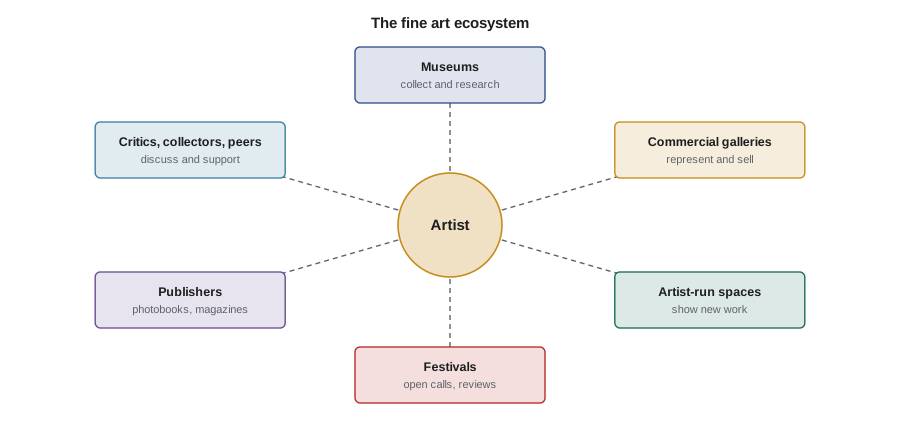
Fine art photography lives within an ecosystem of institutions, each with its own role. Knowing what each does helps you understand where your work might fit and how decisions are made.
- Public museums and galleries collect, preserve and exhibit art for the public. They are run by curators and boards, funded by governments, donors and admissions, and they select work through curatorial research rather than open submission.
- Commercial galleries represent artists and sell their work, usually taking a commission on sales. They build an artist's market and career over years.
- Artist-run centers and non-profit spaces show experimental, emerging and community work and often pay exhibition fees to artists. They frequently accept proposals through calls for submissions.
- Biennials, festivals and photo festivals bring together large, often international, exhibitions on a theme every year or two.
- Publishers, especially independent photobook publishers, circulate work in book form, which for many photographers is the main way their projects reach an audience (lesson 9).
- Schools, critics, writers, collectors and peers form the conversation around the work: they teach, review, buy, recommend and argue.
In the United States, the ecosystem relies heavily on private and non-profit institutions: museums with major photography departments, university galleries, non-profit exhibition spaces and a large commercial gallery market concentrated in cities such as New York, Los Angeles and Chicago. There is no national exhibition-fee standard comparable to Canada's; fees depend on the venue. Festivals, portfolio reviews such as those run by photography non-profits, and university programs are important routes for emerging photographers.
What makes work strong
There is no single checklist for good art, and critics disagree constantly. Still, across critiques, juries and reviews, a few qualities come up again and again. Learning to recognize them in other people's work, and then in your own, is one of the main goals of this course.
- Originality: the work offers a way of seeing, a subject or an approach that is not simply a copy of a familiar style. Originality rarely means inventing something from nothing; it usually means combining influences in a personal way.
- Coherence: the images clearly belong together. Their subject, approach, form and quality are consistent enough that the series reads as one body of work.
- Depth: the work rewards repeated looking. It holds more than a quick idea or a single visual trick.
- Resolution: the form fits the idea. Scale, sequence, print quality, titles and presentation all support what the work is about.
- Awareness: the artist knows the history and the current conversation the work belongs to, and positions the work within it rather than unknowingly repeating it.
Technical skill matters, but in fine art contexts it is a foundation rather than a goal. A beautifully exposed, sharp print of an idea that has been made a thousand times will usually be less interesting to a curator than a rougher image with a genuinely new way of seeing.
Worked problem
Same subject, three purposes
Three photographers photograph the same small-town hardware store. One works for a home-renovation magazine, one is a local newspaper photographer covering the store's closure after 80 years, and one is an artist making a series about objects that outlast their owners. How might their approaches and finished work differ?
Show solution
- The magazine photographer works to a brief: bright, inviting images of products and the shop interior, styled and lit to suit the magazine's look, with the editor choosing the final images.
- The newspaper photographer records the event accurately: the owner on the last day, customers saying goodbye, the sign coming down. Nothing is staged, captions give names and facts, and the images run the next day.
- The artist might return over months, photographing worn tools, hand-written price tags and empty shelves in consistent, slow, frontal compositions, perhaps in large-format, and present 20 prints in an exhibition with a short statement about time and use.
Answer: The subject is the same, but the intention, process, control over meaning and final context are different. The artist's version is defined by a sustained inquiry and a coherent series built for exhibition or a book.
Photography's place in contemporary art
For much of the twentieth century photographers fought to have photography accepted as art at all (VIS-210 traces this history). Today photography is fully part of contemporary art. Photographs hang in every major museum, sell at auction, and appear alongside painting, sculpture, video and installation. Many artists who use photography do not call themselves photographers; they use the camera as one tool among many. At the same time, a strong tradition of photographers who work mainly with the camera, often in long-term projects and books, continues.
This openness brings freedom and responsibility. You can choose almost any approach, from straight documentary-style work to staged scenes, abstraction, archival material or digital and generative processes. But you are also expected to know why you chose it. A curator will ask: why this approach for this idea? Lesson 4 surveys the main visual strategies so that your choices are deliberate.
The role of critique
Critique is the structured discussion of work in progress. In art schools it is the main form of teaching; in professional life it continues in peer groups, portfolio reviews, studio visits and conversations with curators and editors. Good critique is not about whether people like the work. It is about what the work is doing, how it is doing it and how it might do it better. Lessons 7 and 8 teach formal methods for giving and receiving critique, including the Critical Response Process. From this first week, start practicing one habit: when you look at any photograph, describe what you see before you say what you think of it. Description slows you down and makes your eventual judgment more useful.
Your project for this course
Across this course you will develop a fine art project of your own. By the capstone you will produce a written proposal, an edited and sequenced series of about 15 to 20 images, a short artist statement, and a plan for presenting the work as an exhibition or a book. Start now by keeping a process journal: a notebook or digital file where you record ideas, references, test images, reflections after shoots and notes from critiques. Artists across disciplines use journals because ideas arrive at inconvenient times and disappear quickly. Your journal will become the raw material for your proposal and statement.
Worked problem
Estimating the time a series takes
You plan a series of 18 final images. Past experience suggests you keep about 1 frame in 40 from a shoot as a candidate, and about 1 candidate in 4 makes the final series. Each shoot produces about 150 frames. How many shoots should you plan?
Show solution
- Candidates needed: \( 18 \times 4 = 72 \).
- Frames needed: \( 72 \times 40 = 2{,}880 \).
- Shoots needed: \( 2{,}880 / 150 = 19.2 \), so about 20 shoots.
Answer: About 20 shoots. Ratios like these vary widely between artists and projects, but planning them early prevents a rushed final edit.
Ethics and responsibility from the start
Because fine art photography gives the artist control over meaning, it also brings responsibility. Artists photograph real people, communities and places, and the images can travel far from their original context. Questions of consent, representation and power apply as much to art as to journalism, and in some ways more, because art is not protected by the conventions of news reporting in the same way. Lesson 5 covers these questions in detail, including the law on using people's images in art in Canada and the United States. For now, note that a project about other people should begin with a conversation with those people, not end with one.
Common mistakes
MistakeAssuming fine art photography is defined by its subject, such as landscapes or nudes
InsteadRecognize that fine art photography is defined mainly by intention, series and context.
MistakeTreating technical perfection as the main goal of art photography
InsteadTreat technical skill as the foundation that serves an original, coherent idea.
MistakeMaking single strong images with no connection to each other
InsteadDevelop a series in which images build meaning through repetition and variation.
MistakeIgnoring where and how the work will be shown until the end
InsteadConsider the final form, such as exhibition, book or screen, early, because form shapes meaning.
MistakeJudging work by whether you like it
InsteadDescribe what the work does and how, before giving an opinion.
Summary and key terms
- Fine art photography is defined by intention, series and context rather than by subject or equipment.
- Commercial, documentary and fine art photography overlap, but each has different measures of success.
- The art world is an ecosystem of museums, commercial galleries, artist-run centers, festivals, publishers and critics.
- Strong work is original, coherent, deep, resolved and aware of its context.
- Photography is fully part of contemporary art, so artists are expected to justify their choice of approach.
- Critique is the structured discussion of work in progress and the main way artists improve.
- A process journal records ideas, references and reflections and becomes the basis of your proposal.
- Fine art photography
- Photography made primarily to express an idea or create an experience, shown in art contexts.
- Body of work
- A coherent group of images made around one idea, place, community or approach.
- Series
- A set of related images designed to be seen together.
- Context
- The setting, form and institution in which work is shown, which shapes how it is read.
- Artist-run center
- A non-profit exhibition space run by artists, common in Canada, that often pays exhibition fees.
- Commercial gallery
- A gallery that represents artists and sells their work for a commission.
- Curator
- A person who researches, selects and presents art for exhibitions and collections.
- Critique
- A structured discussion of work in progress focused on what it does and how.
- Process journal
- A record of ideas, references, tests and reflections kept throughout a project.
- Resolution
- The degree to which a work's form, scale and presentation fit its idea.
Practice problems
Work each problem on paper first, then reveal the answer to check.
What mainly distinguishes fine art photography from commercial photography?
Show answer
Its intention, serial form and context; the artist rather than a client controls meaning.
Name three institutions in the fine art ecosystem and their roles.
Show answer
Museums collect and exhibit; commercial galleries represent and sell; artist-run centers show experimental work and pay fees.
Why is the series so important in fine art photography?
Show answer
It builds meaning through repetition and variation that single images cannot.
List the five qualities of strong work named in this lesson.
Show answer
Originality, coherence, depth, resolution and awareness.
A series needs 18 images, 1 candidate in 4 is kept, 1 frame in 40 becomes a candidate and shoots yield 150 frames. How many shoots?
Show answer
\( 18 \times 4 \times 40 / 150 = 19.2 \), so about 20.
Why should artists describe a photograph before judging it?
Show answer
Description slows looking and makes judgment more accurate and useful.
What does a process journal contain?
Show answer
Ideas, references, test images, reflections after shoots and critique notes.
Give an example of overlap between documentary and fine art photography.
Show answer
A documentary project exhibited in a gallery or published as a photobook.
Why does context change the meaning of a photograph?
Show answer
Scale, format and setting frame how viewers read and value the image.
Why do ethics matter in fine art photography?
Show answer
Artists control meaning and images of real people can travel far from their original context.
Lesson quiz · 5 questions
Score 60% or more to complete this lesson.
Create a free account to save your progress, take quizzes and earn a certificate.