
PHOT-401 · Lesson 4 of 12 · 29 min
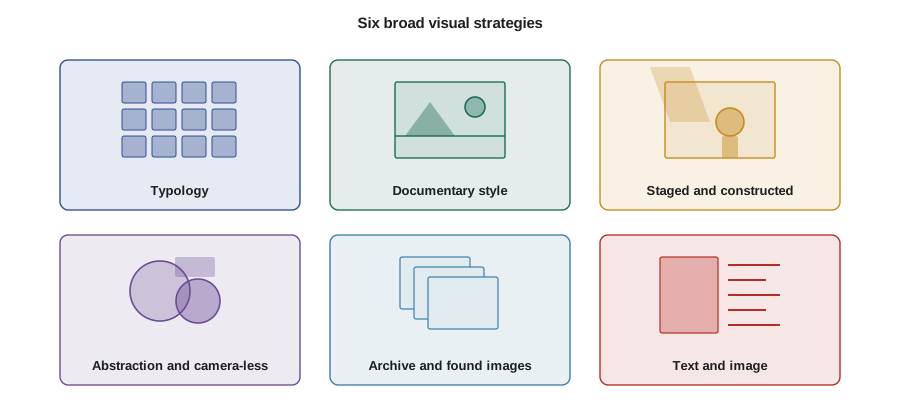
Visual strategies in contemporary photography
Once you know what a project is about, you need to decide how it will look and how it will be made. Contemporary fine art photography uses a wide range of visual strategies, from strict, repetitive typologies to elaborate staged scenes, abstract experiments with light and chemistry, and work built from other people's photographs. None is better than the others in general; each suits some ideas and undermines others. This lesson surveys the main strategies, describes how artists have used them, and gives you questions to choose deliberately. Works are described in words only. To see them, look up the artists in museum collections, books and their own websites.
Strategy follows concept
The guiding principle is simple: the way a series looks should help say what the series is about. A project about bureaucracy might use flat, frontal, repetitive images that echo the feeling of forms and files. A project about memory might use soft focus, fragments or found family snapshots. A project about the fiction of advertising might use staged, glossy images that mimic it. When strategy and concept fit, viewers sense the work's logic even if they cannot name it. When they do not, the work feels arbitrary.
Typologies and the serial grid
A typology is a series of photographs of one type of object, building or person, made under consistent conditions and shown together, often in a grid. The best-known examples are the German artists Bernd and Hilla Becher, who from the late 1950s photographed industrial structures such as water towers, blast furnaces and winding towers, each frontally, in even overcast light and from a similar height, and showed them in grids grouped by type. The strict consistency turns individual structures into a catalog of variations on a form. Their students at the Düsseldorf Art Academy, including several who became internationally known for large color prints, extended this approach in different directions.
Typologies suit ideas about classification, sameness and difference, systems, and the ordinary made strange. They depend heavily on constraints: same viewpoint, light, distance and framing. Their weakness is that they can become mechanical, a collection rather than an argument, unless the subject itself is genuinely revealing.
Worked problem
Planning a typology grid
You are photographing 24 bus shelters for a typology and want to present them as a grid on one wall. Each framed print is 16 inches wide by 20 inches tall, and you want 2-inch gaps between frames. If you arrange them in 4 rows of 6, how wide and tall is the grid?
Show solution
- Width: 6 frames and 5 gaps, \( 6 \times 16 + 5 \times 2 = 106 \) inches.
- Height: 4 frames and 3 gaps, \( 4 \times 20 + 3 \times 2 = 86 \) inches.
Answer: About 106 by 86 inches (roughly 8 feet 10 inches by 7 feet 2 inches), which needs a large wall and a ceiling of at least 10 feet to leave space above and below.
Documentary style
Many artists work in what is often called documentary style: unstaged images of real people, places and events, made with an attention to truth, but presented as art rather than news. This tradition, discussed in VIS-210, includes photographers who spent years in one community, traveled across a country making portraits and landscapes, or recorded their own families. The images may look like reportage, but they are edited, sequenced and contextualized by the artist, and they are judged by artistic as well as factual standards.
Documentary style suits projects about lived experience, communities, places and social questions. It requires time, trust and ethical care (lesson 5). Its risk is that it can drift into clichés: the picturesque poverty shot, the exotic stranger, the dramatic but empty street scene. The strongest documentary-style projects show sustained engagement and avoid easy images.
Staged and constructed photography
Staged photography builds scenes for the camera, using actors, sets, lighting and sometimes digital compositing. The Canadian artist Jeff Wall, associated with the Vancouver School discussed in VIS-210, became known from the late 1970s for large backlit transparencies of carefully staged scenes that look like everyday moments but were constructed with the care of a film production. Other artists have made elaborate tableaux, cinematic suburban scenes lit like film sets, or self-portraits in which the artist plays many invented characters.
Staging suits ideas about fiction, memory, performance, identity and the constructed nature of images. It gives total control over composition and meaning, but it is demanding: it needs planning, crews, locations, budgets and a convincing visual world. It also raises honesty questions: if staged images look like documents, should viewers be told? In fine art contexts, artists usually disclose staging in titles, statements or interviews, and the tension between appearance and fact is often part of the point.
Abstraction and camera-less photography
Some photographers work at the edge of representation: extreme close-ups that dissolve subjects into form and color, light and shadow studies, long exposures that blur time, or prints made with no camera at all. Photograms, made by placing objects directly on light-sensitive paper, date back to the earliest years of photography and were revived by modernist artists in the 1920s. Chemigrams, light drawings, cyanotypes and other alternative processes (PHOT-240) let artists explore the physical and chemical nature of the medium.
Abstraction suits ideas about perception, materiality, time and the medium itself. Its challenge is depth: abstract images can be beautiful but empty unless the series develops an idea through consistent exploration.
Archives, found photographs and appropriation
Many contemporary artists work with photographs they did not take: family albums, flea-market snapshots, institutional archives, newspaper morgues, online images and screenshots. They might re-photograph, enlarge, crop, sequence, annotate or combine these images to reveal histories, question how photographs shape memory, or expose the biases of official records. Some projects pair archival images with new photographs to show change or continuity.
Archival work raises legal and ethical questions. Copyright may belong to the original photographer or their estate, and it lasts a long time: in Canada, generally the author's life plus 70 years for authors who died in 1972 or later, and in the United States, life plus 70 years for works created since 1978, with different rules for older works. Using found images of identifiable people can also raise privacy issues. Fair dealing in Canada and fair use in the United States may cover some uses, such as criticism or parody, but they are not blanket permissions, and the 2023 US Supreme Court decision in Andy Warhol Foundation v. Goldsmith narrowed fair use for some appropriation art. Get advice before building a project on images you do not own.
Worked problem
Scanning found photographs for large prints
You want to enlarge a small 3.5 × 5 inch family snapshot to a print 35 inches wide while keeping at least 200 pixels per inch on the print. What scanning resolution do you need?
Show solution
- Enlargement factor: \( 35 / 5 = 7 \) (assuming the long side becomes the 35-inch width).
- Scan resolution: \( 200 \times 7 = 1{,}400 \) ppi, so scan at about 1,400 to 1,600 ppi to leave a margin.
Answer: Scan at roughly 1,400 to 1,600 pixels per inch. Beyond that, the grain of the original print usually limits detail more than the scanner does.
Text and image, and other combinations
Words have always traveled with photographs: captions, titles, interviews, diary entries, letters, maps and documents. Some artists make text an equal partner, writing alongside images or including handwritten notes, transcripts or found documents. Others combine photography with video, sound, sculpture, installation or performance. These combinations can deepen meaning by adding voices and context that images alone cannot carry. The risk is redundancy, where the text simply repeats what the image shows, or overload, where the viewer is asked to read too much.
Digital, computational and generative images
Digital tools have expanded strategies further: composites built from many exposures, images made with scanners or phones, screenshots and found online material, photogrammetry and 3-D scans, and images produced or altered by generative artificial intelligence. Artists use these tools to explore surveillance, virtual worlds, memory and the reliability of images. Generative tools raise new questions about authorship, training data and disclosure. In most fine art contexts, honesty about how images were made is expected, and some competitions now have explicit rules separating photographs from AI-generated images. The question remains the same as with any strategy: does this method serve the idea, and can you explain why you chose it?
| Strategy | Suits ideas about | Main risk |
|---|---|---|
| Typology | Classification, systems, sameness and difference | Mechanical collecting without an argument |
| Documentary style | Lived experience, communities, places | Clichés and ethical shortcuts |
| Staged and constructed | Fiction, memory, identity, performance | Expense, and theatrical emptiness |
| Abstraction and camera-less | Perception, materiality, the medium | Beauty without depth |
| Archive and found images | History, memory, institutions | Copyright and privacy problems |
| Text and image | Voices, context, narrative | Redundancy or overload |
Worked problem
Matching strategy to concept
Three students each propose a project about their grandparents' generation. Ana wants to examine how official records categorized immigrants; Ben wants to explore his grandfather's memories of a village that no longer exists; Chloe wants to show the daily routines of elderly residents in her town. Which strategies suit each?
Show solution
- Ana's project is about institutions and categories, so an archive strategy suits it: re-photographed immigration records and identity documents, perhaps arranged as a typology, with careful attention to copyright and privacy.
- Ben's project is about memory of something absent, so staged or constructed images, text from recorded conversations and perhaps abstraction could suggest what cannot be photographed directly.
- Chloe's project is about lived routines in the present, so documentary style, made over months with consent and trust, suits it best.
Answer: Archive work for institutional categories, constructed images and text for memory of an absent place, and documentary style for present-day routines. Each strategy follows the concept.
Combining strategies
Many projects combine strategies: portraits with landscapes, new photographs with archival ones, documentary images with staged reconstructions, photographs with text. Combination can be powerful, but each strand should earn its place. A useful test is to remove one strand and ask what is lost. If nothing important disappears, the strand may be decoration.
Testing a strategy before committing
Before committing to a visual strategy for a whole project, test it on a small scale. Make five to ten images using the strategy, print them small, and look at them together. Does the strategy produce images that feel connected? Does it leave enough room for variation, or does it become mechanical? Does it support the concept, or does it dominate it? Show the test set to one or two trusted peers and ask what they think the project is about without telling them your concept. Their answers will show whether the strategy communicates what you intend. A test of a few days can save months of shooting with an approach that does not fit.
Common mistakes
MistakeChoosing a visual style because it is fashionable
InsteadChoose a strategy because it serves the project's concept.
MistakeAssuming found photographs are free to use
InsteadCheck copyright, privacy and fair dealing or fair use before building on images you do not own.
MistakePresenting staged images as documents without disclosure
InsteadDisclose staging or generative methods in titles, statements or conversation.
MistakeMaking a typology with inconsistent viewpoints and light
InsteadKeep viewpoint, distance, light and framing consistent so variations are meaningful.
MistakeAdding text that repeats what the image shows
InsteadUse text to add voices or context the image cannot carry.
Summary and key terms
- A project's visual strategy should help express its concept.
- Typologies use strict consistency to reveal variations within a type, as in the Bechers' industrial structures.
- Documentary style presents unstaged real life as art and demands time, trust and ethical care.
- Staged photography constructs scenes for the camera, as in Jeff Wall's large backlit transparencies.
- Abstraction and camera-less processes explore perception, materiality and the medium.
- Archival and found-image work raises copyright and privacy questions that need careful checking.
- Combining strategies works when each strand adds something essential.
- Typology
- A series of photographs of one type of subject made under consistent conditions.
- Documentary style
- Unstaged photographs of real life presented as art.
- Staged photography
- Images of scenes constructed for the camera.
- Tableau
- A carefully composed staged scene, often with actors.
- Photogram
- An image made by placing objects on light-sensitive material without a camera.
- Found photograph
- An existing image made by someone else and reused by an artist.
- Appropriation
- The use of existing images or objects in new artworks.
- Fair dealing
- The Canadian copyright exception for purposes such as research, criticism and parody.
- Fair use
- The US copyright doctrine allowing some unlicensed uses, judged on four factors.
- Generative image
- An image produced or altered by artificial intelligence models.
Practice problems
Work each problem on paper first, then reveal the answer to check.
State the guiding principle for choosing a visual strategy.
Show answer
Strategy follows concept: how the work looks should help say what it is about.
What makes the Bechers' work a typology?
Show answer
Consistent viewpoint, light and framing applied to one type of structure, shown in grids.
Name one strength and one risk of staged photography.
Show answer
Strength: control over meaning; risk: expense and theatrical emptiness.
A 6 by 4 grid of 40 cm wide, 50 cm tall frames with 5 cm gaps is how large?
Show answer
265 cm wide by 215 cm tall.
How long does copyright generally last in Canada for authors who died in 1972 or later?
Show answer
The author's life plus 70 years.
What US case narrowed fair use for some appropriation art in 2023?
Show answer
Andy Warhol Foundation v. Goldsmith.
What scan resolution keeps 200 ppi when a 5-inch snapshot is printed 35 inches wide?
Show answer
About 1,400 ppi or more.
Why might text be added to a photographic series?
Show answer
To add voices, context or documents the images cannot carry.
What test checks whether a strand of a combined project is needed?
Show answer
Remove it and ask what is lost.
What is expected of artists using generative AI in fine art contexts?
Show answer
Honesty about how images were made.
Lesson quiz · 5 questions
Score 60% or more to complete this lesson.
Create a free account to save your progress, take quizzes and earn a certificate.