
PHOT-401 · Lesson 3 of 12 · 29 min
Developing a project and a body of work
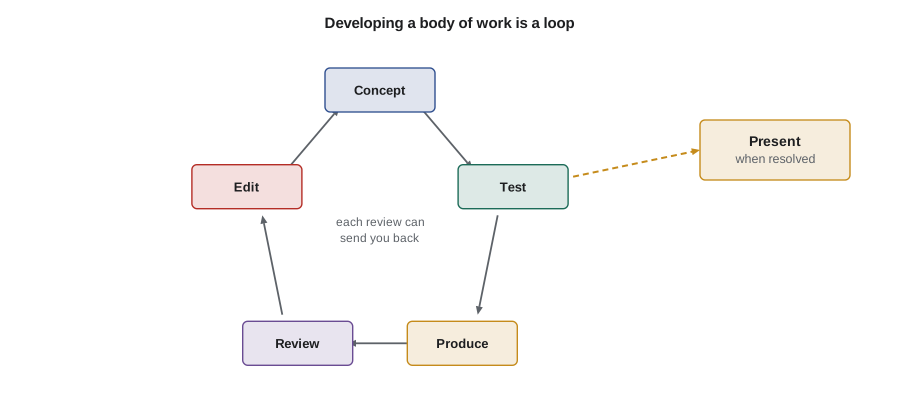
A concept becomes a body of work through months, sometimes years, of making, looking, editing and revising. This lesson covers the practical side of that process: writing a project proposal, choosing constraints that give the work coherence, planning production, budgeting, keeping a disciplined process journal and recognizing when a project is finished. Many talented photographers produce strong single images but struggle to complete a coherent series. The difference is rarely talent. It is usually structure: a clear plan, sensible limits and the habit of regular review.
From idea to project
A project is a concept with a plan attached. It has a defined scope (what is in and what is out), a method (how you will make the work), a timeline, resources and an intended outcome, such as an exhibition, a photobook or a submission to a festival. Writing these down early forces decisions that are easy to postpone. It also gives you something concrete to discuss in critique and, later, to adapt into grant applications and exhibition proposals (VIS-410 covers funding applications in detail).
The project proposal
A project proposal is a short document, usually one to three pages, that explains what you plan to make and how. Even when no one asks for it, writing one clarifies your thinking. A useful structure has six parts.
- Title and one-sentence summary: a working title and a plain description of the project.
- Concept: the idea or question, in about 100 to 200 words, building on your working concept statement from lesson 2.
- Context: two or three sentences on how the project relates to other artists' work and why it adds something.
- Method: what you will photograph, where, with what tools and approach, and how you will work with any people involved.
- Timeline and resources: key stages, dates, costs and what you need, such as access, equipment or permissions.
- Outcome: the intended final form, such as 20 framed prints, a photobook dummy or an online exhibition, and its audience.
Constraints as a creative tool
Constraints are self-imposed limits on how the work is made. They might feel restrictive, but they are one of the most reliable ways to give a series coherence. When every image shares a camera position, a time of day, a focal length, a distance from the subject or a framing rule, the differences between images become meaningful. Viewers compare one image with the next and notice what changes.
- Formal constraints: one lens, one aspect ratio, one height, black and white only, square format, always frontal.
- Temporal constraints: photographing at the same hour, on the same date each year, or only in one season.
- Spatial constraints: one street, one building, a fixed radius from your home, one river from source to mouth.
- Process constraints: one roll of film per subject, a fixed number of frames per visit, only available light.
- Social constraints: photographing only people you have known for at least a year, or only people who invite you.
Constraints should come from the concept. If a project is about routine, photographing at the same time every day reinforces the idea. If it is about change over time, returning to fixed viewpoints makes change visible. Constraints chosen at random, or only to look like a particular artist, add nothing.
Worked problem
Choosing constraints that serve the concept
Sana is starting a project about her neighborhood during a year of construction for a new transit line. She wants viewers to feel the slow, disruptive transformation of familiar streets. What constraints might help?
Show solution
- Temporal constraint: return to the same locations once a month for twelve months, so change can be seen across time.
- Spatial constraint: choose 15 fixed viewpoints along the construction route, marked on a map, and frame each one identically on every visit using a tripod and notes on lens and height.
- Formal constraint: use the same focal length, aspect ratio and overcast or even light where possible, so differences come from the street rather than the photography.
- Allow one open element: alongside the fixed views, make freer portraits of residents and shopkeepers, which can be interleaved in the final sequence.
Answer: Monthly visits to fixed, identically framed viewpoints make transformation visible and comparable, while a looser strand of portraits brings the human experience into the series.
Planning production
Production is the long middle of a project. A realistic plan considers access, frequency, seasons and your own capacity. Ask how often you can realistically shoot given work, school and family commitments; whether your subject is available at certain times only (a seasonal festival, a migratory bird, a school year); and what permissions you need from property owners, organizations or the people you photograph.
Frequency matters more than intensity. A project shot one afternoon a week for six months almost always develops further than one shot in an intense two-week burst, because the gaps between shoots give you time to look, reflect and change course. Regular review sessions, ideally weekly, should be built into the plan as firmly as shoots.
| Weeks | Stage | Main tasks |
|---|---|---|
| 1 to 2 | Concept and research | Working statement, artist research, subject reading, permissions |
| 3 to 5 | Testing | Three to five test shoots, early critique, refine constraints |
| 6 to 11 | Main production | Weekly shoots, weekly review, mid-term critique |
| 12 to 13 | Editing and sequencing | Final edit, sequence, statement draft, print tests |
| 14 | Presentation | Final prints or dummy, statement, presentation |
Budgeting a body of work
Fine art projects cost money even when no one is paying you. A simple budget helps you plan, apply for funding (VIS-410) and avoid unpleasant surprises at the printing stage, which is often the most expensive part.
Worked problem
An illustrative project budget
A student plans a 20-print exhibition project in the United States. Estimated costs are travel to locations $600, film and processing $480, scanning $200, test prints $150, final prints at 20 × 24 inches costing $85 each, framing at $140 per frame, and a 10 % contingency. What is the total?
Show solution
- Prints: \( 20 \times 85 = 1{,}700 \). Frames: \( 20 \times 140 = 2{,}800 \).
- Subtotal: \( 600 + 480 + 200 + 150 + 1{,}700 + 2{,}800 = 5{,}930 \).
- Contingency: \( 0.10 \times 5{,}930 = 593 \).
- Total: \( 5{,}930 + 593 = 6{,}523 \).
Answer: About $6,523, of which framing and printing are about three quarters. Prices here are illustrative only; get real quotes from local labs and framers before committing.
The disciplined process journal
In lesson 1 you started a process journal. During production it becomes a working tool. After every shoot, write a short entry: date, place, conditions, what you tried, what you think worked, what surprised you and what to try next. Paste in or link a contact sheet or thumbnails. Record conversations with subjects, permissions obtained and any promises you made, such as sending prints. Note critique feedback and your response to it.
The journal serves several purposes at once. It slows down your thinking, which improves decisions. It creates a record you can return to when memory fails. It provides material for statements, proposals and artist talks. And it documents your process, which some exhibitions and grant juries ask to see, and which can matter if questions arise later about how the work was made or how consent was obtained.
Regular review: the weekly edit
Set aside a fixed time each week to review new work. Load images into a catalog or print small work prints and pin them up. Mark candidates with a simple rating system: for example, one star for "maybe," two for "strong candidate," three for "core image." Move images in and out of a working edit, a provisional selection of the strongest images, and keep it on a wall or in a dedicated album where you see it often. Patterns become visible over weeks: gaps in the story, repeated ideas, a direction that is stronger than you expected.
Worked problem
Tracking the working edit
After eight weeks of production, your working edit has 46 images. Your target is a final series of 18. If you plan four more weekly reviews and want to reach about 24 candidates before the final editing stage, how many images must you remove per week, on average, assuming you also add about 2 new candidates each week?
Show solution
- You need to go from 46 to 24, a reduction of 22, over four weeks, while adding \( 4 \times 2 = 8 \) new images.
- Total removals needed: \( 22 + 8 = 30 \).
- Per week: \( 30 / 4 = 7.5 \), so about 7 or 8 images per week.
Answer: Remove about 7 or 8 images per week. Steady pruning keeps the working edit honest and makes the final edit far less painful.
When is a project finished?
Knowing when to stop is difficult. Some projects end naturally: a building is demolished, a year of seasons is complete, a family event has passed. Others could continue forever. Signs that a body of work is ready to be shown include: new shoots no longer change the edit; the series has a clear beginning, middle and end when sequenced; critique responses become refinements rather than fundamental questions; and you can explain the work's concept in two or three sentences without hesitation. Being ready to show is not the same as being complete forever. Many artists exhibit a chapter of a long-term project and keep working on it for years.
Working with collaborators and institutions
Some projects depend on others: a community organization that grants access, a museum archive, a scientist whose research you document, a model or performer, a printer or bookbinder. Treat these relationships professionally. Agree in writing what each party contributes and receives, such as credits, copies of prints, approval rights over sensitive images or acknowledgment in a book. Keep promises; artists depend on reputations for trust. When working with institutions, ask early about their rules for photography, publication and the use of their name or logo.
Reviewing progress at the midpoint
Halfway through a project, set aside a day to review everything you have made so far. Lay out work prints, reread your journal and working statement, and ask three questions: what has the project become, what is still missing, and what should stop? Projects often drift during development, and drift is not always bad; sometimes the work finds a stronger subject than the one you planned. The midpoint review is the moment to decide deliberately whether to follow the drift or return to the original concept, and to update the schedule, budget and shot list accordingly. Record the decision in your journal so you can explain it later in critique and in your statement.
Common mistakes
MistakeStarting production without a written plan or proposal
InsteadWrite a short proposal with concept, method, timeline, resources and outcome.
MistakeChoosing constraints only to imitate another artist's look
InsteadChoose constraints that grow from and reinforce the concept.
MistakeShooting intensely for two weeks and then stopping
InsteadShoot regularly over a longer period with review between sessions.
MistakeForgetting printing and framing costs until the end
InsteadBudget presentation costs, often the largest share, from the start.
MistakeReviewing work only at the end of the project
InsteadHold a weekly review and maintain a working edit throughout.
Summary and key terms
- A project is a concept with a defined scope, method, timeline, resources and outcome.
- A short proposal clarifies thinking and becomes the basis for grants and exhibition submissions.
- Constraints chosen from the concept give a series coherence and make differences meaningful.
- Regular, frequent shooting with time for reflection develops work further than short bursts.
- Budgets should include production, post-production, presentation and a contingency.
- A process journal records shoots, permissions, critique and decisions, and documents how the work was made.
- A working edit reviewed weekly reveals patterns and gaps and shows when the work is ready.
- Project proposal
- A short document explaining a project's concept, context, method, timeline, resources and outcome.
- Constraint
- A self-imposed limit on how work is made that gives a series coherence.
- Scope
- What a project includes and excludes.
- Working edit
- A provisional selection of a project's strongest images, revised regularly.
- Work print
- An inexpensive print made for review rather than exhibition.
- Contingency
- Money or time reserved for unexpected costs or delays.
- Production
- The stage of making the main body of images.
- Post-production
- Editing, processing, scanning and preparing images after shooting.
- Fixed viewpoint
- A camera position returned to repeatedly to show change over time.
- Long-term project
- A body of work developed over years, often shown in chapters.
Practice problems
Work each problem on paper first, then reveal the answer to check.
Name the six parts of a project proposal.
Show answer
Title and summary, concept, context, method, timeline and resources, outcome.
Give two examples of formal constraints.
Show answer
One lens, one aspect ratio, black and white only, square format or always frontal.
Why should constraints come from the concept?
Show answer
So that the limits reinforce what the work is about rather than imitating a look.
Why is weekly shooting usually better than an intense two-week burst?
Show answer
The gaps allow reflection, review and changes of direction.
Prints cost $1,700, frames $2,800 and other costs $1,430, with a 10 % contingency. What is the total?
Show answer
\( 5{,}930 \times 1.1 = 6{,}523 \) dollars.
What should a journal entry after a shoot record?
Show answer
Date, place, conditions, what was tried, results, surprises, next steps and permissions.
A working edit of 46 must reach 24 in four weeks while adding 2 per week. How many removals per week?
Show answer
\( (22 + 8) / 4 = 7.5 \), about 7 or 8.
List two signs that a body of work is ready to show.
Show answer
New shoots no longer change the edit; the concept can be explained in two or three sentences.
Why put agreements with collaborators in writing?
Show answer
To be clear about contributions, credits, copies and approvals, and to keep trust.
Which costs often form the largest share of an exhibition budget?
Show answer
Printing and framing.
Lesson quiz · 5 questions
Score 60% or more to complete this lesson.
Create a free account to save your progress, take quizzes and earn a certificate.