
PHOT-401 · Lesson 5 of 12 · 26 min
Working with people: ethics, consent and representation
Many of the most powerful fine art photographs show people: portraits, families, communities, strangers on the street, performers in staged scenes. Photographing people for art raises questions that go beyond technique. Who agreed to be photographed, and to what? How are they represented, and who decides? What happens when images travel to galleries, books and websites far from the people in them? This lesson covers the ethics of consent and representation, the law on using people's images in art in Canada and the United States, Indigenous protocols, and practical tools such as releases and consent records. It builds on PHOT-230, which covered photographing in public, and goes further into the particular situation of art.
Why art raises particular questions
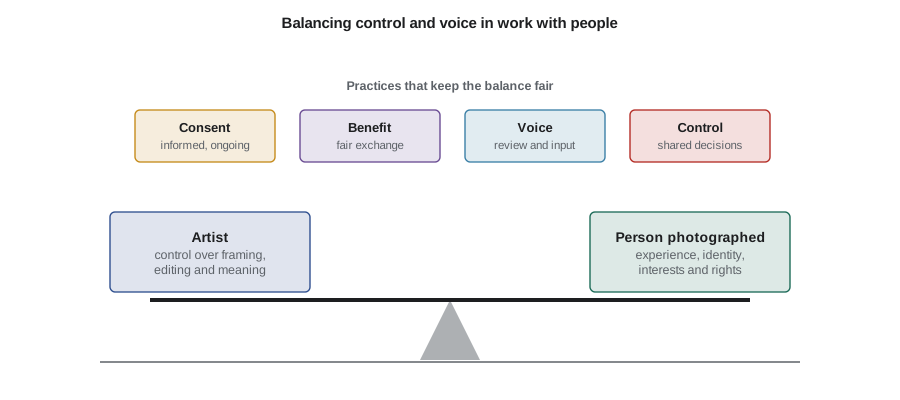
News photography has codes of ethics and a clear public-interest purpose. Commercial photography has contracts and model releases. Fine art sits in between. It is generally protected as free expression, and it often has no client. But art also aestheticizes: it turns real people into images that are admired, sold, collected and interpreted, sometimes for decades. A person who agreed to a snapshot may not expect to appear two meters tall on a gallery wall or in a book sold internationally. The artist's control over meaning, which is one of art's strengths, is also a source of power over the people depicted.
Informed consent
Informed consent means that a person understands what they are agreeing to and agrees freely. In art photography, that includes understanding what the project is about, how images might be used (exhibition, book, website, sale, social media), whether they will be named, how long the images might circulate, and whether they can withdraw. Consent is a process, not a single moment. For long-term projects, check in regularly, especially if a person's situation changes or if you plan a new use.
Consent should be proportionate to risk. A street photograph of a crowd at a festival, exhibited in a group show, carries different risks from an intimate portrait of a person in recovery from addiction, published in a book with their name. The more sensitive the subject, the more care is needed.
- Explain the project in plain language, and give a written summary people can keep.
- Say clearly how images might be used, including sale of prints and online publication.
- Ask whether people want to be named, and respect their choice.
- Offer to show images before they are exhibited or published, especially sensitive ones.
- Record consent in writing or, where writing is inappropriate, by an audio or video record with permission.
- Keep promises, such as sending prints or invitations to the exhibition.
People in vulnerable situations
Extra care applies when people may not be able to give free, informed consent or may face harm from being shown: children, people experiencing homelessness, people with cognitive disabilities, people in crisis, patients, prisoners, refugees and people in precarious immigration situations. Ask whether the person truly has the capacity and freedom to say no, whether the images could expose them to stigma, legal risk or violence, and whether a guardian or support worker should be involved. For minors, obtain consent from a parent or guardian and assent from the child. Consider whether the project can be made in ways that protect identity, such as not showing faces, using pseudonyms or not naming locations.
Representation and the right to tell a story
Beyond consent, artists must think about representation: the overall picture the work creates of a person, group or place. Long histories of photography have shown some groups mainly as exotic, poor, dangerous or in need of rescue. Repeating those patterns, even unintentionally, can cause harm. Ask whether your images reinforce stereotypes, whether the people depicted would recognize themselves, and whether they have a say in how they are shown. Collaborative approaches, where subjects help decide what is photographed, choose images, write captions or co-author the work, are increasingly common and often lead to richer projects.
Insider and outsider positions both have value and risk. An insider may have access and trust but miss what an outsider would notice; an outsider may see freshly but misunderstand or exploit. Whichever you are, acknowledge it and build relationships that give the people in the work real voice.
The law: using people's images in art
The law differs significantly between Canada and the United States, and within each country. In both, art generally receives more protection than advertising, but neither gives artists unlimited freedom.
In the United States, protection of a person's image comes mainly from state right-of-publicity and privacy laws. New York's Civil Rights Law sections 50 and 51 prohibit using a living person's name or likeness for advertising or trade purposes without written consent. In Nussenzweig v. diCorcia, a man photographed without his knowledge on a New York street sued after his portrait was exhibited and sold as part of a fine art series. The trial court dismissed the case in 2006, holding that the art photograph and its sale in a limited edition were protected expression rather than trade; the appeals courts affirmed in 2007 on the narrower ground that the one-year time limit to sue had expired. Courts in New York and elsewhere have often treated art, including limited-edition prints, as protected expression under the First Amendment.
California Civil Code section 3344 and similar laws in other states protect against commercial use of a likeness, with exceptions for news and expressive works that vary from state to state. Artistic protection is broad but not absolute, especially if a work is used in advertising, merchandise or posters. Signed releases remain good practice, particularly for sensitive subjects, minors and any commercial use.
| Use of an identifiable person's image | Relative legal risk | Good practice |
|---|---|---|
| Exhibited fine art print, public place, not sensitive | Lower in most places; higher in Quebec | Seek consent where possible; release in Quebec |
| Limited-edition print sold through a gallery | Moderate; unsettled in some provinces and states | Obtain a release covering sale |
| Photobook sold widely | Moderate | Obtain releases, especially for main subjects |
| Poster, merchandise or advertising for the show | Higher everywhere | Always obtain a written release |
| Sensitive subject, such as health or crime | Higher, plus ethical risk | Detailed informed consent; consider anonymity |
Releases for art projects
A model release is a written agreement in which a person grants permission to use their image in specified ways. For art projects, a good release covers exhibition, sale of limited-edition prints, publication in books and catalogs, online display, publicity for exhibitions and archival use, and it states whether the person will be named. It should be written in plain language the person understands, translated where needed, and signed and dated by the person or, for a minor, a parent or guardian. Keep a copy linked to the relevant images in your catalog, and give the person a copy.
Releases do not replace ethics. A signed form does not make an exploitative image acceptable, and a person who regrets participating deserves a real conversation, even if you are legally entitled to proceed.
Worked problem
Tracking consent across a project
A community portrait project involves 64 people. By week 10, 41 have signed releases, 9 have given recorded verbal consent but not yet signed, 6 declined, and 8 have not yet been asked. The final edit will include 20 portraits. What should you do before finalizing the edit?
Show solution
- Count people you can include with written consent: 41.
- Follow up the 9 with verbal consent to obtain signatures, or a recorded consent that clearly covers the uses, before including them.
- Exclude the 6 who declined from all public uses, and delete or set aside their images according to what you promised.
- Ask the remaining 8 before including any of them, and do not include anyone until consent is confirmed.
Answer: Build the final 20 from the people with confirmed consent, at least 41 now and up to 58 if the follow-ups succeed. Never include the 6 who declined.
Indigenous protocols and community consent
When working with Indigenous people and communities, individual consent may not be enough. Many Indigenous communities have their own protocols governing who may photograph ceremonies, sacred sites, objects and knowledge, and how images may be shared. Some ceremonies may not be photographed at all.
In the United States, many tribal nations have their own laws and policies on photography, especially of ceremonies and sacred sites; some, for example, prohibit photography of certain dances or villages without permission. Contact the tribal government or cultural office before starting, follow its rules, and expect that some subjects may not be photographed at all.
Good practice includes building relationships before photographing, involving community members in decisions about images and captions, sharing benefits such as prints, fees or credits, and agreeing on how images may be used and stored in the future.
Worked problem
Budgeting for fair exchange
Your project involves 12 portrait sessions with community members, and you plan to offer each participant a $50 honorarium and a 28 × 35 cm print costing $25 to produce and $12 to mail. You also plan a community preview event costing $300. What is the total budget for fair exchange?
Show solution
- Honoraria: \( 12 \times 50 = 600 \).
- Prints and mailing: \( 12 \times (25 + 12) = 444 \).
- Total: \( 600 + 444 + 300 = 1{,}344 \).
Answer: About $1,344. Including these costs in your project budget from the start makes fair exchange a planned part of the work rather than an afterthought.
Practical habits
Carry release forms and project information sheets to every shoot. Note consent details in your process journal and catalog metadata. Review sensitive images with the people in them before showing them. Revisit consent when you plan a new use, such as moving from an exhibition to a book. And keep asking the ethical questions throughout the project, not only at the start.
Common mistakes
MistakeAssuming art is always legally protected so consent does not matter
InsteadCheck the law where you work, especially in Quebec, and seek consent as good practice.
MistakeTreating a signed release as the end of ethical responsibility
InsteadKeep considering representation, harm and the person's ongoing wishes.
MistakeGetting consent for an exhibition and then publishing a book without asking
InsteadRevisit consent whenever you plan a new use.
MistakePhotographing ceremonies because they are in public view
InsteadLearn and follow community protocols before photographing Indigenous ceremonies or sites.
MistakeIncluding people who declined because the image is strong
InsteadExclude anyone who declined from all public uses.
Summary and key terms
- Fine art gives artists control over meaning, which brings responsibility to the people depicted.
- Informed consent is a process proportionate to risk, covering uses, naming and withdrawal.
- People in vulnerable situations need extra care, and minors need guardian consent and their own assent.
- In Quebec, Aubry v. Éditions Vice-Versa shows that artistic purpose alone does not justify publishing an identifiable person without consent.
- In the United States, courts have often protected fine art as expression, as in the trial ruling in Nussenzweig v. diCorcia, but commercial uses need releases.
- Releases for art should cover exhibition, sale, books, online use and publicity, in plain language.
- Indigenous communities may require community consent and protocols beyond individual releases.
- Informed consent
- Agreement given freely by a person who understands what they are agreeing to.
- Model release
- A written agreement granting permission to use a person's image in specified ways.
- Representation
- The overall picture a work creates of a person, group or place.
- Right to one's image
- A legal protection, strongest in Quebec, of a person's control over their image.
- Right of publicity
- A US state-law right to control commercial use of one's name or likeness.
- Appropriation of personality
- A Canadian common-law tort for exploiting a person's identity without consent.
- Assent
- A child's own agreement, sought alongside a guardian's consent.
- OCAP
- First Nations principles of ownership, control, access and possession of information.
- Community protocol
- Rules set by a community on how its people, places and knowledge may be photographed and shared.
- Honorarium
- A payment offered to recognize a participant's time and contribution.
Practice problems
Work each problem on paper first, then reveal the answer to check.
What does informed consent include in an art project?
Show answer
Understanding the project, uses, naming, duration and the right to withdraw.
What did the Supreme Court of Canada decide in Aubry v. Éditions Vice-Versa?
Show answer
That publishing an identifiable woman's photograph in an arts magazine without consent violated her right to her image.
What happened in Nussenzweig v. diCorcia?
Show answer
The trial court held the art print was protected expression; appeals affirmed on the one-year time limit.
Name three uses a release for art should cover.
Show answer
Exhibition, sale of prints, books, online display or publicity.
Of 64 participants, 41 signed, 9 gave verbal consent, 6 declined and 8 were not asked. Who can be included now?
Show answer
The 41 with written consent; never the 6 who declined.
Why may individual consent be insufficient in Indigenous communities?
Show answer
Communities may have protocols requiring community consent for ceremonies, sites and knowledge.
What does OCAP stand for?
Show answer
Ownership, control, access and possession.
Twelve participants receive $50 and a print costing $37 including mailing, plus a $300 event. What is the total?
Show answer
\( 600 + 444 + 300 = 1{,}344 \) dollars.
Name two groups requiring extra care in consent.
Show answer
Children, people in crisis, people experiencing homelessness, patients or refugees.
Why revisit consent when moving from an exhibition to a book?
Show answer
A book is a new use with wider and longer circulation.
Lesson quiz · 5 questions
Score 60% or more to complete this lesson.
Create a free account to save your progress, take quizzes and earn a certificate.