
PET-460 · Lesson 3 of 12 · 19 min
Pre-combustion, oxy-fuel and direct air capture
The Brazosport hydrogen plant was the hub's largest source, and its owners did not want an amine plant on a flue gas. “We already make the CO₂ inside the process,” their engineer told Gwen and Ethan on a site visit. “The question is where we take it out.” A steam methane reformer turns natural gas and steam into hydrogen and carbon monoxide, and a shift reactor converts the carbon monoxide and more steam into hydrogen and CO₂. About 60 percent of the plant's CO₂ ends up in that shifted syngas at high pressure; the rest leaves the reformer furnace in dilute flue gas. The plant's options, and those of other sources that could join the hub later, introduced the other families of capture technology.
The minimum work of separation
Separating CO₂ from a mixture lowers its entropy, and thermodynamics sets a minimum work for doing so. For a stream with CO₂ mole fraction x, recovering a fraction f of the CO₂ as a pure product at constant temperature T₀ requires at least the difference in the free energy of mixing between the feed and the depleted outlet stream. For small recoveries from a dilute stream it approaches RT₀ ln(1/x) per mole of CO₂. Three conclusions follow, and the code below quantifies them. The minimum work is small compared with real plants: about 0.16 GJ per metric ton for a 12 percent flue gas, against 3 GJ of heat in an amine plant. Dilution costs work logarithmically, so air at 420 parts per million needs only about three times the minimum work of flue gas, not three hundred times. And real processes lose most of their work to irreversibility, which is why concentration and pressure matter far more in practice than the theory suggests: they shrink equipment and allow less wasteful separation methods.
# Minimum separation work, and the energy and air or oxygen needed by three other capture routes.
import math
SI = False     # True: metric units, False: US units alongside

R, T0 = 8.314, 298.15
MOL_T = 1e6 / 44.01                       # mol CO2 per metric ton

def wmin(x, f):
    """Minimum work (GJ/t CO2) to recover fraction f of the CO2 from a stream with mole fraction x, as pure CO2."""
    def mix(y):                          # -sum y ln y for a binary stream (per mol of stream)
        return -sum(v * math.log(v) for v in (y, 1 - y) if v > 0)
    n_in = 1.0; co2 = x * f; n_out = n_in - co2; y_out = x * (1 - f) / n_out
    w = R * T0 * (n_in * mix(x) - n_out * mix(y_out))     # J per mol of feed
    return w / co2 * MOL_T / 1e9

print("Minimum (reversible) work to capture 90% of the CO2 as a pure product")
for label, x in [("air, 420 ppm", 420e-6), ("gas turbine flue gas", 0.04), ("coal or heater flue gas", 0.12),
                 ("cement kiln flue gas", 0.22), ("SMR shifted syngas, CO2 share", 0.17), ("high-purity vent", 0.95)]:
    print(f"  {label:32s} x = {x:<8.4g}  W_min = {wmin(x, 0.9):5.2f} GJ/t")
print("Real plants need several to many times the minimum, because heat and pressure swings are irreversible.\n")

# direct air capture: air contacted per metric ton, solid sorbent energy (illustrative)
x, f = 420e-6, 0.75
air_mol = MOL_T / (x * f)
air_m3 = air_mol * R * T0 / 101325
heat, power = 6.0, 1.4                   # GJ/t low-temperature heat, GJ/t electricity, solid sorbent DAC
if SI: print(f"DAC: {air_m3 / 1e6:.2f} million m3 of air per metric ton at {f:.0%} uptake")
else:  print(f"DAC: {air_m3 * 35.315 / 1e6:.0f} million ft3 of air per metric ton at {f:.0%} uptake")
print(f"     heat {heat} GJ/t + power {power} GJ/t = {heat + power:.1f} GJ/t, {(heat + power) / wmin(x, f):.0f} times the minimum of {wmin(x, f):.2f}")

# pre-combustion: CO2 partial pressure in shifted syngas sets physical-solvent loading
for p_mpa in (2.5, 3.5):
    pp = 0.17 * p_mpa
    print(f"Shifted syngas at {p_mpa} MPa ({p_mpa * 145.04:,.0f} psia): CO2 partial pressure {pp:.2f} MPa, {pp / 0.0126:.0f} times a 12% flue gas at 1.05 bar")

# oxy-fuel: oxygen per metric ton of CO2 for gas firing and for a cement kiln where ~60% of CO2 is from calcination
asu = 200.0                               # kWh per metric ton O2, cryogenic air separation (illustrative)
o2_gas = 2 * 32.0 / 44.01                 # CH4 + 2 O2 -> CO2 + 2 H2O
o2_cem = o2_gas * 0.40 * 1.15             # only the fuel share needs oxygen; 1.15 for coal-like fuel
for label, o2 in [("natural gas firing", o2_gas), ("cement kiln, 40% fuel CO2", o2_cem)]:
print(f"Oxy-fuel, {label}: {o2:.2f} t O2 per t CO2, ASU power {o2 * asu:.0f} kWh/t CO2")Minimum (reversible) work to capture 90% of the CO2 as a pure product
air, 420 ppm x = 0.00042 W_min = 0.48 GJ/t
gas turbine flue gas x = 0.04 W_min = 0.22 GJ/t
coal or heater flue gas x = 0.12 W_min = 0.16 GJ/t
cement kiln flue gas x = 0.22 W_min = 0.12 GJ/t
SMR shifted syngas, CO2 share x = 0.17 W_min = 0.14 GJ/t
high-purity vent x = 0.95 W_min = 0.01 GJ/t
Real plants need several to many times the minimum, because heat and pressure swings are irreversible.
DAC: 62 million ft3 of air per metric ton at 75% uptake
heat 6.0 GJ/t + power 1.4 GJ/t = 7.4 GJ/t, 16 times the minimum of 0.47
Shifted syngas at 2.5 MPa (363 psia): CO2 partial pressure 0.43 MPa, 34 times a 12% flue gas at 1.05 bar
Shifted syngas at 3.5 MPa (508 psia): CO2 partial pressure 0.60 MPa, 47 times a 12% flue gas at 1.05 bar
Oxy-fuel, natural gas firing: 1.45 t O2 per t CO2, ASU power 291 kWh/t CO2
Oxy-fuel, cement kiln, 40% fuel CO2: 0.67 t O2 per t CO2, ASU power 134 kWh/t CO2Pre-combustion capture
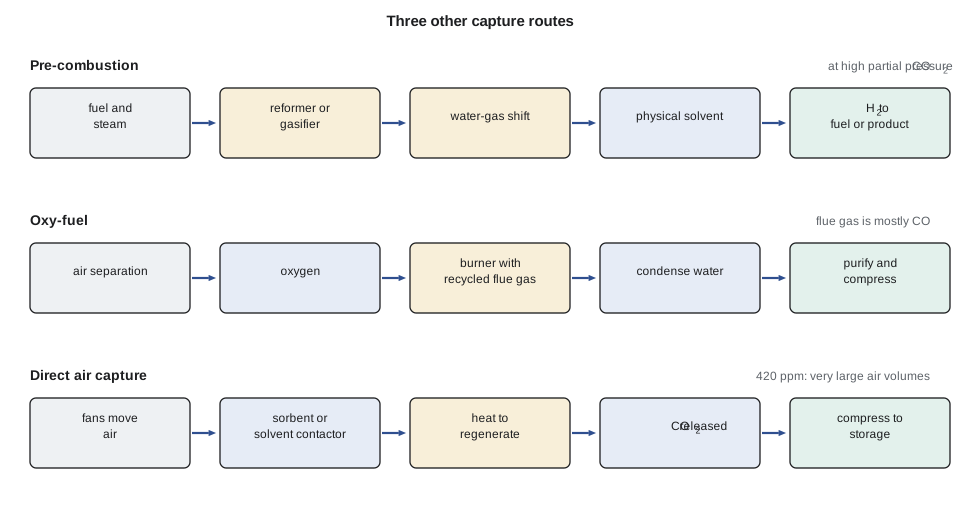
Pre-combustion capture removes carbon before the fuel is burned. Natural gas is reformed, or coal, petroleum coke or biomass is gasified, to make syngas, a mixture of hydrogen and carbon monoxide. A water-gas shift reactor then converts the carbon monoxide:
The shifted syngas contains about 15 to 40 percent CO₂, depending on the feed, at 2 to 7 MPa. Its CO₂ partial pressure is 30 to 50 times that of a flue gas, which allows physical solvents, which dissolve CO₂ in proportion to its partial pressure and release it when the pressure is lowered, with little heat. Selexol (a dimethyl ether of polyethylene glycol) and Rectisol (chilled methanol) are the classic examples, used for decades in gasification and ammonia plants. Amines such as methyldiethanolamine (MDEA), activated with piperazine, are common on reformer syngas. The product is hydrogen, which can be sold, used as a chemical feedstock or burned as a carbon-free fuel.
This is how Quest works: it captures CO₂ from the shifted syngas of three hydrogen manufacturing units at the Scotford upgrader using an activated amine, about 35 percent of the upgrader's direct emissions. The furnace flue gas of a reformer still holds the remaining CO₂. Newer blue hydrogen plants use autothermal reforming instead, in which oxygen and steam react with the gas inside a single reactor without a fired furnace, so nearly all the CO₂ appears in the high-pressure syngas and overall capture rates of 95 percent are possible. The Brazosport hydrogen plant planned to capture its syngas CO₂ first, about 1.2 million metric tons a year, and to study flue gas capture later.
Worked problem
Partial pressure and solvent choice
Shifted syngas at 2.8 MPa contains 18 percent CO₂. Flue gas at 105 kPa contains 12 percent CO₂. Compare the CO₂ partial pressures and explain why the syngas can use a physical solvent.
Show solution
- Syngas: p_CO₂ = 0.18 × 2,800 kPa = 504 kPa.
- Flue gas: p_CO₂ = 0.12 × 10⁵ kPa = 12.6 kPa.
- Ratio = 504 / 12.6 = 40.
Answer: The syngas has 40 times the CO₂ partial pressure. A physical solvent's capacity rises roughly in proportion to partial pressure, so it can carry useful amounts of CO₂ and release them by flashing to lower pressure, without the large heat of reaction of a chemical solvent.
Oxy-fuel combustion
Oxy-fuel combustion burns the fuel in nearly pure oxygen instead of air, with recycled flue gas to control flame temperature. Without nitrogen, the flue gas is mostly CO₂ and water. Condensing the water leaves a stream of 80 to 95 percent CO₂ with oxygen, argon and nitrogen from air leaks and oxygen impurity, which is purified at low temperature and compressed. The energy penalty moves from solvent regeneration to the air separation unit, which separates oxygen from air cryogenically at about 200 kWh per metric ton of oxygen. Burning methane needs two moles of oxygen per mole of CO₂, about 1.45 metric tons of oxygen per metric ton of CO₂, so the air separation unit draws about 290 kWh per metric ton of CO₂ before compression.
Cement is an attractive target for oxy-fuel because about 60 percent of the CO₂ comes from limestone calcination, which needs no oxygen. Only the fuel share needs oxygen, roughly halving the oxygen demand per metric ton of CO₂. Pilot and demonstration work on oxy-fuel kilns has been under way in Europe, and partial oxy-fuel, which applies oxygen to the calciner where most of the CO₂ is released, is a lower-risk route. The difficulty is the kiln itself: air leaks dilute the product, and changing the gas composition changes heat transfer and clinker quality. For the hub, Gwen judged oxy-fuel a credible option for the Sargent gas plant's next kiln rebuild, not for the first phase.
Direct air capture
Direct air capture (DAC) removes CO₂ from ambient air. Because it takes CO₂ already in the atmosphere, storing it counts as carbon removal, which net-zero plans need to offset emissions that cannot be eliminated, such as some from agriculture and aviation. Two families of processes are being commercialized. Liquid solvent systems contact air with a potassium hydroxide solution, precipitate the captured carbon as calcium carbonate, and calcine the carbonate at about 900 °C to release CO₂, usually by burning natural gas in oxygen so that the combustion CO₂ is captured too. Solid sorbent systems pass air over amine-functionalized materials that bind CO₂ at ambient temperature and release it at about 80 to 120 °C, often under vacuum; they can use low-temperature heat from heat pumps or waste heat.
Air holds only 0.042 percent CO₂, so a DAC plant must move very large volumes of air. Capturing a metric ton of CO₂ at 75 percent uptake means contacting about 62 million cubic feet of air. The fans, contactors and land are large, and published energy use is about 5 to 10 GJ per metric ton, roughly 15 times the thermodynamic minimum, with costs well above point-source capture: several hundred US dollars per metric ton in early plants, with targets near 100 to 200 at scale. Climeworks' Orca and Mammoth plants in Iceland began operation in 2021 and 2024, and in the United States 1PointFive's Stratos plant in the Permian Basin was built to capture up to 500,000 metric tons a year. The US 45Q credit pays more per metric ton for DAC than for point-source capture, and Canada's investment tax credit gives its highest rate, 60 percent, to DAC equipment.
For a storage hub, DAC is a potential customer rather than a source to plan around: it can be sited anywhere with low-carbon energy and storage, and a hub with spare capacity is exactly what a DAC developer looks for. Lena asked Ethan to keep 1 to 2 million metric tons a year of headroom in the storage design for that reason.
Other routes and emerging methods
Several other methods are in development or niche use. Membranes separate CO₂ by differences in permeation; they suit high-pressure, high-concentration gas and are used in natural gas processing, but on flue gas they need compression or vacuum and multiple stages. Solid sorbents in pressure or temperature swing beds are used for hydrogen purification and are being scaled for flue gas. Cryogenic separation suits high-concentration streams. Calcium looping uses lime to capture CO₂ and releases it in a calciner, and fits naturally with cement plants because the spent lime can feed the kiln. Bioenergy with CCS (BECCS) captures CO₂ from burning or fermenting biomass; an ethanol plant's fermentation vent, nearly pure CO₂, is the cheapest removal source available, and the Illinois Basin–Decatur project stored exactly that.
| Route | Typical CO₂ partial pressure | Main energy use | Status (mid-2020s) | Fits the hub source |
|---|---|---|---|---|
| Post-combustion amine | 5–30 kPa | steam for solvent regeneration | commercial | Brazos Bend refinery heaters |
| Pre-combustion (syngas) | 300–1,500 kPa | pressure letdown, some heat | commercial in hydrogen and ammonia | Brazosport hydrogen plant |
| Oxy-fuel | near 100% after drying | air separation power | demonstration for cement and power | none in phase 1 |
| Already separated | near 100% | compression only | commercial | Tidewater ammonia plant, Sargent gas plant |
| Direct air capture | 0.04 kPa | heat and power, 5–10 GJ/t | early commercial | future customer |
Common mistakes
MistakeAssuming dilution raises separation work in proportion to dilution.
InsteadMinimum work rises with the logarithm of 1/x; practical cost rises faster because of equipment size and irreversibility.
MistakeCalling a reformer project “95 percent capture” when only the syngas is treated.
InsteadReport capture on the whole facility; a steam methane reformer's furnace flue gas holds about 40 percent of its CO₂.
MistakeCounting DAC stored metric tons as emissions avoided.
InsteadDAC with storage is removal; it offsets emissions elsewhere but does not reduce the source's own.
MistakeForgetting the oxygen impurity in oxy-fuel CO₂.
InsteadOxy-fuel product carries oxygen, argon and nitrogen; purification is needed to meet pipeline limits, especially on oxygen.
Summary and key terms
- The minimum separation work is small and rises with ln(1/x); real plants use several to many times more.
- Pre-combustion capture removes CO₂ from shifted syngas at high partial pressure, allowing physical solvents or activated amines.
- Oxy-fuel burns fuel in oxygen so the flue gas is mostly CO₂; the energy penalty moves to the air separation unit.
- Direct air capture removes atmospheric CO₂; it needs very large air volumes and 5 to 10 GJ per metric ton.
- High-purity streams from gas processing, ammonia and fermentation need only compression and should be captured first.
- Syngas
- A mixture of hydrogen and carbon monoxide made by reforming or gasification.
- Water-gas shift
- The reaction CO + H₂O to CO₂ + H₂, which concentrates carbon as CO₂ in syngas.
- Physical solvent
- A solvent that dissolves CO₂ in proportion to its partial pressure without chemical reaction.
- Oxy-fuel
- Combustion in nearly pure oxygen with flue gas recycle.
- Direct air capture
- Capture of CO₂ from ambient air, a form of carbon removal when the CO₂ is stored.
- BECCS
- Bioenergy with carbon capture and storage.
Practice problems
Work each problem on paper first, then reveal the answer to check.
A syngas at 3.0 MPa contains 16 percent CO₂. What is the CO₂ partial pressure?
Show answer
0.16 × 3,000 = 480 kPa.
Why does oxy-fuel need less oxygen per metric ton of CO₂ for a cement kiln than for a gas boiler?
Show answer
Much of the kiln's CO₂ comes from limestone calcination, which needs no oxygen.
Estimate RT₀ ln(1/x) for air at 420 ppm in GJ per metric ton CO₂ (T₀ = 298 K).
Show answer
8.314 × 298 × ln(2,381) = 19.3 kJ/mol; × 22,700 mol/t = 0.44 GJ/t.
Why might a DAC developer be interested in the hub?
Show answer
DAC can be sited near storage with low-carbon energy; spare permitted storage capacity is its main constraint.
Lesson quiz · 5 questions
Score 60% or more to complete this lesson.
Create a free account to save your progress, take quizzes and earn a certificate.