
PET-460 · Lesson 11 of 12 · 20 min
Regulation, liability and credits in the US
Lena brought in Nadia Brandt, Prairie Crest's regulatory lead, for the meeting Ethan had been dreading. “The rocks will take it,” Nadia said, looking at his capacity charts. “Now tell me who owns the pore space, who approves the wells, who is responsible for the CO₂ in a hundred years, and who pays us. Those four answers decide whether this is a project.” In Texas, she explained, the permit path became shorter in late 2025, but the ownership and long-term liability questions still need careful handling, and the money comes almost entirely from one federal tax credit.
Who owns the pore space
Storage needs the right to use the pore space of a formation. In most US states that have addressed the question by statute or case law, pore space belongs to the surface owner, unless it has been severed. Several states, including North Dakota, Wyoming and Montana, have legislated this directly and created procedures for unitizing a storage area when some owners do not agree, much as oil fields are unitized. In Texas the question has been less settled, so Prairie Crest's lawyers set out to secure storage rights from both surface and mineral owners across the area of review, through leases with payments per acre and per metric ton stored. Storage under state-owned submerged lands in Texas waters is leased by the General Land Office, and offshore federal waters have their own developing framework. Securing pore space from hundreds of owners can take as long as the permit.
Who approves the project
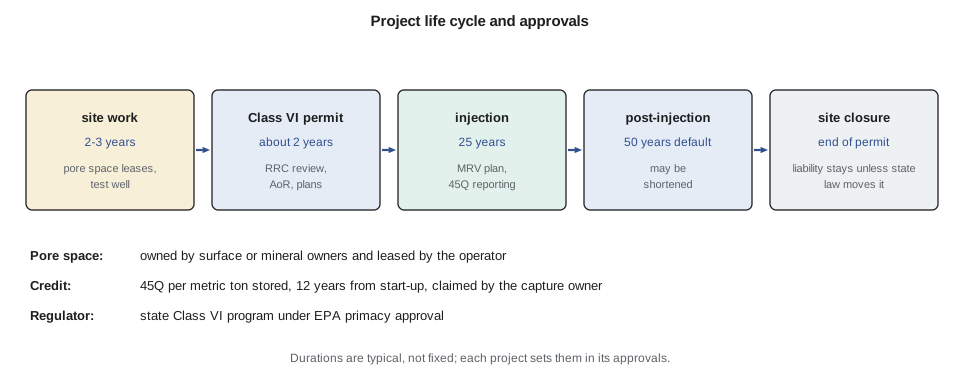
Injection wells in the United States are regulated under the Safe Drinking Water Act's Underground Injection Control program. EPA created a dedicated well class, Class VI, for geologic sequestration in 2010. A Class VI permit requires a detailed site characterization; an area of review delineated by modeling of the plume and pressure front and re-evaluated at least every five years; corrective action on every deficient well in that area; construction with CO₂-compatible materials; testing and monitoring plans; an injection pressure limit below 90 percent of the fracture pressure of the injection zone; emergency and remedial response plans; financial responsibility for corrective action, well plugging, post-injection care and emergency response; and a post-injection site care period, 50 years by default, which can be shortened if the operator shows the plume and pressure are stable. States can take over permitting by obtaining primacy: North Dakota (2018), Wyoming (2020), Louisiana (approved in early 2024), West Virginia and Arizona (2025) and Texas, approved in November 2025, now issue their own Class VI permits; elsewhere EPA does. Louisiana paused new applications in October 2025 to work through a large backlog, a reminder that primacy does not guarantee speed. In Texas, the Railroad Commission permits storage wells, and the hub's application would go there.
Who is responsible in the long term
Liability is the question that most separates storage from oil and gas. An operator is responsible for its wells and for any harm its operations cause, but a storage project's purpose is to leave CO₂ underground indefinitely, long after any company may exist. Regulators handle this with a closure process and, in some jurisdictions, a transfer of long-term responsibility to the state.
Under the federal Class VI rules, the operator remains responsible for the site through the post-injection site care period and until EPA or the primacy state approves site closure; the federal rules do not transfer liability after closure, and the operator remains liable under other laws for any later harm. Several states have changed that for projects they permit. North Dakota, Louisiana and Wyoming, among others, allow ownership of the stored CO₂ and long-term responsibility to pass to the state after a closure period, funded by fees paid during injection. Texas law gives the RRC a storage fund and permitting role, but Prairie Crest's lawyers did not assume any transfer of onshore liability to the state and modeled the hub on the basis that Prairie Crest would carry it, through insurance and reserves.
Worked problem
Financial assurance for closure
The hub must demonstrate financial assurance for plugging its 4 injectors and 6 monitoring wells at about 2.0 million US dollars each, for a post-injection site care period of 50 years at 2 million US dollars a year, and for an emergency and remedial response estimate of 20 million US dollars. Find the undiscounted total.
Show solution
- Plugging = 10 × 2.0 = 20 million.
- Post-injection monitoring = 50 × 2 = 100 million.
- Total = 20 + 100 + 20 = 140 million US dollars.
Answer: About 140 million US dollars, dominated by the long default monitoring period. Showing early that the plume is stable, so that the period can be shortened, is worth a great deal; the instruments can be a trust fund, surety bond, letter of credit or insurance.
Who pays: credits and carbon prices
The United States supports CCS mainly through the section 45Q tax credit, paid per metric ton of CO₂ captured and either stored in secure geologic storage or used. After the 2025 tax law, the credit is 85 US dollars per metric ton for point-source capture with geologic storage and 180 US dollars for direct air capture, with the same amounts now available for CO₂ used in enhanced recovery or converted into products; the amounts are adjusted for inflation from 2027. These full rates require prevailing wage and apprenticeship standards during construction. The credit runs for 12 years from when the capture equipment is placed in service, for projects that begin construction before 2033. It is claimed by the owner of the capture equipment, who can elect to pass it to the party that stores the CO₂, and it can be sold to unrelated taxpayers for cash, which has created a market for credits. Some states add incentives, and voluntary carbon removal buyers pay for direct air capture and bioenergy storage.
# What the policy support is worth per metric ton: Canada's investment tax credit plus a compliance-market credit,
# versus the US 45Q production credit. Illustrative project, 3.0 Mt/yr for 25 years, real discount rate 8%.
SI = False     # True: Canadian hub (ITC + carbon credits), False: US hub (45Q)

rate, years, r = 3.0, 25, 0.08
disc = [1 / (1 + r) ** (t + 1) for t in range(years)]          # operations years 1..25 after a construction year 0
pv_tonnes = sum(rate * d for d in disc)                        # discounted Mt
if SI:
    capex = {"capture (four sources)": 1650.0, "compression and trunk line": 420.0, "storage wells and facilities": 330.0}   # million CAD
    itc = {"capture (four sources)": 0.50, "compression and trunk line": 0.375, "storage wells and facilities": 0.375}
    credit_price, realized = 95.0, 0.70        # headline compliance price per metric ton, and share realized after discounts (illustrative)
    pv_itc = sum(capex[k] * itc[k] for k in capex)     # received at start-up
    pv_cc = sum(rate * credit_price * realized * d for d in disc)
    print("Investment tax credit (full-rate period):")
    for k in capex: print(f"  {k:30s} {capex[k]:7,.0f} M x {itc[k]:.1%} = {capex[k] * itc[k]:6,.0f} M CAD")
    print(f"  total ITC {pv_itc:,.0f} M CAD on {sum(capex.values()):,.0f} M of capital ({pv_itc / sum(capex.values()):.0%})")
    print(f"Compliance credits: {credit_price:.0f} CAD/t x {realized:.0%} realized, PV {pv_cc:,.0f} M CAD")
    print(f"Support per discounted metric ton: ITC {pv_itc / pv_tonnes:.0f} + credits {pv_cc / pv_tonnes:.0f} = {(pv_itc + pv_cc) / pv_tonnes:.0f} CAD/t")
    print("Sensitivity: if the realized credit value falls to 40% of headline, support drops to "
          f"{(pv_itc + pv_cc * 0.40 / realized) / pv_tonnes:.0f} CAD/t.")
else:
    credit, credit_years, infl = 85.0, 12, 0.02     # 45Q per metric ton, credit period, assumed inflation adjustment (nominal)
    pv_45q = sum(rate * credit * (1 + infl) ** t * d for t, d in enumerate(disc[:credit_years]))
    print(f"45Q: {credit:.0f} USD per metric ton for {credit_years} years, inflation-adjusted at an assumed {infl:.0%}/yr")
    print(f"  PV of credits {pv_45q:,.0f} M USD on {pv_tonnes:.1f} discounted Mt")
    print(f"  Support per discounted metric ton over the 25-year project: {pv_45q / pv_tonnes:.0f} USD")
    print(f"  ... over the first 12 years only: {pv_45q / sum(rate * d for d in disc[:credit_years]):.0f} USD")
    print("After year 12 the hub must cover its costs from tariffs alone, so contracts often step up tariffs or end then.")
    for start_delay in (0, 2):
        pv = sum(rate * credit * (1 + infl) ** t * disc[t + start_delay] for t in range(credit_years))
print(f" Start-up delayed {start_delay} years: PV of credits {pv:,.0f} M USD (credit period still 12 years)")45Q: 85 USD per metric ton for 12 years, inflation-adjusted at an assumed 2%/yr PV of credits 2,110 M USD on 32.0 discounted Mt Support per discounted metric ton over the 25-year project: 66 USD ... over the first 12 years only: 93 USD After year 12 the hub must cover its costs from tariffs alone, so contracts often step up tariffs or end then. Start-up delayed 0 years: PV of credits 2,110 M USD (credit period still 12 years) Start-up delayed 2 years: PV of credits 1,809 M USD (credit period still 12 years)
The 45Q credit is worth about 2.1 billion US dollars in present value, about 93 US dollars per discounted metric ton during its 12 years but only 66 averaged over a 25-year project. After year 12 the emitters have no credit, so the hub's tariff contracts must either end then, be priced to cover the later years, or rely on whatever policy exists in the 2040s. A two-year delay in start-up costs about 300 million US dollars of credit value, because the credits arrive later. The support only goes to the emitters that capture; the hub earns its revenue from them through tariffs, the subject of Lesson 12.
Beyond Texas
In Canada, Alberta vested pore space in the Crown in 2010, and its closure framework transfers long-term liability to the province, funded by a per-metric ton levy. Federal support is a refundable investment tax credit of up to 50 percent of capture capital and 37.5 percent of transport and storage capital, combined with provincial carbon pricing. Internationally, the London Protocol to the marine dumping convention was amended to allow sub-seabed storage and, later, export of CO₂ for storage in another country, which European projects such as Northern Lights rely on. The European Union's 2009 directive on geological storage of CO₂ sets a permit and closure framework similar to Alberta's, with liability transfer after at least 20 years, and Norway, the United Kingdom, the Netherlands and Denmark license offshore storage.
The contract chain
Regulation defines who answers to the government; contracts define who answers to whom along the chain. A transport and storage agreement between the hub and each emitter typically covers the reserved capacity and a take-or-pay commitment, so that the hub is paid for capacity it holds even if a source is off line; the CO₂ specification at the delivery point and what happens to off-specification CO₂; the metering point where custody and responsibility pass; outage rules, since an emitter that cannot deliver loses credits and a hub that cannot accept forces venting; and the allocation of credit risk if stored CO₂ is later found to have leaked and credits are recaptured. It also covers who carries the cost of the regulator's closure and post-closure obligations, usually the hub, recovered through the tariff. Nadia's draft term sheet put custody transfer at each source's meter, made the hub responsible for anything that happened downstream of it, and set a tariff with a capacity charge and a smaller charge per metric ton, indexed to inflation. That structure gave the hub the predictable revenue its lenders would want, and gave emitters a clear boundary of responsibility, which their own credit claims required.
Communities and trust
Regulation sets the minimum; acceptance determines whether a project proceeds. Several US pipeline projects in the Midwest have been delayed or canceled after landowners and counties objected to routes and the use of eminent domain, and storage projects have met concerns about groundwater, property values and long-term liability. Projects that succeed tend to engage early, share monitoring data openly, explain risks honestly, offer benefits to the communities that host them and, in many cases, sign community benefit agreements. Prairie Crest planned a community advisory group in Matagorda County before filing the permit.
Common mistakes
MistakeAssuming the surface owner's consent is enough to inject.
InsteadConfirm who owns the pore space under the applicable law and secure it across the whole area the plume will occupy.
MistakeTreating closure as the end of responsibility everywhere.
InsteadCheck whether the jurisdiction transfers liability; under federal US rules the operator remains liable.
MistakeValuing credits at headline prices.
InsteadUse realized credit prices, credit periods and timing; a delayed start or a 12-year limit cuts value sharply.
MistakeEngaging communities after the permit is filed.
InsteadStart engagement at site selection and share monitoring data throughout.
Summary and key terms
- In most US states that have addressed it, pore space belongs to the surface owner; storage rights must be leased or unitized.
- Class VI permits, issued by EPA or primacy states such as Texas since November 2025, cover characterization, area of review, construction, monitoring and financial responsibility.
- The operator stays responsible through post-injection site care (50 years by default) and beyond unless state law transfers liability.
- 45Q pays 85 US dollars per metric ton for point-source storage and 180 for DAC for 12 years, inflation-adjusted from 2027.
- Credits go to the capturing emitter; transport and storage operators earn tariffs.
- Early, honest community engagement is as important as regulatory approval.
- Pore space
- The void space in rock that can hold fluids, including injected CO₂.
- Closure certificate
- In Alberta, the document that ends the operator's obligations and transfers long-term liability to the Crown.
- Class VI well
- The US injection well class for geologic sequestration of CO₂.
- Primacy
- Authority delegated by EPA to a state to run its own injection permitting program.
- Investment tax credit
- A credit paying a share of eligible capital costs, as in Canada's CCUS ITC.
- 45Q
- The US federal tax credit per metric ton of CO₂ captured and stored or used.
Practice problems
Work each problem on paper first, then reveal the answer to check.
Who owns the pore space under a Texas ranch?
Show answer
Most likely the surface owner, though Texas law is less settled, so storage rights are secured from both surface and mineral owners.
For how long can a project claim 45Q?
Show answer
12 years from when the capture equipment is placed in service.
What is the default post-injection site care period under Class VI?
Show answer
50 years, which can be shortened with evidence that the plume and pressure are stable.
Why does a delay in start-up reduce the value of credits even if the credit period is unchanged?
Show answer
The credits arrive later and are worth less when discounted.
Lesson quiz · 5 questions
Score 60% or more to complete this lesson.
Create a free account to save your progress, take quizzes and earn a certificate.