
PET-320 · Lesson 11 of 12 · 19 min
Immiscible displacement and fractional flow
For the Bakken unit, waterflooding is still at the pilot stage across the basin, and the company is watching the results. For the Mission Canyon pool, it is a real option. 'Waterflood design is a whole course on its own, PET-430,' Lena says. 'But the physics starts here: what happens when water pushes oil through rock. If you understand Buckley and Leverett, you understand why some floods recover half the oil and others recover a fifth.'
This lesson develops the theory of immiscible displacement in one dimension: the fractional flow equation, the Buckley-Leverett frontal advance solution and Welge's method for average saturation and recovery. It shows how viscosity, relative permeability and gravity control the efficiency of a waterflood, and how displacement efficiency combines with sweep to give field recovery.
Fractional flow
When water and oil flow together through rock, the fraction of the total flow that is water depends on their relative mobilities. For horizontal flow, neglecting capillary pressure, Darcy's law for each phase gives the fractional flow of water, fw.
Because kro and krw depend on water saturation, so does fw. At the connate water saturation, fw is zero; at the residual oil saturation, it is one. In between, it follows an S-shaped curve. The shape is everything: a curve that rises late and steeply means water displaces oil efficiently; one that rises early means water bypasses oil.
Gravity adds a term in dipping beds. When water is injected down-dip and flows upward, gravity holds the denser water back and makes the displacement more efficient; flowing downward, it does the opposite. Capillary pressure smooths the front slightly. In most field-scale calculations, the viscous terms dominate and the simple form is used, with the gravity term added for dipping reservoirs.
The Buckley-Leverett equation
In 1942, Buckley and Leverett combined fractional flow with conservation of water to describe how a water saturation front moves through a linear system. Each water saturation moves at a velocity proportional to the slope of the fractional flow curve at that saturation.
Taken literally, this gives a physically impossible result for an S-shaped curve: intermediate saturations would travel faster than higher ones and overtake them, giving three saturations at one point. The resolution is a shock: the saturation jumps abruptly from the connate value to a front saturation, Swf, and behind the front it rises gradually toward 1 − Sor. Ahead of the front only oil flows; behind it, both flow.
Welge's tangent construction
Welge showed in 1952 that the front saturation is found by drawing a straight line from the point (Swc, 0) tangent to the fractional flow curve. The tangent point gives Swf and the fractional flow at the front, fwf. Extending the tangent to fw = 1 gives the average water saturation behind the front at breakthrough, Sw,bt.
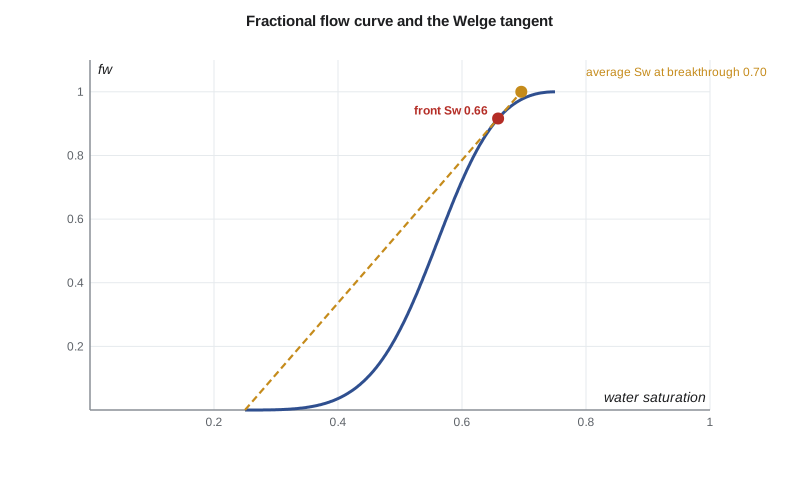
At breakthrough, the pore volumes of water injected equal the reciprocal of the tangent slope, and the oil recovered from the swept region, as a fraction of the oil originally there, is (Sw,bt − Swc)/(1 − Swc). After breakthrough, Welge's equation gives the average saturation in the swept system from the saturation at the outlet, Swe, and the slope of the curve there.
# Buckley-Leverett fractional flow and Welge's tangent for a linear waterflood
SI = False
swc, sor = (0.30, 0.25) if SI else (0.25, 0.25)
krw0, kro0, nw, no = (0.30, 0.85, 3.0, 2.0) if SI else (0.30, 0.80, 3.0, 2.0)
mu_w = 0.45 if SI else 0.50
def fw(sw, mu_o):
    s = min(max((sw - swc) / (1 - swc - sor), 0.0), 1.0)
    krw, kro = krw0 * s ** nw, kro0 * (1 - s) ** no
    if krw == 0: return 0.0
    return 1.0 / (1.0 + (kro / mu_o) / (krw / mu_w))
def dfw(sw, mu_o, h=1e-5): return (fw(sw + h, mu_o) - fw(sw - h, mu_o)) / (2 * h)
def welge(mu_o):
    best, swf = 0.0, swc
    n = 4000
    for i in range(1, n):
        sw = swc + i * (1 - swc - sor) / n
        slope = fw(sw, mu_o) / (sw - swc)
        if slope > best: best, swf = slope, sw
    sw_bt = swc + 1.0 / best                          # average saturation behind the front at breakthrough
    return swf, fw(swf, mu_o), sw_bt, (sw_bt - swc) / (1 - swc), 1.0 / best
for mu_o in ((0.72, 3.0, 10.0) if SI else (0.90, 3.0, 10.0)):
    swf, f, sbt, rbt, pv = welge(mu_o)
    print(f"oil viscosity {mu_o:5.2f}: front Sw {swf:.3f} (fw {f:.2f}), breakthrough after {pv:.2f} pore volumes, recovery {rbt:.0%} of oil in the swept zone")
mu_o = 0.72 if SI else 0.90
print("after breakthrough, for the base oil:")
print("  Sw at outlet   water cut   pore volumes injected   recovery in swept zone")
for swe in (0.68, 0.70, 0.72, 0.74) if SI else (0.66, 0.69, 0.72, 0.745):
    d = dfw(swe, mu_o); sav = swe + (1 - fw(swe, mu_o)) / d
print(f" {swe:.2f} {fw(swe, mu_o):5.1%} {1/d:5.2f} {(sav - swc)/(1 - swc):5.1%}")oil viscosity 0.90: front Sw 0.658 (fw 0.92), breakthrough after 0.45 pore volumes, recovery 59% of oil in the swept zone
oil viscosity 3.00: front Sw 0.583 (fw 0.86), breakthrough after 0.39 pore volumes, recovery 52% of oil in the swept zone
oil viscosity 10.00: front Sw 0.504 (fw 0.80), breakthrough after 0.32 pore volumes, recovery 42% of oil in the swept zone
after breakthrough, for the base oil:
Sw at outlet water cut pore volumes injected recovery in swept zone
0.66 92.0% 0.46 59.6%
0.69 97.0% 0.85 62.1%
0.72 99.4% 2.16 64.5%
0.74 100.0% 16.13 66.3%For the Mission Canyon pool, with light oil of 0.9 cP, water breaks through at a front saturation of about 0.66, after about 0.45 pore volumes of injection, having recovered about 59 percent of the oil in the swept rock. The front is sharp and the water cut jumps to over 90 percent at breakthrough, then the remaining movable oil comes slowly at high water cuts. With a 10 cP oil, breakthrough would come at 0.32 pore volumes with only 42 percent recovered. Light oil and a favorable mobility ratio are the pool's biggest advantages for waterflooding.
What controls displacement efficiency
The shape of the fractional flow curve, and so the displacement efficiency, depends on three groups of properties. Viscosity ratio: the more viscous the oil, the more easily water flows past it, the earlier breakthrough and the lower the recovery at any given volume injected; heavy oil waterfloods recover little. Relative permeability: rock that strongly favors oil flow, typical of water-wet rock with low water relative permeability, gives a more efficient displacement than oil-wet rock, where water flows more easily. Gravity: water injected below oil in a dipping bed, flowing updip, is stabilized by gravity.
The ultimate displacement efficiency is bounded by the residual oil saturation. However many pore volumes of water are injected, the oil trapped at Sor stays behind. Reducing Sor needs a change in the forces that trap it, which is the purpose of chemical and miscible enhanced oil recovery (PET-430).
From displacement to field recovery
Buckley-Leverett describes a linear system in which the water contacts all the rock. In a real reservoir the water does not. Field recovery is the product of displacement efficiency and volumetric sweep efficiency, which itself is the product of areal and vertical sweep.
Areal sweep efficiency is the fraction of the pattern area the water has contacted; it depends on the well pattern and the mobility ratio, and at breakthrough in a five-spot pattern with a mobility ratio near one it is about 70 percent, rising as injection continues. Vertical sweep efficiency is the fraction of the thickness contacted; in layered reservoirs, water races through the high-permeability layers, so the variation of permeability, the Dykstra-Parsons coefficient of PET-250, controls it. Gravity override, where water slumps under the oil, also reduces vertical sweep.
The layered calculation in lesson 9 showed one thin layer carrying three-quarters of the flow capacity in the Mission Canyon pool. That layer will water out long before the others. Ethan estimates field recovery for a waterflood at roughly 0.63 × 0.75 × 0.70, about 33 percent of the oil in place, compared with an estimated 25 percent under the present aquifer support, an incremental 8 percent of 8.5 MMSTB, or about 0.7 MMSTB. 'Now it's worth a proper waterflood study,' Lena says, 'and a simulation model, because that layering is exactly what simple methods handle poorly.'
Other displacements
The same theory applies to gas displacing oil, with gas as the injected phase. Because gas is so much less viscous than oil, the mobility ratio is very unfavorable and immiscible gas displacement in horizontal flow is inefficient, though gravity drainage in thick or steeply dipping reservoirs can make it work well. Miscible gas floods, where the injected gas mixes with the oil and removes the interface, avoid the residual oil trapping and are covered with other enhanced recovery methods in PET-430.
Worked problem
Recovery at breakthrough
A linear waterflood has Swc = 0.25. Welge's tangent touches the fractional flow curve at Swf = 0.60, where fw = 0.85. Find the tangent slope, the pore volumes injected at breakthrough, the average saturation behind the front and the recovery of the oil in the swept region.
Show solution
- Slope = fwf/(Swf − Swc) = 0.85/(0.60 − 0.25) = 0.85/0.35 = 2.43.
- Pore volumes injected at breakthrough = 1/2.43 = 0.41.
- Average saturation behind the front = Swc + 1/slope = 0.25 + 0.41 = 0.66.
- Recovery = (0.66 − 0.25)/(1 − 0.25) = 0.41/0.75 = 0.55, or 55 percent.
Answer: Breakthrough after 0.41 pore volumes, average saturation 0.66, recovery 55 percent of the oil in the swept region.
Voidage replacement and pattern choice
A waterflood is planned to inject enough water to replace the reservoir volume of all fluids produced, a voidage replacement ratio of about one. Injecting less lets pressure fall and gas come out of solution; injecting much more raises pressure toward the fracture gradient and can send water through fractures straight to producers. The volumes come straight from the material balance: the reservoir volume of oil, gas and water withdrawn each month, less any aquifer influx, is the target injection.
Engineers also choose a well pattern. Peripheral floods inject along the edge of a pool, often at the original oil-water contact, and push oil toward producers on the crest; they suit small pools with good permeability. Pattern floods, such as five-spot or line-drive patterns, place injectors among producers and suit larger or tighter pools where water would take too long to cross the field. Horizontal injectors and producers are increasingly used in tight sands, where they improve injectivity and contact more rock.
Before committing to a full flood, operators usually run a pilot in a small part of the pool. A pilot measures injectivity, confirms that water reaches the producers where expected, reveals thief zones and fractures, and gives the real response time. Because it costs a fraction of a full project and reduces most of the uncertainties in this lesson, it is one of the best investments in reservoir engineering.
Monitoring a waterflood
Once injection starts, engineers track it with simple plots that test the theory of this lesson. The water cut of each producer against cumulative injection shows breakthrough timing; the ratio of oil produced to water injected shows efficiency; injection profiles show which layers take water; and the material balance shows whether voidage is being replaced. A plot of the logarithm of the water-oil ratio against cumulative oil often becomes a straight line late in a flood, which engineers extrapolate to an economic water-oil ratio to estimate ultimate waterflood recovery.
Common mistakes
MistakeTaking the Buckley-Leverett solution literally, with three saturations at one point.
InsteadReplace the multi-valued part with a shock found by Welge's tangent.
MistakeDrawing Welge's tangent from the origin.
InsteadDraw it from (Swc, 0), the initial water saturation.
MistakeTreating displacement efficiency as field recovery.
InsteadMultiply by areal and vertical sweep efficiencies.
MistakeExpecting more injection to reduce oil below Sor.
InsteadResidual oil is trapped by capillary forces; it needs EOR methods.
MistakeIgnoring layering when estimating waterflood performance.
InsteadHigh-permeability layers break through early and reduce vertical sweep.
Summary and key terms
- The fractional flow of water depends on relative permeability and viscosity, and follows an S-shaped curve.
- Each saturation travels at a speed proportional to dfw/dSw; an S-shaped curve produces a sharp front.
- Welge's tangent from (Swc, 0) gives the front saturation, the breakthrough time and the average saturation behind the front.
- Viscous oil, oil-wet rock and unfavorable gravity reduce displacement efficiency.
- Field recovery is displacement efficiency times areal and vertical sweep efficiencies.
- Residual oil cannot be displaced by more water alone.
- Fractional flow
- The fraction of the total flowing stream that is water at a given saturation.
- Buckley-Leverett equation
- The frontal advance equation for immiscible displacement in one dimension.
- Shock front
- A sharp jump in saturation at the leading edge of the displacement.
- Welge tangent
- A tangent to the fractional flow curve from the initial saturation, giving the front saturation.
- Displacement efficiency
- The fraction of oil displaced from the rock that the water actually contacts.
- Areal sweep efficiency
- The fraction of pattern area contacted by injected fluid.
- Vertical sweep efficiency
- The fraction of the thickness contacted by injected fluid.
Practice problems
Work each problem on paper first, then reveal the answer to check.
How does increasing oil viscosity change the fractional flow curve?
Show answer
It shifts it to the left: water flows more easily at lower saturation, giving earlier breakthrough.
Why does gravity help when water is injected down-dip and flows updip?
Show answer
The denser water is held back by gravity, slowing water relative to oil and sharpening the front.
Displacement efficiency 0.6, areal sweep 0.7, vertical sweep 0.6. What is recovery?
Show answer
0.6 × 0.7 × 0.6 = 0.25, or 25 percent.
After breakthrough, what does Welge's equation need to give the average saturation?
Show answer
The outlet saturation, the fractional flow there and the slope of the curve there.
Lesson quiz · 5 questions
Score 60% or more to complete this lesson.
Create a free account to save your progress, take quizzes and earn a certificate.