
PET-310 · Lesson 9 of 12 · 19 min
Cementing and zonal isolation
The cementing company's engineer, Priya Sandhu, visits Denver to review the cement program for the 3-22H well with Ethan and Marcus. 'Casing holds pressure,' she says. 'Cement decides where the fluids can go. A good cement sheath keeps gas out of the annulus for the life of the well. A poor one shows up years later as gas at the surface casing vent or a leak into an aquifer, and fixing it then costs far more than doing it right now.'
What primary cement must do
Primary cementing places cement slurry in the annulus between the casing and the hole immediately after the casing is run. The set cement must isolate zones from each other and from surface, so that fluids cannot migrate along the wellbore; support the casing and protect it from corrosive formation fluids; and seal off weak or lost-circulation zones. The cement sheath is part of the well's barrier system for its whole life, through drilling, completion, production and finally abandonment.
Cement and slurry design
Oilwell cements are Portland cements made to API Specification 10A, which defines classes by depth and temperature. Class G and Class H are the most widely used, as basic cements to which additives are added. Slurries are designed for density, thickening time, fluid loss, free water, rheology and compressive strength development, tested to API recommended practice 10B. Additives include accelerators and retarders to control setting time, extenders such as bentonite or fly ash to reduce density and cost, weighting agents, fluid-loss additives, dispersants, lost-circulation materials, and gas-migration additives that help the slurry resist gas entry while it changes from liquid to solid.
A typical job uses two slurries. The lead slurry is light and economical and fills the upper annulus. The tail slurry is denser and stronger and covers the bottom of the casing, the shoe and the productive zone, where isolation matters most. The densities must stay within the mud weight window: heavy enough, with the mud and spacer above them, to control formation pressure while the cement sets, and light enough that the total pressure does not fracture the formation and lose cement.
Volumes
The slurry volume is the annular volume over the planned cement length plus excess to allow for washouts and an uncertain hole size, plus the shoe track: the casing volume between the float collar and the shoe, which is left full of cement. Caliper logs, where run, reduce the uncertainty; otherwise operators use excess percentages from offset experience, often 10 to 30 percent in open hole. The amount of dry cement follows from the slurry yield, the volume of slurry made by one metric ton or one sack of blend.
The displacement volume, the fluid pumped behind the top plug to push the cement out of the casing, equals the casing capacity from surface to the float collar. Accurate displacement matters: too little leaves cement inside the casing; too much over-displaces and leaves the shoe area with poor cement or mud.
The job
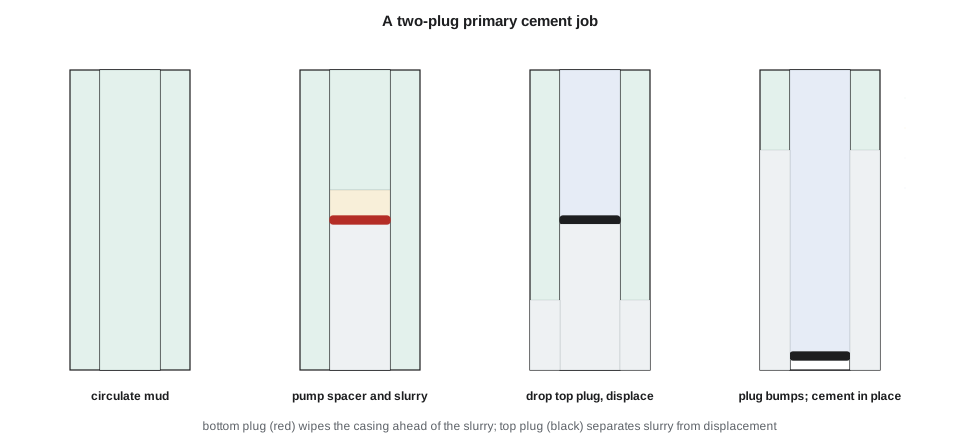
Before cementing, the hole is circulated to condition the mud: lowering its yield point and gel strength and removing cuttings, so the cement can displace it. A spacer or flush is pumped ahead to separate the mud from the cement, which are often chemically incompatible, and to help clean the wall. A bottom plug wipes the mud from inside the casing ahead of the cement and ruptures when it lands on the float collar. The slurry follows, then the top plug, then the displacement fluid. When the top plug lands on the float collar, the pump pressure rises sharply, called bumping the plug, which confirms full displacement. The float valves are checked to make sure they hold, and the cement is left to set, usually for a waiting-on-cement time set by the slurry's strength development.
Getting good displacement
The main cause of poor cement jobs is not the cement itself but incomplete removal of mud, especially on the narrow side of a casing that lies against the low side of a deviated hole. Mud channels left there allow fluids to migrate. Good practice is to centralize the casing for a good standoff, typically at least 70 percent of the ideal annular gap; to condition the mud; to pump spacers with rheology and density that push the mud ahead of them; to pump at the highest rate the fracture gradient allows; and, where possible, to reciprocate or rotate the casing during cementing. Centralizer placement programs use the directional survey and the casing weight to predict standoff along the well.
Pressure during the job
During placement, the annulus contains mud, spacer, lead and tail slurries of different densities, plus the friction from pumping. The bottomhole pressure must stay above the pore pressure, to prevent gas entry, and below the fracture pressure, to avoid losing cement. A pressure simulation of the job checks this at each step. In horizontal wells the heavy tail slurry lies mostly along the flat lateral, where it adds little vertical height, so the equivalent density at the heel is set mostly by the slurries in the vertical and build sections.
# Cement job volumes: slurry volume with excess, cement quantity, displacement and bottomhole pressure check
import math
SI = False
if SI:   # 139.7 mm production casing in 200 mm hole to 3,260 m MD; lead and tail slurries
    md, tvd, hole, od, idc = 3260.0, 1560.0, 0.200, 0.1397, 0.1240
    toc_lead, len_tail, excess = 0.0, 1900.0, 0.20      # lead to surface; tail over the last 1,900 m MD (build and lateral)
    rho_mud, rho_lead, rho_tail, rho_disp = 1150.0, 1500.0, 1900.0, 1000.0
    y_lead, y_tail = 1.20, 0.76                          # slurry yield, m3 per metric ton of blend (illustrative)
    ann = math.pi / 4 * (hole ** 2 - od ** 2)            # m3/m
    cap = math.pi / 4 * idc ** 2
    v_tail = ann * len_tail * (1 + excess); v_lead = ann * (md - len_tail) * (1 + excess)
    print(f"annular capacity {ann:.4f} m3/m; casing capacity {cap:.4f} m3/m")
    print(f"lead slurry {v_lead:.1f} m3 = {v_lead/y_lead:.1f} t of blend; tail slurry {v_tail:.1f} m3 = {v_tail/y_tail:.1f} t")
    v_disp = cap * (md - 25)                             # float collar 25 m above the shoe
    print(f"displacement volume to the float collar {v_disp:.1f} m3 of water")
    # hydrostatic at the end of the job (vertical heights): tail occupies the build and lateral, lead above
    tail_tvd = 1560 - 1388 + 0                           # tail in the build: about 172 m of TVD
    p_ann = 9.81 * (rho_tail * tail_tvd + rho_lead * (tvd - tail_tvd)) / 1000
    print(f"annular pressure at the heel {p_ann:,.0f} kPa = {p_ann*1000/(9.81*tvd):,.0f} kg/m3 equivalent; fracture gradient about 1,600 kg/m3")
else:    # 7 in intermediate casing in 8-3/4 in hole to 10,720 ft MD
    md, tvd, hole, od, idc = 10720.0, 10450.0, 8.75, 7.0, 6.094
    len_lead, len_tail, excess = 6500.0, 2600.0, 0.20     # lead from 1,620 ft (overlap into surface casing) ; tail on the bottom 2,600 ft
    w_mud, w_lead, w_tail, w_disp = 10.2, 12.5, 15.8, 10.2
    y_lead, y_tail = 2.10, 1.18                          # ft3 per sack
    ann = (hole ** 2 - od ** 2) / 1029.4                 # bbl/ft
    cap = idc ** 2 / 1029.4
    v_tail = ann * len_tail * (1 + excess); v_lead = ann * len_lead * (1 + excess)
    print(f"annular capacity {ann:.4f} bbl/ft; casing capacity {cap:.4f} bbl/ft")
    print(f"lead slurry {v_lead:.0f} bbl = {v_lead*5.615/y_lead:,.0f} sacks; tail slurry {v_tail:.0f} bbl = {v_tail*5.615/y_tail:,.0f} sacks")
    v_disp = cap * (md - 80)
    print(f"displacement volume to the float collar {v_disp:.0f} bbl of mud")
    top_cem = md - len_tail - len_lead
    p_ann = 0.052 * (w_tail * 2600 * 0.92 + w_lead * len_lead + w_mud * top_cem)   # tail TVD shortened by the build
print(f"annular pressure at the shoe {p_ann:,.0f} psi = {p_ann/(0.052*tvd):.2f} ppg equivalent; fracture gradient about 14.5 ppg")annular capacity 0.0268 bbl/ft; casing capacity 0.0361 bbl/ft lead slurry 209 bbl = 558 sacks; tail slurry 84 bbl = 398 sacks displacement volume to the float collar 384 bbl of mud annular pressure at the shoe 7,050 psi = 12.97 ppg equivalent; fracture gradient about 14.5 ppg
For the 7 in intermediate casing in 8-3/4 in hole, the annulus holds about 0.027 bbl per foot. With 20 percent excess, the lead slurry needs about 209 bbl (about 560 sacks) and the tail slurry over the bottom 2,600 ft about 84 bbl (about 400 sacks). Displacement to the float collar is about 384 bbl of mud. At the end of the job the shoe sees an equivalent density of about 13.0 ppg, about 1.5 ppg below the estimated fracture gradient of 14.5 ppg, an acceptable margin.
Evaluating the cement
Cement quality is judged first from the job itself: returns at surface, pressures during placement, whether the plug bumped and the floats held. Logs then measure the bond. The cement bond log measures the amplitude of a sonic signal traveling along the casing; well-bonded cement damps it. Variable density displays and ultrasonic tools, which scan the full circumference, give more detail and can find channels. The casing pressure test and, for surface casing, monitoring of the surface casing vent flow show whether isolation holds in practice. Where cement is poor, remedial squeeze cementing forces cement through perforations into the gaps, but it is costly and not always successful.
Regulators, including the the Industrial Commission, require surface casing to be cemented to surface and set requirements for testing and repair when pressure or flow appears on the surface casing annulus, a common long-term well integrity problem.
Worked problem
Slurry volume and sacks
Cement 1,500 ft of annulus between 7 in casing and 8-3/4 in hole with 25 percent excess, plus a 40 ft shoe track inside casing with 6.276 in inside diameter. The slurry yield is 1.18 ft³ per sack. Find the slurry volume and the sacks.
Show solution
- Annulus: (8.75² − 7²)/1,029.4 = 0.02677 bbl/ft; × 1,500 × 1.25 = 50.2 bbl.
- Shoe track: 6.276²/1,029.4 × 40 = 1.53 bbl.
- Total 51.7 bbl = 290.4 ft³; sacks = 290.4/1.18 = 246.
Answer: About 52 bbl of slurry and 246 sacks.
Gas migration while cement sets
As cement slurry sets, it passes through a transition period when it is no longer a liquid that transmits full hydrostatic pressure but is not yet strong enough to resist gas entry. If the pressure the slurry exerts on a gas zone falls below the gas pressure during this period, gas can enter and create channels through the setting cement. Gas-tight slurry designs with short transition times, expanding or compressible additives, and good placement help prevent it. The waiting-on-cement time before the next operation is set from laboratory tests of strength development at the well's temperature.
Plugs and abandonment
Cement is also used for plugs: to isolate a depleted zone, to provide a base for a sidetrack, to cure severe losses, and finally to abandon the well. Abandonment plugs restore the natural barriers the well penetrated and must remain effective for an indefinitely long time. Regulators set rules for the number, length and placement of abandonment plugs and for testing them. Designing a well with good primary cement makes its eventual abandonment simpler and cheaper, because sound annular cement across the key formations does not need to be repaired first.
Cementing in horizontal wells
Horizontal wells add difficulties. The casing tends to lie on the low side, so centralization is harder and the narrow side is where mud channels form. Cuttings beds left in the lateral can be picked up by the cement and spacer, contaminating them. Free water separating from the slurry can collect along the high side and form a channel. Slurries for laterals are therefore designed for zero free water and stable rheology, the hole is cleaned thoroughly before running casing, and rotating or reciprocating the casing during the job is especially valuable. Some operators use swellable packers or other mechanical isolation in the lateral instead of, or in addition to, cement.
Common mistakes
MistakeBlaming poor bonds on the cement blend first.
InsteadLook first at mud removal, centralization and pump rate.
MistakeForgetting the shoe track volume.
InsteadAdd the casing volume between the float collar and the shoe.
MistakeOver-displacing to be safe.
InsteadDisplace to the calculated volume and confirm with the plug bump.
MistakeIgnoring the fracture gradient during placement.
InsteadSimulate the job pressures; adjust densities and rates to stay within the window.
Summary and key terms
- Primary cement isolates zones, supports and protects the casing, and is part of the well's lifelong barrier system.
- API 10A Class G and H cements with additives give the required density, setting time, fluid loss and strength; lead and tail slurries are common.
- Slurry volume is the annular volume with excess plus the shoe track; displacement is the casing capacity to the float collar.
- Mud removal through conditioning, spacers, centralization, high rate and pipe movement is the key to good cement.
- Job records, bond logs, pressure tests and vent monitoring evaluate isolation; squeezes repair it at higher cost.
- Primary cementing
- Placing cement in the annulus right after running casing.
- Lead slurry
- The lighter cement slurry pumped first to fill the upper annulus.
- Tail slurry
- The denser, stronger slurry placed at the bottom of the casing.
- Shoe track
- The casing between the float collar and the shoe, left full of cement.
- Spacer
- A fluid pumped between the mud and cement to separate and clean.
- Standoff
- The distance of the casing from the hole wall, as a percentage of the ideal gap.
- Cement bond log
- A sonic log that measures how well cement is bonded to the casing.
- Squeeze cementing
- Forcing cement under pressure into gaps behind the casing to repair isolation.
Practice problems
Work each problem on paper first, then reveal the answer to check.
Why is mud conditioned before cementing?
Show answer
Lower gels and yield point make the mud easier to displace, preventing channels.
What confirms that the displacement is complete?
Show answer
The pressure rise when the top plug bumps on the float collar.
Why can heavy tail slurry in a lateral add little to the heel pressure?
Show answer
Most of it lies along the near-horizontal section, adding measured length but little vertical height.
Name two signs of a long-term cement isolation problem.
Show answer
Pressure or flow at the surface casing vent, or gas migration found by testing.
Lesson quiz · 5 questions
Score 60% or more to complete this lesson.
Create a free account to save your progress, take quizzes and earn a certificate.