
PET-310 · Lesson 12 of 12 · 19 min
The drilling program: capstone
With every section reviewed, Marcus asks Ethan to write the full drilling program for the 3-22H well and present it at the 'drill the well on paper' meeting with the rig contractor, the mud, cementing and directional companies and the wellsite supervisors. 'Write it so the night supervisor can run the well from it without phoning you,' Marcus says. 'Then we'll take it apart together and see if it still stands up.'
What a drilling program contains
A drilling program is the operator's instruction to everyone who will work on the well. Its usual contents are: well data and objectives; the location, surface and bottomhole coordinates and the directional plan with anti-collision results; the geological prognosis with formation tops, hazards and the pressure profile; the casing and cementing program; the mud program by section; the bit and BHA program; the hydraulics and hole cleaning plan; the well control plan with BOP requirements, test pressures, kick tolerance and kill sheet data; the logging, survey and data acquisition plan; special procedures such as for sour zones or losses; the time and cost estimate; and contacts and regulatory approvals. Each section draws on one lesson of this course.
Section by section
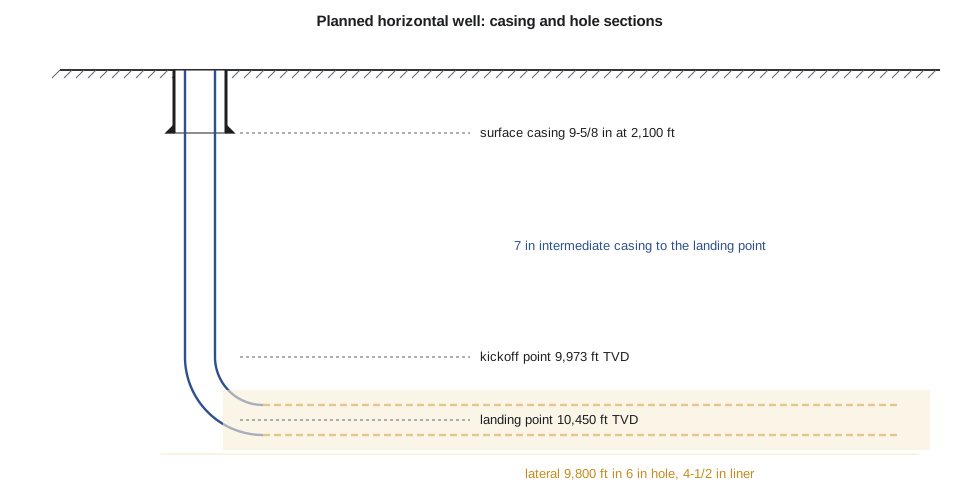
Surface hole: drill 13-1/2 in hole to about 2,100 ft with fresh water at about 8.8 ppg, run 9-5/8 in 36 lb/ft J-55 surface casing below the freshwater aquifers, cement to surface, install and test the BOP stack, then drill out and run a leak-off test, expected to reach about 15.8 ppg.
Intermediate hole: drill 8-3/4 in hole to the kickoff point at about 9,973 ft with invert oil-based mud at about 10.2 ppg through the salts; build at 12 degrees per 100 ft to land in the middle Bakken at 10,450 ft TVD; run a combination string of 7 in 29 and 32 lb/ft P-110, with 32 lb/ft across the salt, and cement it with lead and tail slurries.
Lateral: drill the 6 in lateral 9,800 ft with saltwater-based fluid using a rotary steerable tool and gamma ray geosteering, keeping flow rate and rotation high for hole cleaning, then run a 4-1/2 in liner for the completion, checked by torque and drag for reach.
Time and cost
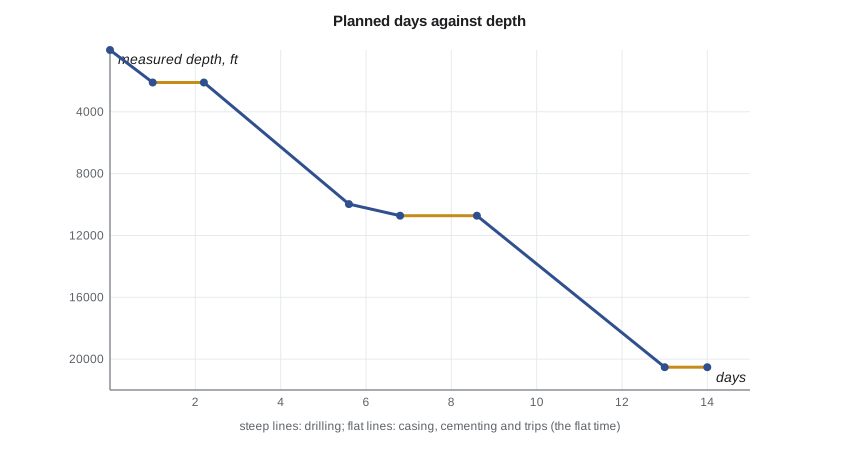
The time-depth curve shows the plan at a glance: drilling segments slope downward, flat segments show casing, cementing, testing and trips. During drilling, the actual curve is plotted against it every day, which shows immediately when the well is ahead or behind. Comparing time-depth curves across a field's wells shows where the best crews and practices save time, and which sections deserve engineering attention.
Bit selection and drilling parameters are judged economically by the cost per unit length drilled, which combines the bit's price, the rig's spread cost and the trip time. A more expensive bit that drills farther or faster often gives a lower cost per meter or per foot.
Here Cb is the bit cost, Cr the rig and spread cost per hour, td the drilling time, tt the trip time and ΔD the length drilled.
# Drilling cost per unit length for a bit run, and the time-depth (days against depth) curve of the plan
SI = False
rig = 38000 / 24 if SI else 52000 / 24                       # rig and spread cost per hour
bits = [("PDC A", 18000 if SI else 26000, 34.0, 1.0, 1300 if SI else 7600),     # name, bit cost, drilling hours, ROP decline factor, footage
        ("PDC B", 24000 if SI else 34000, 26.0, 1.0, 1250 if SI else 7300)]
trip = (3260 / 300 if SI else 20500 / 1000) * 1.0             # round-trip hours: about 1 h per 300 m (1,000 ft) each way
for name, B, t, _, F in bits:
    cpf = (B + rig * (t + trip)) / F
    print(f"{name}: cost {cpf:,.0f} per meter" if SI else f"{name}: cost {cpf:,.0f} per foot")
# time-depth curve from the well plan (days, depth)
if SI:
    plan = [(0, 0), (0.6, 210), (1.4, 210), (2.8, 1388), (3.6, 1658), (4.1, 1658), (5.4, 3260), (6.2, 3260)]
    unit = "m"
else:
    plan = [(0, 0), (1.0, 2100), (2.2, 2100), (5.6, 9973), (6.8, 10723), (8.6, 10723), (13.0, 20523), (14.0, 20523)]
    unit = "ft"
for (d1, z1), (d2, z2) in zip(plan, plan[1:]):
    what = "drilling" if z2 > z1 else "casing, cementing or trips"
    rate = (z2 - z1) / (d2 - d1) if z2 > z1 else 0
print(f"day {d1:4.1f}-{d2:4.1f}: {z1:6,.0f} to {z2:6,.0f} {unit} {what}" + (f", {rate:,.0f} {unit}/day" if rate else ""))PDC A: cost 19 per foot PDC B: cost 18 per foot day 0.0- 1.0: 0 to 2,100 ft drilling, 2,100 ft/day day 1.0- 2.2: 2,100 to 2,100 ft casing, cementing or trips day 2.2- 5.6: 2,100 to 9,973 ft drilling, 2,316 ft/day day 5.6- 6.8: 9,973 to 10,723 ft drilling, 625 ft/day day 6.8- 8.6: 10,723 to 10,723 ft casing, cementing or trips day 8.6-13.0: 10,723 to 20,523 ft drilling, 2,227 ft/day day 13.0-14.0: 20,523 to 20,523 ft casing, cementing or trips
In the lateral, the more expensive bit B costs slightly less per foot than bit A because it drills nearly as far in eight fewer hours. The plan shows about 14 days from spud to rig release, consistent with the lesson 1 estimate once casing and cementing time is laid out section by section. Ethan's AFE comes to about 2.6 million US dollars, which Marcus says leaves little room for a lost-circulation or stuck-pipe event: the risk register must show how those risks are being reduced.
Risk register
The program ends with a risk register: each credible hazard with its likelihood, consequence, prevention and response. Typical entries for a horizontal well include: kick in the build or lateral, with kick tolerance and detection practices; lost circulation at the shoe or in fractured zones, with ECD limits and LCM on site; differential sticking in depleted zones, with mud density and pipe movement rules; shale instability, with mud chemistry and weight; collision with offset wells, with separation factors and gyro surveys; failure to get casing to bottom, with torque and drag results and floating plans; poor cement, with centralization and displacement design; and H₂S where present. Each line names who is responsible and what triggers the response.
The review
At the review, the rig contractor's toolpush asks for clearer tripping speed limits in the lateral; Rosa questions whether the reduced lateral mud density still supports the shale above the target and agrees to run a stability check; the directional driller notes that one offset well on the pad comes within the warning separation zone at the kickoff point and proposes a gyro survey there; and the cementing engineer confirms the lighter lead slurry. Ethan updates the program, and Marcus signs it. 'Now it's a promise we can keep,' he says. 'And when we're drilling, we'll compare the real numbers to every one of these every day.'
After the well, a post-well review compares actual and planned time, cost, mud, hydraulics, surveys and problems, and the lessons go into the next well's program. On a pad of many wells, this learning curve is what makes each well faster and cheaper than the last.
Professional responsibility
The drilling program is engineering work prepared under the supervision of experienced engineers; state licensing of professional engineers applies to engineering practice, and the operator remains accountable to the the Industrial Commission for the well. Ethan, as an engineer-in-training, prepares the work under Marcus's supervision, and Marcus signs it.
Worked problem
Cost per unit length for two bits
Bit A costs 22,000 dollars and drills 3,000 ft in 30 hours; bit B costs 30,000 dollars and drills 3,300 ft in 26 hours. The spread rate is 2,200 dollars per hour and the round trip takes 12 hours. Which bit is cheaper per foot?
Show solution
- A: (22,000 + 2,200 × (30 + 12))/3,000 = (22,000 + 92,400)/3,000 = 38.1 dollars per foot.
- B: (30,000 + 2,200 × (26 + 12))/3,300 = (30,000 + 83,600)/3,300 = 34.4 dollars per foot.
Answer: Bit B, at about 34 dollars per foot against 38.
Writing for the crew
Ethan learns that a good program is short where it can be and exact where it must be. Each section begins with a one-page summary: depths, hole and casing sizes, mud type and density range, key hazards and their responses, and the main limits, such as maximum ECD, MAASP, tripping speeds and casing running speeds. The details follow for those who need them. Numbers are given in the units the rig uses, with conversions where the service companies use other units. Every limit has an action attached: what to do, and whom to call, if it is reached.
Marcus reviews the draft for consistency. The mud density in the mud program must match the kill sheet and the casing collapse design; the flow rate in the hydraulics plan must be within the pump envelope and give an ECD below the fracture gradient; the centralizer program must use the same survey as the anti-collision report. Ethan finds two inconsistencies: the cement simulation used the old lead slurry density, and the torque and drag model used a casing weight from the first casing design. He corrects both.
Measuring performance
During drilling, performance is measured against the plan with a small set of indicators: days per 1,000 m or per 1,000 ft, rate of penetration by section, flat time by operation, nonproductive time by cause, cost against the AFE, and safety indicators such as recordable incidents and well control events. Plotted across the wells of a pad or a field, these indicators show which practices improve results. A drilling engineer's career is built as much on this steady improvement as on solving the occasional dramatic problem.
The 3-22H well is scheduled to spud in six weeks. Ethan's last task before then is to brief the night wellsite supervisor on the program, section by section, with the summary pages in hand. The supervisor's questions are practical: where the tight spots were in the offset wells, what the trip tank volumes should read when pulling out of the lateral, and when to call Marcus. Ethan finds that he can answer each one from the program, which is exactly what Marcus intended.
Beyond this well
The skills in this course carry over to other wells: offshore wells with larger, more complex BOP systems and subsea wellheads, geothermal wells with high temperatures and hard rock, carbon storage wells that must keep injected carbon dioxide isolated for very long periods, and wells for the hydrogen and helium industries. The principles are the same in each: understand the pressures, keep two barriers, design the tubulars and cement for the worst credible loads, plan the trajectory and hydraulics, prepare for problems and measure the results. PET-330 picks up the well where this course leaves it: at the completion.
Sustainability in drilling
Operators increasingly measure the environmental footprint of drilling. Rigs powered from the grid or by natural gas and batteries emit less than diesel rigs; fewer rig days mean less fuel; pad drilling reduces land disturbance, roads and truck traffic; and mud reuse and good solids control cut waste. The drilling engineer's choices on rig specification, well design and practices therefore affect emissions as well as cost. Ethan adds an estimate of fuel use and emissions to the 3-22H well program, using the planned days and the rig's power system, so that the actual figures can be compared after the well.
Well integrity is part of sustainability too. A well whose casing and cement keep fluids in place throughout its life, and which can be abandoned cleanly at the end, protects groundwater and avoids methane leaks for decades. That long view is the final reason Marcus insists that every number in the program is checked twice.
Common mistakes
MistakeWriting the program for engineers only.
InsteadWrite it so the rig crew and supervisors can execute it: clear numbers, limits and actions.
MistakeChoosing bits by price alone.
InsteadCompare cost per unit length including rig time and trips.
MistakeLeaving risks as general statements.
InsteadGive each risk a prevention, a trigger and a named response.
MistakeSkipping the post-well review.
InsteadFeed actual results into the next well's plan.
Summary and key terms
- A drilling program sets out the well's design, mud, casing, cement, directional, hydraulics, well control, time, cost and risks.
- Each section of the program applies a lesson of this course to the specific well.
- Time-depth curves and cost per unit length track and optimize performance.
- A risk register links each hazard to prevention, triggers and responses.
- Reviews before and after the well turn experience into better plans.
- Drilling program
- The operator's written plan and instructions for drilling a well.
- Time-depth curve
- A plot of depth against days for a well, planned and actual.
- Cost per unit length
- Bit and rig costs divided by the length drilled in a bit run.
- Risk register
- A table of hazards with likelihood, consequence, prevention and response.
- Post-well review
- A comparison of planned and actual results after the well is finished.
- Learning curve
- The reduction in time and cost per well as experience accumulates.
Practice problems
Work each problem on paper first, then reveal the answer to check.
Name six sections of a typical drilling program.
Show answer
Any six of: well data, directional plan, geological prognosis, pressure profile, casing and cement, mud, bits and BHA, hydraulics, well control, logging, special procedures, time and cost, risks.
What does a flat segment on a time-depth curve represent?
Show answer
Time spent without drilling new hole: casing, cementing, testing, trips or problems.
Why might a more expensive bit be the better choice?
Show answer
If it drills farther or faster, saving rig time and trips, its cost per unit length is lower.
What should each risk register entry include?
Show answer
The hazard, likelihood, consequence, prevention measures, trigger and response, and who is responsible.
Lesson quiz · 5 questions
Score 60% or more to complete this lesson.
Create a free account to save your progress, take quizzes and earn a certificate.