
PET-310 · Lesson 8 of 12 · 19 min
Casing design
Casing is the most expensive single item on the 3-22H well's AFE after the rig itself. 'Every pound per foot we can safely leave out saves money on every well we drill here,' Marcus says, 'and every pound we leave out that we should have kept can cost us the well.' He gives Ethan the load cases for the 7 in intermediate casing and asks him to pick the weight and grade.
Casing strings and their jobs
Each casing string has a purpose. Conductor pipe, set shallow, supports unconsolidated surface soils and carries the flowline. Surface casing protects freshwater aquifers, provides a strong shoe for drilling the next section, and supports the wellhead and BOP stack. Intermediate casing isolates troublesome zones, such as salts, unstable shales, lost-circulation zones or pressures that would conflict with the next section's mud weight. Production casing, or a liner hung from the previous string, carries the completion and isolates the reservoir. A liner does not reach surface; it is hung from the bottom of the previous casing, saving steel, and can later be tied back to surface if needed.
In North Dakota the the Industrial Commission's casing and cementing rule requires surface casing to protect freshwater zones, and in the Williston Basin operators set it below the shallow aquifers. For the 3-22H well, the 7 in intermediate string isolates the salts and shales above the Bakken, and the 4-1/2 in liner in the lateral carries the completion.
Pipe properties and API standards
Casing is made to API Specification 5CT (ISO 11960), which defines sizes, weights, steel grades, connections and testing. The grade gives the minimum yield strength in thousands of psi: J-55 and K-55 have a minimum yield of 55,000 psi (379 MPa), L-80 has 80,000 psi (552 MPa) with controlled hardness for sour service, N-80 has 80,000 psi without that control, and P-110 has 110,000 psi (758 MPa). For a given outside diameter, higher weight per unit length means a thicker wall and higher strengths. The performance properties, minimum burst (internal yield) pressure, collapse pressure and tensile strength of the body and connection, are calculated with the formulas of API TR 5C3 (ISO/TR 10400) and tabulated by manufacturers.
Connections matter as much as the pipe body. API round-thread and buttress connections are common in land wells; premium connections with metal-to-metal seals are used where gas-tightness, high torque for rotating casing, or high loads demand it. A connection may be weaker in tension than the pipe body, so the joint strength is often the limiting tension rating.
Load cases
Casing design checks the pipe against the worst credible loads during its life, each with a design factor: the ratio of rated strength to load that must be met. Three basic loads are checked at every depth.
Burst occurs when internal pressure exceeds external pressure by more than the burst rating. A common design case for intermediate and production casing is a gas kick or a gas-filled well: the casing is filled with gas from the reservoir to surface, so the internal pressure at the top equals the reservoir pressure less the weight of a light gas column. Outside, a backup pressure from formation fluid or degraded mud is assumed. For production casing, the completion loads, especially pressure testing and hydraulic fracturing down the casing, often govern, which is why the completions team signs off the production casing design (PET-330).
Collapse occurs when external pressure exceeds internal pressure by more than the collapse rating. The design case is often full or partial evacuation: the casing is empty (for example during lost circulation, or late in the well's life when the reservoir is depleted and the casing is pumped down) while the mud or formation pressure acts outside. Salt and some shales creep and can load casing beyond the mud pressure, so collapse design in salt uses higher loads.
Tension comes mainly from the weight of the string itself, greatest at the top, plus extra loads from overpull if the casing sticks, from bending in curves and from pressure testing. Tension is usually checked on the buoyed weight with an overpull margin, or on the air weight with a higher design factor, as a simple screening method.
Typical design factors are about 1.1 for burst, 1.0 to 1.125 for collapse and 1.6 to 1.8 for tension on air weight, but each operator sets its own in a design standard. Tension also reduces collapse resistance, because the axial stress combines with the hoop stress; full designs use a biaxial correction, and modern tubular design uses triaxial (von Mises) checks.
Designing the string
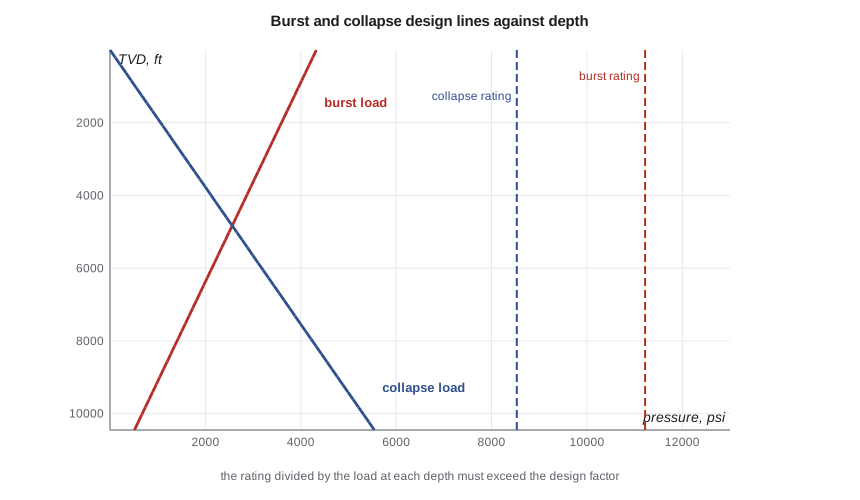
Graphical design plots each load against depth with the design factor applied, then chooses the lightest pipe that meets all loads at each depth. In deep wells a combination string is used: heavier or stronger pipe where collapse loads are greatest near the bottom and where burst loads are greatest near the top, lighter pipe in between, with tension checked from the bottom up because each section must carry the sections below it. In shallow wells such as many Bakken horizontals, a single weight and grade is usually simpler and cheaper overall.
# Casing design check: burst, collapse and tension with design factors (ratings approximate, from API-style tables)
SI = False
if SI:   # 139.7 mm production casing to the Cardium, two candidate weights and grades
    tvd, md, mw, pp = 1560 / 0.3048, 3260 / 0.3048, 1150 / 119.826, 9.03 * 1560 / 6.894757
    cands = [("139.7 mm 23.07 kg/m J-55", 15.5, 4810, 4040, 248000), ("139.7 mm 25.30 kg/m L-80", 17.0, 7740, 6290, 397000)]
else:    # 7 in intermediate casing to the landing point
    tvd, md, mw, pp = 10450.0, 10720.0, 10.2, 0.514 * 10450
    cands = [("7 in 29 lb/ft P-110", 29.0, 11220, 8530, 929000), ("7 in 32 lb/ft P-110", 32.0, 12460, 10780, 1025000)]
DFb, DFc, DFt = 1.10, 1.125, 1.60
gas, back = 0.10, 0.465                      # gas gradient inside, backup gradient outside (psi/ft)
burst_surf = pp - gas * tvd                  # gas to surface: maximum internal pressure at the top, no backup there
collapse = 0.052 * mw * tvd                  # full evacuation with mud outside
bf = 1 - mw / 65.5
k = 6.894757 if SI else 1.0; un = "kPa" if SI else "psi"
print(f"design loads: burst at the top {burst_surf*k:,.0f} {un}, collapse at the bottom {collapse*k:,.0f} {un}")
for name, w, rb, rc, rt in cands:
    tens = w * md * bf + 100000             # buoyed weight plus 100,000 lb of overpull, hanging the full measured length
    sb, sc, st = rb / burst_surf, rc / collapse, rt / (w * md)
    ok = all([sb >= DFb, sc >= DFc, st >= DFt, rt / tens >= 1.3])
print(f"{name}: burst SF {sb:.2f} (need {DFb}), collapse SF {sc:.2f} (need {DFc}), tension SF on air weight {st:.2f} (need {DFt}), with overpull {rt/tens:.2f} -> {'passes' if ok else 'fails'}")design loads: burst at the top 4,326 psi, collapse at the bottom 5,543 psi 7 in 29 lb/ft P-110: burst SF 2.59 (need 1.1), collapse SF 1.54 (need 1.125), tension SF on air weight 2.99 (need 1.6), with overpull 2.56 -> passes 7 in 32 lb/ft P-110: burst SF 2.88 (need 1.1), collapse SF 1.94 (need 1.125), tension SF on air weight 2.99 (need 1.6), with overpull 2.63 -> passes
For the 7 in intermediate casing, the gas-to-surface burst load at the top is about 4,330 psi and the full evacuation collapse load at the landing point is about 5,540 psi. Both 29 and 32 lb/ft P-110 pass the simple checks with margin. Marcus chooses 32 lb/ft anyway for the interval through the salts, where creeping salt can load the casing well above the mud pressure, and keeps 29 lb/ft above it, a combination string common in the basin.
Running casing
Casing is run with floating equipment at the bottom, a guide shoe and a float collar with check valves that stop cement from flowing back, and with centralizers to keep it off the low side of the hole (lesson 9). In horizontal wells the casing must be pushed along the lateral against friction, and torque and drag models (lesson 11) check that it can reach bottom; casing can be floated, partly filled with air or light fluid to reduce its weight in the lateral, or rotated while running. Connections are made up to the specified torque and, for premium connections, checked against the torque-turn curve. Running speed is limited to control surge pressures on weak formations.
Corrosion and sour service
Where hydrogen sulfide is present, high-strength steels can suffer sulfide stress cracking, a brittle failure at loads below the rated strength. Sour service grades such as L-80 and C-90 have controlled hardness and chemistry to resist it, and NACE MR0175/ISO 15156 sets the requirements. Carbon dioxide and produced water also cause corrosion over the well's life, which is part of the reason for corrosion allowances, inhibitors and periodic integrity logging.
Worked problem
Collapse safety factor for full evacuation
Casing set at 8,000 ft TVD has 10.5 ppg mud outside and is fully evacuated. Its collapse rating is 5,400 psi. Find the collapse load at the bottom and the safety factor.
Show solution
- Collapse load = 0.052 × 10.5 × 8,000 = 4,368 psi.
- Safety factor = 5,400/4,368 = 1.24.
Answer: Load about 4,370 psi, safety factor 1.24, above a typical 1.125 design factor.
Setting depths and the casing program table
The casing program in the drilling program is usually a single table: for each string, the hole size, the casing size, weight, grade and connection, the setting depth in both measured and true vertical depth, the top of cement, the design factors achieved for burst, collapse and tension, and the test pressure. The test pressure is chosen to prove the casing and its connections against the highest load expected before the next string is set, without exceeding the burst rating with its design factor. Writing it this way makes it easy for the wellsite supervisor to check each string as it is run and for the regulator to review the design.
Casing wear is another consideration in long wells. While drilling below a casing string, the rotating drill pipe wears a groove into the inside of the casing, especially at doglegs. Wear reduces the burst and collapse strength. Operators estimate wear from the time spent rotating and the side forces from torque and drag models, use hardbanding on tool joints that is kind to casing, and in critical wells run calipers to measure the remaining wall before relying on the casing for later loads, such as fracturing.
Thermal and completion loads
Temperature changes load the casing too. Cold fluid pumped during a fracture treatment shrinks the casing and adds tension, while hot production fluids expand trapped annular fluid and can raise the pressure in sealed annuli, a load called annular pressure build-up that is important in offshore wells. Hydraulic fracturing adds very high internal pressure for hours at a time, which is why the completions engineer checks the production casing burst rating against the planned treating pressure with its own design factor. These loads are analyzed with tubular design software that combines them with the drilling loads in a triaxial check.
Wellheads and casing hangers
Each casing string is hung at surface in the wellhead, either on slips or on a mandrel hanger, and sealed with packoffs that are pressure tested. The wellhead's working pressure rating must exceed the maximum anticipated surface pressure for every phase, including fracturing. On pads, multi-bowl wellheads let several strings be landed without removing the BOP stack, saving rig time. The wellhead design is part of the casing program and is chosen with the completion team, since the same wellhead will carry the frac tree and later the production tree.
Common mistakes
MistakeDesigning for burst with mud inside the casing only.
InsteadConsider gas to surface, pressure tests and completion pressures.
MistakeIgnoring tension's effect on collapse resistance.
InsteadApply a biaxial or triaxial correction where tension is significant.
MistakeUsing the pipe body tensile rating when the connection is weaker.
InsteadUse the lower of body and joint strengths.
MistakeChoosing high-strength grades in sour service without checking.
InsteadUse sour-service grades meeting NACE MR0175/ISO 15156.
Summary and key terms
- Conductor, surface, intermediate and production casing or liners each have a purpose; casing points come from the pressure profile.
- API 5CT defines grades; API TR 5C3 gives formulas for burst, collapse and tension ratings.
- Burst, collapse and tension are checked at every depth against the worst credible loads with design factors.
- Gas to surface and completion pressures govern burst; evacuation and salt govern collapse; string weight and overpull govern tension.
- Running procedures, centralization, floating, connections and sour service complete the design.
- Burst
- Failure from internal pressure exceeding external pressure.
- Collapse
- Failure from external pressure exceeding internal pressure.
- Design factor
- The required minimum ratio of rated strength to load.
- Liner
- A casing string hung from the bottom of the previous string instead of reaching surface.
- Float collar
- A collar near the bottom of the casing with check valves that prevent cement backflow.
- Combination string
- A casing string made of different weights or grades at different depths.
- Sulfide stress cracking
- Brittle cracking of high-strength steel in hydrogen sulfide environments.
Practice problems
Work each problem on paper first, then reveal the answer to check.
Why is surface casing set before drilling deeper?
Show answer
To protect groundwater, give a strong shoe for the next section and support the BOP stack.
Casing with a burst rating of 7,000 psi sees a burst load of 6,000 psi. Does it meet a design factor of 1.1?
Show answer
7,000/6,000 = 1.17, which is more than 1.1, so yes.
Why might long horizontal wells need casing floated or rotated while running?
Show answer
Friction in the lateral may stop the casing reaching bottom; floating reduces weight on the low side and rotation reduces drag.
What does the grade L-80 tell you?
Show answer
A minimum yield of 80,000 psi with hardness control suitable for sour service.
Lesson quiz · 5 questions
Score 60% or more to complete this lesson.
Create a free account to save your progress, take quizzes and earn a certificate.