
PET-310 · Lesson 2 of 12 · 20 min
Rig systems
Before he can judge a drilling plan, Ethan needs to understand the machine that will carry it out. Marcus takes him to Watford City, where the rig contracted for the 3-22H well is finishing a well on another pad. The rig is a pad-capable land rig that can 'walk' a few meters between wells on the same pad without being taken apart. On the drive, Marcus lists what they will look at: 'Five systems. Hoisting lifts the pipe. Rotating turns the bit. Circulating moves the mud. Power drives everything. Well control keeps the well shut in when we need it. If you can say what each system's limit is, you can tell whether a rig can drill our well.'
The five systems
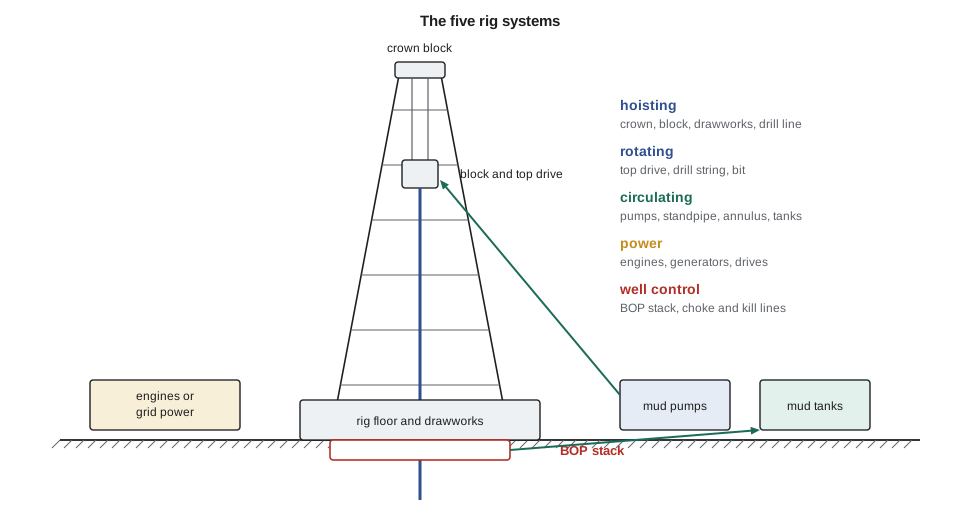
Every rotary rig, from a small shallow-well rig to an offshore drillship, has the same five systems. They differ in size and automation, and a drilling engineer selects a rig by checking that each system can meet the loads of the planned well with a margin. The usual rating figures are hook load capacity, mast height and setback capacity, drawworks power, top drive torque and speed, pump pressure and flow rate, mud tank volume, and the pressure rating of the blowout preventer stack.
Hoisting
The hoisting system raises and lowers the drill string and casing. It consists of the mast or derrick, the crown block of sheaves at the top, the traveling block that hangs from the drilling line, and the drawworks, a powered drum that reels the drilling line in and out. The drilling line is wire rope reeved several times between the crown and traveling blocks; the number of lines strung between them gives a mechanical advantage. One end, the fast line, runs to the drawworks drum; the other, the dead line, is anchored to the rig floor substructure.
With n lines strung, the load on the hook is shared by n lines, so the tension in the fast line is the hook load divided by n and by the efficiency of the sheave system, which falls as more sheaves are added. The derrick must carry the hook load plus the tensions in the fast line and dead line. Rig ratings therefore distinguish the hook load capacity from the derrick capacity.
The heaviest hook loads usually come not from drilling but from running casing, from pulling on stuck pipe, or from pulling the drill string out of a long lateral where drag adds to its weight. The rig's hook load rating must cover the heaviest planned load plus a margin of overpull.
Buoyancy and hook load
The drill string hangs in mud, so it weighs less than in air. The buoyancy factor is the ratio of buoyed weight to air weight for steel immersed in mud, and depends only on the ratio of the mud density to the steel density. Steel has a density of about 65.5 ppg. Buoyancy reduces the effective weight by roughly 15 percent in typical muds and matters in every load calculation in this course.
Rotating
The rotating system turns the drill string and the bit. Older rigs used a rotary table in the rig floor and a square kelly; almost all modern rigs use a top drive, an electric or hydraulic motor that hangs from the traveling block and screws directly into the top of the drill string. A top drive can rotate and circulate while tripping, which helps in tight hole, and it drills with three-joint stands instead of single joints. Torque and speed ratings matter: long laterals need high torque to overcome friction.
Downhole, a positive displacement mud motor or a rotary steerable tool may turn the bit faster than the string rotates (lesson 10). The rotating system's power is the product of torque and rotary speed.
Circulating
The circulating system moves drilling fluid in a loop. Mud pumps, usually large triplex piston pumps, take mud from the suction tank and push it through the standpipe, the rotary hose, the top drive, down the drill string and out of the bit nozzles. It returns up the annulus, through the flowline to the shale shakers, which screen out cuttings, and then through other solids control equipment, degassers and the active tanks back to the pumps. The trip tank, a small calibrated tank, measures the mud needed to keep the hole full when pipe is pulled, a key well control check (lesson 7).
Pump output is set by the liner size and stroke rate; the maximum pressure is set by the liner size and the pump's rated pressure, and pump power limits the combination of pressure and flow rate. Lesson 5 shows how to calculate the pressure needed to circulate the planned flow rate, which must stay inside the pump's limits.
Power
The power system drives the hoisting, rotating and circulating systems and the rig's auxiliaries. Most land rigs use diesel engines driving generators, with variable-frequency drives for the drawworks, top drive and pumps. Where a grid connection is available, more operators now power rigs from the grid or with natural gas or dual-fuel engines and battery storage, reducing fuel cost and emissions. The total installed power sets how many heavy loads can run at once, for example pumping at full rate while pulling hard on the drawworks.
Well control
The well control system lets the crew close the well and circulate out an influx safely. Its main component is the blowout preventer (BOP) stack on the wellhead, usually an annular preventer that can close on any shape of pipe, and two or more ram preventers: pipe rams that close around the drill pipe and blind or blind-shear rams that close the open hole or cut the pipe. The stack is opened and closed hydraulically from an accumulator unit that stores enough energy to close the preventers even if the rig loses power. The choke manifold and choke let the crew control the backpressure while circulating out a kick, and the kill line allows pumping into the well below the closed rams.
The the Industrial Commission's blowout prevention rule sets requirements for BOP equipment, testing and drills, and API Standard 53 gives industry requirements for BOP equipment systems. The stack for the 3-22H well will be rated well above the maximum expected surface pressure.
Checking the rig against the well
# Hookload, block line tension and rotary power for the rig
SI = False
if SI:
    md_m, wpipe, mud = 3260.0, 24.7, 1150.0                   # m, drill string weight kg/m (101.6 mm pipe + BHA average), mud kg/m3
    md, w, mw = md_m / 0.3048, wpipe / 1.48816, mud / 119.826 # convert to ft, lb/ft, ppg
else:
    md, w, mw = 20520.0, 16.6, 10.2
bf = 1 - mw / 65.5                                           # buoyancy factor, steel 65.5 ppg
air = md * w; hook = air * bf + 45000                         # add traveling block and top drive weight (lb)
for n in (8, 10, 12):
    eff = {8: 0.841, 10: 0.811, 12: 0.782}[n]                # typical block efficiency for n lines
    fast = hook / (n * eff)
    der = hook + fast + hook / n                              # derrick load: hook + fast line + dead line
    if SI: print(f"{n} lines: fast-line tension {fast*0.004448:,.0f} kN, derrick load {der*0.004448:,.0f} kN")
    else: print(f"{n} lines: fast-line tension {fast:,.0f} lb, derrick load {der:,.0f} lb")
torque_ftlb, rpm = 9000.0, 120.0
hp = torque_ftlb * rpm / 5252
if SI:
    print(f"buoyancy factor {bf:.3f}; string weight in air {air*0.004448:,.0f} kN; static hookload {hook*0.004448:,.0f} kN")
    print(f"top drive: {torque_ftlb*1.3558/1000:.1f} kN·m at {rpm:.0f} rpm needs {hp*0.7457:,.0f} kW")
else:
    print(f"buoyancy factor {bf:.3f}; string weight in air {air:,.0f} lb; static hookload {hook:,.0f} lb")
print(f"top drive: {torque_ftlb:,.0f} ft·lb at {rpm:.0f} rpm needs {hp:,.0f} hp")8 lines: fast-line tension 49,433 lb, derrick load 423,594 lb 10 lines: fast-line tension 41,009 lb, derrick load 406,855 lb 12 lines: fast-line tension 35,442 lb, derrick load 395,745 lb buoyancy factor 0.844; string weight in air 340,632 lb; static hookload 332,587 lb top drive: 9,000 ft·lb at 120 rpm needs 206 hp
For the 3-22H well, with about 20,520 ft of string averaging 16.6 lb/ft in 10.2 ppg mud, the buoyancy factor is 0.844 and the static hook load, including the traveling equipment, is about 333,000 lb. With 10 lines strung the fast line carries about 41,000 lb and the derrick about 407,000 lb. The top drive needs about 206 hp to deliver 9,000 ft·lb at 120 rpm. Pulling out of the long lateral will add drag (lesson 11), and running the 7 in casing adds its own load, so Marcus checks that the rig's hook load rating covers both with margin.
Worked problem
Fast-line tension and derrick load
A hook load of 200,000 lb is hoisted with 10 lines; the block efficiency is 0.81. Find the fast-line tension and the derrick load.
Show solution
- Fast line: 200,000/(10 × 0.81) = 24,700 lb.
- Dead line: 200,000/10 = 20,000 lb.
- Derrick load: 200,000 + 24,700 + 20,000 = 244,700 lb.
Answer: About 24,700 lb in the fast line and 244,700 lb on the derrick.
Rig selection and contracts
Land rigs are classed by hook load and power, and many operators specify additional features for horizontal pad drilling: walking systems, high-torque top drives, high-pressure pumps, large mud tank capacity, automated pipe handling and modern drilling control systems. Drilling contracts are usually day-rate contracts, where the operator pays a daily rate and carries the risk of slow drilling, or occasionally footage or turnkey contracts, where the contractor carries more risk for a higher price. Under a day-rate contract the operator's drilling engineer and wellsite supervisor direct the work, so their plans and decisions directly drive cost.
Rig inspections before contract and before spud check the condition of the hoisting equipment, the BOPs and their test records, the pumps, the solids control equipment and the safety systems. Marcus has Ethan read the last BOP test chart and the drill line ton-mile record. 'Wire rope wears with work done,' he explains. 'Crews slip and cut the line on a schedule based on ton-miles so that no part of it carries the wear for too long.'
Automation is changing rig operations. Many rigs now run drilling control software that holds the weight on bit and differential pressure steady, controls the speed of tripping to limit surge and swab pressures, and records thousands of data channels for later analysis. Some operators run remote operations centers where engineers watch several rigs at once and spot problems from trends. For the drilling engineer, the benefit is data: the actual hook load, torque, standpipe pressure and pit volumes can be compared with the planned values from the calculations in this course, and differences point to problems early.
Rig moves and pad drilling
Moving a rig between locations takes days and many truckloads, and during that time the rig earns little or nothing. Pad drilling reduces this cost. When several wells are drilled from one pad, a walking or skidding rig moves a few meters between wellheads in hours, keeping its mast up and its pipe racked. Pads also allow batch drilling: the rig drills the surface holes of all the wells first, then returns to drill each intermediate or main hole, and finally each lateral, so that the same mud system and the same BHA are used for many sections in a row. The crew repeats the same operation several times, which improves both speed and safety, because familiar tasks are done more consistently.
Batch drilling changes the engineer's work as well. The mud program must suit each batch, the casing and wellhead equipment for several wells must be on site together, and the anti-collision plan must cover all the wells on the pad at once (lesson 10). Simultaneous operations, such as completing one well while drilling another on the same pad, require a written plan that shows how the two crews, their equipment and their emergency responses will interact.
Reading a rig specification sheet
A contractor's rig sheet lists the ratings that matter. Ethan checks four of them against the well: the hook load rating, which must cover the heaviest casing run and the overpull margin; the setback capacity, the weight of pipe the floor can carry racked in the mast, which must hold the whole drill string; the pump pressure and flow rating, from lesson 5; and the BOP stack pressure rating and configuration, which must meet the regulator's requirements for the well class. He also notes the drilling line diameter and the drawworks power, which set how fast the rig can trip, and the top drive's continuous torque, which must exceed the torque predicted for rotating in the lateral with a margin.
Common mistakes
MistakeUsing the air weight of the string for hook load.
InsteadMultiply by the buoyancy factor for the mud in the hole, then add the traveling equipment.
MistakeAssuming hook load and derrick load are the same.
InsteadThe derrick also carries the fast-line and dead-line tensions.
MistakeRating the rig on drilling loads only.
InsteadCheck casing runs and overpull on stuck or dragging pipe, which are usually heavier.
MistakeTreating the BOP stack as a backup to the mud.
InsteadMud is the primary barrier; the BOP stack is the secondary barrier, and both must be maintained and tested.
Summary and key terms
- A rig has five systems: hoisting, rotating, circulating, power and well control.
- Fast-line tension is the hook load divided by the number of lines and the block efficiency; the derrick also carries the fast and dead lines.
- Buoyancy reduces the effective weight of steel in mud by the factor 1 − ρmud/ρsteel.
- Top drives rotate and circulate while tripping; power equals torque times rotary speed.
- The BOP stack, accumulator and choke manifold let the crew shut in and circulate out a kick.
- Top drive
- A motor hanging from the traveling block that rotates the drill string from the top.
- Drawworks
- The hoisting drum that reels the drilling line.
- Fast line
- The part of the drilling line running from the crown block to the drawworks.
- Buoyancy factor
- The ratio of the weight of steel in mud to its weight in air.
- Blowout preventer (BOP)
- A set of valves on the wellhead that can close the well around pipe or across the open hole.
- Accumulator
- A bank of pressurized bottles that stores the hydraulic energy to operate the BOPs.
- Trip tank
- A small calibrated tank used to measure the fill-up volume while tripping.
Practice problems
Work each problem on paper first, then reveal the answer to check.
Find the buoyancy factor in 11.0 ppg mud.
Show answer
1 − 11.0/65.5 = 0.832.
A string weighs 250,000 lb in air. What is its buoyed weight in 11.0 ppg mud?
Show answer
250,000 × 0.832 = 208,000 lb.
Why is efficiency lower with more lines strung?
Show answer
Each extra sheave adds friction, so the overall efficiency of the block system falls.
Name three components of a typical BOP stack.
Show answer
An annular preventer, pipe rams and blind or blind-shear rams.
Lesson quiz · 5 questions
Score 60% or more to complete this lesson.
Create a free account to save your progress, take quizzes and earn a certificate.