
PET-310 · Lesson 11 of 12 · 19 min
Drilling problems and hydrogen sulfide safety
Marcus asks Ethan to read the daily drilling reports from the ten nearest offset wells and add up every hour that was not spent making hole or doing planned work. The total surprises him: about one day in six went to problems. 'That's normal for a field,' Marcus says, 'and that's why this lesson pays for the whole course. Nonproductive time is where wells go over budget, and where people get hurt when the crew is rushing to recover.'
Nonproductive time
Nonproductive time (NPT) is rig time lost to unplanned events: equipment failures, waiting on weather or services, and downhole problems such as stuck pipe, lost circulation, wellbore instability and well control incidents. Industry studies commonly find that downhole problems are a large share of NPT. The drilling engineer's job is to predict the likely problems from offset data, design to avoid them, and prepare responses so that, when they happen, they cost hours rather than days.
Stuck pipe
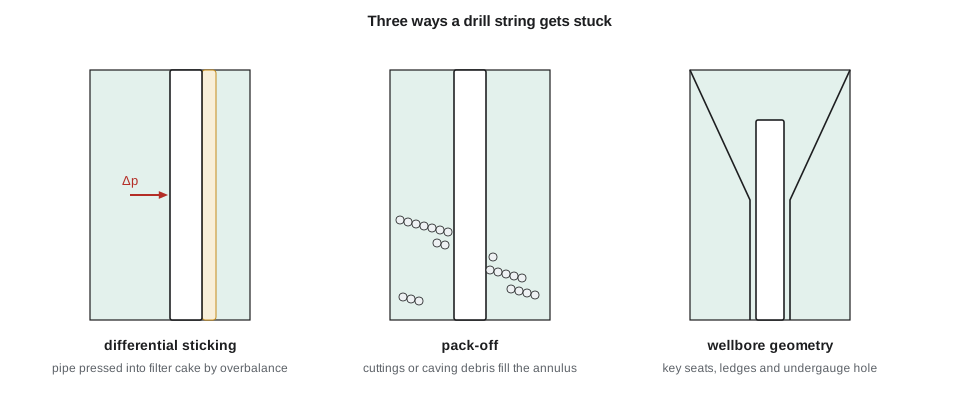
Stuck pipe is one of the costliest drilling problems. Its mechanisms fall into three groups, and the right response depends on recognizing which one is acting.
Differential sticking happens when the string lies still against a permeable formation covered with filter cake, and the overbalance pushes it into the cake. The sticking force is roughly the pressure difference times the contact area times a friction coefficient, and grows with time as the pipe embeds deeper. Its signs: the pipe becomes stuck after it has been stationary, typically during a connection or survey; circulation is still possible; the string cannot move up, down or rotate. Prevention includes keeping the overbalance low, keeping the pipe moving, using thin, slick filter cake and lubricants, and minimizing the length of collars against permeable zones. The first response is to work the pipe and apply the jar, then to spot fluids that reduce the cake friction or to reduce the hydrostatic pressure if the well allows.
Pack-off and bridging happen when solids fill the annulus around the string: cuttings beds sliding in deviated holes, cavings from unstable shale, unconsolidated sand falling in, or junk. Signs include rising pump pressure, loss of returns and difficulty moving the pipe while circulating. Wellbore geometry sticking happens when the string meets a ledge, a key seat worn into a dogleg by the rotating pipe, an undergauge hole after a worn bit, or a stiff BHA that cannot pass a crooked section. Each has its own prevention: good hole cleaning (lesson 5), mud chemistry and weight to hold shales, reaming before tripping, and controlled doglegs.
Locating and freeing stuck pipe
When pipe is stuck, the depth of the stuck point is estimated from stretch: a known pull above the string's hanging weight stretches the free pipe above the stuck point by an amount proportional to its length. This simple calculation is confirmed with a free-point tool on wireline. If the pipe cannot be freed, it is backed off or cut above the stuck point and the stuck section becomes a fish, to be recovered with fishing tools or left in place while the well is sidetracked. The decision between fishing and sidetracking is economic: fishing time is compared with the cost of a new section.
Lost circulation
Lost circulation is the loss of mud to the formation, partial or total. Mud is lost into very permeable or vuggy rock, into natural fractures, or into fractures the well itself creates when the ECD or surge pressure exceeds the fracture gradient. Losses waste expensive mud, can drop the mud level enough to cause a kick, and can damage the reservoir. Prevention means keeping ECD and surge pressures in the window, sometimes adding wellbore strengthening materials ahead of a weak zone. Treatments range from lost-circulation material pills of graded particles and fibers, to cement plugs and specialized gunk squeezes for severe losses, to drilling with managed pressure or casing off the zone.
Wellbore instability
Shales are the commonest source of instability. Mechanical instability occurs when the mud weight is too low to support the stresses around the hole, causing breakouts and large, angular cavings, or too high, causing fractures. Chemical instability arises when water from the mud enters shale, swelling clays and weakening the rock over time. The hole may enlarge or close, causing tight hole, packing off and poor cement. Remedies include choosing the mud weight from a geomechanical model, using inhibitive water-based or oil-based muds, and limiting the time the hole is left open.
# Drilling problems: differential sticking force, free point from stretch, and soft-string drag in the lateral
import math
SI = False
if SI:
    dp_k = (1150 * 9.81 * 1560 / 1000) - 9.03 * 1560          # overbalance kPa at the heel
    dp = dp_k / 6.894757                                      # psi
    mu, contact_in, wall_ft = 0.15, 2.0, 30 / 0.3048           # friction, contact width (in), cake contact length
else:
    dp = 0.052 * 10.2 * 10450 - 0.514 * 10450
    mu, contact_in, wall_ft = 0.15, 2.0, 30.0
force = mu * dp * contact_in * wall_ft * 12                  # lbf = friction x pressure x area (in2)
print(f"overbalance {dp*6.894757:,.0f} kPa; differential sticking force over 30 m {force*0.004448:,.0f} kN" if SI
      else f"overbalance {dp:,.0f} psi; differential sticking force over 30 ft of contact {force:,.0f} lbf")
# free point from pipe stretch: L = E * A * stretch / pull
E, As = 30e6, 3.6                                            # psi, steel area of 4 in (101.6 mm) pipe in in2 (approximate)
pull, stretch_in = 40000.0, 24.0
L = E * As * stretch_in / 12 / pull
print(f"free point about {L*0.3048:,.0f} m below the rotary table" if SI else f"free point about {L:,.0f} ft below the rotary table")
# soft-string drag: weight of the lateral pipe on the low side times friction, tripping out (axial only)
w = 16.6 * (1 - (1150 / 119.826 if SI else 10.2) / 65.5)     # buoyed lb/ft
lat = 1600 / 0.3048 if SI else 9800.0
for f in (0.20, 0.25, 0.30):
    drag = f * w * lat
print(f" friction factor {f:.2f}: lateral drag {drag*0.004448:,.0f} kN when pulling out" if SI else f" friction factor {f:.2f}: lateral drag {drag:,.0f} lb when pulling out")overbalance 171 psi; differential sticking force over 30 ft of contact 18,509 lbf free point about 5,400 ft below the rotary table friction factor 0.20: lateral drag 27,469 lb when pulling out friction factor 0.25: lateral drag 34,337 lb when pulling out friction factor 0.30: lateral drag 41,204 lb when pulling out
The overbalance at the landing point of the 3-22H well, with 10.2 ppg mud against the 9.9 ppg Bakken, is about 170 psi. Over 30 ft of contact the differential sticking force is about 18,500 lb, manageable with the jar and the margin of overpull. The stretch calculation shows how a 40,000 lb pull and 24 in of stretch locate the stuck point near 5,400 ft. In the 9,800 ft lateral, friction factors from 0.20 to 0.30 add about 27,000 to 41,000 lb of drag when pulling out, which Ethan includes in the hook load check.
Torque and drag
In deviated and horizontal wells, the string lies on the low side and touches the wall at bends, so friction adds drag when moving the pipe axially and torque when rotating it. Torque and drag models, usually the soft-string model that treats the string as a cable following the hole, calculate the hook load when tripping in and out and the surface torque, using friction factors calibrated on offset wells, typically 0.15 to 0.30 depending on mud type and casing or open hole. The models check that the rig and pipe can handle the loads, that the string will not buckle severely when pushed, and that casing can reach bottom. During drilling, measured hook loads and torque plotted against the model show developing problems: rising friction factors point to poor hole cleaning, ledges or sticking tendencies.
Hydrogen sulfide
Hydrogen sulfide (H₂S) is a colorless gas that occurs in some oil and gas reservoirs. At low concentrations it smells of rotten eggs, but it quickly paralyses the sense of smell, so odor is not a reliable warning. At high concentrations it causes collapse and death within minutes. It is heavier than air and collects in low places such as cellars and tanks. H₂S also causes sulfide stress cracking of steel (lesson 8).
In the United States, OSHA sets exposure limits for H₂S, including a ceiling limit in general industry, and many operators follow the stricter ACGIH threshold limit values. Operators in sour areas follow state rules and API recommended practices for H₂S operations, and workers complete H₂S safety training before working on sour sites.
Sour drilling operations use fixed and personal H₂S monitors with alarms, wind indicators, briefing areas upwind, breathing air equipment and trained crews, sour-service tubulars and BOP equipment, and emergency response plans that cover the public near the site. The drilling engineer's part is to identify sour zones from offset data, specify the equipment and metallurgy, and make sure the plan includes detection, response and rescue arrangements.
Worked problem
Free point from stretch
A string of 5 in drill pipe with a steel area of 4.30 in² is pulled 50,000 lb above its hanging weight and stretches 30 in. With E = 30,000,000 psi, estimate the depth of the free point.
Show solution
- E A = 30,000,000 × 4.30 = 1.29 × 10⁸ lb.
- ΔL = 30/12 = 2.5 ft; E A ΔL = 3.225 × 10⁸ lb·ft.
- L = 3.225 × 10⁸/50,000 = 6,450 ft.
Answer: About 6,450 ft below the rotary table.
Learning from the offset problems
Ethan sorts the offset nonproductive time by cause. The largest items are two stuck-pipe events in depleted intervals, several days of losses in one well where the surge pressure from running casing too fast fractured the shoe, and repeated tight hole on trips through a shale above the target that had been exposed for many days. For each, he writes a prevention measure into the program: lower mud density and pipe movement rules in depleted zones; running speed limits for casing based on surge calculations; and a requirement to minimize open-hole time through the shale, with a wiper trip only if torque and drag trends show it is needed.
He also notes the time each event took to resolve. The stuck-pipe events that were freed within an hour by jarring cost little; the two that were not freed within a day ended in sidetracks costing several days each. Marcus explains the practice of setting a decision point in advance: if pipe is not free after a set time and set number of jarring cycles, the team stops trying and moves to the next option, rather than spending days on a fishing job whose odds have become poor.
Other hazards
Shallow gas, gas trapped in shallow sands, can flow quickly and is dangerous because the shallow casing may not be strong enough to shut it in; it is usually handled by diverting the flow away from the rig rather than closing the well. Boulders and unconsolidated gravel near surface can cause lost circulation and stuck pipe in surface holes. Salt can creep and close the hole; sticky clays can ball bits; and fractured carbonates can take whole mud. The offset review lists which of these occur in the area so that each has a planned response.
Communication when problems happen
When a problem begins, the wellsite supervisor calls the drilling engineer, and the two agree on the immediate response from the program and on when to escalate. Ethan practices the call with Marcus: the current depth and operation, what was seen and when, what has been done, the current pressures and volumes, and what is proposed next. Clear, structured reports save time and prevent misunderstandings, which matter most when the crew is under pressure.
Common mistakes
MistakeJarring down on differentially stuck pipe without reducing the overbalance where possible.
InsteadCombine jarring with spotting fluids or reducing hydrostatic pressure within well control limits.
MistakeLeaving the string stationary across permeable zones.
InsteadKeep the pipe moving during connections and surveys.
MistakeTreating losses only with more LCM.
InsteadFind the cause: excessive ECD, surge or a weak zone, and address it.
MistakeRelying on smell to detect H₂S.
InsteadUse fixed and personal monitors; H₂S deadens the sense of smell.
Summary and key terms
- Nonproductive time from downhole problems is a major cost; offset data predicts the likely problems.
- Stuck pipe mechanisms are differential sticking, pack-off and wellbore geometry; each has its own signs and remedies.
- The free point is estimated from stretch, L = EAΔL/F, and confirmed with a free-point tool.
- Lost circulation and wellbore instability are controlled by keeping ECD and mud chemistry within the right window.
- Torque and drag models track friction; H₂S requires detection, training, sour-service equipment and emergency plans.
- Nonproductive time (NPT)
- Rig time lost to unplanned events.
- Differential sticking
- Sticking caused by overbalance pressing the pipe into filter cake.
- Pack-off
- Blockage of the annulus by cuttings or cavings around the string.
- Key seat
- A groove worn into the wall of a dogleg by rotating pipe.
- Fish
- Equipment left in the hole that must be recovered or bypassed.
- Lost circulation
- The loss of drilling fluid to the formation.
- Friction factor
- A calibrated coefficient used in torque and drag models.
- Hydrogen sulfide (H₂S)
- A toxic, heavier-than-air gas found in sour reservoirs.
Practice problems
Work each problem on paper first, then reveal the answer to check.
Pipe becomes stuck during a connection, circulation is normal and the pipe cannot move. What is the likely mechanism?
Show answer
Differential sticking.
Pump pressure rises and returns are lost while working the pipe. What does this suggest?
Show answer
Pack-off or bridging around the string.
Why do friction factors from torque and drag matching rise when hole cleaning is poor?
Show answer
Cuttings beds increase contact and resistance along the string.
Give three precautions for drilling in sour zones.
Show answer
H₂S monitors and alarms, trained crews with breathing air, sour-service tubulars and an emergency response plan.
Lesson quiz · 5 questions
Score 60% or more to complete this lesson.
Create a free account to save your progress, take quizzes and earn a certificate.