
NUC-440 · Lesson 6 of 12 · 20 min
Neutron flux instrumentation
Rohan Desai keeps a spare fission chamber on his desk, a sealed aluminum cylinder with a connector at one end. “This is how a reactor sees itself at start-up,” he tells Hana. “Outside the vessel, in the concrete around it, there are three kinds of detectors: source range, intermediate range and power range. Inside the core, fixed or movable detectors map the flux shape. Between them they cover more than ten decades of power, from a shut-down core with only the neutron source to full power.”
This lesson describes how neutron flux is measured over the full range from shutdown to full power: the physics of gas-filled detectors, the pulse, current and mean-square-voltage modes of operation, ex-core and in-core detectors, self-powered detectors and their delayed response, and the calibration of flux signals against thermal power.
The range problem
A shut-down reactor with a start-up neutron source may have a flux about ten orders of magnitude below full power. No single detector can measure accurately across that range. At low flux, individual neutron interactions can be counted as pulses, and counting is the most sensitive and noise-free method. At high flux, pulses overlap and only the average current makes sense. In between, the fluctuations of the current can be used. Reactors therefore use overlapping ranges of instruments, and the transition between them is a key point in every start-up: operators must confirm that the higher range is reading on scale before the lower range saturates or is switched off.
Gas-filled detectors
Neutrons carry no charge, so they are detected through nuclear reactions that make charged particles. Boron-10 absorbs a neutron and emits an alpha particle and a lithium nucleus; helium-3 absorbs a neutron and emits a proton and a triton; uranium-235 fissions and emits two energetic fission fragments. A detector places one of these materials as a gas or as a coating inside a chamber filled with gas between two electrodes. The charged particles ionize the gas, and the applied voltage collects the ions and electrons. In a proportional counter, used for counting at low flux, the field near a thin central wire is high enough to multiply the charge into a clear pulse. In an ionization chamber, used at higher flux, the voltage collects the charge without multiplication, giving a current proportional to the reaction rate.
Gamma rays also ionize the gas, and near a power reactor the gamma field is intense. In counting mode, gamma pulses are small and can be rejected by a discriminator, because a fission fragment or an alpha particle deposits far more energy than a gamma interaction. In current mode, gamma current adds directly to neutron current. A compensated ion chamber solves this with two volumes, one coated with boron and one not; the gamma current of the uncoated volume is subtracted, leaving the neutron signal. In Campbell or mean-square-voltage mode, used in modern wide-range fission chambers, the variance of the current is measured; because the variance scales with the square of the charge per event, the large fission fragment pulses dominate and gammas are suppressed.
| Detector | Reaction | Mode | Typical use |
|---|---|---|---|
| BF3 or boron-lined proportional counter | B-10 (n, α) | pulse | source range at start-up |
| Fission chamber | U-235 fission | pulse, Campbell or current | source and intermediate range; wide range |
| Compensated ion chamber | B-10 (n, α), gamma subtracted | current | intermediate range |
| Uncompensated ion chamber | B-10 (n, α) | current | power range and CANDU ex-core control |
| Self-powered detector | activation or prompt capture in emitter | current, no bias | in-core flux and power |
PWR flux instrumentation
A PWR uses detectors in instrument wells in the concrete around the vessel. The source range uses two boron-lined proportional counters or fission chambers in pulse mode for start-up. The intermediate range uses two compensated ion chambers or fission chambers covering about eight decades. The power range uses four channels of long uncompensated ion chambers, each split into an upper and a lower section, so that the difference gives axial flux difference and the sum gives power. The power range channels feed the reactor protection system and rod control. Source range detectors are de-energized at higher power to protect them and are re-energized after a trip. In the core, either movable miniature fission chambers are driven through thimbles to make periodic flux maps, or fixed rhodium self-powered detectors give continuous axial and radial power distributions.
A rate signal matters as much as level. The log of flux, differentiated, gives the inverse period, the rate of change of power. At low power, where the reactor is close to an integrator, an excessive rate means an excessive reactivity addition, and both start-up procedures and protection logic act on it. CANDU shutdown systems trip on high log rate; PWR operators watch start-up rate, in decades per minute, and some designs have a source range high flux trip or an intermediate range rod stop.
Self-powered detectors
A self-powered neutron detector, or SPND, has a central emitter wire of a material that absorbs neutrons, surrounded by an insulator, usually magnesium oxide or alumina, and an outer metal sheath, the collector. It needs no bias voltage. Its current comes from electrons emitted from the emitter, which either come from the beta decay of an isotope made by neutron capture, a delayed signal, or from prompt processes such as internal conversion and Compton electrons created by capture gammas, a prompt signal. The current is tiny, nanoamperes to microamperes, and is carried out of the core by mineral-insulated cable.
The choice of emitter sets the detector's speed and life. Vanadium-51 absorbs a neutron to become vanadium-52, which decays with a half-life of 3.75 minutes; a vanadium detector's signal is almost entirely delayed, so it is accurate and burns up slowly but responds to a power change only over several minutes. Rhodium-103 activates to rhodium-104, with a 42-second half-life, faster but still delayed. Cobalt and platinum, or the Inconel used in some CANDU designs, give a largely prompt signal from capture gammas and Compton electrons, responding within a fraction of a second, which is what a shutdown system needs, at the cost of a smaller signal and some sensitivity to the gamma field from fission products, which itself lags power.
# Self-powered detector response to a power step: prompt platinum vs delayed vanadium, and compensation.
import math
dt = 0.5
T_half_V52 = 225.0                 # s, vanadium-52 half-life (3.75 min)
lamV = math.log(2) / T_half_V52
prompt_V, prompt_Pt = 0.0, 0.9     # prompt fraction of the signal
def respond(prompt, lam, t_end=1200):
    sig_delayed = 1.0 - prompt; out = []; d = sig_delayed
    for k in range(int(t_end / dt)):
        t = k * dt; P = 0.8 if t >= 60 else 1.0          # 20% power drop at 60 s
        d += lam * ((1.0 - prompt) * P - d) * dt
        out.append((t, prompt * P + d))
    return out
V = respond(prompt_V, lamV)
Pt = respond(prompt_Pt, 1 / 30.0)   # platinum: small delayed part from gamma and activation
# dynamic compensation for vanadium: estimate flux from signal and its rate of change
comp = []; prev = V[0][1]
for t, s in V:
    comp.append((t, s + (s - prev) / dt / lamV)); prev = s
print(f"{'t (s)':>6s}{'true':>6s}{'vanadium':>10s}{'compensated':>13s}{'platinum':>10s}")
for i in range(0, len(V), int(120 / dt)):
    t = V[i][0]; true = 0.8 if t >= 60 else 1.0
print(f"{t:6.0f}{true:6.2f}{V[i][1]:10.3f}{comp[i][1]:13.3f}{Pt[i][1]:10.3f}") t (s) true vanadium compensated platinum
0 1.00 1.000 1.000 1.000
120 0.80 0.966 0.800 0.803
240 0.80 0.915 0.800 0.800
360 0.80 0.879 0.800 0.800
480 0.80 0.855 0.800 0.800
600 0.80 0.838 0.800 0.800
720 0.80 0.826 0.800 0.800
840 0.80 0.818 0.800 0.800
960 0.80 0.812 0.800 0.800
1080 0.80 0.809 0.800 0.800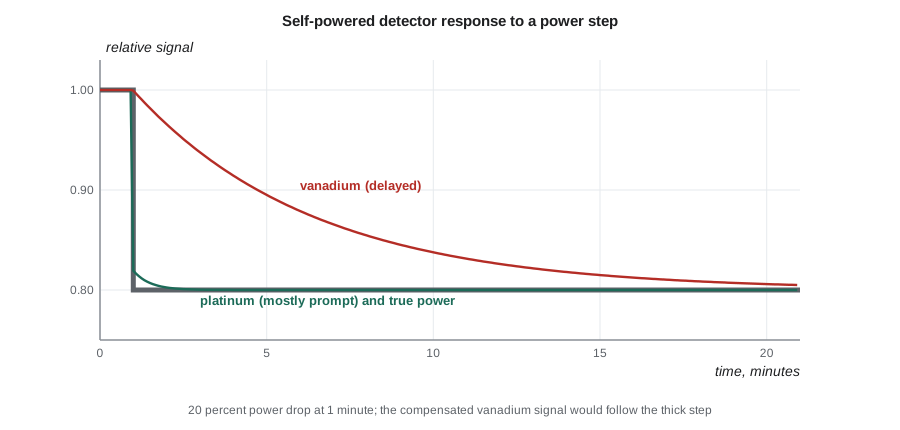
The table shows the vanadium detector still reading about 10 percent high five minutes after the drop, while the platinum detector is within half a percent of the true value after one minute. Because the vanadium signal follows a first-order lag with a known time constant, the regulating system can estimate the true flux from the signal and its rate of change, a dynamic compensation. In the ideal model the compensation is exact; in practice noise in the rate term limits how aggressive it can be, and real CANDU regulating systems use vanadium detectors mainly for slow spatial control and calibrate the faster platinum signals against them. Platinum detectors also have a smaller delayed part, from gamma rays emitted by fission products, which is why the prompt fraction is less than one.
Calibration against thermal power
Neutron signals must be calibrated. The relation between a detector's current and reactor power changes as the flux shape changes with rod and zone movement, fueling and xenon, as the detector's emitter burns up, and as the shielding between core and ex-core detectors changes with coolant density. The reference is thermal power, calculated from a heat balance. On the primary side, it is the product of coolant flow and enthalpy rise across the core; on the secondary side, it is feedwater flow times the enthalpy rise from feedwater to steam, adjusted for blowdown and losses. The secondary-side heat balance is usually the most accurate, often within about 1 to 2 percent, and in recent decades ultrasonic feedwater flow meters have reduced its uncertainty enough for plants to justify measurement uncertainty recapture power uprates.
In a PWR the technical specifications require the power range channels to be adjusted to agree with a calorimetric heat balance at least daily at power, and the excore axial flux difference to be calibrated against incore flux maps periodically, with tighter checks after large changes in rod position or burnup.
Worked problem
Doubling time from start-up rate
During a start-up, the intermediate range shows a start-up rate of 0.5 decades per minute. What is the reactor period, and how long does power take to double?
Show solution
- A decade is a factor of 10, so power multiplies by 10 every 2 minutes, or 120 s.
- Period T = 120 / ln 10 ≈ 52 s.
- Doubling time = T ln 2 ≈ 36 s.
Answer: A period of about 52 seconds and a doubling time of about 36 seconds, which most procedures would treat as too fast.
Detector aging and replacement
Neutron detectors wear out. Self-powered detectors lose sensitivity as their emitters burn up: a rhodium emitter loses a significant fraction of its sensitivity over a few years at full flux, a vanadium emitter much less, and platinum less still. The sensitivity loss is tracked with burnup models and corrected in the signal processing, and detectors are replaced when the correction becomes too large or the insulation resistance falls. Fission chambers lose sensitivity as their uranium coating fissions, which some designs offset by adding fertile material that breeds new fissile atoms. Ex-core ion chambers age slowly but their cables and connectors suffer from heat and radiation, and insulation degradation can create noise or false currents.
In PWRs, movable in-core detectors and their drive systems need regular maintenance, and fixed in-core detector strings are replaced at refueling outages as their sensitivity falls. Ex-core power range detectors are replaced on condition. Because the power range channels feed the reactor protection system, replacement is followed by calibration and functional testing before the channel is returned to service.
Choosing a detector for a job
Rohan gives Hana a checklist. What range must it cover, and does it overlap with the next range? How fast must it respond, and is a delayed signal acceptable? How large is the gamma field, and does the mode reject gammas? How long must it last at the expected flux? Can it be calibrated, tested and replaced? And is it independent of the detectors used by the other systems that depend on flux, so that one failure cannot disable both control and protection? Every detector in the core represents a choice among these factors.
The final link is signal processing. Detector currents of nanoamperes travel through long cables to amplifiers outside the shielding, where they are converted to voltages, filtered and digitized. Cable insulation resistance, connector moisture and electrical noise from nearby equipment can all add errors comparable to the signal, so in-core detector cables are tested for insulation resistance and leakage current regularly, and amplifier channels include test inputs that inject known currents to check the whole chain.
Hana writes in her notes that every flux signal is an inference: a current or a count rate converted into power by a calibration that depends on geometry, spectrum, burnup and electronics. The skill of the instrumentation engineer lies in knowing how far each inference can be trusted, and in giving the control and protection systems signals whose limitations are understood and allowed for.
Common mistakes
MistakeAn ion chamber measures neutrons only.
InsteadGammas also ionize the gas; compensation or Campbell mode is needed at high gamma fields.
MistakeA vanadium detector reading is the current flux.
InsteadIt lags with a 3.75-minute half-life unless compensated.
MistakeCalibration is done once at commissioning.
InsteadSignals are recalibrated against thermal power continually or daily.
Summary and key terms
- Flux spans more than ten decades, so overlapping instrument ranges are needed.
- Gas detectors use boron, helium-3 or fission reactions and work in pulse, current or Campbell modes.
- PWRs use ex-core source, intermediate and power range detectors and in-core detectors for flux maps.
- SPND emitters trade speed for signal and life: vanadium is slow, platinum and cobalt are prompt.
- Flux signals are calibrated against a heat balance.
- Proportional counter
- A gas detector that multiplies charge to give pulses at low flux.
- Ionization chamber
- A gas detector that collects charge without multiplication.
- Compensated ion chamber
- An ion chamber with a second volume to cancel gamma current.
- Campbell mode
- Measurement of current variance to suppress gamma signals.
- Self-powered neutron detector
- An in-core detector whose current comes from its emitter, with no bias supply.
- Start-up rate
- Rate of change of power in decades per minute.
Practice problems
Work each problem on paper first, then reveal the answer to check.
Why do ranges overlap?
Show answer
So the next range is on scale before the previous one leaves its useful range.
Why are gamma pulses easy to reject in counting mode?
Show answer
They deposit much less energy than alpha particles or fission fragments.
Which emitter would you choose for a shutdown system and why?
Show answer
Platinum, cobalt or Inconel, for a prompt response.
What is the half-life of vanadium-52?
Show answer
3.75 minutes.
What reference is used to calibrate flux signals?
Show answer
Thermal power from a heat balance.
Lesson quiz · 5 questions
Score 60% or more to complete this lesson.
Create a free account to save your progress, take quizzes and earn a certificate.