
NUC-360 · Lesson 5 of 12 · 21 min
Steam generators and turbines
During a refueling outage at one of TVA's PWRs, Hana joins the steam generator inspection team. A remotely operated probe is threaded into the tubes from the primary channel head, sending eddy current signals to a trailer outside containment. "Every one of these tubes is part of the reactor coolant pressure boundary," the inspection lead tells her. "A rupture is a small loss-of-coolant accident that bypasses containment. So we look at a large sample every outage, and all of them over a few cycles."
The role of the steam generator
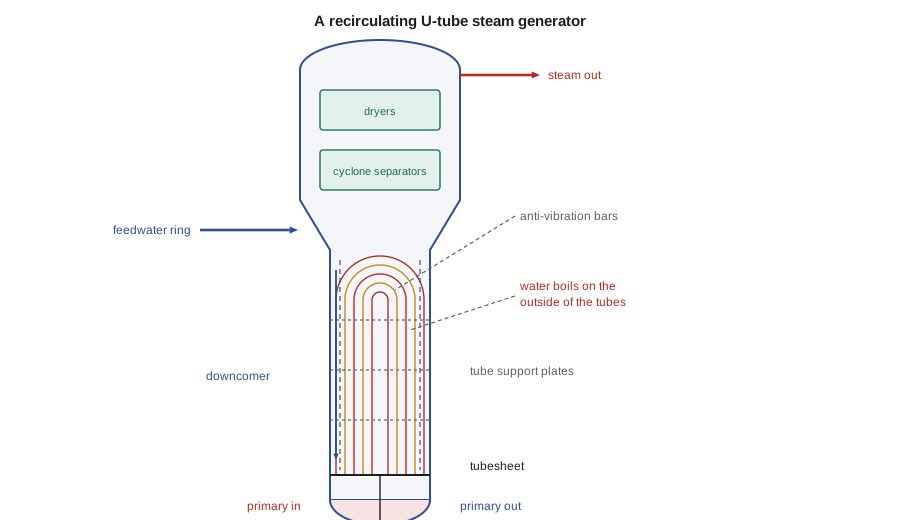
In a PWR or CANDU plant, the steam generators are the link between the reactor and the turbine. They are large shell-and-tube heat exchangers. Hot primary coolant flows inside thousands of small tubes; secondary water on the shell side boils on the outside of the tubes. The tubes are thin, about 1 mm (0.04 in) wall, so that heat passes through easily, and they must stay leak-tight for decades while carrying a pressure difference of about 8 to 9 MPa (1 200 psi) in a PWR and about 5 MPa in CANDU. Steam generator tubes typically make up about half of the area of the whole reactor coolant pressure boundary.
Most PWR and CANDU steam generators are recirculating U-tube designs. Primary coolant enters a hemispherical head at the bottom, flows up one leg of each inverted U-tube and down the other, and leaves through the outlet side of the head. On the secondary side, feedwater mixes with recirculating water from the steam separators and flows down the annulus between the tube bundle wrapper and the shell, then up through the tube bundle, where part of it boils. The steam-water mixture passes through cyclone separators and dryers at the top, and dry saturated steam leaves through the steam outlet. Babcock and Wilcox once-through steam generators, used in some US plants, instead pass the secondary water once along straight tubes and produce slightly superheated steam.
Sizing the heat transfer area
The heat transfer area follows from the duty, the overall heat transfer coefficient and the log mean temperature difference between the primary coolant and the boiling secondary water. Because the secondary side is at saturation, its temperature is nearly constant, and the temperature difference falls from the hot end to the cold end of the tubes:
The overall coefficient combines convection inside the tubes, conduction through the wall and boiling on the outside, plus allowances for fouling. For PWR steam generators, it is several thousand watts per square meter per kelvin. The temperature difference is modest, about 20 K, because the steam pressure must be as high as possible for turbine efficiency while the primary hot leg is limited by its own pressure. That combination makes steam generators very large.
# Steam generator tubes and a simple Rankine cycle with moisture (illustrative).
import math
Q = 3411e6 / 4                     # W per steam generator
T_hot, T_cold, T_sat = 326.0, 292.0, 285.0
dT1, dT2 = T_hot - T_sat, T_cold - T_sat
lmtd = (dT1 - dT2) / math.log(dT1 / dT2)
U = 5500.0                          # W/(m2 K), overall coefficient
A = Q / (U * lmtd)
d_o, L_avg = 0.0175, 20.0           # m tube outside diameter, average U-tube length
n = A / (math.pi * d_o * L_avg)
print(f"LMTD {lmtd:5.1f} K, area {A:6.0f} m2, about {n:5.0f} U-tubes")
# Turbine: high-pressure expansion, moisture removal, then low-pressure expansion
h1, s1 = 2773e3, 5.89e3             # saturated steam at about 6.9 MPa
def wet(p_name, hf, hfg, sf, sfg, s):
    x = (s - sf) / sfg
    return hf + x * hfg, x
h2s, x2 = wet("1.0 MPa", 763e3, 2015e3, 2.14e3, 4.45e3, s1)
eta = 0.86
h2 = h1 - eta * (h1 - h2s)
print(f"HP exhaust quality (ideal) {x2:5.1%}, HP work {(h1-h2)/1000:5.0f} kJ/kg")
# After the moisture separator reheater the steam is superheated, about 265 C at 1 MPa
h3, s3 = 2975e3, 7.00e3
h4s, x4 = wet("7 kPa", 163e3, 2409e3, 0.559e3, 7.72e3, s3)
h4 = h3 - eta * (h3 - h4s)
print(f"LP exhaust quality (ideal) {x4:5.1%}, LP work {(h3-h4)/1000:5.0f} kJ/kg")
h_cond = 163e3                      # J/kg, condensate returned without feedwater heating
q_in = (h1 - h_cond) + (h3 - h2)    # boiler heat plus reheat
w = (h1 - h2) + (h3 - h4)
print(f"cycle efficiency without feedwater heating {w/q_in:5.1%}")LMTD 19.2 K, area 8061 m2, about 7331 U-tubes HP exhaust quality (ideal) 84.3%, HP work 268 kJ/kg LP exhaust quality (ideal) 83.4%, LP work 690 kJ/kg cycle efficiency without feedwater heating 31.1%
Worked problem
Tube count for a PWR steam generator
One steam generator transfers 853 MW. The hot leg is 326 °C, the cold leg 292 °C and the secondary saturation temperature 285 °C. With U = 5 500 W/m²·K, tube outside diameter 17.5 mm and average U-tube length 20 m, estimate the area and number of tubes.
Show solution
- ΔT_lm = (41 − 7)/ln(41/7) ≈ 19.2 K.
- A = Q/(U ΔT_lm) = 853 × 10⁶/(5 500 × 19.2) ≈ 8 100 m² (about 87 000 ft²).
- One tube's outside area: π × 0.0175 × 20 ≈ 1.10 m², so about 7 300 tubes.
Answer: Real four-loop steam generators have a few thousand to about six thousand tubes of similar size; the estimate is the right order, and the extra area allowed in practice covers fouling and plugged tubes.
Tube degradation and inspection
Steam generator tubes have been one of the most persistent maintenance problems in the PWR fleet. Early Alloy 600 tubes suffered stress corrosion cracking on both the primary and secondary sides, denting at support plates from corrosion products, wear from vibration, and pitting where sludge collected on the tube sheet. Replacement steam generators use thermally treated Alloy 690 tubes, which resist cracking far better, and support structures designed to avoid crevices. CANDU steam generators have used Alloy 600, Alloy 800 and Monel tubes, and have had their own problems with sludge, fretting and secondary-side deposits.
Tubes are inspected by eddy current probes during outages. Tubes with defects beyond a plugging limit are removed from service by plugging both ends; some plants have also repaired tubes with sleeves. Utilities manage secondary water chemistry carefully, using all-volatile treatment with amines to control pH, oxygen removal, and blowdown to keep impurities low, because almost every degradation mechanism on the secondary side is driven by impurities concentrating in crevices and under deposits.
In the United States, NRC technical specifications require a steam generator program based on industry guidelines, with inspection intervals, performance criteria for structural and leakage integrity and plugging limits. Several US plants have replaced their original steam generators, and a few units were retired early after steam generator problems.
The turbine
The steam from a light water or CANDU reactor is saturated, at about 6 to 7 MPa and 280 °C, or only slightly superheated. This steam has much less energy per kilogram than the superheated steam of a fossil plant, so nuclear turbines must pass a very large flow. A large nuclear turbine has one high-pressure cylinder and three or more double-flow low-pressure cylinders, with last-stage blades over 1.5 m (5 ft) long. Many nuclear turbines run at half speed, 1 500 or 1 800 rpm, to keep the stresses in those long blades acceptable, with four-pole generators to produce 50 or 60 Hz.
As saturated steam expands through the high-pressure turbine, it becomes wet. Water droplets erode the blades and reduce efficiency. Between the high- and low-pressure turbines, the steam passes through a moisture separator reheater: chevron separators remove the water, and tube bundles heated by live steam from the steam generators reheat the steam to a modest superheat before it enters the low-pressure turbines. The steam becomes wet again at the low-pressure end, and moisture is removed at intermediate points as well.
The program's simplified cycle, with no feedwater heaters, gives an efficiency of about 31 percent. Real plants add six or seven stages of feedwater heating with steam extracted from the turbines, which raises the feedwater temperature to about 220 to 230 °C and the net efficiency to about 33 to 35 percent. The condenser pressure, set by the cooling water temperature, also matters: a colder lake or sea gives a lower back pressure and more work.
Feedwater and condensate
Below the turbines, the condenser condenses the exhaust steam under vacuum. Condensate pumps send the water through low-pressure feedwater heaters and a deaerator, and feedwater pumps raise it to steam generator pressure through high-pressure heaters. The feedwater system controls the water level in each steam generator. Loss of feedwater is one of the most frequent plant transients, and every PWR and CANDU plant has an auxiliary or emergency feedwater system to keep the steam generators supplied if the main feedwater pumps fail. The steam generators are then the heat sink for decay heat, with steam released to the condenser or, if needed, to the atmosphere through relief valves.
BWR differences
A BWR has no steam generators, so the turbine receives steam directly from the reactor vessel. The turbine itself is similar to a PWR turbine, but it is shielded against the nitrogen-16 activity, and the turbine building is a radiation-controlled area at power. Turbine bypass valves, which can send steam directly to the condenser, are especially important in a BWR because a turbine trip suddenly stops the steam flow and raises vessel pressure, which collapses voids and adds reactivity. The bypass and the reactor protection system handle this pressurization transient.
The condenser and circulating water
The condenser is a large shell-and-tube heat exchanger below the low-pressure turbines, with tens of thousands of tubes carrying cooling water from the lake, river, sea or cooling tower. Steam condenses on the outside of the tubes, and the condensate collects in a hotwell below. The condenser runs under vacuum, at an absolute pressure of a few kilopascals, set by the cooling water temperature: the colder the water, the lower the pressure and the more work the turbine can extract. Air that leaks into the condenser is removed by vacuum pumps or steam jet air ejectors; in a PWR, radioactivity detected in the air ejector discharge is one of the first signs of a steam generator tube leak.
Condenser tube leaks let cooling water, with its dissolved minerals, into the condensate. Because impurities concentrate in the steam generators and drive corrosion, plants monitor condensate chemistry continuously, and many use condensate polishers, beds of ion exchange resin that remove impurities before the feedwater reaches the steam generators. Tube materials, such as stainless steel or titanium for seawater-cooled plants, are chosen to resist corrosion by the cooling water.
Generators and the grid
The turbine drives a large synchronous generator, often well over 1 000 MVA for a large unit, cooled by hydrogen gas and water. The generator output passes through main transformers to the high-voltage grid. The plant also needs power from the grid, or from its own generator, for its pumps and systems; loss of offsite power and its effect on the safety systems is a central topic in lesson 6. Large units contribute inertia and voltage support to the grid, and a sudden trip of a large unit is one of the contingencies grid operators plan for.
Turbine protection and overspeed
A large steam turbine stores a great deal of energy in its spinning rotors. If the generator suddenly loses its electrical load, for example when the main breaker opens after a grid fault, the steam still flowing into the turbine would accelerate the rotors rapidly. The turbine control system closes the governor valves within a fraction of a second to limit the speed rise, and independent overspeed protection closes the stop valves if the speed exceeds a set limit, usually about 110 percent of rated speed. Steam already inside the turbine, and steam flashing from water in the moisture separator reheaters and extraction lines, can still drive the rotor, so non-return valves on extraction lines prevent backflow into the turbine. Turbine rotors are inspected and tested because a rotor failure at overspeed could produce high-energy missiles, which is one reason the orientation of the turbine relative to the reactor building is considered in plant layout.
After a turbine trip, steam from the steam generators is dumped to the condenser through bypass valves, or to the atmosphere through relief valves if the condenser is unavailable, so that the reactor can be brought down in power smoothly or shut down.
Common mistakes
MistakeSteam generator tubes are a minor part of the pressure boundary.
InsteadThey make up roughly half of its area and are a common source of degradation.
MistakeNuclear turbines use highly superheated steam.
InsteadThey use saturated or nearly saturated steam and therefore pass very large flows.
MistakeThe moisture separator reheater uses fossil fuel.
InsteadIt reheats steam with live steam taken from the steam generators.
Summary and key terms
- Recirculating U-tube steam generators transfer heat from primary coolant to boiling secondary water.
- Heat transfer area follows from Q = U A ΔT_lm with a small temperature difference.
- Tube degradation led to Alloy 690 replacements and strict chemistry control.
- Nuclear turbines pass large flows of wet steam and use moisture separator reheaters.
- Feedwater heating raises cycle efficiency to about one third.
- U-tube
- An inverted U-shaped heat exchanger tube carrying primary coolant inside a steam generator.
- Log mean temperature difference
- The effective average temperature difference for a heat exchanger.
- Plugging limit
- The flaw size at which a steam generator tube is removed from service.
- Moisture separator reheater
- Equipment between turbine stages that removes water and reheats steam.
- Feedwater heater
- A heat exchanger that preheats feedwater with steam extracted from the turbine.
- Turbine bypass
- Valves that send steam directly to the condenser when the turbine cannot accept it.
Practice problems
Work each problem on paper first, then reveal the answer to check.
Why is the temperature difference in a PWR steam generator only about 20 K?
Show answer
Steam pressure is kept high for turbine efficiency while the primary hot leg is limited by its pressure.
What replaced Alloy 600 tubing in replacement PWR steam generators?
Show answer
Thermally treated Alloy 690.
Why do many nuclear turbines run at half speed?
Show answer
To limit stresses in the very long last-stage blades.
What does the moisture separator reheater do?
Show answer
Removes water from high-pressure exhaust steam and reheats it before the low-pressure turbine.
Why are turbine bypass valves important in a BWR?
Show answer
A turbine trip raises vessel pressure and collapses voids, adding reactivity.
Lesson quiz · 5 questions
Score 60% or more to complete this lesson.
Create a free account to save your progress, take quizzes and earn a certificate.