
NUC-360 · Lesson 10 of 12 · 20 min
Sodium-cooled fast reactors
The next row in Hana's table is the sodium-cooled fast reactor. Dr. Teodora Vasquez, whose background is core physics, is enthusiastic. "No moderator, a compact core, a coolant that runs at atmospheric pressure and is still 400 kelvin below its boiling point," she says. "It is a completely different machine. The engineering challenge is the sodium itself." TerraPower's Natrium plant in Kemmerer, Wyoming, received its NRC construction permit in 2026, and the client wants to understand the technology.
Why fast and why sodium
A fast reactor has no moderator. Fission neutrons sustain the chain reaction at high energies, around 0.1 to 1 MeV on average. Fission cross sections are much smaller at high energy, so a fast reactor needs a higher concentration of fissile material in its fuel, typically 15 to 20 percent or more, and a compact core with a high power density. The fast spectrum has two attractions for power production. More neutrons are released per neutron absorbed, which allows a fast reactor to convert more fertile uranium-238 into fuel and to use its uranium resources far more completely than a thermal reactor. Fast neutrons also cause fission in heavier actinides that accumulate in thermal reactor fuel, which can reduce the long-lived part of the waste. The fuel cycle options are discussed in NUC-450; this lesson concentrates on the plant.
A fast reactor coolant must not moderate neutrons, must carry heat from a very compact core, and should work at low pressure. Liquid sodium meets these needs well. It has excellent thermal conductivity, about a hundred times that of water, a melting point of 98 °C and a boiling point of about 883 °C at atmospheric pressure. A sodium-cooled reactor can therefore run with an outlet temperature of about 500 to 550 °C at nearly atmospheric pressure, with hundreds of kelvin of margin to boiling. There is no need for a thick pressure vessel, and a pipe break does not cause the coolant to flash to steam.
Pool and loop configurations
Sodium-cooled reactors use two main arrangements. In a pool-type reactor, the core, primary pumps and intermediate heat exchangers all sit inside a large tank of sodium, so that a leak in a primary pipe stays inside the pool and the large sodium inventory provides thermal inertia. In a loop-type reactor, primary sodium flows out of the reactor vessel through pipes to external heat exchangers. Most current designs, including Natrium and the Russian BN-800, are pool type.
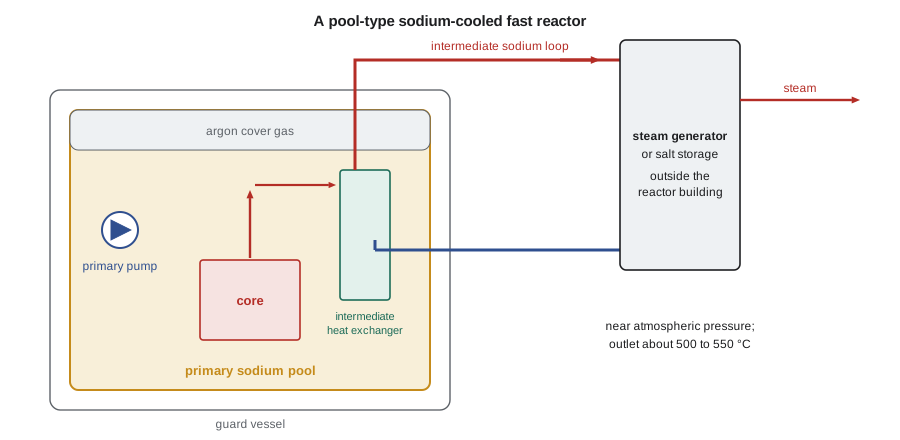
Primary sodium becomes radioactive in the core: sodium-24, with a half-life of about 15 hours, emits energetic gamma rays. To keep this activity away from the water and steam system and to isolate the core from any sodium-water reaction, sodium reactors use an intermediate, non-radioactive sodium loop. Primary sodium heats intermediate sodium in the intermediate heat exchanger inside the pool, and the intermediate loop carries the heat to a steam generator outside. The Natrium design instead sends the intermediate heat to tanks of molten nitrate salt, which store energy and can boost the plant's output above its reactor rating for several hours to follow demand.
Heat transport
Sodium has a low volumetric heat capacity compared with water, but it can run with a large temperature rise across the core because of its wide liquid range. The primary flow and pump power follow from the same mass and energy balance as in other reactors:
# Sodium-cooled fast reactor primary loop: flow, temperature rise, pump power (illustrative).
Q = 840e6                       # W thermal, Natrium-like
cp_na, rho_na = 1270.0, 850.0   # J/(kg K), kg/m3 near 450 C
T_in, T_out = 360.0, 500.0
m = Q / (cp_na * (T_out - T_in))
Vdot = m / rho_na
print(f"sodium flow {m:6.0f} kg/s = {Vdot:5.2f} m3/s for a {T_out-T_in:3.0f} K rise")
dp = 0.5e6                      # Pa across core and loop
P_pump = Vdot * dp / 0.75
print(f"pump power about {P_pump/1e6:4.1f} MW")
# Margin to boiling at atmospheric pressure (sodium boils near 883 C)
print(f"margin from core outlet to sodium boiling: {883 - T_out:4.0f} K")
# Compare with water: flow needed for the same heat and rise at 15.5 MPa
m_w = Q / (5600 * 34)
print(f"a PWR with the same power and a 34 K rise moves {m_w:6.0f} kg/s of water")sodium flow 4724 kg/s = 5.56 m3/s for a 140 K rise pump power about 3.7 MW margin from core outlet to sodium boiling: 383 K a PWR with the same power and a 34 K rise moves 4412 kg/s of water
The sodium flow needed is similar in mass to that of a PWR of the same power, because the larger temperature rise compensates for the lower heat capacity, but the primary system is at low pressure. The margin to boiling at the core outlet is large. Electromagnetic pumps, which push the conducting liquid with magnetic fields and have no moving parts, are used in some smaller designs; large plants use mechanical centrifugal pumps immersed in the pool.
Worked problem
Sodium flow for a 840 MW core
A pool-type reactor makes 840 MW thermal with a core inlet of 360 °C and outlet of 500 °C. With c_p = 1 270 J/kg·K and ρ = 850 kg/m³, find the mass and volume flows.
Show solution
- ṁ = 8.4 × 10⁸/(1 270 × 140) ≈ 4 720 kg/s.
- V̇ = 4 720/850 ≈ 5.6 m³/s (about 88 000 US gal/min).
- Margin to boiling at the outlet: about 883 − 500 = 383 K.
Answer: The mass flow is similar to a comparable PWR, but at near-atmospheric pressure and with hundreds of kelvin of margin to boiling.
Fuel and core
Sodium fast reactor fuel is usually either a metal alloy, such as uranium-zirconium, or mixed oxide pellets, in thin stainless steel cladding tubes arranged in hexagonal assemblies with wire wrap spacers. Metal fuel has high thermal conductivity, which keeps fuel temperatures low, and it was demonstrated in the Experimental Breeder Reactor II in Idaho. The core is compact, and its reactivity responds to temperature through Doppler broadening, fuel and structural expansion, and changes in sodium density. Because sodium absorbs and scatters some neutrons, voiding sodium in the center of a large core can add reactivity, while voiding at the edge increases leakage and removes reactivity. Designers shape the core to keep the overall void effect small or negative.
In 1986, EBR-II demonstrated passive safety in two tests: with the reactor at full power, operators deliberately cut off primary pump power, and in another test cut off heat removal from the intermediate loop, both without inserting the control rods. In both cases, the reactor's inherent feedbacks reduced power and the plant settled to a safe state without damage. These tests remain a reference point for metal-fueled sodium reactor safety.
Sodium chemistry and safety
The main engineering challenge is sodium's chemistry. Sodium reacts vigorously with water, producing hydrogen and heat, and it burns in air. Plants must keep sodium and water apart, monitor steam generators for small leaks with hydrogen detectors, and design steam generators to limit the consequences of a tube failure. Primary sodium is covered by an inert argon blanket, and sodium-filled rooms are often inerted with nitrogen. Sodium is opaque, so inspection of components inside the pool requires ultrasonic methods rather than cameras. Sodium freezes at 98 °C, so heating systems keep pipes and components above the freezing point during shutdown and filling.
Decay heat removal in sodium reactors can be fully passive. Natural circulation of sodium inside the pool carries heat to dedicated heat exchangers or to the vessel wall, and air flowing by natural draft around the guard vessel or through air heat exchangers removes it to the atmosphere. The low system pressure means there is no driving force to expel coolant from the vessel, and the guard vessel catches sodium if the main vessel leaks.
TerraPower's Natrium plant at Kemmerer, Wyoming, pairs a 345 MWe pool-type sodium reactor with molten salt thermal storage that can boost output to about 500 MWe for several hours. The NRC issued its construction permit in March 2026.
Steam generators and the sodium-water reaction
Where a sodium reactor makes steam, the steam generator is the place where sodium and water are closest, separated only by a tube wall. A leak lets water or steam into the sodium, where it reacts to produce sodium hydroxide, hydrogen and heat. A small leak can grow quickly by wastage of neighboring tubes. Sodium steam generators are designed with leak detection by hydrogen meters, rupture discs and pressure relief to a reaction products tank, and with the ability to isolate and drain a module quickly. Some designs use double-walled tubes. The intermediate loop ensures that any reaction affects only non-radioactive sodium and is separated from the reactor. Using molten salt, rather than water, as the medium heated by the intermediate loop, as Natrium does, moves the steam generator further from the sodium.
Operating experience
Sodium-cooled fast reactors have accumulated several hundred reactor-years of operation. EBR-I in Idaho produced the first nuclear electricity in 1951. EBR-II ran for three decades and demonstrated metal fuel and passive safety. Fermi 1 in Michigan, a fast breeder demonstration plant, suffered partial fuel melting in 1966 when debris blocked coolant flow to some assemblies. France's Phénix and Superphénix and the United Kingdom's Dounreay reactors ran in Europe; Japan's Monju had a sodium leak and fire in its secondary loop in 1995. Russia's BN-350, BN-600 and BN-800 have the longest commercial experience, with BN-600 operating since 1980. India's Prototype Fast Breeder Reactor has been in commissioning. These experiences show that sodium reactors can operate reliably, and that sodium leaks and fires must be prevented and handled carefully.
Thermal storage and flexible output
Natrium's molten salt storage is a plant systems innovation. The reactor runs at constant power, heating nitrate salt in a hot tank through the intermediate sodium loop. The salt then feeds steam generators, and the steam turbine can run above or below the reactor's equivalent output depending on how fast salt is drawn from storage. Nitrate salt systems of this kind are used in concentrating solar power plants, so the storage technology is well developed. The design lets a constant-power reactor follow the daily variation in grid demand and in wind and solar output, and it separates the nuclear island from the conventional power plant, which may simplify construction.
Fuel handling under sodium
Refueling a sodium reactor is more complex than refueling a water reactor because sodium is opaque and reacts with air. The reactor is shut down and cooled to a refueling temperature of about 200 °C, still well above sodium's freezing point. Rotating plugs in the reactor head allow a fuel handling machine to reach any assembly position without exposing the sodium to air, working entirely under the argon cover gas. Used assemblies are moved to an in-vessel or ex-vessel storage location under sodium, where their decay heat falls, then washed to remove residual sodium before they are moved to a water pool or to dry storage. Assembly positions are identified by careful indexing rather than by sight, and ultrasonic viewing systems can check for obstructions. Because of this complexity, sodium reactors are usually designed for long fuel cycles and infrequent refueling.
Instrumentation must also work in sodium. Thermocouples measure assembly outlet temperatures, electromagnetic flowmeters measure sodium flow, and detectors in the cover gas identify fission gas released from a failed fuel pin, while tagging gases with distinctive isotopic signatures placed in each assembly during fabrication can locate which one has failed.
Sodium fires, when they occur, burn with dense white smoke of sodium oxide and hydroxide but with lower flame temperatures than hydrocarbon fires. Plants limit their consequences with steel catch pans and liners under sodium piping, leak detectors on pipes and vessels, rooms filled with nitrogen in the primary areas, and dry powder extinguishing agents, never water. These measures, refined after the leak at Monju and other events, are part of the reason current designs favor pool arrangements with little primary piping outside the vessel.
Common mistakes
MistakeSodium reactors must be highly pressurized to keep the coolant liquid.
InsteadSodium boils near 883 °C at atmospheric pressure, so the primary system runs near atmospheric pressure.
MistakePrimary sodium goes directly to the steam generator.
InsteadAn intermediate sodium loop separates radioactive primary sodium from the water and steam.
MistakeFast reactors use a moderator.
InsteadThey have no moderator; the chain reaction runs on fast neutrons.
Summary and key terms
- Sodium fast reactors have no moderator and a compact, high power density core.
- Liquid sodium allows outlet temperatures of 500 to 550 °C at near-atmospheric pressure.
- Pool designs contain the core, pumps and intermediate heat exchangers in one sodium tank.
- An intermediate loop isolates radioactive primary sodium from water and steam.
- EBR-II demonstrated passive response to loss of flow and loss of heat sink without rod insertion.
- Fast reactor
- A reactor with no moderator, in which fast neutrons sustain the chain reaction.
- Pool-type reactor
- A design with the core, pumps and intermediate heat exchangers in a single tank of coolant.
- Intermediate heat exchanger
- The heat exchanger that transfers heat from primary to intermediate sodium.
- Sodium-24
- A gamma-emitting activation product in primary sodium with a half-life of about 15 hours.
- Guard vessel
- A vessel around the main tank that catches sodium if the main vessel leaks.
- Electromagnetic pump
- A pump that drives liquid metal with magnetic fields and has no moving parts.
Practice problems
Work each problem on paper first, then reveal the answer to check.
Why do sodium reactors run at near-atmospheric pressure?
Show answer
Sodium's boiling point of about 883 °C leaves a large margin at operating temperature.
Why is there an intermediate sodium loop?
Show answer
To keep radioactive primary sodium away from the steam system and isolate the core from sodium-water reactions.
What did the 1986 EBR-II tests demonstrate?
Show answer
Inherent shutdown and safe cooling after loss of flow and loss of heat sink without rod insertion.
Name two hazards of sodium.
Show answer
It reacts with water and burns in air.
What does Natrium's molten salt storage allow?
Show answer
Boosting electrical output above the reactor rating for several hours.
Lesson quiz · 5 questions
Score 60% or more to complete this lesson.
Create a free account to save your progress, take quizzes and earn a certificate.