
NUC-340 · Lesson 8 of 12 · 20 min
Corrosion in reactor environments
Malik hands Hana a photograph of a small, rust-colored deposit on a vessel head nozzle, and a cut-away drawing of the cavity beneath it. "Primary water stress corrosion cracking," he says. "The nozzle weld cracked, borated water leaked, and the boric acid ate a hole in the carbon steel head until only the stainless cladding was holding the pressure. That was at Davis-Besse in 2002. Corrosion is the degradation you can measure most easily, and also the one that surprises people most often."
Water chemistry in reactors
Reactor coolant is very pure water, but its chemistry is controlled precisely because small changes have large effects on corrosion. The main variables are pH at temperature, dissolved oxygen and hydrogen, and impurities such as chloride and sulfate.
| Circuit | Chemistry control | Purpose |
|---|---|---|
| PWR primary | boric acid for reactivity control; lithium hydroxide for pH; dissolved hydrogen | low corrosion, low activity transport, suppress radiolysis |
| CANDU primary heat transport | heavy water at controlled pD with lithium hydroxide; dissolved deuterium | minimize feeder and steam generator corrosion |
| BWR reactor water | very pure water; hydrogen water chemistry or noble metal additions in many plants | lower the electrochemical potential to reduce cracking |
| Secondary side (PWR and CANDU) | amines for pH; oxygen scavenging; strict impurity limits | protect steam generator tubes and carbon steel piping |
Radiolysis is a feature unique to reactors. Radiation splits water into radicals that recombine into hydrogen, oxygen and hydrogen peroxide. In BWRs, where steam carries away the hydrogen, oxygen and peroxide build up in the water and raise its electrochemical corrosion potential, which drives stress corrosion cracking of stainless steels. In PWRs and CANDU reactors, excess dissolved hydrogen or deuterium suppresses net radiolysis, keeping the coolant reducing.
General corrosion and activity transport
All the metals in the primary circuit corrode slowly, forming thin oxide films. Some of the metal released travels with the coolant, deposits in the core where it is activated, and then is released again and deposits on piping and steam generators outside the core. This activity transport, mainly of cobalt-60 and cobalt-58, sets the radiation fields that workers face during outages. Chemistry programs, low-cobalt materials, zinc injection in many PWRs and BWRs, and careful start-up and shutdown chemistry all aim to reduce it.
Flow-accelerated corrosion
Flow-accelerated corrosion (FAC) thins carbon steel in flowing water or wet steam at about 100 to 250 °C when the water is deoxygenated. In those conditions, the protective magnetite film on the steel dissolves into the flowing water as fast as it forms, so the metal wastes away steadily. The rate depends on flow velocity and turbulence, temperature, pH, dissolved oxygen and, very strongly, on the chromium content of the steel: even a few tenths of a percent of chromium reduces FAC greatly. Elbows, tees, reducers and the regions just downstream of orifices and valves are most affected.
In U.S. plants, FAC is managed by programs that predict, measure and replace thinning components in feedwater, condensate and extraction steam systems. A rupture of a thinned elbow in a feedwater line at the Surry plant in 1986 killed four workers, and a condensate line rupture at the Mihama plant in Japan in 2004 killed five; both events drove improvements in FAC programs.
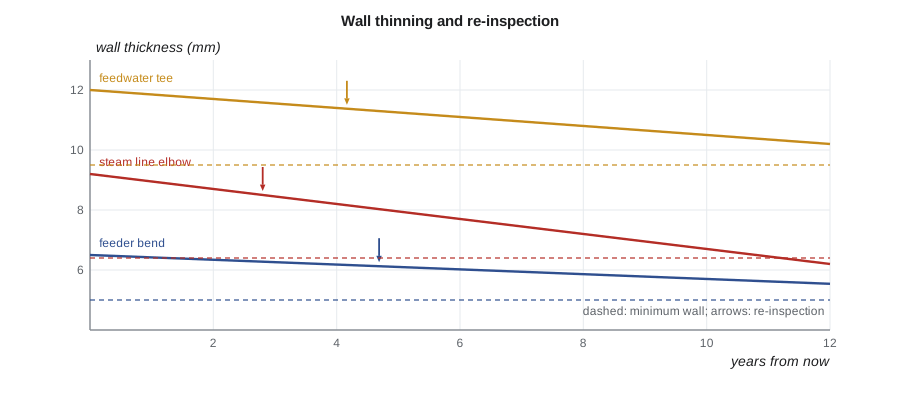
The equation gives a simple remaining-life estimate: the remaining thickness allowance divided by the wear rate multiplied by a safety factor. Programs then set the next inspection well before the predicted time to reach the minimum wall.
Worked problem
Remaining life of a thinned elbow
An extraction steam elbow measures 9.2 mm, its minimum allowable wall is 6.4 mm, and its measured wear rate is 0.25 mm per year. With a safety factor of 2 on the rate, find the remaining life and a sensible re-inspection interval.
Show solution
- Allowance = 9.2 − 6.4 = 2.8 mm.
- Remaining life = 2.8 / (2 × 0.25) = 5.6 years.
- Re-inspect within about half the remaining life, roughly 2.8 years, or replace with a chromium-bearing steel.
Answer: About 5.6 years of remaining life, so re-inspection within about three years; a replacement with chromium-bearing steel would essentially stop the problem.
# Corrosion in reactor environments: general corrosion and flow-accelerated corrosion (FAC)
# wall thinning, with remaining life and a re-inspection date.
def remaining_life(t_now_mm, t_min_mm, rate_mm_per_yr, sf=2.0):
    # Divide the remaining allowance by a rate increased by a safety factor
    return (t_now_mm - t_min_mm) / (rate_mm_per_yr * sf)
cases = [("feeder pipe bend (CANDU outlet)", 6.5, 5.0, 0.08),
         ("extraction steam line elbow", 9.2, 6.4, 0.25),
         ("feedwater tee (low chromium)", 12.0, 9.5, 0.15)]
for name, t_now, t_min, rate in cases:
    life = remaining_life(t_now, t_min, rate)
    print(f"{name:34s}: {t_now} mm now, {t_min} mm minimum, rate {rate} mm/yr -> {life:4.1f} years; re-inspect within {min(life/2, 10):.1f} years")
# Effect of chromium content on FAC rate (trend only): rate falls steeply with a little chromium
for cr in (0.01, 0.05, 0.1, 0.5, 1.0):
    rel = 1.0 / (1.0 + 30.0 * cr)
print(f"chromium {cr:4.2f} wt%: relative FAC rate {rel:4.2f}")feeder pipe bend (CANDU outlet) : 6.5 mm now, 5.0 mm minimum, rate 0.08 mm/yr -> 9.4 years; re-inspect within 4.7 years extraction steam line elbow : 9.2 mm now, 6.4 mm minimum, rate 0.25 mm/yr -> 5.6 years; re-inspect within 2.8 years feedwater tee (low chromium) : 12.0 mm now, 9.5 mm minimum, rate 0.15 mm/yr -> 8.3 years; re-inspect within 4.2 years chromium 0.01 wt%: relative FAC rate 0.77 chromium 0.05 wt%: relative FAC rate 0.40 chromium 0.10 wt%: relative FAC rate 0.25 chromium 0.50 wt%: relative FAC rate 0.06 chromium 1.00 wt%: relative FAC rate 0.03
Stress corrosion cracking
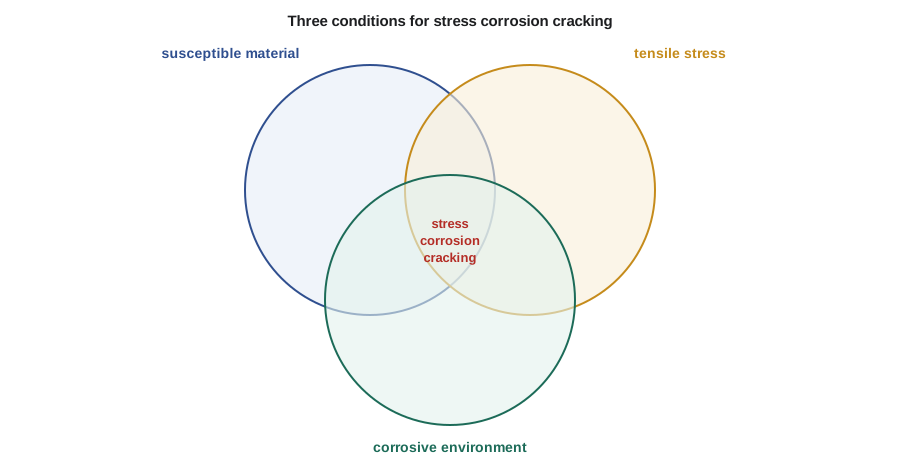
Stress corrosion cracking (SCC) needs three things together: a susceptible material, a tensile stress (often residual stress from welding or cold work) and a corrosive environment. Remove any one, and cracking stops. Several forms are important in reactors.
| Form | Materials affected | Environment | Main remedies |
|---|---|---|---|
| Intergranular SCC | sensitized stainless steel near welds | BWR water with dissolved oxygen | low-carbon grades, hydrogen water chemistry, stress improvement |
| Primary water SCC | Alloy 600 and its weld metals (82, 182) | PWR primary water at high temperature | replacement with Alloy 690 and weld metals 52 and 152; peening; overlays |
| Outside-diameter SCC | steam generator tubes | concentrated impurities in crevices on the secondary side | improved alloys, chemistry, sludge removal |
| Irradiation-assisted SCC | stainless internals after high dose | any reactor water | inspection, bolt replacement, lower stresses |
| Delayed hydride cracking | zirconium alloys | hydrogen in the metal (not water-driven) | hydrogen limits, flaw evaluation (Lesson 4) |
Sensitization is a key idea for stainless steels. When austenitic stainless steel is held between about 500 and 800 °C, as in the heat-affected zone of a weld, chromium carbides form at grain boundaries and the metal next to them is depleted of chromium. Those depleted zones corrode and crack preferentially. Low-carbon grades such as 304L and 316L, or stabilized grades, avoid most sensitization, and heat input during welding is controlled. In BWRs, hydrogen water chemistry lowers the corrosion potential below the level at which intergranular cracking grows quickly.
Primary water SCC of Alloy 600 is a slow, thermally activated process with a long incubation period, which is why it appeared only after many years of operation. Its replacement, Alloy 690, which has about 30 percent chromium instead of 15, has shown very high resistance in decades of service, and steam generators in both countries have largely been replaced or built with Alloy 690 or Alloy 800 tubing.
Boric acid corrosion and crevices
If borated primary coolant leaks onto carbon or low-alloy steel, the water evaporates and leaves concentrated boric acid, which can corrode steel at rates of centimeters per year. Plants therefore have boric acid corrosion control programs to find and clean small leaks promptly and inspect the steel beneath them. Crevices, such as those between steam generator tubes and their support plates, are another classic site for corrosion, because impurities concentrate where flow is restricted and boiling occurs.
Steam generator tubes
Steam generator tubes are the largest area of primary pressure boundary in a plant: thousands of thin tubes, about 1 mm thick, with a total surface area of several thousand square meters per generator. Their degradation has been one of the most costly materials problems in the industry. Early tubes of Alloy 600 cracked from the primary side at roll transitions and tight U-bends, and from the secondary side in crevices and under sludge piles. Tubes also wear where they rub against support structures or loose parts, and they can pit or dent where corrosion products build up in support plates.
| Degradation | Location | Typical response |
|---|---|---|
| Primary water SCC | roll transitions, U-bends | plugging or sleeving; replacement with Alloy 690 |
| Outside-diameter SCC and intergranular attack | crevices at tube sheet and supports, sludge piles | chemistry control, sludge lancing, chemical cleaning |
| Fretting and wear | anti-vibration bars, support plates, loose parts | plugging; foreign material exclusion |
| Pitting | under deposits near the tube sheet | chemistry control, deposit removal |
| Denting | carbon steel support plates corroding against tubes | stainless steel supports with broached holes in later designs |
Tubes are inspected during outages with eddy current probes pushed through each tube from the primary side. Flaw signals are sized and compared with plugging criteria; tubes that exceed them are plugged at both ends or repaired with sleeves. Each generator has a plugging margin, the fraction of tubes that can be plugged before thermal performance or flow is affected. Many plants in both countries have replaced their original generators, and the replacements, with Alloy 690 or Alloy 800 tubes and better support designs, have performed far better.
Corrosion outside the primary circuit
Not every corrosion problem involves high-temperature water. Service water systems, which use raw lake or river water to cool safety-related equipment, suffer pitting, microbiologically influenced corrosion, fouling by mussels and silt, and erosion. Buried piping and tanks corrode on the outside where coatings fail or cathodic protection is inadequate; leaks of tritiated water from buried lines at several plants in the 2000s led to industry groundwater protection initiatives. Containment liners and reinforcing steel in concrete can corrode where water collects. These systems are less glamorous than the core, but they make up a large share of the aging management work at an operating plant.
Monitoring corrosion
Corrosion programs combine prediction with measurement. Chemistry is sampled continuously or daily, and deviations trigger action levels that require correction within set times. Corrosion coupons and probes in some systems give direct rates. Wall thickness is measured by ultrasonic testing at locations chosen by prediction models and by experience. Cracks are looked for by eddy current, ultrasonic and visual examinations. Operating experience from other plants is reviewed for new mechanisms, which is how most of the corrosion problems described in this lesson spread from first discovery to industry-wide programs within a few years.
At the end of the week Malik gives Hana a simple exercise: list every corrosion mechanism that could affect one system, then name the measurement that would detect each. It turns out to be harder than it sounds, and it is exactly the kind of thinking that aging management programs require.
Chemistry as a corrosion tool
Water chemistry is the cheapest corrosion control available, and plants have refined it steadily. In PWRs, the lithium concentration is coordinated with the boron concentration through each cycle so that the pH at temperature stays close to a target, commonly about 7.0 to 7.4, which minimizes corrosion product transport and crud deposition on fuel. Zinc injection at a few parts per billion changes the structure of oxide films on stainless steel and nickel alloys, making them thinner and more protective, lowering radiation fields and, in laboratory tests, slowing crack initiation in Alloy 600. In BWRs, noble metal chemistry deposits small amounts of platinum on wetted surfaces, so that a modest hydrogen addition is enough to lower the corrosion potential where it matters.
On the secondary side, the most important control is keeping oxygen, chloride, sulfate and sodium very low, because these concentrate in steam generator crevices and drive tube corrosion. Condenser leaks that admit lake or river water are therefore treated as chemistry events requiring quick action. Each change to chemistry has to be checked against all the materials in contact with the water: a change that helps one alloy may harm another or affect fuel deposits, which is why chemistry programs are reviewed jointly by chemists, materials engineers and fuel designers.
Summary and key terms
- Reactor water chemistry is controlled closely; radiolysis makes BWR water oxidizing unless hydrogen is added.
- General corrosion releases metal that is activated in the core and raises radiation fields elsewhere.
- Flow-accelerated corrosion thins carbon steel in deoxygenated flowing water; chromium greatly reduces it.
- Stress corrosion cracking requires a susceptible material, tensile stress and a corrosive environment together.
- Alloy 600 and its weld metals crack in PWR primary water; Alloy 690 and its weld metals are much more resistant.
- Boric acid from leaks can rapidly corrode carbon steel, so leaks are found and cleaned promptly.
- Radiolysis
- The splitting of water by radiation into radicals, hydrogen, oxygen and peroxide.
- Activity transport
- Movement of corrosion products into the core, their activation, and their deposition elsewhere.
- Flow-accelerated corrosion
- Thinning of carbon steel as its protective oxide dissolves into flowing water.
- Stress corrosion cracking
- Cracking caused by the combined action of tensile stress and a corrosive environment on a susceptible material.
- Sensitization
- Chromium depletion at grain boundaries of stainless steel from carbide precipitation.
- Electrochemical corrosion potential
- The potential of a metal in water, which controls cracking rates in BWRs.
Practice problems
Work each problem on paper first, then reveal the answer to check.
Why is hydrogen added to BWR water in many plants?
Show answer
To lower the electrochemical corrosion potential and slow stress corrosion cracking.
Which element in carbon steel most reduces flow-accelerated corrosion?
Show answer
Chromium.
An elbow has 2.0 mm of allowance and wears at 0.1 mm per year. With a safety factor of 2, what is its remaining life?
Show answer
\(2.0/(2 \times 0.1) = 10\) years.
Name the three conditions required for stress corrosion cracking.
Show answer
Susceptible material, tensile stress and a corrosive environment.
What replaced Alloy 600 in steam generator tubes and nozzle repairs?
Show answer
Alloy 690 and its weld metals 52 and 152.
Lesson quiz · 5 questions
Score 60% or more to complete this lesson.
Create a free account to save your progress, take quizzes and earn a certificate.