
NUC-340 · Lesson 3 of 12 · 21 min
Uranium fuels
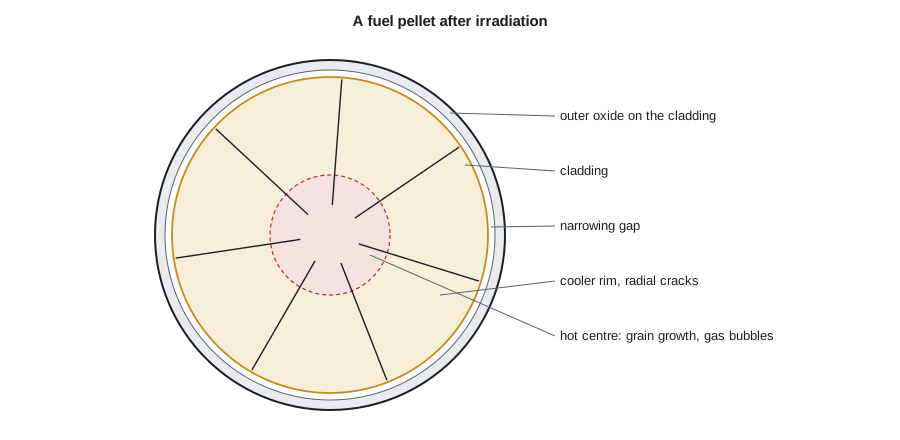
Malik takes Hana to the fuel laboratory, where a technician is examining a cross-section of a high-burnup PWR fuel rod under a microscope. The pellet is no longer a clean cylinder: a pattern of radial cracks runs out from the center, the center has a different grain structure, a porous rim has formed at the edge, and the gap to the cladding has closed. "Low-enriched uranium dioxide, about 60 megawatt-days per kilogram after three cycles," Malik says. "The pellet has been completely reshaped by heat and fission."
Why uranium dioxide
Almost all power reactors burn uranium dioxide (UO₂) fuel. Metallic uranium, used in some early reactors, has a much higher density of uranium atoms and higher thermal conductivity, but it changes phase at modest temperatures, swells badly under irradiation and reacts with water. UO₂ is a ceramic with the fluorite crystal structure. It melts at about 2850 °C, is chemically compatible with water and zirconium alloys, keeps its crystal structure up to melting, and can hold large amounts of fission products in its lattice. Its main drawbacks are low thermal conductivity, which makes the pellet center run hot, and brittleness, which means pellets crack during the first power rise.
| Property | Approximate value | Consequence |
|---|---|---|
| Melting point | about 2850 °C (falls slightly with burnup) | large margin at normal power |
| Theoretical density | 10.96 g/cm³; pellets are about 95 to 97 percent dense | pores accommodate some swelling and gas |
| Thermal conductivity | about 2.5 to 7 W/m·K, falling with temperature and burnup | steep radial temperature gradient |
| Thermal expansion | about 1 × 10⁻⁵ per kelvin | pellets crack and relocate outward |
| Oxygen-to-metal ratio | about 2.00 as fabricated | controls conductivity and fission product chemistry |
Natural and enriched fuel
Uranium in nature contains about 0.711 percent uranium-235 by mass, the rest being almost all uranium-238. CANDU reactors can use natural uranium because heavy water absorbs so few neutrons. Light water reactors need fuel enriched in uranium-235, typically 3 to 5 percent, with some recent fuel programs moving toward slightly higher levels within the low-enriched range. Enrichment itself is a separate industrial process and is not covered in this materials course; what matters here is that enrichment and burnup together set how long fuel stays in the core and how much it is changed by irradiation.
A 17 × 17 PWR fuel assembly is about 4 m long and holds 264 fuel rods. Each rod holds a stack of enriched UO₂ pellets inside a zirconium alloy cladding tube filled with pressurized helium. Assemblies stay in the core for three or four cycles of 18 to 24 months each, so a third or so of the core is replaced at each refueling outage.
Burnup
Burnup measures how much energy the fuel has produced per unit mass of initial heavy metal, usually in megawatt-days per kilogram of uranium (MWd/kgU). About 200 MeV is released per fission, so 1 MWd of energy corresponds to roughly 1 gram of heavy metal fissioned. A burnup of 10 MWd/kgU, which is typical of CANDU discharge, means about 1 percent of the heavy atoms have fissioned. Light water reactor fuel reaches 40 to 60 MWd/kgU, so roughly 4 to 6 percent of the atoms have fissioned, and in the United States the burnup of a rod is limited by its licensing basis, commonly a rod-average burnup of about 62 MWd/kgU.
Each fission replaces one heavy atom with two lighter fission product atoms, so the number of atoms in the fuel grows with burnup. Some fission products, such as cesium and strontium, form oxides or compounds; others, such as zirconium and the rare earths, dissolve in the UO₂ lattice; others form metallic precipitates; and the noble gases xenon and krypton, about 15 percent of fission products, are almost insoluble.
The temperature profile and pellet cracking
Because UO₂ conducts heat poorly, the center of a pellet is much hotter than its surface. For a pellet with uniform heat generation and constant conductivity, the temperature difference between center and surface depends only on the linear heat rate q' and the conductivity:
With q' = 40 kW/m and k = 3 W/m·K, the difference is about 1060 K. Because k falls as temperature rises, real calculations use the conductivity integral, the area under the k(T) curve, rather than a single value. The steep gradient means the hot center expands more than the cooler rim, and the resulting tensile hoop stress at the rim cracks the pellet during the first power rise, into a handful of radial wedges. The fragments move outward toward the cladding, an effect called relocation, which narrows the gap.
Changes with burnup
| Effect | What happens | Consequence |
|---|---|---|
| Densification | small pores sinter away early in life | pellet shrinks slightly; gap opens |
| Swelling | solid fission products and gas bubbles add volume, about 0.7 to 1 percent per 10 MWd/kgU | pellet grows; gap closes |
| Conductivity degradation | dissolved fission products and lattice damage scatter phonons | center temperature rises at the same power |
| Fission gas release | xenon and krypton diffuse to grain boundaries and escape to the gap | rod pressure rises; gap conductance falls |
| High burnup structure | at the pellet rim, grains subdivide into very fine grains with many pores | forms above about 60 MWd/kgU local burnup |
| Pellet-cladding interaction | expanding pellet presses against the cladding during power increases | stress and possible cracking with iodine |
Conductivity degradation and fission gas release interact in a way that matters for safety. As burnup rises, the fuel conducts heat less well, so for the same linear heat rate the center runs hotter. Fission gas release rises steeply once the center exceeds about 1200 to 1300 °C, because diffusion of gas atoms is thermally activated. Released xenon and krypton conduct heat far worse than the helium fill gas, so gap conductance falls and the fuel runs hotter still. Fuel performance codes follow this coupled behavior step by step through the fuel's life, and design limits on linear heat rate fall with burnup to keep it in check.
Worked problem
Center temperature as fuel ages
A rod operates at 30 kW/m with a pellet surface temperature of 500 °C. Estimate the centerline temperature for fresh fuel and for fuel at 60 MWd/kgU using an illustrative conductivity model.
Show solution
- Integrate the conductivity from the surface temperature upward until the conductivity integral equals q'/4π = 30 000/(4π) ≈ 2390 W/m.
- For fresh fuel, the conductivity is higher, so the integral is reached at a lower temperature, about 1140 °C.
- At 60 MWd/kgU, conductivity is lower at every temperature, so the same integral requires a centerline temperature of about 1750 °C.
Answer: Aging raises the centerline temperature by several hundred kelvin at the same power, which is why allowable linear heat rates fall as fuel burns.
# UO2 fuel: conductivity degradation with burnup and the fuel centerline temperature.
import math
def k_uo2(T_K, bu_MWd_kgU):
    # Illustrative fit of a widely used form: phonon term with a burnup penalty plus an electronic term.
    t = T_K / 1000.0
    phonon = 1.0 / (0.0375 + 2.165e-4 * T_K + 0.0035 * bu_MWd_kgU)
    elec = 4715e6 / t**2.5 * math.exp(-16361.0 / T_K) / 1e9 * 1e3
    return phonon + elec
def center_temp(q_lin, T_surf_K, bu):
    # Integrate dT = q'/(4 pi k(T)) in small steps of conductivity integral.
    target = q_lin / (4 * math.pi)          # W/m, conductivity integral required
    T, acc, dT = T_surf_K, 0.0, 1.0
    while acc < target:
        acc += k_uo2(T, bu) * dT
        T += dT
    return T
T_s = 773.0     # pellet surface temperature, K (about 500 C)
for q in (20e3, 30e3, 40e3):
    for bu in (0.0, 30.0, 60.0):
        Tc = center_temp(q, T_s, bu)
        print(f"q' = {q/1e3:4.0f} kW/m, burnup {bu:4.0f} MWd/kgU: centerline {Tc-273.15:6.0f} C")
# Fission gas release, a simplified threshold view (illustrative)
for Tc in (1100, 1300, 1500, 1700):
    frac = 0.01 if Tc < 1250 else min(0.5, 0.01 + 0.0012 * (Tc - 1250))
print(f"centerline {Tc} C -> fission gas release roughly {100*frac:.0f} percent")q' = 20 kW/m, burnup 0 MWd/kgU: centerline 889 C q' = 20 kW/m, burnup 30 MWd/kgU: centerline 1088 C q' = 20 kW/m, burnup 60 MWd/kgU: centerline 1285 C q' = 30 kW/m, burnup 0 MWd/kgU: centerline 1140 C q' = 30 kW/m, burnup 30 MWd/kgU: centerline 1459 C q' = 30 kW/m, burnup 60 MWd/kgU: centerline 1751 C q' = 40 kW/m, burnup 0 MWd/kgU: centerline 1432 C q' = 40 kW/m, burnup 30 MWd/kgU: centerline 1860 C q' = 40 kW/m, burnup 60 MWd/kgU: centerline 2194 C centerline 1100 C -> fission gas release roughly 1 percent centerline 1300 C -> fission gas release roughly 7 percent centerline 1500 C -> fission gas release roughly 31 percent centerline 1700 C -> fission gas release roughly 50 percent
Pellet-cladding interaction
When reactor power rises quickly, pellets heat and expand faster than the cladding, and if the gap has closed the pellet pushes the cladding outward. Stress concentrates where pellet cracks meet the cladding. If corrosive fission products such as iodine are present, the cladding can crack from the inside by stress corrosion cracking, a failure mode called pellet-cladding interaction (PCI). Defenses include limits on how fast power can be raised after a period at low power, barrier liners of pure zirconium on the inside of some BWR cladding, chamfered pellets and, in CANDU fuel, the graphite-based coating inside the sheath. CANDU on-power refueling also moves bundles into higher-power positions, so fuel management rules limit the power increase a bundle may experience as it is shuffled.
Other fuel forms
Several other fuel forms are in use or under development. Mixed oxide fuel combines uranium and plutonium oxides and is used in some light water reactors overseas. Uranium silicide and uranium nitride have higher uranium density and conductivity and are studied for accident-tolerant fuel, as Lesson 10 explains. TRISO particle fuel, used in high-temperature gas reactors, packs a small kernel inside layers of carbon and silicon carbide that retain fission products to very high temperatures, as Lesson 11 describes. Metallic fuels of uranium alloyed with zirconium are used in some fast reactor designs. Each has its own behavior under irradiation, but the questions are always the same: how hot it runs, how it swells, how it releases gas and how it interacts with its cladding.
Fabrication and quality
Fuel behavior in the reactor begins with fabrication. UO₂ powder is pressed into green pellets and sintered at about 1700 °C in a hydrogen atmosphere to reach the specified density. The grain size, pore size distribution and oxygen-to-metal ratio all affect later behavior: larger grains, for example, slow fission gas release because gas atoms must travel farther to reach a grain boundary, and some vendors add small amounts of chromium or aluminum oxides to grow larger grains. Pellets are ground to a precise diameter, inspected, and loaded into tubes, which are then filled with helium and sealed by welding end caps.
| Fabrication parameter | Typical control | Why it matters in service |
|---|---|---|
| Pellet density | about 95 to 97 percent of theoretical | sets densification, swelling and gas accommodation |
| Grain size | about 10 µm, larger in doped fuel | larger grains retain more fission gas |
| Pellet-to-cladding gap | tens of micrometers | sets early fuel temperatures and when the gap closes |
| Moisture and hydrogen content | kept very low | hydrogen from moisture can cause internal hydriding of the cladding |
| End cap weld quality | inspected for every rod or element | a poor weld can be a leak path |
Moisture control deserves special mention. Early experience with zirconium alloy fuel showed that small amounts of moisture or hydrogenous contamination inside a rod could cause local hydriding of the cladding from the inside, producing sunbursts of hydride and eventually defects. Strict drying of pellets and control of fill gas now make such failures rare. Debris is another common cause of fuel defects in light water reactors: small pieces of metal carried by the coolant can fret through cladding, so plants use debris filters at the bottom of each assembly and strict foreign-material exclusion during outages.
Fuel after the reactor
Used fuel continues to be a materials problem after it leaves the core. It is first cooled in water-filled pools, where the cladding must resist corrosion for years or decades. Later it may be transferred to dry storage casks or containers, where it is held in an inert gas. In dry storage, the main concerns are the cladding temperature during drying and early storage, which limits hydride reorientation and creep, and the long-term integrity of the container and its welds. In Canada, used CANDU bundles are stored in pools and then in dry storage containers at the stations, pending a deep geological repository. In the United States, used fuel is likewise stored in pools and dry casks at reactor sites. In both cases, the fuel's materials history in the reactor affects how it behaves in storage.
Summary and key terms
- Uranium dioxide is the standard power reactor fuel: a ceramic with a high melting point, good compatibility with water and low thermal conductivity.
- CANDU reactors use natural uranium; light water reactors use low-enriched uranium, typically 3 to 5 percent uranium-235.
- Burnup, in MWd/kgU, measures energy per mass of heavy metal; about 950 MWd/kgU corresponds to complete fission.
- The center-to-surface temperature difference is q'/4πk; pellets crack and relocate during the first power rise.
- With burnup, fuel swells, loses conductivity and releases fission gas, raising temperatures at a given power.
- Pellet-cladding interaction during power increases can crack cladding; operating rules and design features limit it.
- Burnup
- Energy produced per unit mass of initial heavy metal, usually in MWd/kgU.
- Relocation
- Outward movement of cracked pellet fragments toward the cladding.
- Fission gas release
- The escape of xenon and krypton from the fuel into the gap and plenum.
- Conductivity integral
- The integral of thermal conductivity over temperature, used to find fuel temperatures.
- Pellet-cladding interaction
- Stress and possible cracking of cladding caused by pellet expansion against it.
- High burnup structure
- A fine-grained, porous microstructure that forms at the pellet rim at high local burnup.
Practice problems
Work each problem on paper first, then reveal the answer to check.
Why is UO₂ preferred to uranium metal for power reactor fuel?
Show answer
It keeps its crystal structure to its melting point, swells less, and is compatible with water and zirconium.
A pellet runs at 35 kW/m with k = 3.5 W/m·K. Estimate the center-to-surface temperature difference.
Show answer
\(35\,000/(4\pi \times 3.5) \approx 800\) K.
What fraction of heavy atoms has fissioned at 40 MWd/kgU?
Show answer
About 4 percent.
Why does fission gas release reduce gap conductance?
Show answer
Xenon and krypton conduct heat much worse than helium.
Name two defenses against pellet-cladding interaction.
Show answer
Power ramp rate limits and barrier liners or internal sheath coatings.
Lesson quiz · 5 questions
Score 60% or more to complete this lesson.
Create a free account to save your progress, take quizzes and earn a certificate.