
NUC-340 · Lesson 10 of 12 · 20 min
Accident-tolerant fuels
Malik opens the next session with a single number: 2200. "That is the peak cladding temperature limit, in degrees Fahrenheit, in 10 CFR 50.46," he says. "That is 1204 degrees Celsius. Above it, zirconium reacts with steam so fast that it feeds the accident with heat and makes hydrogen. Fukushima showed what happens when cooling is lost for long enough. Accident-tolerant fuels are about buying time."
Why the zirconium–steam reaction matters
Zirconium alloys perform very well in normal operation, but at high temperatures in steam their oxidation becomes rapid and strongly exothermic:
Above about 1200 °C the reaction rate increases steeply, and the heat it releases can exceed the decay heat in the affected region, accelerating the temperature rise. The oxygen absorbed into the metal beneath the oxide embrittles it, which is why emergency core cooling criteria limit both peak cladding temperature and the extent of oxidation. The hydrogen produced can accumulate and burn: at Fukushima Daiichi in 2011, after cooling was lost for many hours, hydrogen from extensive zirconium oxidation escaped into the reactor buildings of three units and exploded, damaging them.
High-temperature steam oxidation of zirconium alloys follows parabolic kinetics, because the rate is controlled by diffusion through the growing oxide:
where w is the weight gain per unit area. The Baker–Just and Cathcart–Pawel correlations are classic examples of this form for Zircaloy. The goal of accident-tolerant fuel (ATF) is to lower k_p by large factors, raise the temperature at which rapid oxidation starts, retain fission products better, or all three, while matching or improving normal operating performance.
Goals of accident-tolerant fuels
| Goal | How it helps in an accident | Example approaches |
|---|---|---|
| Slower oxidation in steam | less heat and hydrogen from cladding reaction; more time for operators | chromium coatings; FeCrAl cladding; silicon carbide composites |
| Higher temperature capability | cladding survives longer above normal limits | silicon carbide composites; coatings |
| Better fission product retention | less release if cladding fails | doped pellets with larger grains |
| Higher fuel thermal conductivity | lower fuel temperatures and stored energy | uranium silicide; uranium nitride |
| Better normal performance | higher burnup and power uprates | doped pellets; coated cladding with lower corrosion |
Near-term concepts
Several concepts are close to use in commercial light water reactors.
Chromium-coated zirconium alloy cladding adds a thin layer of chromium, about 10 to 20 micrometers thick, to the outside of a standard tube, by physical vapor deposition or cold spray. In steam, the chromium forms a protective chromia layer that grows much more slowly than zirconia. Coated cladding also resists wear from debris and has lower corrosion in normal operation. Its limits include interdiffusion of chromium and zirconium at very high temperatures and the behavior of the uncoated inner surface if the cladding balloons and bursts.
Iron–chromium–aluminum (FeCrAl) alloy cladding forms a protective alumina layer at high temperature and oxidizes orders of magnitude more slowly than zirconium. Its drawbacks are higher neutron absorption, which requires slightly higher enrichment or thinner walls, and the release of tritium through the cladding because hydrogen diffuses readily in iron-based alloys.
Doped uranium dioxide pellets contain small additions of chromium oxide, sometimes with aluminum oxide, which produce larger grains during sintering. Larger grains slow fission gas release and make pellets more plastic at high temperature, reducing pellet-cladding interaction.
Worked problem
Comparing oxidation after ten minutes at 1200 °C
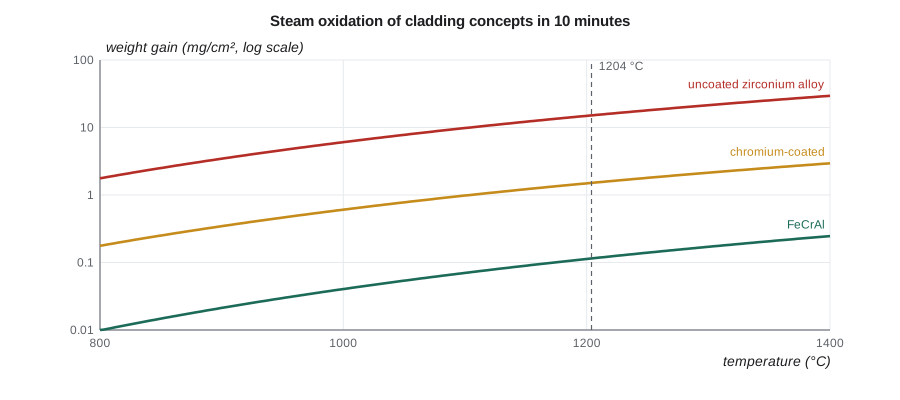
Using illustrative parabolic constants with an activation energy of 140 kJ/mol, compare weight gains after 10 minutes at 1200 °C for uncoated zirconium (A = 3.4 × 10⁴) and chromium-coated zirconium (A = 3.4 × 10²), both in (mg/cm²)²/s.
Show solution
- k_p = A exp(−140 000 / (8.314 × 1473)) = A × 1.09 × 10⁻⁵.
- Uncoated: k_p ≈ 0.37, so w = √(0.37 × 600) ≈ 14.9 mg/cm².
- Coated: k_p is 100 times smaller, so w is 10 times smaller, about 1.5 mg/cm².
Answer: About 15 mg/cm² for uncoated zirconium against 1.5 mg/cm² with a chromium coating. Because hydrogen and heat scale with oxidation, the coated cladding gives about ten times less of each over this period.
# Accident-tolerant fuels: high-temperature steam oxidation of zirconium alloy vs a
# chromium coating and FeCrAl, using parabolic kinetics w^2 = k t (illustrative constants).
import math
R = 8.314
materials = {
    "uncoated zirconium alloy": (3.4e4, 1.4e5),     # (A in (mg/cm2)^2/s, activation energy J/mol)
    "chromium-coated zirconium": (3.4e2, 1.4e5),
    "FeCrAl (alumina former)": (1.0e1, 1.6e5),
}
def weight_gain(A, Q, T_C, t_s):
    k = A * math.exp(-Q / (R * (T_C + 273.15)))
    return math.sqrt(k * t_s)
for T in (1000, 1200):
    for name, (A, Q) in materials.items():
        w = weight_gain(A, Q, T, 600.0)
        print(f"{T} C, 10 min, {name:28s}: weight gain {w:6.2f} mg/cm2")
# Hydrogen from oxidation: Zr + 2 H2O -> ZrO2 + 2 H2  (each mg of oxygen picked up releases 1/8 mg of H2)
w = weight_gain(*materials["uncoated zirconium alloy"], 1200, 600.0)
area_m2 = 6000.0     # rough cladding surface area of a large core
h2_kg = w * 1e-3 / 8.0 * area_m2 * 1e4 / 1000.0
print(f"if the whole uncoated core reacted this much: about {h2_kg:,.0f} kg of hydrogen")1000 C, 10 min, uncoated zirconium alloy : weight gain 6.06 mg/cm2 1000 C, 10 min, chromium-coated zirconium : weight gain 0.61 mg/cm2 1000 C, 10 min, FeCrAl (alumina former) : weight gain 0.04 mg/cm2 1200 C, 10 min, uncoated zirconium alloy : weight gain 14.88 mg/cm2 1200 C, 10 min, chromium-coated zirconium : weight gain 1.49 mg/cm2 1200 C, 10 min, FeCrAl (alumina former) : weight gain 0.11 mg/cm2 if the whole uncoated core reacted this much: about 112 kg of hydrogen
Longer-term concepts
Silicon carbide fiber-reinforced silicon carbide composites can survive temperatures far above zirconium's limits and react only slowly with steam. Their challenges include making long, gas-tight, thin tubes, joining end caps, and their dissolution in normal reactor water, which may need protective coatings. Higher-density fuels such as uranium silicide (U₃Si₂) and uranium nitride have greater uranium density and conductivity than UO₂, which lowers fuel temperatures and could offset the absorption of FeCrAl cladding, but they react with water if the cladding fails, so they need careful qualification.
Qualification and licensing
New fuel must be qualified before it can be used across a core. Qualification typically follows a sequence: laboratory tests of properties; irradiation of rodlets and specimens in test reactors; insertion of lead test rods or lead test assemblies in commercial reactors, where they run for several cycles; post-irradiation examination in hot cells; transient tests that simulate accidents; and finally licensing of the design for batch use, including updated fuel performance models and safety analysis.
In the United States, lead test rods and assemblies with coated cladding, FeCrAl cladding and doped pellets have been operating in commercial reactors since 2018 and 2019, and the NRC has been reviewing topical reports and associated requests for higher enrichment and burnup. The Department of Energy has supported the program through cost-shared work with fuel vendors and testing at its national laboratories.
Accident-tolerant fuels also interact with other plans. Utilities want higher burnups and longer cycles, which may need enrichment slightly above 5 percent while staying in the low-enriched range. Changes in enrichment and burnup affect fuel fabrication, transport and storage licenses, and the behavior of fuel in loss-of-coolant accidents at high burnup, including fragmentation and relocation of fuel pellets into ballooned cladding, a phenomenon that regulators and researchers have studied closely.
What happens to cladding in a loss-of-coolant accident
To understand what accident-tolerant fuel must improve, it helps to follow standard cladding through a large-break loss-of-coolant accident. As the coolant blows down, the cladding heats up because the fuel's stored heat and decay heat are no longer carried away. The pressure outside the cladding falls, while the gas inside, helium plus released fission gas, is hot and at high pressure. At around 700 to 900 °C, the cladding is weak enough that this internal pressure balloons it outward. The balloon may burst, opening a hole through which fuel fragments can escape and steam can oxidize the inside of the cladding. Ballooned rods can also narrow the coolant channels between them, so experiments have measured how much flow blockage can occur before cooling is affected.
When emergency coolant reaches the hot cladding, it quenches it, cooling it suddenly. Thermal stresses during quench can break cladding that has been made brittle by oxygen absorption or hydrogen. The original acceptance criteria were derived from quench tests on oxidized cladding: if oxidation and peak temperature stay within the limits, the cladding keeps enough ductility to survive quench and later handling. More recent research found that hydrogen absorbed in normal operation reduces the oxidation that cladding can tolerate, and that oxygen can enter from the inside surface too, leading to revised criteria in the United States that depend on pre-accident hydrogen content.
| Accident phase | Cladding behavior | What accident-tolerant fuel could change |
|---|---|---|
| Heat-up | temperature rises from stored and decay heat | higher-conductivity fuel lowers stored heat |
| Ballooning and burst | internal pressure deforms weakened cladding | stronger cladding at temperature; less fission gas |
| High-temperature oxidation | steam reacts with zirconium, releasing heat and hydrogen | much slower oxidation of coatings and FeCrAl |
| Quench | thermal shock can break embrittled cladding | less oxygen and hydrogen embrittlement |
| Long-term cooling | fuel must stay in a coolable geometry | better retention of pellet fragments |
Reactivity-initiated accidents
A second accident class tests fuel in a completely different way. In a reactivity-initiated accident, such as the ejection of a control rod in a PWR, power rises sharply for a few tens of milliseconds. The fuel heats almost adiabatically, and the pellet expands against the cladding before the cladding has time to warm. Cladding that is brittle from hydrides can crack in this pellet-cladding mechanical interaction. Limits on the energy deposited in the fuel during such events depend on cladding hydrogen content, and pulse tests in research reactors, such as the TREAT reactor in Idaho and the NSRR in Japan, measure how new fuels behave.
A CANDU perspective
Other reactor types face the same questions in different forms. In the CANDU reactors used in Canada, for example, fuel sits in horizontal pressure tubes surrounded by a large volume of cool heavy water moderator, which can act as an additional heat sink in a severe loss of cooling. Accident tolerance there depends on the behavior of whole fuel channels as well as of fuel elements.
Accident tolerance beyond the fuel
Fuel is only one part of accident tolerance. Since 2011, plants in both countries have added portable pumps and generators, hardened connections and procedures to keep cores cooled after extreme events. Passive autocatalytic recombiners, which convert hydrogen and oxygen back into water without power, have been installed in many containments to prevent hydrogen burns. Filtered containment venting has been added at some plants. These measures and accident-tolerant fuel are complementary: better fuel buys time, and plant improvements make sure the time is used to restore cooling.
Judging a new fuel
Comparing fuel concepts needs a consistent set of questions. How much does the concept extend the time before cladding reaches its limits in the key accident scenarios? How does it behave in normal operation, including corrosion, hydrogen pickup, wear, creep and pellet-cladding interaction? What does it do to the neutron economy and therefore to enrichment, cycle length and fuel costs? Can it be manufactured at scale with consistent quality? How does it behave in transport, wet storage and dry storage? And how large is the database behind each of these answers? A concept that does well on accident behavior but poorly on normal operation will not be adopted, because utilities run their fuel in normal conditions every day and in accident conditions, it is hoped, never. The concepts that are furthest along are those that improve both.
Hana asks whether accident-tolerant fuel will ever be standard. Malik's answer is cautious: some concepts, such as doped pellets and coated cladding, are likely to become routine because they also improve normal operation and economics; others will need longer to prove. The decisive data will come from the lead assemblies now in reactors and from the hot cells that examine them.
Summary and key terms
- Zirconium reacts with steam exothermically above about 1200 °C, producing heat and hydrogen; oxidation is parabolic in time.
- Emergency core cooling criteria limit peak cladding temperature and oxidation to preserve coolable geometry.
- Accident-tolerant fuels aim for slower oxidation, higher temperature capability, better retention and better normal performance.
- Near-term concepts include chromium-coated zirconium, FeCrAl cladding and doped UO₂ pellets.
- Longer-term concepts include silicon carbide composites and high-density fuels such as uranium silicide and nitride.
- Qualification proceeds from laboratory tests to test reactors, lead test assemblies, examination, transient tests and licensing.
- Accident-tolerant fuel
- Fuel and cladding designed to tolerate loss of cooling for longer than standard zirconium-UO₂ fuel.
- Parabolic oxidation
- Oxidation in which weight gain grows as the square root of time.
- FeCrAl
- An iron–chromium–aluminum alloy that forms protective alumina in steam.
- Doped pellet
- A UO₂ pellet with small additives that produce larger grains.
- Lead test assembly
- A small number of assemblies of a new design inserted in a commercial reactor for testing.
- Fuel fragmentation
- Breaking of high-burnup pellets into small particles during an accident.
Practice problems
Work each problem on paper first, then reveal the answer to check.
Why does the zirconium–steam reaction make accidents worse?
Show answer
It releases heat that accelerates heating, and it produces hydrogen that can burn.
If the parabolic rate constant is reduced 100 times, how much does the weight gain at a given time fall?
Show answer
By a factor of 10, because weight gain goes as the square root of the rate constant.
Give one drawback of FeCrAl cladding.
Show answer
Higher neutron absorption or greater tritium permeation.
What do doped pellets improve?
Show answer
They retain more fission gas and reduce pellet-cladding interaction.
Name the steps of fuel qualification.
Show answer
Laboratory tests, test reactor irradiation, lead test assemblies, examination, transient tests and licensing.
Lesson quiz · 5 questions
Score 60% or more to complete this lesson.
Create a free account to save your progress, take quizzes and earn a certificate.