
NUC-340 · Lesson 4 of 12 · 19 min
Zirconium alloys
Hana's first real task in the materials group is to help review oxide thickness and hydrogen data from high-burnup PWR fuel rods examined in a hot cell. "Corrosion and hydrogen are the clock on zirconium cladding," Malik tells her. "The cladding picks up hydrogen slowly from corrosion. Below a certain level it stays dissolved and harmless. Above it, hydrides form, and hydrides make the cladding less ductile, which matters for accidents and for handling used fuel."
Why zirconium
Zirconium is used inside water-cooled reactor cores because it combines a very low thermal neutron absorption cross section, about 0.18 barn, with good corrosion resistance in high-temperature water and adequate strength. Pure zirconium is too weak and corrodes too unevenly, so it is alloyed with small amounts of tin, iron, chromium, nickel or niobium. Hafnium, which occurs naturally with zirconium and is a strong neutron absorber, must be removed to below about 100 parts per million.
| Alloy | Main additions (approximate) | Typical use |
|---|---|---|
| Zircaloy-2 | about 1.5 % Sn, with Fe, Cr and Ni | BWR cladding; CANDU calandria tubes; early pressure tubes |
| Zircaloy-4 | about 1.5 % Sn, with Fe and Cr, no Ni | PWR cladding (older designs); CANDU fuel sheaths |
| Zr–2.5 % Nb | 2.5 % niobium | CANDU pressure tubes |
| Zr–1 % Nb alloys | about 1 % niobium, sometimes with tin and iron | modern PWR cladding, such as ZIRLO-type and M5-type alloys |
| Zircaloy-2 variants with liners | Zircaloy-2 with an inner layer of purer zirconium | BWR cladding resistant to pellet-cladding interaction |
Crystal structure and texture
Below about 860 °C, zirconium has a hexagonal close-packed (hcp) crystal structure, the alpha phase. Above that, it transforms to a body-centerd cubic beta phase. The hcp crystal is strongly anisotropic: its properties along the c-axis, perpendicular to the basal planes, differ from those in the basal plane. Tube manufacturing, by extrusion and cold drawing or pilgering, aligns the grains so that most basal-plane normals point in particular directions, a preferred orientation called crystallographic texture. Texture controls how the tube creeps and grows under irradiation, how hydrides orient, and how it deforms under pressure, so it is specified and measured for every batch of tubing.
Zr–2.5 % Nb pressure tubes contain both alpha grains and thin filaments of a niobium-rich beta phase between them, produced by extrusion at about 800 °C and cold drawing. The tubes are then autoclaved in steam, which forms a protective black oxide film before they go into service. Their microstructure, texture and strength vary slightly along each tube and between tubes, and these variations are among the inputs to fitness-for-service assessments.
Corrosion in water
Zirconium reacts with water to form zirconium dioxide and hydrogen:
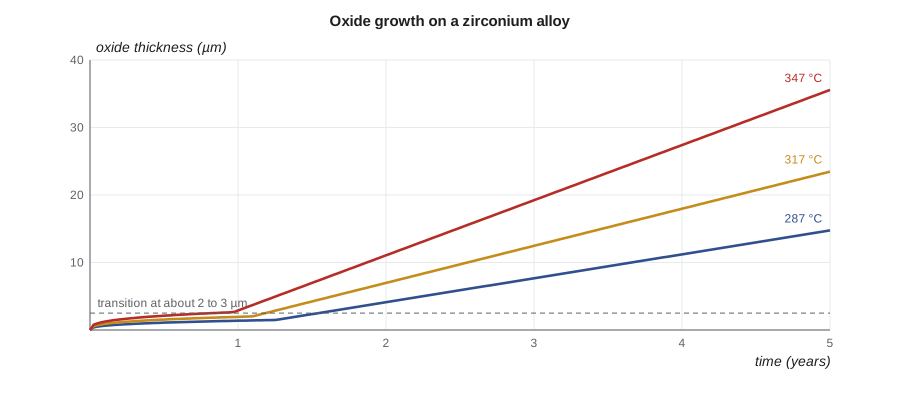
At reactor temperatures this reaction is slow because the oxide forms an adherent, protective layer. Oxygen ions must diffuse through the oxide to reach the metal, so in the early stage the oxide thickness s grows roughly as the cube root of time. After the oxide reaches a thickness of about 2 to 3 micrometers, it develops cracks and porosity and its protective inner layer is renewed periodically; this is the kinetic transition. After transition, oxide growth is roughly linear with time, made up of a series of small cubic cycles.
Corrosion rates rise steeply with metal temperature, so the hottest parts of fuel rods, near the top of a PWR core where the coolant is hottest, have the thickest oxide. Coolant chemistry matters too: lithium hydroxide used for pH control in PWRs can accelerate corrosion at high concentrations, and boiling at the cladding surface concentrates impurities. Modern niobium-bearing alloys corrode much more slowly than Zircaloy-4 at high burnup, which is one reason they were developed. Oxide layers also reduce heat transfer, because ZrO₂ conducts poorly, and thick oxides can spall, leaving cooler spots where hydrides gather.
Hydrogen pickup
Only a fraction of the hydrogen released by corrosion enters the metal; the rest goes into the coolant. This hydrogen pickup fraction is typically 10 to 20 percent for Zircaloy-4, varies among alloys, and changes with exposure. Each zirconium atom oxidized releases four hydrogen atoms, so the hydrogen concentration added to the remaining metal can be estimated from the oxide thickness, the wall thickness and the pickup fraction. In CANDU pressure tubes, hydrogen and deuterium enter from the inner surface by corrosion and also from the rolled joints at the end fittings; analysts combine them as a hydrogen equivalent concentration (Heq), counting deuterium at half its weight concentration.
Hydrides and terminal solid solubility
Hydrogen dissolves in zirconium only up to a limit called the terminal solid solubility (TSS), which rises steeply with temperature, from a few parts per million by weight near room temperature to tens of parts per million at 300 °C. Above the limit, brittle zirconium hydride platelets precipitate. The limit is different for dissolution on heating (TSSD) and for precipitation on cooling (TSSP), because precipitation needs extra supersaturation; this hysteresis is important when components are cooled down and heated up during outages.
Hydrides form as thin platelets on particular crystal planes. Their orientation matters: platelets lying in the circumferential–axial plane of a tube barely affect resistance to hoop stress, while radially oriented platelets provide easy paths for cracks through the wall. Tensile stress during cooling can reorient hydrides from circumferential to radial, which is one reason the temperature and stress history of used fuel during drying for dry storage is controlled.
Delayed hydride cracking
Delayed hydride cracking (DHC) is a slow crack growth mechanism that operates in zirconium alloys at temperatures where hydrogen is mobile. At the tip of a sharp flaw under tensile stress, the hydrostatic stress lowers the chemical potential of hydrogen, so hydrogen diffuses toward the tip and precipitates as hydride there. The hydride grows until it cracks under the stress, the crack advances through it, and the process repeats. DHC requires a flaw, a sufficient stress intensity above a threshold, and enough hydrogen to form hydride at the crack tip. It is a principal concern for CANDU pressure tubes, where flaws such as fretting marks or debris scratches could in principle initiate it, and the fitness-for-service rules for pressure tubes include DHC initiation and growth evaluations.
For PWR fuel, hydrogen matters less for crack growth in service than for ductility. The NRC has reviewed how hydrogen content affects cladding performance in loss-of-coolant accidents and in reactivity-initiated accidents, and fuel licensing analyzes must consider pre-transient hydrogen content in the cladding.
Worked problem
Hydrogen added by corrosion
A fuel sheath with a 570 µm wall has grown 20 µm of oxide. With a hydrogen pickup fraction of 0.15, estimate the hydrogen added to the metal.
Show solution
- Metal consumed ≈ oxide thickness / 1.56 = 12.8 µm, using the Pilling–Bedworth ratio of about 1.56.
- Hydrogen released per gram of zirconium oxidized = 4 × 1.008 / 91.22 ≈ 0.044 g.
- Hydrogen in the remaining wall ≈ 0.15 × 0.044 × 12.8 / 570 × 10⁶ ≈ 150 ppm by weight.
Answer: About 150 ppm, well above terminal solid solubility at room temperature, so much of it will be present as hydride when the component is cold.
# Zirconium alloys: oxide growth, hydrogen pickup and terminal solid solubility.
import math
# Pre-transition cubic kinetics, then roughly linear post-transition growth (illustrative constants).
def oxide_um(days, T_K):
    k = 5.9e6 * math.exp(-11500.0 / T_K)                         # um^3 per day
    t_tr = 400.0 * math.exp(1500.0 * (1.0 / T_K - 1.0 / 590.0))  # days to the first transition
    s_tr = (k * t_tr) ** (1.0 / 3.0)
    if days <= t_tr: return (k * days) ** (1.0 / 3.0)
    return s_tr + 3.0 * s_tr / t_tr * (days - t_tr)
for T in (560.0, 590.0, 620.0):
    print(f"metal {T-273.15:4.0f} C: oxide after 1, 3, 5 years =",
          ", ".join(f"{oxide_um(365*y, T):5.1f} um" for y in (1, 3, 5)))
# Hydrogen pickup: each zirconium atom oxidized by water releases 4 hydrogen atoms.
def h_ppm(oxide_um, wall_um, f_pickup):
    metal_um = oxide_um / 1.56                 # Pilling-Bedworth ratio of about 1.56
    h_mass_per_zr = 4 * 1.008 / 91.22          # grams of H per gram of Zr oxidized
    return f_pickup * h_mass_per_zr * metal_um / wall_um * 1e6
for f in (0.10, 0.15, 0.20):
    print(f"pickup fraction {f:.2f}: 20 um of oxide on a 570 um sheath adds about {h_ppm(20, 570, f):.0f} ppm hydrogen")
# Terminal solid solubility (dissolution and precipitation) - Arrhenius forms, illustrative constants
def tssd(T_K): return 1.02e5 * math.exp(-4330.0 / T_K)
def tssp(T_K): return 3.4e4 * math.exp(-3460.0 / T_K)
for Tc in (150, 250, 300):
    T = Tc + 273.15
print(f"{Tc:3d} C: TSSD {tssd(T):5.0f} ppm, TSSP {tssp(T):5.0f} ppm")metal 287 C: oxide after 1, 3, 5 years = 1.4 um, 7.7 um, 14.7 um metal 317 C: oxide after 1, 3, 5 years = 1.9 um, 12.5 um, 23.5 um metal 347 C: oxide after 1, 3, 5 years = 2.9 um, 19.2 um, 35.6 um pickup fraction 0.10: 20 um of oxide on a 570 um sheath adds about 99 ppm hydrogen pickup fraction 0.15: 20 um of oxide on a 570 um sheath adds about 149 ppm hydrogen pickup fraction 0.20: 20 um of oxide on a 570 um sheath adds about 199 ppm hydrogen 150 C: TSSD 4 ppm, TSSP 10 ppm 250 C: TSSD 26 ppm, TSSP 46 ppm 300 C: TSSD 53 ppm, TSSP 81 ppm
Mechanical properties under irradiation
Irradiation hardens zirconium alloys, raising yield strength and lowering ductility, with most of the change in the first few dpa. Fracture toughness of pressure tubes falls with fluence and hydrogen content, and it varies with temperature, falling sharply at low temperatures if hydrides are present. Because pressure tubes cannot be tested in place, toughness is predicted from tests on tubes removed from operating reactors, with curves that relate toughness to temperature and hydrogen equivalent concentration. This is why measurements of hydrogen equivalent and removed-tube programs remain so important for CANDU stations.
Lessons from CANDU pressure tube history
The history of CANDU pressure tubes shows how materials problems are found and managed. Early reactors used Zircaloy-2 pressure tubes. In 1983, a Zircaloy-2 tube in one unit at the Pickering station ruptured in service. Investigation showed that the garter springs, which keep each hot pressure tube from touching the cooler calandria tube around it, had moved out of position. The tube sagged into contact with the calandria tube, the contact point cooled, hydrogen migrated toward the cold spot, and hydride blisters formed and cracked. Zircaloy-2 tubes were also picking up hydrogen faster than expected.
The responses set the pattern for later practice. The affected units were retubed with Zr–2.5 % Nb, which picks up hydrogen more slowly. Tools were developed to locate garter springs and move them back into position. Inspection systems were improved to measure tube diameter, wall thickness, sag and the gap between pressure and calandria tubes, and to take scrape samples for hydrogen. Fitness-for-service standards were written, now in CSA N285.8, and research programs on delayed hydride cracking and fracture toughness of irradiated tubes became a permanent part of the industry.
| Problem found | Mechanism | Response |
|---|---|---|
| Displaced garter springs | vibration and assembly tolerances let springs move | location and repositioning tools; improved spring designs |
| Hydride blisters at contact points | hydrogen migrates to cooler regions and forms hydride | avoid contact; limit hydrogen; monitor gaps |
| Faster hydrogen pickup in Zircaloy-2 | alloy chemistry and corrosion behavior | change to Zr–2.5 % Nb |
| Cracks at rolled joints in early tubes | residual stress and delayed hydride cracking | improved rolling procedures; stress relief |
The thermal gradient effect in that story is general: hydrogen in zirconium moves from hot regions to cold regions, because the solubility is lower where the metal is cooler. Any local cold spot on a zirconium component that also has enough hydrogen can accumulate hydride. Designers therefore try to avoid unintended cold spots, and analysts check for them when components are modified or when operating conditions change.
Calandria tubes and fuel sheaths
Not all zirconium components carry high stress. Calandria tubes in CANDU reactors are thin Zircaloy-2 tubes that separate the hot pressure tubes from the cool moderator. They operate near 70 °C, so they pick up little hydrogen, but they still receive high neutron doses and must keep their shape so that the gap to the pressure tube is maintained. Fuel sheaths are thin, collapsible tubes that press onto the pellets under coolant pressure. Their main concerns are corrosion, hydriding from the inside if moisture is present, and pellet-cladding interaction during power increases, as Lesson 3 explained.
Summary and key terms
- Zirconium alloys are used in cores for their low neutron absorption and good corrosion resistance; hafnium must be removed.
- Their hcp crystal structure and crystallographic texture make properties anisotropic.
- Corrosion forms ZrO₂ with cubic kinetics before a transition at about 2 to 3 µm and roughly linear growth after.
- A fraction of the corrosion hydrogen, typically 10 to 20 percent, enters the metal.
- Above terminal solid solubility, brittle hydrides precipitate; their orientation affects cracking resistance.
- Delayed hydride cracking is slow crack growth driven by hydrogen diffusion to flaw tips under stress, a key concern for pressure tubes.
- Terminal solid solubility
- The maximum concentration of hydrogen that stays dissolved in zirconium at a given temperature.
- Hydrogen pickup fraction
- The fraction of corrosion hydrogen absorbed by the metal.
- Kinetic transition
- The change from cubic to roughly linear oxide growth as the oxide loses protectiveness.
- Texture
- Preferred crystal orientation produced by manufacturing.
- Delayed hydride cracking
- Slow crack growth by repeated hydride formation and fracture at a crack tip.
- Hydrogen equivalent concentration
- Hydrogen plus half the deuterium concentration, used for CANDU pressure tubes.
Practice problems
Work each problem on paper first, then reveal the answer to check.
Why must hafnium be removed from reactor-grade zirconium?
Show answer
Hafnium strongly absorbs neutrons.
What happens to oxide growth after the kinetic transition?
Show answer
It becomes roughly linear with time.
Why are radial hydrides more harmful than circumferential hydrides in a tube?
Show answer
They provide easy crack paths through the wall under hoop stress.
Name the three conditions needed for delayed hydride cracking.
Show answer
A flaw, enough stress intensity, and enough hydrogen to form hydride at the tip.
How is the hydrogen equivalent concentration defined?
Show answer
Hydrogen concentration plus half the deuterium concentration.
Lesson quiz · 5 questions
Score 60% or more to complete this lesson.
Create a free account to save your progress, take quizzes and earn a certificate.