
NUC-340 · Lesson 1 of 12 · 21 min
Materials in a reactor
After six months in thermal hydraulics, Hana Okoye's next rotation at Meridian Nuclear Engineering is with the materials and aging group. Its lead, Dr. Malik Osei, meets her in a laboratory corridor lined with sectioned components: a slice of reactor vessel surveillance specimen, a steam generator tube with a short axial crack, a nozzle weld cut open to show where cracking began. "Thermal hydraulics tells you how hot things get," he says. "Materials tells you what that heat, the neutrons and the water do to the metal over sixty or eighty years. TVA's units are planning for operation well past their original forty-year licenses. Our job is to know, years ahead of time, whether the vessels and piping can safely get there."
Why materials limit reactor life
A power reactor is, among other things, a collection of metal and ceramic components that must keep their shape, strength and leak tightness in one of the harshest environments in engineering. The fuel must hold its fission products. The cladding or sheath must stay intact and coolable. The pressure boundary, whether a large steel vessel or many small zirconium alloy pressure tubes, must not fail by fracture or leak. Steam generator tubes separate radioactive primary coolant from the secondary side. Piping, pumps and valves must resist corrosion and fatigue for decades. Concrete and cables must survive radiation and heat. In practice, the economic life of many plants is set not by the reactor physics or the turbine but by how fast a few key components degrade and whether they can be inspected, repaired or replaced.
Materials engineering in a nuclear plant therefore has three jobs. The first is selection: choosing alloys and ceramics with the right properties at the start. The second is prediction: estimating how properties will change with neutron dose, temperature, stress and time, using test reactors, surveillance specimens and models. The third is management: inspecting, testing and acting before degradation reaches a limit. This course follows those three jobs from the atom to the aging management program.
The reactor environment
Four features of the environment act together on reactor materials.
| Feature | Typical range | Main effects on materials |
|---|---|---|
| Temperature | about 250 to 350 °C in water-cooled reactors; 500 to 900 °C in advanced designs | diffusion, creep, phase changes, faster corrosion |
| Neutron flux | fast flux up to about 10¹⁴ n/cm²·s at the fuel; much less at a vessel wall | atomic displacements, hardening, embrittlement, growth, transmutation |
| Coolant chemistry | high-purity water with controlled pH, dissolved hydrogen or oxygen, boron or lithium | general corrosion, stress corrosion cracking, hydrogen pickup, deposits |
| Stress | pressure stresses of about 100 to 200 MPa, plus thermal and residual stresses | creep, fatigue, crack growth, fracture |
Each feature alone would be manageable; their combination is what makes reactor materials difficult. Irradiation speeds up creep that would be negligible at 300 °C without neutrons. Hydrogen from corrosion makes zirconium alloys more susceptible to cracking. Thermal cycling during start-ups and shutdowns adds fatigue to slowly growing flaws. A sound materials argument considers every mechanism that the combined environment can drive.
A tour of the components
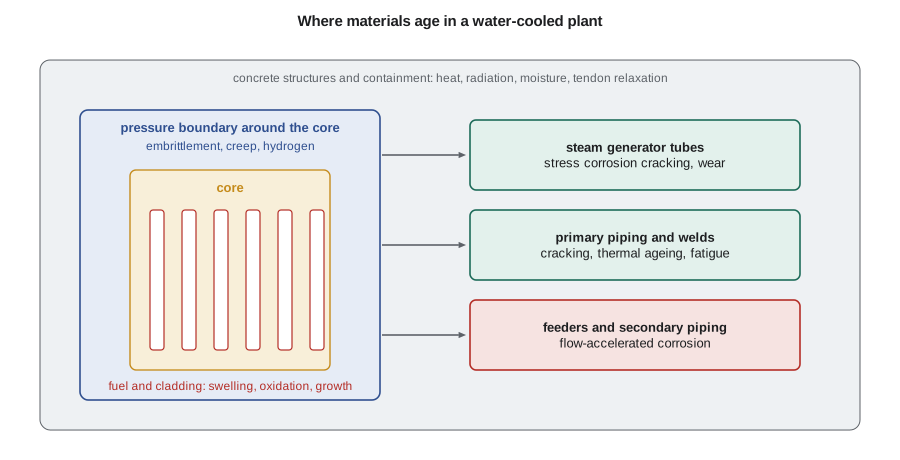
In a pressurized water reactor such as those in TVA's fleet, the most important materials are concentrated in the reactor vessel and the primary loops, while the fuel is replaced in batches.
| Component | Typical material | Main aging concerns |
|---|---|---|
| Fuel pellets | uranium dioxide ceramic | swelling, cracking, fission gas release, conductivity loss |
| Fuel sheath or cladding | zirconium alloy (Zircaloy-4 or newer alloys) | oxidation, hydriding, irradiation growth |
| Pressure tubes (CANDU) | zirconium–2.5 % niobium | creep, growth, hydrogen pickup, hydride cracking |
| Calandria and calandria tubes (CANDU) | austenitic stainless steel and Zircaloy-2 | low-temperature irradiation, sag |
| Reactor vessel (PWR, BWR) | low-alloy steel with stainless cladding | neutron embrittlement, fatigue |
| Core internals | austenitic stainless steels | irradiation-assisted stress corrosion cracking, void swelling |
| Steam generator tubes | Alloy 690 (older units Alloy 600 or 800) | stress corrosion cracking, fretting, deposits |
| Primary piping and welds | stainless steel, carbon steel, nickel alloy welds | thermal aging, cracking, fatigue |
| Feeders and secondary piping | carbon steel | flow-accelerated corrosion |
| Concrete and cables | reinforced concrete, polymer insulation | radiation, heat and moisture aging |
How properties are measured
Materials engineers rely on a few families of tests, each tied to a design question.
| Test | What it measures | Design question it answers |
|---|---|---|
| Tensile test | yield strength, ultimate strength, elongation | Is the material strong and ductile enough at temperature? |
| Charpy impact test | energy absorbed in breaking a notched bar | Has the material become brittle, and at what temperature? |
| Fracture toughness test | K or J at crack initiation | How large a flaw can the component tolerate? |
| Creep and creep rupture tests | strain and life under constant load at temperature | Will the part deform or fail slowly over years? |
| Fatigue tests | cycles to crack initiation and crack growth rate | How many start-ups and transients can it survive? |
| Corrosion and crack growth tests in water | oxide growth, stress corrosion crack growth rates | How fast will degradation progress in service? |
| Microscopy and microanalysis | grain structure, precipitates, defects, hydrides | What is the mechanism behind a property change? |
Irradiated specimens are tested in shielded hot cells, behind thick windows, using remote manipulators. The specimens themselves come from three sources: test reactors, where materials are exposed to high flux under controlled conditions; surveillance capsules placed inside operating reactors, which age alongside the real components; and samples removed from components during outages or refurbishment. Each source answers a different question, and the best predictions combine all three.
In U.S. PWRs, surveillance capsules containing specimens of the vessel's own plate, forging and weld materials are placed between the core and the vessel wall, where the flux is higher than at the vessel itself. Removed and tested on a schedule, they show in advance how the vessel will embrittle, a requirement under the NRC's surveillance rules for reactor vessels.
Materials and safety requirements
Materials requirements appear in codes, standards and regulatory documents. Pressure-retaining components are designed and fabricated to the ASME Boiler and Pressure Vessel Code, whose Section III covers nuclear components and Section XI covers in-service inspection; both are used in Canada and the United States, alongside national standards. The licensing basis then requires that materials degradation be monitored and managed.
In the United States, the NRC's rules in 10 CFR Part 50 include requirements for fracture toughness of the reactor coolant pressure boundary (Appendix G), a reactor vessel material surveillance program (Appendix H) and protection against pressurized thermal shock (§ 50.61). License renewal under 10 CFR Part 54 requires programs to manage aging effects; the NRC's GALL-SLR report, NUREG-2191, describes acceptable programs for operation from 60 to 80 years, as Lesson 12 discusses.
Worked problem
Screening a component for its main concern
Score each environment factor for a pressure tube from 0 to 3: temperature 2, fast flux 3, chemistry 2, stress 3. Combine factors in pairs to estimate which mechanism should get most attention.
Show solution
- Irradiation damage depends on flux and temperature: 3 × 2 = 6.
- Creep and growth depend on flux and stress: 3 × 3 = 9.
- Corrosion depends on chemistry and temperature: 2 × 2 = 4; cracking depends on chemistry and stress: 2 × 3 = 6.
Answer: Creep and growth score highest, consistent with experience: pressure tube life is often limited by diametral creep, elongation and sag, together with hydrogen uptake. A screening of this kind is only a starting point for a detailed degradation assessment.
# Materials in a reactor: a simple screening table for one component.
# Each environment factor is scored 0-3; the products show which damage
# mechanisms dominate. Scores are illustrative teaching values.
components = {
    "fuel sheath (zirconium alloy)": {"T": 2, "flux": 3, "chem": 2, "stress": 2},
    "pressure tube (Zr-2.5Nb)":      {"T": 2, "flux": 3, "chem": 2, "stress": 3},
    "pressure vessel (low-alloy steel)": {"T": 2, "flux": 1, "chem": 1, "stress": 3},
    "steam generator tube (Alloy 690)":  {"T": 2, "flux": 0, "chem": 3, "stress": 2},
    "turbine-side piping (carbon steel)": {"T": 1, "flux": 0, "chem": 3, "stress": 2},
}
mechs = {
    "irradiation damage": ("flux", "T"),
    "creep and growth":   ("flux", "stress"),
    "corrosion":          ("chem", "T"),
    "cracking":           ("chem", "stress"),
}
for name, e in components.items():
    scores = {m: e[a] * e[b] for m, (a, b) in mechs.items()}
    top = max(scores, key=scores.get)
    row = ", ".join(f"{m} {v}" for m, v in scores.items())
print(f"{name:36s} -> {row}; main concern: {top}")fuel sheath (zirconium alloy) -> irradiation damage 6, creep and growth 6, corrosion 4, cracking 4; main concern: irradiation damage pressure tube (Zr-2.5Nb) -> irradiation damage 6, creep and growth 9, corrosion 4, cracking 6; main concern: creep and growth pressure vessel (low-alloy steel) -> irradiation damage 2, creep and growth 3, corrosion 2, cracking 3; main concern: creep and growth steam generator tube (Alloy 690) -> irradiation damage 0, creep and growth 0, corrosion 6, cracking 6; main concern: corrosion turbine-side piping (carbon steel) -> irradiation damage 0, creep and growth 0, corrosion 3, cracking 6; main concern: cracking
Thinking in mechanisms
Malik's first lesson for Hana is to think in mechanisms rather than in symptoms. A crack found in an inspection is a symptom. The mechanism might be fatigue, stress corrosion cracking, hydride cracking or a fabrication flaw; each has different causes, different growth rates and different remedies. The same is true of a change in dimension, which might be creep, growth or swelling. The rest of this course works through the main mechanisms in turn: radiation damage and its effects on strength and toughness, the behavior of fuel, zirconium alloys and steels, creep and growth, corrosion, moderator materials, accident-tolerant fuels and materials for advanced reactors, and finally how all of this is tied together in an aging management program.
Why so few materials are used in the core
The choice of materials inside the core is narrower than in almost any other industry, because every material placed near the fuel also affects the neutrons. A structural metal in the core must absorb few neutrons, keep its properties under irradiation, resist corrosion by the coolant and not become too radioactive for maintenance. Zirconium is used for cladding and pressure tubes mainly because its thermal neutron absorption cross section is very small, about 0.18 barn, compared with about 2.6 barns for iron and nearly 4.5 barns for nickel. Natural zirconium ore contains about 2 percent hafnium, a strong absorber, so reactor-grade zirconium must be specially purified to remove it.
Outside the core, the constraints change. Pressure vessels and piping are made of steel because steel is strong, tough, weldable and well understood, and because the flux at the vessel wall is low enough that absorption hardly matters. Steam generator tubes need corrosion resistance and good heat transfer above all, which leads to nickel-chromium-iron alloys. In each region, the selection is a compromise among nuclear, mechanical, chemical and economic properties.
| Property | Why it matters in a reactor | Example of a good choice |
|---|---|---|
| Low neutron absorption | saves neutrons for fission and lowers enrichment needs | zirconium alloys for cladding |
| Low induced activity | reduces dose to maintenance staff | avoiding cobalt in wear surfaces where possible |
| High toughness | tolerates flaws without sudden fracture | clean low-alloy steels for vessels |
| Corrosion resistance | limits wall loss, deposits and activity transport | Alloy 690 for steam generator tubes |
| Stability under irradiation | avoids swelling, growth and embrittlement | tempered ferritic steels for some advanced designs |
The point about induced activity deserves emphasis. Cobalt-59 in steels and hard-facing alloys absorbs neutrons to form cobalt-60, a strong gamma emitter with a half-life of about 5.3 years. Corrosion releases small amounts of cobalt into the coolant, which then deposits on piping outside the core and raises radiation fields where people work. Specifications for reactor steels therefore limit cobalt content, and plants have replaced cobalt-based hard-facing in valves with cobalt-free alternatives where they can. Materials choices made at the design stage affect worker dose for the life of the plant.
Learning from operating experience
Much of what is known about reactor materials was learned the hard way, from degradation found in operating plants. Stress corrosion cracking of stainless steel piping in boiling water reactors in the 1970s and 1980s led to changes in alloys, welding practice and water chemistry. Cracking of Alloy 600 steam generator tubes and nozzle welds led to the use of Alloy 690. In CANDU reactors, early pressure tubes of Zircaloy-2 and a few tubes that cracked from hydride blisters led to the use of zirconium–2.5 % niobium and to the garter spring inspection and repositioning programs. Each event fed back into codes, standards and inspection programs, and operating experience exchanged among plants and countries remains one of the main inputs to every aging management program.
Summary and key terms
- Reactor materials must hold their shape, strength and leak tightness under heat, neutrons, chemistry and stress acting together.
- Materials engineering in a plant covers selection, prediction and management of degradation.
- Key materials include uranium dioxide fuel, zirconium alloy cladding and pressure tubes, low-alloy steel vessels, stainless steel internals, nickel alloy steam generator tubes and carbon steel piping.
- Properties are measured by tensile, impact, fracture toughness, creep, fatigue and corrosion tests, with irradiated specimens tested in hot cells.
- Surveillance specimens and removed components show in advance how real components age.
- Codes, standards and regulations require that degradation be monitored and managed over the plant's life.
- Degradation mechanism
- A physical or chemical process that changes a material’s properties or dimensions in service.
- Fast neutron
- A neutron with energy above about 1 MeV, the main cause of displacement damage.
- Hot cell
- A heavily shielded laboratory enclosure for handling radioactive specimens remotely.
- Surveillance capsule
- A set of specimens exposed inside an operating reactor to track how its materials change.
- Charpy test
- An impact test that measures the energy absorbed in breaking a notched bar.
- Pressure boundary
- The components that contain the high-pressure reactor coolant.
Practice problems
Work each problem on paper first, then reveal the answer to check.
Name four environmental features that act on reactor materials.
Show answer
Temperature, neutron flux, coolant chemistry and stress.
Why are irradiated specimens tested in hot cells?
Show answer
They are radioactive, so they must be handled remotely behind shielding.
Give one aging concern for steam generator tubes.
Show answer
Stress corrosion cracking, fretting wear or deposits.
What is the difference between a symptom and a mechanism?
Show answer
A symptom, such as a crack, is what is observed; the mechanism, such as fatigue or stress corrosion cracking, is the process that caused it.
Which test shows whether a steel has become brittle?
Show answer
The Charpy impact test, together with fracture toughness tests.
Lesson quiz · 5 questions
Score 60% or more to complete this lesson.
Create a free account to save your progress, take quizzes and earn a certificate.