
NUC-200 · Lesson 11 of 12 · 22 min
Fusion
A student at the information session asked why anyone builds fission reactors when fusion, which powers the Sun, promises clean and limitless energy. Dr. Brennan answers with a smile that fusion has been thirty years away for a long time, and then asks Hana to prepare a fair account: what fusion is, why it is so hard, how far research has come and what it might mean for engineers like her. That account is this lesson.
What fusion is
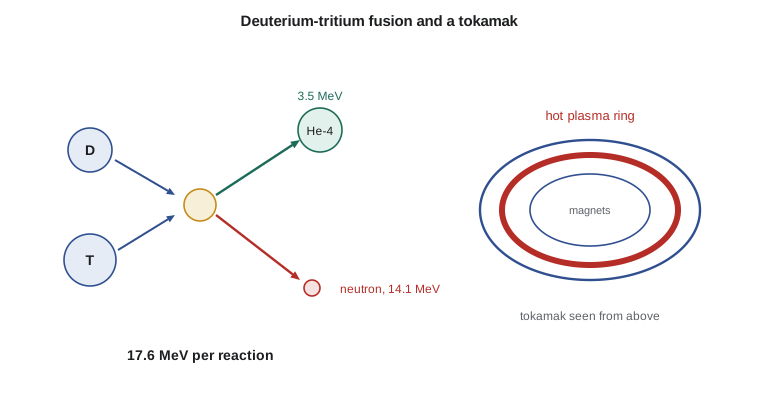
Fusion joins light nuclei into a heavier one. Lesson 2 showed that binding energy per nucleon rises steeply for the lightest nuclei, so fusing them releases energy. The Sun fuses hydrogen into helium through a slow chain of reactions in its core, at about 15 million kelvin and enormous density. On Earth, the most practical reaction joins deuterium and tritium, two heavy isotopes of hydrogen, to make helium-4 and a neutron.
Each reaction releases 17.6 MeV. Momentum conservation shares it unequally: the light neutron carries four fifths, 14.1 MeV, and the helium nucleus, also called an alpha particle, carries 3.5 MeV. The alpha particle is charged and stays in the hot fuel, heating it. The neutron has no charge, escapes the fuel and deposits its energy in the surrounding structure, where it is turned into heat for a power plant.
Per kilogram of fuel, deuterium-tritium fusion releases about four times as much energy as uranium-235 fission, as the program below shows. Deuterium is plentiful: about one hydrogen atom in 6400 in ordinary water is deuterium, enough for millions of years. Tritium is radioactive, with a half-life of 12.3 years, and almost none exists in nature. A fusion power plant would have to breed its own tritium by letting fusion neutrons strike lithium in a blanket around the plasma, a process that has never yet been demonstrated at scale.
Today's main civilian source of tritium is in Canada. CANDU reactors produce tritium in their heavy water moderator when deuterium captures neutrons, and the operator of the Darlington plant in Ontario recovers it, which lowers worker doses and supplies tritium for research, including fusion experiments, and for products such as self-luminous exit signs. The supply is limited, which is another reason fusion plants must breed their own.
Why fusion is hard
Nuclei are positively charged and repel one another. To fuse, they must approach closely enough for the strong force to act, which means overcoming the Coulomb barrier. Quantum tunneling helps, but even so, the deuterium-tritium reaction needs fuel at about 150 million kelvin, ten times hotter than the Sun's core, because a reactor on Earth cannot match the Sun's density and size. At those temperatures, atoms lose their electrons and the fuel becomes a plasma, a gas of free ions and electrons. No material wall can touch it, so the plasma must be held away from the walls, and it must stay hot and dense long enough for many reactions to occur.
Three quantities matter together: the density of the plasma \(n\), its temperature \(T\) and its energy confinement time \(\tau_E\), the time the plasma would take to lose its energy if heating stopped. John Lawson showed in the 1950s that for the fusion heat to make up for the losses, their product must exceed a threshold. For deuterium-tritium fuel near its best temperature, the alpha particles alone can keep the plasma hot, a condition called ignition, when the triple product reaches about \(3 \times 10^{21}\ \text{keV s/m}^3\).
# Deuterium-tritium fusion: energy per reaction and per kilogram of fuel,
# and the Lawson triple product a plasma must reach.
U, MEV = 931.494, 1.602e-13
m_D, m_T, m_He, m_n = 2.014102, 3.016049, 4.002602, 1.008665    # u
Q = (m_D + m_T - m_He - m_n) * U
print(f"Energy per D-T reaction: {Q:.1f} MeV (neutron carries {Q*0.8:.1f} MeV, helium {Q*0.2:.1f} MeV)")
reactions_per_kg = 1000 / (m_D + m_T) * 6.022e23
E_kg = reactions_per_kg * Q * MEV
print(f"Energy per kg of D-T fuel: {E_kg:.2e} J, about {E_kg/8.21e13:.1f} times U-235 fission")

# Lawson-style triple product n T tau needed for ignition, about 3e21 keV s per m3
target = 3e21
plasmas = [  # name, density per m3, temperature in keV, confinement time in s
    ("Early tokamak", 3e19, 1.0, 0.01),
    ("Large tokamak, 1990s", 6e19, 10.0, 0.4),
    ("Design point of a burning-plasma tokamak", 1.0e20, 9.0, 3.5),
]
for name, n, T, tau in plasmas:
    p = n * T * tau
print(f"{name}: n T tau = {p:.1e} keV s/m3 ({p/target:.2%} of the ignition target)")Energy per D-T reaction: 17.6 MeV (neutron carries 14.1 MeV, helium 3.5 MeV) Energy per kg of D-T fuel: 3.37e+14 J, about 4.1 times U-235 fission Early tokamak: n T tau = 3.0e+17 keV s/m3 (0.01% of the ignition target) Large tokamak, 1990s: n T tau = 2.4e+20 keV s/m3 (8.00% of the ignition target) Design point of a burning-plasma tokamak: n T tau = 3.2e+21 keV s/m3 (105.00% of the ignition target)
The program shows how far research has come. Early tokamaks in the 1960s reached a tiny fraction of the ignition target. Large tokamaks of the 1990s reached several percent. Burning-plasma devices now being built are designed to exceed it. The triple product has risen by a factor of about ten thousand over sixty years, faster than many other technologies improved over the same period, but the last steps are the hardest.
Magnetic confinement
Charged particles spiral around magnetic field lines, so a magnetic field can hold a plasma away from walls. A tokamak, a design developed in the Soviet Union in the 1960s, bends the field into a ring, a torus, using large coils, and a current driven through the plasma itself adds a twist that keeps the particles confined. The plasma is heated by the current, by beams of energetic neutral atoms and by radio-frequency waves. A stellarator achieves the twist with intricately shaped external coils instead, which avoids driving a plasma current and allows steady operation; Germany's Wendelstein 7-X is the largest.
The international ITER project in southern France, with seven members including the European Union, China, India, Japan, Korea, Russia and the United States, is building the largest tokamak. It is designed to produce 500 MW of fusion power from 50 MW of heating, a gain of ten, for several minutes at a time, though it will not generate electricity. Its schedule has slipped repeatedly; the current plan calls for first research operations in the mid-2030s and deuterium-tritium operation a few years after that. The US contribution to ITER is managed from Oak Ridge National Laboratory in Tennessee, near Meridian's Knoxville office. Meanwhile, the Joint European Torus in the United Kingdom set a record in 2023 by releasing 69 MJ of fusion energy in a single pulse before it closed.
Inertial confinement
Inertial confinement takes the opposite approach: instead of holding a plasma for seconds, it compresses a tiny fuel capsule so fast and so hard that fusion occurs before the fuel flies apart, in less than a billionth of a second. At the National Ignition Facility in California, 192 laser beams heat the inside of a small gold cylinder, which emits x-rays that crush a peppercorn-sized capsule of deuterium-tritium fuel. In December 2022, an experiment there released about 3.15 MJ of fusion energy from 2.05 MJ of laser light delivered to the target, the first time a fusion experiment had produced more energy than it received. Later shots have produced more.
That milestone was scientific, not practical. The lasers drew far more electricity from the grid than the energy released, and the facility fires a few times a week, while a power plant would need to ignite several capsules every second. Inertial fusion power would require lasers hundreds of times more efficient, capsules made cheaply by the million and a chamber that survives the repeated blasts.
The engineering challenge
Even with a burning plasma, a fusion power plant faces formidable engineering problems, and they are the ones that interest Hana most. The 14 MeV neutrons damage materials, knocking atoms out of place and producing helium inside steel, so the first wall and blanket must withstand more neutron damage than any fission reactor component, and new materials need testing in neutron sources that do not yet exist at full scale. The blanket must breed more tritium than the plant burns, extract heat at high temperature and shield the superconducting magnets, which operate at a few degrees above absolute zero just a meter or two from the hottest place in the solar system. The divertor, which removes exhaust heat and helium, faces heat loads similar to those on a spacecraft entering the atmosphere, continuously.
Fusion also makes radioactive material, though of a different kind from fission. There are no long-lived fission products and no chain reaction that could run away: if anything goes wrong, the plasma cools and fusion stops within seconds. But neutrons activate the structure, and tritium is mobile and must be carefully contained. With suitable low-activation materials, most fusion waste would decay to low levels within about a century, rather than needing isolation for many thousands of years.
Worked problem
Fuel for a year
A future fusion plant produces 1000 MW of electricity at 40 percent efficiency, running all year. How much deuterium-tritium fuel does it burn?
Show solution
- Fusion heat: \(1000/0.40 = 2500\ \text{MW}\). Energy per year: \(2500 \times 10^6 \times 3.15 \times 10^7 = 7.9 \times 10^{16}\ \text{J}\).
- Fuel: \(7.9 \times 10^{16} / 3.37 \times 10^{14}\ \text{J/kg} = 234\ \text{kg}\).
Answer: About a quarter of a metric ton of fuel a year, roughly 94 kg of deuterium and 140 kg of tritium, for an output that a coal plant would need about three million metric tons of coal to match. The tritium would be bred from lithium in the blanket.
Fusion and the rest of the plant
Outside the plasma, a fusion power plant would look much like any other thermal plant. Heat from the blanket would raise steam or heat a gas to drive a turbine, and the condenser, cooling water and switchyard would be familiar to anyone who has worked at a fission or coal station. The plant would also need systems that fission plants do not: cryogenic plants to keep the magnets cold, large power supplies to drive heating systems and magnets, and a tritium plant to recover unburned fuel from the exhaust and bred tritium from the blanket and return it to the plasma within hours. Because only a few grams of fuel are in the plasma at any moment, the tritium processing system, not the plasma itself, would hold most of the radioactive inventory, and its design would be central to licensing. Hana notes that skills in heat transfer, materials, remote handling and radiation protection, the subjects of this course, transfer directly from fission to fusion.
Private ventures and timelines
Alongside the public programs, dozens of private companies have raised billions of dollars to pursue faster paths. Some build compact tokamaks with high-temperature superconducting magnets, which allow stronger fields in smaller machines; others pursue stellarators, magnetized targets compressed by pistons or liquid metal, or alternative fuels such as deuterium and helium-3 or hydrogen and boron. Several companies aim to demonstrate net energy from a magnetically confined plasma in the late 2020s and to deliver electricity to the grid in the 2030s. Regulators in several countries, including the United States, have begun to set out how fusion machines will be regulated, generally treating them more like particle accelerators than fission reactors.
Hana's fair account ends this way. Fusion has made real and accelerating progress, and some of the problems that remain are engineering problems that engineers like her could help solve. But it is unlikely to supply a large share of electricity before the 2040s or later, while the need to replace fossil fuels is urgent now. Fission and fusion are therefore not rivals: one can help decarbonize the grid in the coming decades, and the other may join it later. The student who asked the question signs up for the Meridian summer internship program.
Common mistakes
MistakeThinking fusion and fission are the same process.
InsteadFission splits heavy nuclei; fusion joins light ones. Both release binding energy.
MistakeAssuming fusion fuel is all abundant.
InsteadDeuterium is plentiful, but tritium must be bred from lithium because almost none exists naturally.
MistakeBelieving the 2022 ignition result means fusion power is ready.
InsteadIt showed target gain above one, not net electricity; the lasers used far more energy from the grid.
MistakeThinking a fusion plant could have a runaway reaction.
InsteadThe plasma cools and fusion stops within seconds if conditions are lost.
MistakeSaying fusion produces no radioactive material.
InsteadNeutrons activate the structure and tritium is radioactive, though long-lived waste is much less.
Summary and key terms
- Fusion joins light nuclei; D-T fusion releases 17.6 MeV, 14.1 MeV of it carried by the neutron.
- D-T fuel needs about 150 million kelvin; the fuel becomes a plasma that must not touch the walls.
- The Lawson triple product n T τ must reach about 3 × 10²¹ keV s/m³ for ignition.
- Tokamaks and stellarators confine plasma magnetically; ITER aims for a gain of ten.
- Inertial confinement compresses fuel capsules; NIF achieved target gain above one in 2022.
- Materials, tritium breeding and heat exhaust are the main engineering challenges.
- Fusion is unlikely to supply much electricity before the 2040s.
- Fusion
- The joining of light nuclei into a heavier nucleus with release of energy.
- Plasma
- A hot gas of free ions and electrons.
- Coulomb barrier
- The electrical repulsion that nuclei must overcome to fuse.
- Triple product
- The product of density, temperature and confinement time, n T τ.
- Ignition
- The state in which fusion heating alone keeps the plasma hot.
- Tokamak
- A ring-shaped magnetic confinement device with a plasma current.
- Stellarator
- A ring-shaped device that uses twisted external coils instead of a plasma current.
- Blanket
- The structure around a fusion plasma that absorbs neutrons, extracts heat and breeds tritium.
Practice problems
Work each problem on paper first, then reveal the answer to check.
What fraction of D-T energy does the neutron carry?
Show answer
14.1/17.6 = 80 percent.
Why must tritium be bred?
Show answer
Its 12.3 year half-life means almost none exists in nature.
From the program, what percentage of the ignition target did large 1990s tokamaks reach?
Show answer
About 8 percent.
What was the target gain of the December 2022 NIF shot?
Show answer
3.15/2.05 ≈ 1.5.
A plasma has n = 10²⁰ m⁻³ and T = 15 keV. What confinement time is needed for 3 × 10²¹?
Show answer
τ = 3 × 10²¹ / (10²⁰ × 15) = 2 s.
Give one reason fusion waste is easier to manage than fission waste.
Show answer
No long-lived fission products; activated low-activation materials decay within about a century.
Lesson quiz · 5 questions
Score 60% or more to complete this lesson.
Create a free account to save your progress, take quizzes and earn a certificate.