
NUC-200 · Lesson 5 of 12 · 23 min
How a reactor works
Meridian's first assignment for Hana on the Clinch River work is a one-page explainer on the plant itself. The reactor chosen for the Tennessee Valley Authority's Clinch River project is a 300 MW electrical boiling water small modular reactor, and the public wants to know what is inside the building. Dr. Brennan's advice is to start with what a reactor has in common with every thermal power plant, then explain the parts that are special to nuclear. That is the plan for this lesson.
A reactor is a heat source
A nuclear power plant is a thermal power plant. Like a coal or gas plant, it boils water, uses the steam to spin a turbine, and the turbine drives a generator. What differs is the heat source. Instead of a furnace, the plant has a reactor core where the chain reaction from Lesson 4 releases heat inside the fuel. Everything else, the turbine hall, the condenser and the cooling water, would look familiar to a conventional power engineer.
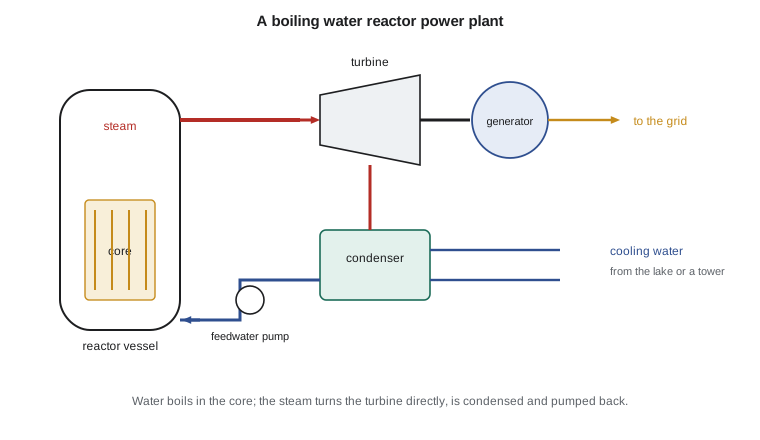
In a boiling water reactor, the design used for the Tennessee Valley Authority's Clinch River project, water boils as it flows up through the core, and the steam goes straight to the turbine. After the turbine, the steam is condensed back to water in the condenser, which is cooled by a large flow of water from the Clinch River or from a cooling tower, and the feedwater pump returns it to the reactor. Other designs, described in Lesson 6, keep the reactor water under high pressure so it does not boil and make steam in a separate heat exchanger.
The core and the fuel
The fuel is uranium dioxide, a ceramic, pressed into pellets about the size of a fingertip. Ceramic fuel melts only at about 2800 degrees Celsius and holds most fission products inside its crystal structure. The pellets are stacked inside thin tubes of zirconium alloy, called cladding, to form fuel rods about four meters long. Rods are grouped into fuel assemblies, and a few hundred assemblies make up the core. The cladding is the first sealed barrier that keeps radioactive material in, and it must stay intact through years of high temperature and radiation.
Around the fuel flows the coolant, which carries heat away, and in water reactors the same water is also the moderator that slows neutrons. The core sits inside a thick steel reactor pressure vessel. Around that is the containment, a sealed structure of steel and concrete designed to hold in radioactive material even if the reactor coolant system itself were to fail. Lesson 10 describes these barriers as part of the defense-in-depth approach to safety.
| Part | Function | Typical material |
|---|---|---|
| Fuel pellets | produce heat by fission, hold fission products | uranium dioxide ceramic |
| Cladding | seal the fuel, transfer heat | zirconium alloy |
| Coolant | carry heat from the core | water, heavy water, gas or liquid metal |
| Moderator | slow neutrons (thermal reactors) | water, heavy water or graphite |
| Control rods | absorb neutrons to control power | boron carbide, hafnium, cadmium |
| Pressure vessel | contain the coolant at pressure | thick low-alloy steel |
| Containment | final barrier around the reactor | steel and reinforced concrete |
Controlling the chain reaction
Control means keeping the multiplication factor \(k\) at exactly one during steady operation, and being able to make it well below one at any time. The main tool is the control rod, made of a strong neutron absorber such as boron carbide. Inserting control rods absorbs more neutrons and lowers \(k\); withdrawing them raises it. In a boiling water reactor, the rods enter from below and are driven hydraulically for fast insertion. Power can also be adjusted by changing the coolant flow: in a boiling water reactor, faster flow sweeps steam bubbles away, increases moderation and raises power.
Over months of operation, uranium-235 is used up and neutron-absorbing fission products build up, so \(k\) would gradually fall. To make up for this, fresh fuel starts with extra reactivity, held down at first by control rods and by burnable absorbers, such as gadolinium mixed into some pellets, which gradually burn out as the fuel burns. In pressurized water reactors, operators also dissolve boric acid in the coolant and reduce its concentration as the fuel ages.
Delayed neutrons make control possible
The time between one generation of neutrons and the next in a thermal reactor is very short, about a ten-thousandth of a second. If all neutrons were released at the moment of fission, a reactor with \(k\) just slightly above one would increase its power extremely quickly, far faster than any mechanism could follow. Nature provides the solution. About 0.65 percent of the neutrons from uranium-235 fission are delayed: they are emitted by certain fission products several seconds after the fission, in the decay chains from Lesson 3.
Those few delayed neutrons stretch the effective generation time to about a tenth of a second. As long as the reactor is kept below the point where prompt neutrons alone could sustain the chain, power changes on a timescale of seconds to minutes, slow enough for control rods and operators to follow. Reactor engineers measure reactivity relative to the delayed neutron fraction, and every reactor is designed and operated so that power changes stay well within this slow, controllable range.
Here \(\rho\) is the reactivity, the fractional departure of \(k\) from one, and \(T\) is the reactor period, the time for the power to grow by a factor of \(e\). For small positive reactivity, the period is long, often tens of seconds or more, and operators raise power gently over minutes.
Feedback: the reactor regulates itself
Good reactor designs have negative feedback: when power or temperature rises, \(k\) falls on its own, which pulls power back down. Two effects dominate in water-cooled reactors. As the fuel heats up, uranium-238 absorbs more neutrons, an effect called Doppler broadening, which acts within a fraction of a second. As the coolant heats up and, in a boiling water reactor, forms more steam, its density falls and it moderates less effectively, so fewer neutrons are slowed to the energies where fission is likely. Both effects reduce reactivity when temperature rises.
Negative feedback is the most important passive safety feature of a reactor. It means that a disturbance which raises power tends to correct itself without any action by operators or control systems. Lesson 10 shows that the Chernobyl accident happened in a design that, under the conditions on that night, had positive feedback from steam formation, the opposite of the behavior described here. Licensing rules in the United States and elsewhere now require designs with negative feedback across their operating range.
Shutdown
Every reactor has a rapid shutdown system, often called a scram or a trip, that inserts enough negative reactivity to stop the chain reaction within seconds. In a boiling water reactor, all control rods are driven into the core. CANDU reactors have two independent shutdown systems: spring-assisted absorber rods that drop into the core, and a second system that injects a neutron-absorbing solution into the moderator. After shutdown, the fission power falls within a minute to a small fraction of its previous value, but decay heat remains and must be removed, as Lesson 10 explains.
From core heat to electricity
The program below follows the energy through Meridian's reference plant: 870 MW of heat in the core produces 300 MW of electricity, and the rest is rejected as waste heat in the condenser. The efficiency of about one third is typical of water-cooled reactors, which produce steam at about 290 degrees Celsius, lower than the steam in modern coal plants. The program also finds how much uranium-235 is fissioned each day, how much fuel is discharged each year, and how much cooling water the condenser needs.
# From reactor power to fuel use: heat, electricity, fissions and burn-up.
P_th = 870e6          # thermal power of a 300 MWe boiling water SMR, W (approximate)
P_e = 300e6           # net electrical output, W
CF = 0.93             # capacity factor
eff = P_e / P_th
print(f"Thermal efficiency: {eff:.1%}")
print(f"Waste heat to the condenser at full power: {(P_th - P_e)/1e6:.0f} MW")

fissions = P_th / (200 * 1.602e-13)
u235_g_day = fissions * 86400 * 235.04 / 6.022e23
print(f"Fissions per second: {fissions:.2e}")
print(f"U-235 fissioned per full-power day: {u235_g_day/1000:.2f} kg")

# Annual energy and fuel discharged for two fuel types at the same thermal output
mwd = P_th / 1e6 * 365 * CF                 # megawatt-days of heat per year
for name, burnup in (("Enriched LWR fuel, 50 GWd/t", 50000), ("Natural uranium CANDU fuel, 7.5 GWd/t", 7500)):
    print(f"{name}: {mwd/burnup:.1f} t of uranium discharged per year")

# Cooling water: heat rejected = flow x specific heat x temperature rise
dT = 10.0                                    # condenser temperature rise, K
flow = (P_th - P_e) / (4186 * dT)            # kg/s
print(f"Cooling water at a {dT:.0f} K rise: {flow/1000:.1f} m3/s")Thermal efficiency: 34.5% Waste heat to the condenser at full power: 570 MW Fissions per second: 2.72e+19 U-235 fissioned per full-power day: 0.92 kg Enriched LWR fuel, 50 GWd/t: 5.9 t of uranium discharged per year Natural uranium CANDU fuel, 7.5 GWd/t: 39.4 t of uranium discharged per year Cooling water at a 10 K rise: 13.6 m3/s
Fuel use is measured by burn-up, the heat produced per metric ton of uranium in the fuel, in gigawatt-days per metric ton (GWd/t). Enriched light water reactor fuel reaches about 50 GWd/t before it is discharged. Natural uranium CANDU fuel reaches about 7.5 GWd/t, because it starts with less uranium-235. So a CANDU reactor discharges more used fuel per unit of energy, but it uses no enrichment and its fuel is simple and inexpensive to make. The comparison is one of the trade-offs Lesson 9 explores.
Worked problem
Burn-up and fuel loading
The reference plant runs at 870 MW thermal with a capacity factor of 93 percent. Its fuel reaches a burn-up of 50 GWd/t. How many metric tons of uranium are discharged each year?
Show solution
- Heat per year: \(870\ \text{MW} \times 365\ \text{days} \times 0.93 = 295\,000\ \text{MWd} = 295\ \text{GWd}\).
- Uranium discharged: \(295\ \text{GWd} / 50\ \text{GWd/t} = 5.9\ \text{t}\).
Answer: About 5.9 metric tons of uranium leave the reactor each year, roughly the volume of a small car's worth of pellets, as the code shows. A CANDU of the same power would discharge about 39 metric tons of natural uranium fuel.
Instruments and the control room
Operators watch the reactor through instruments. Neutron detectors in and around the core measure power directly, from the start-up range, where only a few neutrons are present, up to full power. Thermocouples and resistance thermometers measure coolant temperatures, and pressure and flow sensors monitor the coolant system. Radiation monitors watch for leaks and measure releases from the plant. The control room presents all of this to a licensed crew, and the protection system compares key readings against limits and trips the reactor automatically if any limit is reached, without waiting for a human decision.
Modern small modular reactors put more emphasis on passive systems that need no pumps or operator action. In the design chosen for Clinch River, for example, decay heat after shutdown can be removed by natural circulation of water to large isolation condensers, which boil off water from a pool above the reactor. Hana adds a sentence about this to her explainer, because it addresses the question people most often ask: what happens if the power to the plant itself is lost?
Operating a reactor through a cycle
A boiling water reactor runs for one to two years between refueling outages. During the cycle, operators keep the reactor at or near full power most of the time, because the fuel cost per unit of energy is low and the plant earns most when it runs continuously. They make small adjustments with coolant flow and control rods as the fuel burns. At the end of the cycle, the reactor shuts down, the vessel head is removed under water, and the oldest fuel assemblies are moved to the used fuel pool while fresh ones are loaded and the rest are rearranged to give an even power distribution. The outage also allows inspection and maintenance of equipment that cannot be reached during operation. A well-run outage lasts a few weeks.
Some reactors also follow load, changing power to match daily swings in demand. French reactors do this routinely, because nuclear energy supplies most of France's electricity. Load following is possible because of the control methods described above, but it puts more thermal cycling on the fuel and components, so most fleets prefer to run at steady power and let other sources follow demand. Hana adds this to her explainer as a short answer to the question of whether a reactor can work alongside wind and solar power.
Common mistakes
MistakeThinking a nuclear plant makes electricity directly from radiation.
InsteadIt is a thermal plant: fission heat makes steam that drives a turbine and generator.
MistakeBelieving control rods are needed only for emergencies.
InsteadRods also shape power and compensate for fuel burn-up during normal operation.
MistakeIgnoring delayed neutrons.
InsteadThey are under one percent of neutrons but slow the reactor's response enough to make control possible.
MistakeAssuming all reactors respond to heating the same way.
InsteadSafe designs have negative temperature and void feedback, so rising power reduces reactivity.
MistakeThinking shutdown ends the need for cooling.
InsteadDecay heat continues and must be removed for days to years after shutdown.
Summary and key terms
- A nuclear plant boils water with fission heat and uses a standard steam turbine and generator.
- Fuel is ceramic uranium dioxide in zirconium alloy cladding; the core sits in a pressure vessel inside a containment.
- Control rods and burnable absorbers keep k at one and compensate for fuel burn-up.
- Delayed neutrons stretch the effective generation time so power changes slowly enough to control.
- Negative temperature and void feedback make a reactor tend to correct power rises by itself.
- A rapid shutdown system stops the chain reaction in seconds; decay heat remains.
- Water reactors convert about a third of their heat to electricity; burn-up measures energy per metric ton of fuel.
- Fuel assembly
- A bundle of fuel rods handled as a unit.
- Cladding
- The sealed metal tube around the fuel pellets.
- Control rod
- A movable neutron absorber used to control the chain reaction.
- Delayed neutrons
- Neutrons emitted by fission products seconds after fission.
- Reactivity
- The fractional departure of k from one, ρ = (k − 1)/k.
- Negative feedback
- A reduction in reactivity when temperature or power rises.
- Scram
- A rapid automatic shutdown of a reactor.
- Burn-up
- The heat produced per metric ton of fuel, usually in GWd/t.
Practice problems
Work each problem on paper first, then reveal the answer to check.
A plant produces 1100 MW of electricity from 3300 MW of heat. What is its efficiency?
Show answer
1100/3300 = 33 percent.
Using the program, how much heat goes to the condenser of the reference plant?
Show answer
870 − 300 = 570 MW.
Find the reactivity when k = 1.002.
Show answer
ρ = 0.002/1.002 ≈ 0.0020.
If the period is 60 s, by what factor does power rise in 3 minutes?
Show answer
e^(180/60) = e³ ≈ 20.
Why does steam forming in a boiling water core reduce power?
Show answer
Steam is less dense than water, so it moderates less and fewer neutrons are slowed to thermal energy.
A CANDU reactor's fuel reaches 7.5 GWd/t. How much fuel does it use for 295 GWd of heat?
Show answer
295/7.5 ≈ 39 t of natural uranium.
Lesson quiz · 5 questions
Score 60% or more to complete this lesson.
Create a free account to save your progress, take quizzes and earn a certificate.