
NUC-200 · Lesson 6 of 12 · 22 min
Reactor types
A reporter from a local newspaper calls Meridian with a question for Hana's team: why did TVA choose a boiling water reactor for Clinch River, when most of the reactors people have heard of are of other kinds? Dr. Brennan asks Hana to draft the background. Answering the question means comparing reactor types: what each uses for fuel, moderator and coolant, what that choice makes easy or hard, and why there is no single best design.
Three choices define a reactor
Every reactor design answers three questions. What is the fuel, and how much fissile material does it contain? What, if anything, slows the neutrons down? What carries the heat away? Lesson 4 showed that the moderator decides how enriched the fuel must be. The coolant decides the operating temperature and pressure, and therefore the efficiency and the engineering of the pressure boundary. Together, these choices set the character of a reactor type. Around the world, about 440 power reactors are in operation, and the great majority are cooled and moderated by water.
Pressurized water reactors
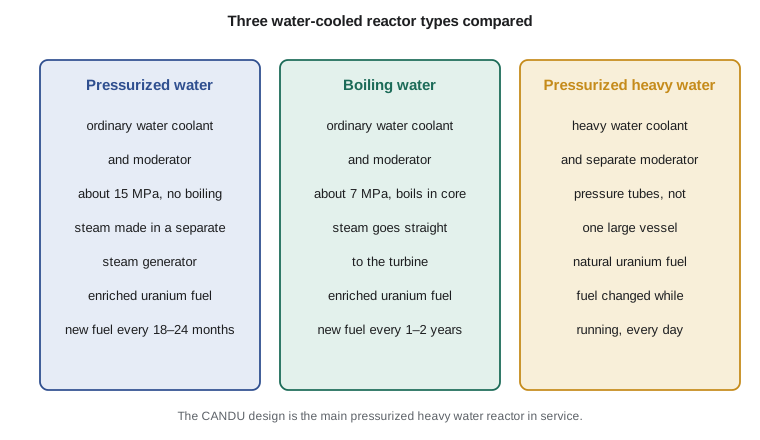
The pressurized water reactor, or PWR, is the most common type in the world, with about two thirds of the global fleet. Ordinary water serves as both moderator and coolant. It is kept at about 15 MPa, roughly 150 times atmospheric pressure, so that it stays liquid at about 320 degrees Celsius. The hot water flows from the reactor vessel to steam generators, large heat exchangers where it boils water in a separate secondary circuit. The secondary steam drives the turbine.
Separating the two circuits keeps the slightly radioactive reactor water out of the turbine hall, which simplifies maintenance. The cost is extra equipment, the steam generators and a pressurizer that holds the system pressure, and a very thick pressure vessel. PWRs use fuel enriched to about 3 to 5 percent uranium-235 and are refueled every 18 to 24 months, with about a third of the core replaced each time. PWRs also power nuclear-propelled ships and submarines, a different application from power stations, and were adapted from that early work in the 1950s.
Boiling water reactors
In the boiling water reactor, or BWR, the water boils in the core, at about 7 MPa and 287 degrees Celsius, and the steam goes directly to the turbine. That removes the steam generators and the pressurizer and allows a thinner vessel at lower pressure. Steam separators and dryers above the core remove water droplets. The trade-off is that the turbine handles steam that has passed through the core, so it is slightly radioactive while the plant is running, mainly from short-lived nitrogen-16, which decays within seconds. Turbine areas are shielded during operation, and the radiation disappears almost immediately when the reactor shuts down.
BWRs make up about a sixth of the world fleet, with many in the United States and Japan. Their simplicity is what attracted TVA to a small BWR design: fewer large components, lower pressure and natural circulation of coolant, with no recirculation pumps, all mean a smaller and simpler plant. The design selected for Clinch River also relies on passive cooling after shutdown, as Lesson 5 described.
Pressurized heavy water reactors: CANDU
The CANDU reactor, developed in Canada from the 1950s, uses heavy water as both moderator and coolant, though in separate systems. Heavy water contains deuterium in place of ordinary hydrogen, and because it absorbs so few neutrons, CANDU reactors run on natural uranium. Instead of one large pressure vessel, the fuel sits in a few hundred horizontal pressure tubes passing through a large tank, the calandria, which holds cool, low-pressure heavy water moderator. Hot, pressurized heavy water coolant flows through the tubes and on to steam generators, as in a PWR.
The pressure tube design allows on-power refueling: fueling machines attach to each end of a channel and push new fuel bundles in while the reactor runs, so the plant never needs to shut down to change fuel. CANDU fuel bundles are about half a meter long and weigh about 24 kilograms, much simpler than light water fuel assemblies. The costs are the heavy water inventory, which is expensive, more used fuel per unit of energy because of the lower burn-up, and the need to replace pressure tubes in a major refurbishment after about 30 years. CANDU and related designs operate in Canada, India, South Korea, China, Romania, Argentina and Pakistan. All of Canada's power reactors are CANDU units, a contrast with the United States, where every operating power reactor is a light water design.
Gas-cooled and graphite reactors
Graphite also moderates well and absorbs few neutrons. The first reactors, including the Chicago Pile in 1942, used graphite. The United Kingdom built a fleet of gas-cooled graphite reactors, the Magnox and then the advanced gas-cooled reactors, cooled by carbon dioxide at higher temperatures than water reactors. The Soviet RBMK design used graphite as moderator with boiling water in pressure tubes; Lesson 10 explains how its characteristics contributed to the Chernobyl accident. Graphite-moderated, water-cooled designs of that kind are no longer built.
High-temperature gas-cooled reactors use helium coolant and fuel in the form of tiny coated particles, each a uranium kernel wrapped in layers of carbon and silicon carbide, embedded in graphite spheres or blocks. The coatings retain fission products to very high temperatures, above 1600 degrees Celsius, giving a large safety margin. Outlet temperatures of 750 degrees Celsius or more allow higher efficiency and supply of high-temperature heat for industry. China connected a demonstration plant of this type to its grid in 2021.
Fast reactors
Fast reactors use no moderator. Fission by fast neutrons releases more neutrons on average, so a fast reactor can convert fertile uranium-238 into fissile plutonium-239 efficiently and make use of much more of the energy in natural uranium. Fast reactors can also consume long-lived actinides from used fuel, which could reduce the long-term radiotoxicity of waste. Because water would moderate the neutrons, the coolant is a liquid metal, usually sodium, or lead, or a gas. Sodium-cooled fast reactors operate at low pressure and about 500 degrees Celsius, but sodium reacts with water and air, which requires careful engineering. Russia operates sodium-cooled fast reactors commercially, and several countries are developing new ones.
Molten salt and other advanced designs
In molten salt reactors, the fuel is dissolved in a molten fluoride or chloride salt, or the salt cools solid fuel. Salt coolant operates at atmospheric pressure and very high temperature, with good heat transfer, and the liquid fuel can be cleaned of some fission products while running. An experimental molten salt reactor operated at Oak Ridge in the 1960s. Materials that resist hot salt for decades are a major development challenge. Other advanced concepts include very small microreactors for remote communities and mines, which may use heat pipes instead of pumped coolant.
Temperature and efficiency
A thermal power plant cannot convert all of its heat into work. The Carnot limit sets the maximum efficiency for given hot and cold temperatures, and the Curzon-Ahlborn estimate gives a rough guide to the efficiency of a real plant operating at maximum power output. The higher the coolant outlet temperature, the higher both limits are. That is the main thermodynamic argument for gas, salt and liquid metal coolants.
# Why hotter coolant means higher efficiency: Carnot and Curzon-Ahlborn limits
# against typical net efficiencies for each reactor type (approximate values).
import math
T_cold = 30 + 273.15                  # condenser temperature, K
types = [  # name, coolant outlet temperature in deg C, typical net efficiency
    ("Pressurized heavy water (CANDU)", 310, 0.31),
    ("Pressurized water (PWR)", 325, 0.33),
    ("Boiling water (BWR)", 287, 0.34),
    ("Sodium-cooled fast", 530, 0.39),
    ("Molten salt", 700, 0.44),
    ("High-temperature gas", 750, 0.42),
]
print(f"{'Reactor type':32}{'Outlet':>8}{'Carnot':>8}{'C-A':>7}{'Typical':>9}")
for name, t_out, eta in types:
    Th = t_out + 273.15
    carnot = 1 - T_cold / Th
    ca = 1 - math.sqrt(T_cold / Th)
print(f"{name:32}{t_out:>6} C{carnot:>8.0%}{ca:>7.0%}{eta:>9.0%}")Reactor type Outlet Carnot C-A Typical Pressurized heavy water (CANDU) 310 C 48% 28% 31% Pressurized water (PWR) 325 C 49% 29% 33% Boiling water (BWR) 287 C 46% 26% 34% Sodium-cooled fast 530 C 62% 39% 39% Molten salt 700 C 69% 44% 44% High-temperature gas 750 C 70% 46% 42%
The program shows that water reactors operate near their Curzon-Ahlborn estimate, while the higher temperature designs promise roughly 40 to 45 percent efficiency. The Curzon-Ahlborn figure is only a rough guide; real plants with well-designed steam cycles can and do beat it, as the boiling water figure shows. Higher efficiency means less fuel and less waste heat per unit of electricity, and high-temperature heat can serve hydrogen production or chemical plants directly.
Worked problem
Comparing waste heat
Two plants each produce 300 MW of electricity: a boiling water reactor at 34 percent efficiency and a high-temperature gas reactor at 42 percent. How much heat does each reject?
Show solution
- BWR heat input: \(300/0.34 = 882\ \text{MW}\); rejected heat \(882 - 300 = 582\ \text{MW}\).
- HTGR heat input: \(300/0.42 = 714\ \text{MW}\); rejected heat \(714 - 300 = 414\ \text{MW}\).
Answer: The gas reactor rejects about 29 percent less heat for the same output, which reduces cooling water needs. The water reactor's advantage is decades of operating experience and a mature supply chain.
| Type | Fuel | Moderator | Coolant | Outlet temperature |
|---|---|---|---|---|
| PWR | enriched UO₂, 3–5% | ordinary water | pressurized water | about 325 °C |
| BWR | enriched UO₂, 3–5% | ordinary water | boiling water | about 287 °C |
| CANDU (PHWR) | natural UO₂ | heavy water | pressurized heavy water | about 310 °C |
| HTGR | coated particles, enriched | graphite | helium | 750 °C or more |
| Sodium fast | mixed oxide or metal | none | liquid sodium | about 530 °C |
| Molten salt | dissolved in salt or solid | graphite or none | molten salt | about 700 °C |
Why there is no single best design
Hana's draft for the reporter ends with the practical reasons behind TVA's choice. Water reactors dominate because they were developed first, at enormous scale, and their fuel, components and regulatory requirements are well understood. A first-of-a-kind advanced design carries more risk to cost and schedule. A small BWR uses familiar fuel and principles from a large existing fleet, while simplifying the plant. Advanced designs promise higher temperatures, better fuel use or lower waste, and some may compete in the 2030s, but each must still prove itself in construction and operation.
Small modular reactors
Small modular reactors, or SMRs, are reactors of up to about 300 MW electrical whose main components are built in factories and shipped to site. The idea is to replace the long, custom construction of a large plant with repeated manufacture of a standard design, gaining speed and cost reductions with each unit built. SMRs include water-cooled designs, such as the boiling water reactor chosen for Clinch River, small PWRs and advanced designs using gas, salt or liquid metal cooling. Smaller cores also hold less radioactive material and lose heat more easily, which supports passive safety features that need no pumps or power after shutdown.
The economic case is not yet proven. A small reactor loses some of the economies of scale that made large plants attractive in the first place, and the first units of any design are expensive, as Lesson 12 discusses. Supporters argue that factory production, smaller financing needs and the ability to add units one at a time make up for that loss. Several first units under construction around the world in the mid-2020s, including the one at Clinch River, will provide the first real evidence. Hana notes in her draft that the reporter should expect the debate on SMR costs to continue until those projects report actual figures.
Fuel forms beyond pellets
Reactor types also differ in the physical form of their fuel. Light water and CANDU reactors use ceramic uranium dioxide pellets, which are well understood after decades of use. Gas-cooled reactors use the coated particles described earlier, sometimes called TRISO fuel, which several advanced designs plan to adopt. Some fast reactors use metallic fuel, which conducts heat very well. Molten salt designs have no solid fuel at all. Research is also under way on accident-tolerant fuels for existing water reactors, with coated or alternative cladding that reacts less with steam at high temperature, an idea that grew out of the lessons of the Fukushima accident.
Common mistakes
MistakeThinking all reactors need enriched uranium.
InsteadHeavy water and graphite moderated reactors can use natural uranium.
MistakeAssuming a BWR turbine stays radioactive after shutdown.
InsteadIts radioactivity is mainly nitrogen-16, which decays within seconds.
MistakeBelieving fast reactors use fast-moving coolant.
InsteadThe name refers to unmoderated, high-energy neutrons.
MistakeTreating the Curzon-Ahlborn estimate as a hard limit.
InsteadIt is a rough guide; only the Carnot limit cannot be exceeded.
MistakeThinking advanced reactors are all the same idea.
InsteadGas, salt and liquid metal designs differ greatly in fuel, materials and challenges.
Summary and key terms
- Each design is defined by its fuel, moderator and coolant.
- PWRs keep water liquid at 15 MPa and make steam in separate steam generators.
- BWRs boil water in the core and send steam straight to the turbine.
- CANDU reactors use heavy water, natural uranium, pressure tubes and on-power refueling.
- Gas, sodium and salt coolants allow higher temperatures and efficiencies.
- Fast reactors use unmoderated neutrons and can make better use of uranium.
- Water reactors dominate because of experience, supply chains and known licensing paths.
- PWR
- Pressurized water reactor, with a separate steam generator.
- BWR
- Boiling water reactor, which makes steam in the core.
- PHWR
- Pressurized heavy water reactor, such as CANDU.
- Calandria
- The large moderator tank of a CANDU reactor, crossed by pressure tubes.
- On-power refueling
- Changing fuel while the reactor operates.
- HTGR
- High-temperature gas-cooled reactor using helium and coated particle fuel.
- Fast reactor
- A reactor without a moderator, using high-energy neutrons.
- Carnot limit
- The maximum possible efficiency of a heat engine between two temperatures.
Practice problems
Work each problem on paper first, then reveal the answer to check.
Find the Carnot efficiency for an outlet at 325 °C and a condenser at 30 °C.
Show answer
1 − 303/598 = 0.49, or 49 percent.
Why does a PWR need a pressurizer?
Show answer
To hold the coolant at about 15 MPa so it does not boil in the core.
Give one advantage and one drawback of on-power refueling.
Show answer
No refueling outages; but more complex fueling machines and many pressure tube connections.
Why can't a fast reactor use water as coolant?
Show answer
Water would slow the neutrons, making it a thermal reactor.
From the program, which type has the highest Carnot efficiency?
Show answer
The high-temperature gas reactor at about 70 percent.
A 600 MWe plant has 40 percent efficiency. How much heat does it reject?
Show answer
1500 − 600 = 900 MW.
Lesson quiz · 5 questions
Score 60% or more to complete this lesson.
Create a free account to save your progress, take quizzes and earn a certificate.