
MSBA-351 · Lesson 4 of 12 · 21 min
Pricing and discounts
▶ Video coming soon A video version of this lesson is on the way.
Pricing at Corbel & Finch had grown by accident. Wholesale customers paid a list price, except the ones who had negotiated something with Bettina years ago; offices on weekly orders got a discount that nobody had written down; and the winter COLDBREW26 campaign ran on a printed sheet taped to the sales desk. Callum found 37 different price arrangements in old emails. "We are not going to rebuild that mess," Noor said. "We will decide the rules, put them in price lists, and let Business Central choose." The session in mid-October set out to replace the folklore with a structure anyone could read.
How Business Central finds a price
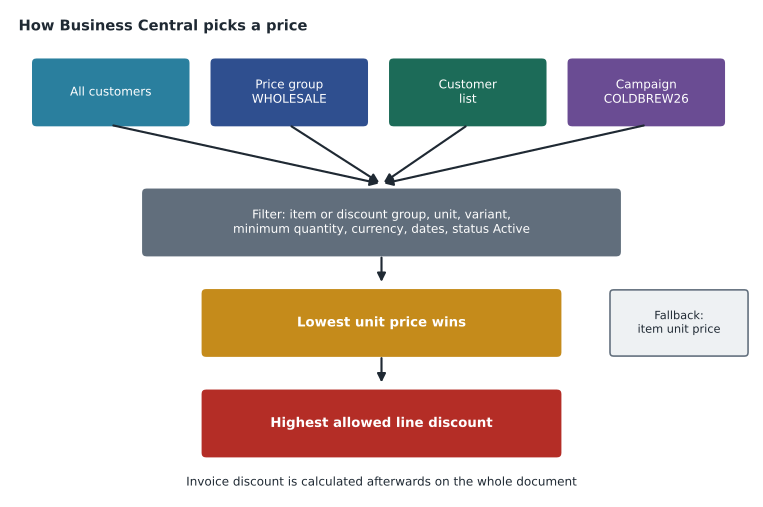
When a user enters an item on a sales line, Business Central looks for every price and discount that could apply and picks the one that is best for the customer. The item card's Unit Price is only the fallback when nothing else matches. Prices and discounts are maintained in price lists, which are the current pricing experience in Business Central; older environments may still show the legacy sales price and line discount pages, which Microsoft replaced with price lists.
Price lists
A price list has a header and lines. The header names the list, says whether it is for sales or purchases, who it is assigned to (all customers, a customer, a customer price group, a contact or a campaign for sales; all vendors or a vendor for purchases), the currency, starting and ending dates, and whether prices include tax. The header can also allow or block line and invoice discounts for everything on the list. Each line names an item, an item discount group, a resource or a G/L account, with an optional variant, unit of measure, minimum quantity, and a unit price or line discount, or both.
| Price list | Assign-to | Contents |
|---|---|---|
| S-LIST-2027 | All customers | Retail and web shop prices per BAG; effective Jan 1, 2027 |
| S-WHOLESALE-2027 | Customer price group WHOLESALE | Wholesale prices per CASE, with a lower price from 10 cases |
| S-GROCERY-CHAIN | Customer: a three-store grocery chain | Negotiated prices on four blends |
| S-COLDBREW26 | Campaign COLDBREW26 | Winter cold brew concentrate at a promotional price, Dec 1, 2026 to Feb 28, 2027 |
| P-IMPORTER-A | Vendor: an importer | Contract green coffee prices per KG for 2027 |
Price lists go through a status: Draft, Active or Inactive. Only active lists are used. A draft list can be prepared weeks ahead and activated on the day. Sales & Receivables Setup controls whether lines on an active list can be edited directly, and a price approval workflow can be added so changes are approved before they apply. Price lists can be edited in Excel, which Callum used to load the wholesale list from the spreadsheet the sales team already kept, and the Price Worksheet suggests or copies lines in bulk, for example raising every wholesale price by a percentage.
Customer price groups and discount groups
Assigning a price list to each customer would be unmanageable. A customer price group collects customers who share prices; the WHOLESALE group holds all 140 wholesale customers, and a customer card carries one price group. A customer discount group does the same for line discounts. On the item side, an item discount group collects items that share a discount, such as all ROASTED coffees or all MERCH, so one price list line can give 5 percent off every roasted coffee instead of one line per item.
Groups make pricing changes cheap. When Bettina wanted to give the offices on weekly orders 4 percent off all roasted coffee, Callum created a customer discount group OFFICE, assigned the eleven customers, and added one line to a price list: assign-to customer discount group OFFICE, product type item discount group ROASTED, line discount 4 percent.
Best price and line discounts
Business Central chooses the lowest unit price among the active lines that match the customer, item, variant, unit of measure, currency, date and minimum quantity. Then, if the chosen price line allows line discounts, it finds the highest line discount among matching discount lines. This "best price" behavior is predictable but sometimes surprising: a customer in the WHOLESALE group with a negotiated price on their own list gets whichever price is lower, not their negotiated price by default.
Worked problem
Which price wins?
The grocery chain orders 12 CASE of Breakwater Blend on December 10, 2026. Matching lines: S-WHOLESALE-2027 is not yet active; the 2026 wholesale list gives 138.00 dollars per case, or 132.00 from 10 cases; the chain's own list gives 134.00 per case; the OFFICE discount does not apply to the chain. What price does Business Central use?
Show solution
- Collect active lines that match: 2026 wholesale 138.00 (minimum 0), 2026 wholesale 132.00 (minimum 10 cases), chain list 134.00.
- Check the quantity: 12 cases meets the 10-case minimum, so the 132.00 line qualifies.
- Pick the lowest price: 132.00 dollars per case.
- Look for line discounts allowed on that line: none match the chain, so the line shows 132.00 with no discount, for 1,584.00 dollars.
Answer: 132.00 dollars per case, from the volume line on the wholesale list, because it is the best price that matches.
If a negotiated list must win even when it is not the cheapest, the usual design is to keep the customer out of the general group, or to set the general list's lines so they do not match that customer. Noor kept it simple: customers with their own list are placed in a separate price group with no general wholesale prices.
Business Central also supports price calculation methods. The standard method is lowest price; extensions can add others. The price calculation method is chosen in Sales & Receivables Setup and can be overridden per customer. Corbel & Finch uses lowest price everywhere.
Minimum quantities and units of measure
A price list line with a Minimum Quantity applies only when the line quantity, in the line's unit of measure, reaches the minimum. Prices are also unit-specific: a price for CASE does not apply to a line entered in BAG unless the line has no unit of measure filter. Corbel & Finch prices wholesale coffee per CASE and retail coffee per BAG, and the wholesale list deliberately has no BAG lines, so a wholesale customer ordering loose bags pays the list price per bag, which is higher.
Invoice discounts
An invoice discount applies to the whole document after line prices and discounts. It is set up as customer invoice discount terms on the customer card, by currency and minimum amount: for example, 2 percent off orders over 1,000 dollars and 3 percent over 2,500. The discount is calculated when the user chooses Calculate Invoice Discount, or automatically if Sales & Receivables Setup has Calc. Inv. Discount turned on. Items with Allow Invoice Disc. turned off, such as COLDBREW26 promotional items, are left out of the base. Several customers can share terms through an invoice discount code.
| Discount type | Set up on | Applies to | Example |
|---|---|---|---|
| Line discount | Price list line (discount), by customer, group or campaign | Each matching line | 4 percent off roasted coffee for OFFICE |
| Invoice discount | Customer invoice discount terms | The document total above a minimum | 2 percent over 1,000 dollars |
| Payment discount | Payment terms (finance course) | Early payment of the invoice | 2/10NET30 |
Purchase prices and discounts
Purchasing uses the same machinery. Purchase price lists assigned to a vendor hold direct unit costs, with minimum quantities and dates, and purchase line discounts. The best (lowest) cost wins. Imogen's green coffee contracts are entered as a purchase price list per importer for 2027, so a purchase order or a blanket order release picks up the contract price per kilogram automatically. Vendor invoice discounts work like customer invoice discounts: terms by minimum amount on the vendor card, often used by packaging suppliers who give 1.5 percent on orders over a certain value.
Vendor price lists also matter to costing. For items with the standard costing method, the purchase price is compared with the standard cost when invoices post, and the difference goes to a variance account (lesson 11). For FIFO and average items, the purchase price becomes the inventory cost directly.
Campaigns and dates
A campaign in Business Central comes from relationship management: a named marketing activity with a start and end date. Price lists assigned to a campaign apply when the sales document's campaign matches and the campaign is active. Corbel & Finch's COLDBREW26 campaign has its own price list, valid December 1, 2026 to February 28, 2027, and the shortcut dimension CAMPAIGN set up in the foundations course records the campaign on posted entries for reporting. When the campaign ends, the price list stops applying without anyone remembering to remove it.
Checking and testing prices
The Sales Price Lists page, the Price List Lines overview and the Get Price and Get Line Discount actions on a sales line show which lines are candidates. Before go-live, Callum tested thirty real orders from the old system in CONFIG and compared the calculated totals with what customers had actually paid. Four differences turned out to be old arrangements nobody wanted to keep; two were mistakes in the new lists, fixed before activation.
Prices including tax
Retail and web shop prices are shown to customers with tax included in some places and without it in others. A price list header has a Price Includes Tax setting, and a sales document has Prices Including Tax. If they differ, Business Central converts the price using the tax rate for the line. In the US, shelf and web prices are normally shown before sales tax, so Corbel & Finch keeps all price lists exclusive of tax. The cafés' point-of-sale system handles counter prices, so the setting matters mainly for the web shop integration, which sends prices before tax.
Currency on price lists
Price lists can be in a specific currency. Corbel & Finch has a small number of export customers who are billed in Canadian dollars, with posting group EXPORT. A price list in that currency applies only to documents in that currency; for other currencies, Business Central converts the local-currency price at the document's exchange rate. Bettina preferred a fixed export price list in the foreign currency, so export customers see a stable price that is reviewed twice a year rather than one that moves with the exchange rate every day.
Prices for variants and units
Because each roasted coffee has grind variants (lesson 1), price list lines can be specific to a variant. Corbel & Finch prices all variants the same, so its lines leave the variant blank, which means the line applies to every variant. Similarly, a line with a blank unit of measure applies only when the line's unit matches the item's base unit or sales unit, depending on setup; to avoid surprises, Callum fills the unit of measure on every line explicitly: BAG on retail lists, CASE on wholesale lists.
| Price list line field | Blank means | Corbel & Finch practice |
|---|---|---|
| Variant Code | All variants | Left blank; grinds cost the same |
| Unit of Measure Code | Depends on the item's units | Always filled to avoid surprises |
| Minimum Quantity | Any quantity | Filled only on volume lines |
| Starting and Ending Date | No date limit | Filled on campaign lists and annual lists |
Reviewing price changes
Every January, Corbel & Finch reviews wholesale prices after the new green coffee contracts are signed. The process Callum set up has four steps: copy the current wholesale list to a new draft list with next year's dates, use the Price Worksheet to suggest new prices by applying an adjustment factor, for example 1.04 for a 4 percent rise, to selected item discount groups, review the suggestions in Excel with Bettina, then activate the new list. The old list ends on December 31 and stays in Business Central for reference, so last year's invoices can still be explained.
Worked problem
A volume line and a discount together
An office customer in discount group OFFICE orders 8 CASE of Breakwater at the wholesale price of 138.00 dollars. The OFFICE line gives 4 percent off roasted coffee, and the customer has invoice discount terms of 2 percent over 1,000 dollars. What is the total before tax?
Show solution
- Line price: 138.00 dollars per case; 8 cases is below the 10-case volume minimum, so the 132.00 price does not apply.
- Line discount: 4 percent of 1,104.00 is 44.16 dollars, so the line amount is 1,059.84 dollars.
- Invoice discount: the total is over 1,000, so 2 percent of 1,059.84 is 21.20 dollars.
- Total before tax: 1,038.64 dollars.
Answer: 1,038.64 dollars: the list price, less the 4 percent line discount, less the 2 percent invoice discount.
Common mistakes
MistakeExpecting a customer's own price list to win automatically.
InsteadBusiness Central picks the lowest matching price; design groups so only the intended lines match.
MistakeCreating one discount line per item.
InsteadUse item discount groups and customer discount groups.
MistakeForgetting units of measure on price lines.
InsteadPrices are unit-specific; add lines for each unit sold or leave the unit blank deliberately.
MistakeLeaving promotional items in the invoice discount base.
InsteadTurn off Allow Invoice Disc. on items or price lines that should not get more discount.
MistakeActivating a new price list on the day without testing.
InsteadPrepare it as a draft, test real orders in a sandbox, then activate.
Summary and key terms
- Price lists hold sales and purchase prices and line discounts, with assign-to, dates, currency and status.
- Customer price groups, customer discount groups and item discount groups keep pricing manageable.
- Business Central uses the lowest matching price, then the highest allowed line discount.
- Minimum quantities and units of measure decide which lines match.
- Invoice discounts apply to the document total above minimum amounts.
- Purchase price lists bring contract costs onto purchase orders.
- Campaign price lists apply only while the campaign is active.
- Price list
- A set of price and discount lines for sales or purchases with an assign-to and dates.
- Customer price group
- A group of customers who share prices.
- Item discount group
- A group of items that share a line discount.
- Line discount
- A percentage off the price on a document line.
- Invoice discount
- A discount on the whole document above a minimum amount.
- Minimum quantity
- The line quantity a price list line needs before it applies.
- Campaign
- A dated marketing activity that can have its own price list.
Practice problems
Work each problem on paper first, then reveal the answer to check.
A customer qualifies for 140.00 on the general list and 135.00 on their own list. Which price is used?
Show answer
135.00, the lowest matching price.
Where are invoice discounts for a customer set up?
Show answer
In customer invoice discount terms on the customer card, by currency and minimum amount.
How does a new price list take effect on a future date without manual work?
Show answer
Set its starting date and activate it; it applies from that date.
Lesson quiz · 5 questions
Score 60% or more to complete this lesson.
Create a free account to save your progress, take quizzes and earn a certificate.