
MSBA-351 · Lesson 12 of 12 · 20 min
Case study: a wholesale business
▶ Video coming soon A video version of this lesson is on the way.
For the final session on November 23, 2026, Noor brought a different company. Quillcrest Provisions is a fictional specialty food wholesaler in Spokane with about 55 staff, one warehouse, a small cross-dock at a second site, and 600 restaurant, café and grocery customers. It distributes cheeses, cured meats, oils, preserves and dry goods, some of them bought from small producers and some imported. Its operations manager, Harlan Oduya, is evaluating Business Central after outgrowing an older system. Noor gave Callum Harlan's list of problems and asked him to design the sales, purchasing and inventory setup the way a functional consultant would, using everything from this course. Corbel & Finch is one of Quillcrest's suppliers, which is how the two had met.
The brief
| Area | Harlan's problem today |
|---|---|
| Items | 4,100 products, many duplicates; cheese sold by the wheel, by the kilogram and in pre-cut packs |
| Sales | Phone and email orders typed by three order takers; frequent short shipments; customers on standing weekly orders |
| Pricing | Five price levels, dozens of special deals, and a monthly promotion flyer |
| Purchasing | Producer deliveries that differ from the order; freight and duty added in a spreadsheet |
| Locations | Main warehouse plus a cross-dock site; stock moved by truck without records |
| Warehouse | Two shifts, eight pickers, a chilled room and a dry store |
| Tracking | Food safety rules require lot traceability and best-before dates |
| Assembly | Gift hampers assembled for the holiday season |
| Planning | Buyers reorder from memory; regular stock-outs of popular lines |
| Returns | Credits issued without receiving goods; spoiled returns put back on shelves |
| Costing | Stock valued at the latest purchase price |
Part 1: items and units
Callum started with the item master, because everything else depends on it. He proposed cleaning the 4,100 products to about 2,600 inventory items, using item categories for the main product families (CHEESE, CHARCUTERIE, OILS, PRESERVES, DRY GOODS, HAMPERS) with category attributes such as country of origin, milk type, organic and allergens. For cheese he weighed the options carefully: whole wheels and pre-cut packs have different costs, labels and best-before dates, so they should be separate items, not variants. Selling one item by the kilogram and by the wheel, however, is a unit of measure question: a 9-kilogram wheel is a unit with Qty. per Unit of Measure 9 on an item whose base unit is KG. Catch weight, where each wheel weighs slightly differently, is not handled by standard units of measure, so he proposed recording the actual weight on the line, or an extension if Harlan needs true catch-weight pricing.
Part 2: sales
For sales, Callum proposed sales orders for all wholesale customers, with ship-to addresses carrying tax area codes for every delivery point, shipping agents for Quillcrest's own trucks and the courier, and recurring sales lines for the 140 customers on standing weekly orders. Order takers would check Item Availability by Event on each line, and short shipments would be posted as partial shipments with Shipping Advice Partial, so backorders stay visible on the order rather than disappearing. For the email orders, he suggested a later pilot of the Sales Order Agent, after cleaning contact email addresses, because the agent matches customers only by email and always creates a quote first, with every outgoing message reviewed.
Part 3: pricing
The five price levels became five customer price groups with one price list each, and special deals became customer price lists only where they were genuinely negotiated. Because Business Central uses the lowest matching price, Callum warned Harlan that a customer in a price group with a cheaper special list would always get the cheaper price, and he proposed placing customers with negotiated lists in their own group. The monthly flyer became a campaign with a dated price list each month. Volume pricing used minimum quantities on price list lines, and customer invoice discount terms replaced a manual end-of-month rebate for large customers.
Part 4: purchasing and landed cost
For producer deliveries that differ from orders, Callum proposed over-receipt codes with a 5 percent tolerance and approval above it, so a producer delivering one extra case is accepted without a new order. Imported goods carry item charges for freight, duty and brokerage, assigned by amount for duty and by weight for freight, so landed cost is part of inventory value. Blanket purchase orders would hold annual agreements with the two olive oil importers, and purchase price lists per vendor would bring contract costs onto orders.
Part 5: locations and warehousing
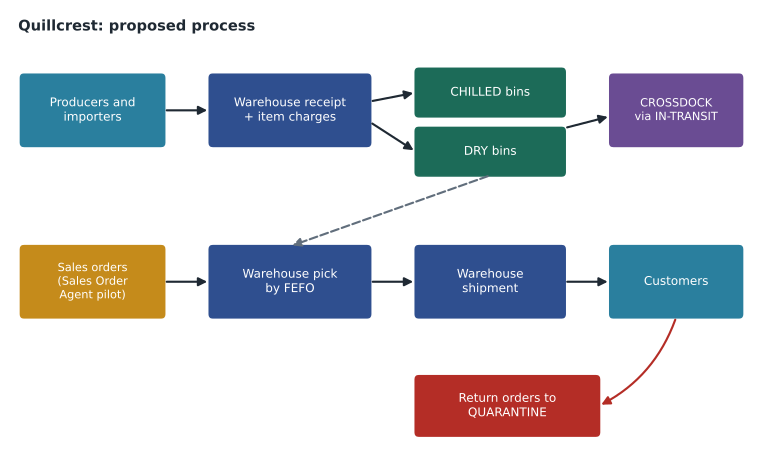
Two locations, MAIN and CROSSDOCK, plus IN-TRANSIT and QUARANTINE. Stock moving between sites goes on transfer orders with a transfer route. With eight pickers on two shifts and trucks from many producers, MAIN justifies the higher warehouse level: Require Receive, Require Put-away, Require Shipment and Require Pick with Bin Mandatory, so receiving, putting away, picking and shipping are separate steps on warehouse receipts, put-aways, picks and shipments. Bins are grouped into the chilled room and the dry store. Callum considered directed put-away and pick, which adds zones and bin rankings, but suggested starting one level lower and moving up after a year if the volume warrants it. CROSSDOCK stays simple, with no warehouse documents.
Part 6: item tracking
Food safety requires traceability, so every food item gets a lot-specific item tracking code with warehouse tracking, expiration dates required on receipt, and strict expiration posting. Picks at MAIN use FEFO. Item Tracing answers recall questions in both directions, and lot information cards can be blocked during a quality hold. Callum noted that the item tracking code must be set before the first receipt, and that opening stock at go-live must be loaded with lot numbers and expiration dates, or outbound postings will be blocked.
Part 7: assembly
Holiday hampers fit assembly management: each hamper is an item with replenishment system Assembly and an assembly BOM of the products, the basket and wrapping, plus a resource for packing time. Standard hampers are assemble-to-stock in November; corporate orders with a customer's card or logo are assemble-to-order, linked to the sales line. Because the components are lot-tracked foods, the assembly order records which lots went into each hamper, and the hamper itself gets a lot and a best-before date from the earliest component, entered on the output.
Part 8: planning
Buyers will run the requisition worksheet every Monday and Thursday. Fast-moving lines use Fixed Reorder Qty. or Maximum Qty. with safety stock and realistic vendor lead times from the item vendor catalog; slow special lines use the Order policy so they are bought only when sold; and producer pack sizes are set as order multiples. A demand forecast for the holiday season helps the hampers and the cheese buyers plan ahead. Drop shipments handle large restaurant equipment orders that a partner ships directly.
Part 9: returns
Returns move to sales return orders so goods are received before credit is given. Return reason codes send spoiled goods to QUARANTINE with Inventory Value Zero, and resaleable goods back to MAIN. Get Posted Document Lines to Reverse and Exact Cost Reversing Mandatory make sure returns come back at the right price and cost, with their lot numbers.
Part 10: costing
Valuing everything at the latest purchase price was the root of Harlan's margin problems. Callum proposed FIFO for perishable food, which matches how the stock physically moves and works naturally with lots, and Standard for hampers, so their cost is stable for pricing and the variance shows how much component costs drifted. Item charges, cost adjustment every night through a job queue entry, Automatic Cost Posting, and a monthly Inventory - G/L Reconciliation complete the design.
Worked problem
Checking the design against one order
A restaurant orders 2 wheels of aged cheddar, 6 kg of the same cheddar cut, and one corporate hamper with its logo, for delivery on Thursday. Trace what happens in the proposed design.
Show solution
- The order taker enters a sales order. The wheel line uses unit WHEEL (9 KG each); the cut cheddar is a separate item sold by KG. Prices come from the customer's price group list, with the best price applied.
- The hamper is assemble-to-order: a linked assembly order is created, and the packing team assembles it with lots chosen for each component.
- The release creates warehouse shipment lines; a warehouse pick takes the oldest-expiring cheddar lots by FEFO from the chilled bins.
- Posting the warehouse shipment posts the sales shipment, the assembly and the lot numbers; the invoice follows the same day.
- If the restaurant later returns a wheel that arrived warm, a return order with reason SPOILED receives it into QUARANTINE at zero value, and the credit memo follows.
Answer: Every step is a document Business Central links to the next, with lots, prices and costs carried through.
What Callum learned
Harlan's reaction surprised Callum. "You did not suggest anything clever," he said. "Every piece is standard. That is what I wanted." Noor agreed that this is the real skill: knowing which standard feature fits each problem, setting it up carefully, and resisting extensions until the standard has been tried. The same thinking runs through the MB-800 exam, which asks candidates to choose the right setup for a scenario more often than to remember a menu.
Back at Corbel & Finch, the inventory design was frozen in CONFIG on November 23, 2026. Data migration of items, open purchase orders and opening stock with lots is planned for December, ready for go-live on January 1, 2027.
The fit-gap summary
Callum finished with a fit-gap table, the standard way a consultant summarizes a proposal: each requirement, the standard feature that meets it, and anything that needs more.
| Requirement | Standard feature | Gap or note |
|---|---|---|
| Clean product master | Item categories, attributes, templates | Data cleanup project before go-live |
| Sell by wheel and by kilogram | Units of measure | True catch weight needs an extension |
| Standing weekly orders | Recurring sales lines | None |
| Five price levels and deals | Price lists with customer price groups | Design groups so best price works as intended |
| Producer over-deliveries | Over-receipt codes | None |
| Freight and duty in cost | Item charges | None |
| Two sites with trucks | Transfer orders with in-transit | None |
| Eight pickers, chilled and dry areas | Warehouse receipts, put-aways, picks and shipments with bins | Directed put-away and pick later if needed |
| Food traceability | Lot-specific tracking, FEFO, Item Tracing | Label printing may need an add-on |
| Holiday hampers | Assembly management | None |
| Stock-outs | Requisition worksheet, reordering policies, forecasts | Clean lead time data first |
| Returns without control | Return orders, return reasons, quarantine | None |
| Wrong stock values | FIFO and Standard costing, cost adjustment | Migrate opening stock at agreed values |
Rollout order
Callum suggested a rollout order based on dependencies, not on what looks most impressive. Items, units, categories and tracking codes come first, because every other area uses them and they are hard to change later. Pricing, customers and vendors come next. Locations, bins and warehouse settings follow, tested with real orders in a sandbox. Planning parameters are set once the item data is clean, and costing methods are fixed before any opening stock is loaded. The Sales Order Agent pilot comes last, months after go-live, when contact data and item descriptions are reliable.
Exam connection
The MB-800 study guide, as of June 30, 2026, puts sales and purchasing configuration at 10 to 15 percent of the exam, and the operations domain, which includes processing purchases, sales and inventory transactions, at 30 to 35 percent. Its objectives include setting up inventory and costing methods, stockkeeping units, customer and vendor settings, pricing and discounts, quotes, orders, receipts and shipments and their reversal, recurring lines, blanket orders, deferrals on documents, transfers, cost adjustment, counting and reclassification, and enabling Copilot and agent capabilities. Item tracking, assembly, warehousing and planning are not listed as separate objectives, but they are part of real Business Central projects, and scenario questions often assume them. This course has covered both.
Worked problem
A scenario question in exam style
A company receives goods weekly but receives vendor invoices monthly for all receipts. The accounts payable clerk wants to post one invoice per vendor per month without opening each purchase order. What should the clerk do?
Show solution
- Identify the requirement: one invoice covering many posted receipts.
- Rule out options that do not fit: Combine Shipments is a sales feature; blanket orders are for releasing orders, not invoicing; Undo Receipt reverses receipts.
- Choose the feature: create a purchase invoice for the vendor and use Get Receipt Lines to pull in the uninvoiced receipt lines.
Answer: Create one purchase invoice and use Get Receipt Lines.
Common mistakes
MistakeUsing variants for products with different costs and best-before dates.
InsteadUse separate items; use units of measure for different selling quantities of the same product.
MistakeJumping to directed put-away and pick on day one.
InsteadStart at the level the operation needs and move up when volume justifies it.
MistakeLoading opening stock without lot numbers for tracked items.
InsteadMigrate stock with lots and expiration dates so outbound postings work.
MistakeProposing an extension before trying the standard feature.
InsteadFit standard features first and document gaps such as catch weight.
Summary and key terms
- Item design comes first: types, separate items versus variants, units of measure and categories.
- Sales, pricing and purchasing features each solve a specific operational problem.
- Warehouse level is chosen per location to match the volume and team.
- Lot tracking, FEFO and Item Tracing meet food safety requirements.
- Assembly, planning and returns complete the operational design.
- Costing method and cost adjustment decide whether margins can be trusted.
- Catch weight
- Selling an item at its actual weight per unit, which needs special handling.
- Cross-dock
- A site where goods are moved through quickly with little storage.
- Landed cost
- The full cost of an item including freight, duty and fees.
- Fit-gap analysis
- Matching requirements to standard features and listing what needs more.
Practice problems
Work each problem on paper first, then reveal the answer to check.
Why did Callum make whole wheels and pre-cut packs separate items?
Show answer
They have different costs, labels and best-before dates, which variants cannot separate.
Which warehouse settings did he propose for MAIN?
Show answer
Require Receive, Require Put-away, Require Shipment and Require Pick with Bin Mandatory.
What costing methods did he propose, and why?
Show answer
FIFO for perishables to match physical flow and lots; Standard for hampers for a stable cost with variances.
Lesson quiz · 5 questions
Score 60% or more to complete this lesson.
Create a free account to save your progress, take quizzes and earn a certificate.