
MSBA-350 · Lesson 12 of 12 · 18 min
Case study: month-end close for a retailer
▶ Video coming soon A video version of this lesson is on the way.
For the last session of the finance build, on November 23, 2026, Noor brought a case instead of a new feature. "Corbel & Finch goes live in January, and your first close is in February," she told Callum. "Before then, I want you to run a full close for a business that isn't yours, so you have to think about every step." The case was Saltgrass Outfitters, a fictional outdoor gear retailer with three stores in Missoula, Bozeman and Helena, a web shop and about 60 staff, running Business Central with the US localization. Noor had built the company in the TRAINING environment with a month of invented October 2026 data and planted problems in it. This lesson presents the case, Callum's close plan, the problems he found and how he fixed them, and the close checklist that came out of it.
The business and its setup
| Area | Saltgrass Outfitters setup |
|---|---|
| Company | One legal entity; fiscal year January to December |
| Dimensions | Global: STORE (KAM, KEL, VER or MSL, BZN, HLN in the US version, and WEB) and DEPARTMENT; shortcut: CATEGORY (Camping, Clothing, Footwear, Bikes) |
| Bank accounts | OPERATING, CARDS (store and web card settlements), PAYROLL CLEARING |
| Sales | Store sales posted daily from the point-of-sale system as summarized sales invoices to one customer per store; web shop orders through an extension |
| Purchases | About 140 vendors; purchase orders for inventory; item charges for inbound freight |
| Inventory | Average costing; four locations (three stores and a small warehouse) |
| Fixed assets | Store fit-outs, point-of-sale hardware, a delivery van; COMPANY book integrated |
| Payroll | An outside payroll provider; payroll posted by a monthly journal from the provider's report |
| Tax | Sales tax with tax areas for each store; web orders taxed by ship-to address |
The controller, Hester Quillby, wanted the October close finished in five working days, with a pack for the owner on day five. Noor played Hester's role and answered Callum's questions as Hester would.
The close plan
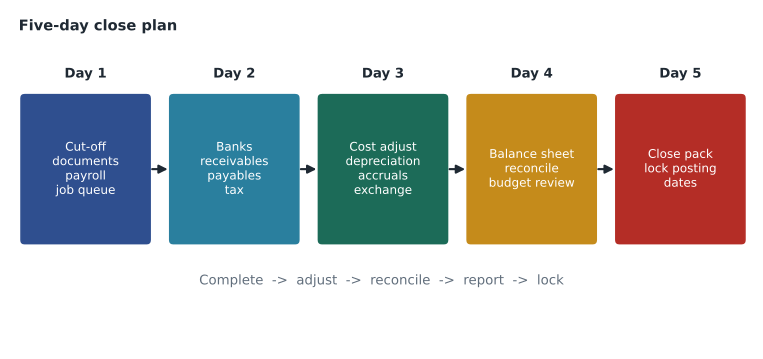
Callum's first move was not to open Business Central but to write the plan. A close has a natural order: complete the transactions, then adjust, then reconcile, then report, then lock. He set it out by day.
| Day | Tasks | Business Central tools |
|---|---|---|
| 1 | Cut-off: post all October store sales, web orders, purchase receipts and invoices; post the payroll journal; clear the job queue errors | Sales and purchase documents, general journal, Job Queue Entries |
| 2 | Reconcile bank accounts; review aged receivables and payables; reconcile tax accounts to tax reports | Bank account reconciliation, payment reconciliation journal, Aged reports, tax reports |
| 3 | Adjust item costs and post to G/L; calculate depreciation; post accruals and deferral releases; adjust exchange rates | Adjust Cost - Item Entries, Post Inventory Cost to G/L, Calculate Depreciation, recurring journals, Adjust Exchange Rates |
| 4 | Reconcile balance sheet accounts; review income statement against budget and last year | Trial balance, financial reports, Trial Balance/Budget |
| 5 | Produce the close pack; move the posting window; close the inventory period if used | Financial reports, General Ledger Setup, User Setup, Inventory Periods |
Day 1: completing the month
Callum began with cut-off: making sure every October transaction was in October and nothing from November had crept in. He filtered purchase receipts that had been received but not invoiced, and found 11 receipts worth 18,640 dollars with no vendor invoice yet. The goods were in inventory, so their cost belonged in October. Business Central had already posted the receipts at the expected cost to inventory and to an interim account, as Saltgrass used expected cost posting to the G/L; he confirmed the interim balance matched the receipts not yet invoiced, so no accrual was needed. (Without expected cost posting, he would have accrued the cost with a reversing journal.)
The payroll provider's October report was posted through a general journal from a standard journal with the right accounts and STORE dimensions, so each store's wages landed in the right place. Finally he opened Job Queue Entries and found that the nightly web shop synchronization had failed on October 30 and 31. Twelve web orders had never arrived. He fixed the expired credential the job was using, reran the job, and posted the orders with October dates.
Day 2: banks, customers, vendors and tax
The bank reconciliations followed lesson 3. The OPERATING account matched except for two vendor payments made by electronic transfer on October 31 that cleared on November 2: outstanding items, left open. The CARDS account showed a planted problem: card settlements from one store were about 900 dollars lower than the store's card sales for the month. Drilling in, Callum found that the card processor had begun deducting a new monthly equipment fee from settlements. He added a text-to-account mapping in the payment reconciliation journal to post the fee to bank charges, which reconciled the account and would handle the fee automatically next month.
Worked problem
The receivables control account that would not agree
On day 2, the Aged Accounts Receivable report totals 46,310 dollars, but the receivables G/L account shows 48,810. What happened, and how is it fixed?
Show solution
- The difference is 2,500. Callum filters G/L entries on the receivables account for October and looks for entries with no customer ledger entry: source codes other than SALES or CASHRECJNL.
- He finds one general journal entry of 2,500 posted directly to receivables by a store manager trying to record a gift card sale, because Direct Posting had been left on for the account.
- He reverses the entry from the G/L register and reposts it correctly to the gift card liability account.
- He turns Direct Posting off on the receivables account so the error cannot recur, and notes it in the close pack.
Answer: A direct journal posting to the control account caused the 2,500 difference; reverse it, repost correctly and turn Direct Posting off.
Payables reconciled to the general ledger at once. The tax reconciliation found the second planted problem: the twelve late web orders included three shipped to another state, and the web shop extension had used the store's tax area rather than the ship-to address. Callum corrected the three invoices with the Correct action, which posted credit memos and reissued the invoices with the right tax area, and raised a setup issue for the extension. The tax report then agreed with the tax accounts.
Day 3: adjustments
Day 3 was the adjustment day. Adjust Cost - Item Entries ran over all items, updating the cost of goods sold for items whose late freight invoices had arrived, and Post Inventory Cost to G/L posted the result. Callum compared the Inventory Valuation report with the inventory G/L accounts; they agreed. Calculate Depreciation for October filled the FA G/L journal with 31 lines totaling 7,420 dollars; he previewed and posted it. The recurring journal posted the month's accruals with reversing methods and the deferral schedules released prepaid insurance and software. Saltgrass had a small euro supplier, so Adjust Exchange Rates revalued its open invoices, posting a 38-dollar unrealized loss.
| Adjustment | Amount (invented) | Accounts affected |
|---|---|---|
| Inventory cost adjustment | 1,260 increase in cost of goods sold | Cost of goods sold, inventory |
| Depreciation | 7,420 | Depreciation expense, accumulated depreciation |
| Accruals (reversing) | 5,980 | Utilities, cleaning, professional fees, accrued liabilities |
| Deferral releases | 2,150 | Insurance and software expense, prepaid expenses |
| Exchange rate adjustment | 38 loss | Unrealized loss, payables |
Day 4: reconcile and review
With the adjustments posted, Callum reconciled every balance sheet account using the list from lesson 11 and recorded the evidence for each: a report, a reconciliation or an explanation. The suspense account held one planted item, a 460-dollar deposit from September that had never been identified. Noor, as Hester, revealed it was a customer's refund check returned uncashed; Callum reversed the original refund to the customer's account. Suspense went to zero.
The income statement review compared October with budget and with September using a financial report with actual, budget and variance columns by STORE. Two variances stood out. Footwear margin at one store was well below budget, which turned out to be a promotion that had not been in the budget: a real business result, explained in the pack. Repairs expense was triple the budget, which turned out to be the delivery van's new transmission, coded to repairs instead of being capitalized. Callum checked Saltgrass's capitalization policy (amounts over 2,500 dollars that extend an asset's life are capitalized), reclassified the 4,800-dollar repair to the van's fixed asset as an acquisition cost with a corrective entry through the FA G/L journal, and noted it.
Day 5: report and lock
The close pack for the owner had four pages: the income statement by store against budget with comments on each large variance, the balance sheet against last month, a cash flow forecast for the next eight weeks (lesson 8), and a short list of issues found and fixed. Callum produced the statements from financial reports, the forecast from the cash flow worksheet, and the issue list from his notes. Then he locked October: on General Ledger Setup, Allow Posting From moved to November 1; on User Setup, Hester kept October open for one more week for any late adjustments.
| Planted problem | How it was found | Fix | Prevention |
|---|---|---|---|
| Failed web shop synchronization | Job Queue Entries showed errors | Fixed the credential, reran, posted with October dates | Job queue error notifications |
| New card processor fee | CARDS reconciliation difference | Text-to-account mapping to bank charges | Mapping handles it monthly |
| Direct posting to receivables | Aged receivables against the G/L | Reversed and reposted to the gift card liability | Direct Posting turned off |
| Wrong tax area on web orders | Tax report against tax accounts | Corrected invoices with the right tax area | Extension setup issue raised |
| Unidentified deposit | Suspense account review | Reversed the returned refund | Monthly suspense review |
| Capital repair expensed | Budget variance review | Reclassified to the fixed asset | Capitalization check in the close |
The checklist Callum kept
Callum turned the exercise into Corbel & Finch's month-end checklist for 2027. He saved it as a shared document linked from the finance role center and planned to review it after the first three closes. The checklist kept the day-by-day order, named the Business Central page or report for each step, and added a "who and when" column so that tasks could be split between him and Imogen. It also listed the controls each step proved: a reconciliation is not just a task, it is evidence for the auditors that a balance is right.
Noor's parting advice summed up the course. "Business Central will post whatever you tell it to, perfectly, every time. The close is where you check that what you told it was right." Callum's first real close was set for February 1 to 5, 2027, with Noor on call.
Who does what
A close is a team effort even in a small company. Callum's plan for Saltgrass assigned each task to a role, which he later used for Corbel & Finch with Imogen taking purchasing and payables tasks.
| Task | Role at Saltgrass | Role at Corbel & Finch (planned) |
|---|---|---|
| Post remaining purchase invoices | Accounts payable clerk | Imogen |
| Post store sales and web orders | Store managers and the web shop job | Café managers and the web shop job |
| Bank reconciliations | Controller | Callum |
| Adjustments and depreciation | Controller | Callum |
| Variance review | Controller with the owner | Callum with Bettina |
| Lock posting dates | Controller | Callum |
The last question Noor asked was what Callum would automate after the first few closes. His answer: reminders and statements through the job queue (already planned), text-to-account mappings for every recurring bank fee, recurring journals for every regular accrual, and a review of the Payables Agent in March 2027. "Automate the routine," Noor said, "so the close is spent on the exceptions."
Callum also added a short review step at the end of every close: a ten-minute conversation with Bettina about what went wrong and what to change next month. The first item for February 2027 was already on the list from the exercise: check the job queue every morning during the close, because a silent synchronization failure had cost Saltgrass twelve orders and a day of work. The second was to agree, before the first close, the capitalization threshold and the materiality level below which small variances need no comment. Writing those rules down in advance, Noor said, is what keeps a five-day close at five days.
Common mistakes
MistakeStarting adjustments before all of the month's documents are posted.
InsteadComplete cut-off first; adjustments depend on complete data.
MistakeTreating reconciliation differences as rounding.
InsteadInvestigate every difference; most have a cause that will recur.
MistakeFixing a problem without fixing its cause.
InsteadAdd a control, mapping or setup change so it does not happen again.
MistakeLocking the period before late adjustments are agreed.
InsteadLock ordinary users, and give the controller a short extra window.
Summary and key terms
- A month-end close follows an order: complete, adjust, reconcile, report, lock.
- Cut-off checks receipts not invoiced, payroll, job queue failures and late documents.
- Bank, receivables, payables and tax reconciliations find posting and setup errors.
- Inventory cost adjustment, depreciation, accruals, deferrals and exchange rate adjustments are posted before review.
- Balance sheet reconciliations and budget variance review find misclassifications.
- The close pack reports results; posting date windows lock the month.
- Cut-off
- Making sure each transaction is recorded in the correct period.
- Expected cost posting
- Posting the expected cost of received but uninvoiced items to the G/L.
- Close pack
- The set of reports and notes that presents a month's results.
- Capitalization policy
- The rule that decides when a cost is recorded as a fixed asset.
- Reconciliation evidence
- The report or explanation that proves an account balance is right.
- Posting window
- The range of dates in which users may post, set in General Ledger Setup and User Setup.
Practice problems
Work each problem on paper first, then reveal the answer to check.
Why is cut-off done before adjustments?
Show answer
Adjustments such as cost adjustment and accruals depend on all the month's documents being posted.
How did Callum find the direct posting to receivables?
Show answer
By comparing Aged Accounts Receivable with the receivables G/L balance and filtering entries by source code.
What is the last step of the close?
Show answer
Moving the posting date window so the month is locked for ordinary users.
Lesson quiz · 5 questions
Score 60% or more to complete this lesson.
Create a free account to save your progress, take quizzes and earn a certificate.