
MSBA-350 · Lesson 10 of 12 · 18 min
Consolidation
▶ Video coming soon A video version of this lesson is on the way.
Noor continued the training exercise from lesson 9. If Corbel & Finch ever split into a roasting company and a retail company, Bettina, the bank and the tax authorities would still want to see the business as a whole: one income statement and one balance sheet for the group. Producing those combined statements is consolidation. In the TRAINING environment, Noor added a third demonstration company, CF DEMO GROUP, to act as the consolidation company, and showed Callum how Business Central pulls the two companies' results together, translates currencies and eliminates the intercompany trade from lesson 9.
The consolidation model
Consolidation in Business Central works by copying G/L balances from business units into a consolidation company. A business unit is one company to be consolidated. The consolidation company is a separate company, usually with no transactions of its own, that receives consolidated entries and holds elimination entries. Group reports are run in the consolidation company. The source companies keep their own books untouched.
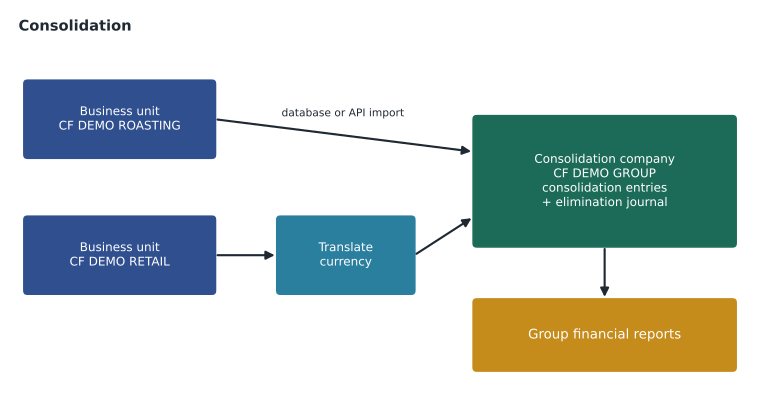
Each source company decides how its accounts map into the group. On each G/L account in a business unit, the Consol. Debit Acc. and Consol. Credit Acc. fields name the account in the consolidation company to receive that account's balance; blank means the same account number. The Consol. Translation Method field says which exchange rate to use when the business unit uses a different currency. When all companies share one chart of accounts, as is common for groups set up together, the mapping is simple.
Setting up business units
In the consolidation company, each source company is a business unit card. The Company Consolidation assisted setup guide creates the consolidation company and business units for basic cases; advanced setups are done on the cards directly.
| Field on the business unit card | Purpose |
|---|---|
| Code and Name | Identifies the business unit; the code is stamped on consolidated entries |
| Company Name | The source company |
| Default Data Import Method | Database for companies in the same environment, API for other environments |
| Consolidate | Whether the unit is included in the next run |
| Consolidation percentage | The share of the unit's amounts to include, such as 100 or a partial ownership share |
| Starting and Ending Date | The unit's fiscal year, if it differs from the group's |
| Currency Code and exchange rate table | The unit's currency and where the rates come from |
| Exchange rate gain and loss, residual and composite accounts | Where translation differences post |
Since Microsoft's 2023 release wave 2, consolidation works across environments. For a business unit in another environment, the import method is API. The consolidation company is given the business unit's API endpoint, copied from the Consolidation Setup page in the source company, and each source company must turn on an option that allows it to be used as a subsidiary, consenting to the data transfer. Business units in the same environment can use the database method, and older file-based methods remain for companies outside Business Central.
Running a consolidation
A consolidation run imports G/L balances for a period from each business unit. Business Central creates consolidation entries in the consolidation company, one per account and dimension combination, stamped with the business unit code. The run can include dimensions if the business units and consolidation company share them. Running again for the same period replaces the earlier entries for that period, so a consolidation can be rerun after a late adjustment in a source company.
Worked problem
Consolidating the demonstration month
Both demo companies have posted a test month, October 2026. How does Callum produce group results for October?
Show solution
- In each source company, check that the period is complete and intercompany outboxes and inboxes are empty (lesson 9).
- In CF DEMO GROUP, open Business Units and run the consolidation for October 1 to October 31, 2026, with both units selected.
- Review the consolidation entries by business unit and run the consolidated trial balance.
- Post elimination entries for intercompany sales, purchases and balances (below).
- Run the group income statement and balance sheet in CF DEMO GROUP.
Answer: Clear intercompany, run the consolidation for the period, review, eliminate, then report in the consolidation company.
Currency translation
If a business unit keeps its books in another currency, its balances must be translated into the group's currency. Different kinds of accounts use different rates, chosen by the Consol. Translation Method on each G/L account.
| Translation method | Rate used | Typical accounts |
|---|---|---|
| Average Rate (Manual) | An average rate for the period, entered on the business unit | Income statement accounts |
| Closing Rate | The rate at the end of the period | Most balance sheet accounts |
| Historical Rate | The rate on each entry's date | Fixed assets and some equity accounts |
| Composite Rate | Current period at average, earlier periods at historical | Retained earnings and similar accounts |
| Equity Rate | Like composite, with differences posted to a separate equity account | Equity accounts |
Because different accounts use different rates, the translated trial balance does not balance by itself. The difference is a translation difference that Business Central posts to the exchange rate gain or loss or residual accounts set on the business unit, which accountants usually treat as part of equity in the group statements. In the training exercise both demo companies used the same currency, so Noor changed RETAIL to a foreign currency for one test run to show Callum the translation entries, then changed it back.
Eliminations
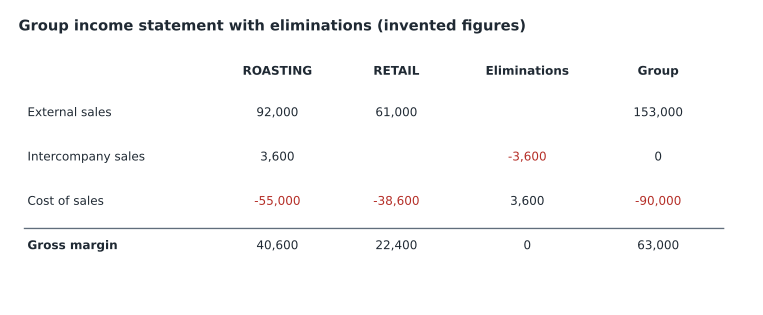
Consolidated statements must show the group as if it were one company, so trade between group companies is removed. In the exercise, ROASTING sold 3,600 dollars of coffee to RETAIL. In the group, that is neither a sale nor a cost: it is an internal transfer. The receivable in ROASTING and the payable in RETAIL also cancel out. Elimination entries are posted in the consolidation company with a general journal in which each line carries the Business Unit Code of the unit it adjusts.
| Elimination | Debit | Credit | Business unit |
|---|---|---|---|
| Intercompany sales and purchases | Intercompany sales 3,600 | ROASTING | |
| Intercompany purchases or cost 3,600 | RETAIL | ||
| Intercompany balances | Intercompany payable 3,600 | RETAIL | |
| Intercompany receivable 3,600 | ROASTING |
The G/L Consolidation Eliminations report shows the consolidated trial balance with proposed eliminations side by side, so the effect can be checked before posting. If RETAIL has not yet sold the coffee to its own customers by month end, a more complex elimination removes the internal profit from RETAIL's inventory; Noor showed the idea but left the detail to the group's accountants, because the method depends on the group's accounting policy. Separate intercompany accounts, as recommended in lesson 9, make all of these entries simple to identify.
Group reporting
Once consolidated and eliminated, the consolidation company's ledger holds the group's results. The Consolidated Trial Balance report shows amounts by business unit and in total. Financial reports built in the consolidation company produce the group income statement, balance sheet and cash flow statement, with columns by business unit if needed, using the Business Unit filter. Because consolidation entries keep dimensions when set up to do so, group results can also be analyzed by business line or department.
When consolidation is the wrong tool
Noor ended the exercise with a caution. Consolidation is for separate legal entities. Within one company, such as Corbel & Finch today, the cafés, the web shop and wholesale are reported with dimensions, not as business units. A group with a few companies that need only a combined view occasionally might use Power BI reports across companies instead of a full consolidation company. And groups with complex ownership structures, minority interests and many currencies often use dedicated consolidation software fed from Business Central. Choosing the simplest approach that meets the reporting requirement is part of the consultant's job.
A translation example
To show translation in numbers, Noor switched CF DEMO RETAIL to a foreign currency for one test run and gave it a tiny trial balance. The group currency is the local currency; RETAIL's currency is called FC here to keep the example neutral.
| RETAIL account | Amount in FC | Method | Rate | Group amount |
|---|---|---|---|---|
| Cash | 10,000 | Closing Rate | 1.30 | 13,000 |
| Equipment | 20,000 | Historical Rate | 1.25 (purchase date) | 25,000 |
| Share capital | -25,000 | Historical Rate | 1.25 | -31,250 |
| Revenue | -15,000 | Average Rate (Manual) | 1.28 | -19,200 |
| Expenses | 10,000 | Average Rate (Manual) | 1.28 | 12,800 |
| Total | 0 | 350 |
The trial balance balances in FC but not in the group currency: the translated amounts add up to 350. That 350 is the translation difference. Business Central posts it to the exchange rate gain or loss or residual account set on the business unit, so the consolidated trial balance balances. In real groups the accountants decide, under their accounting standards, how the difference is presented; Business Central's job is to calculate it consistently and post it to the accounts chosen.
Partial ownership and different fiscal years
The consolidation percentage field on a business unit includes only a share of the unit's amounts, which some groups use for joint ventures. Most accounting standards require more complex treatment of minority interests, so groups with partially owned subsidiaries often consolidate at 100 percent and record the minority interest with journal entries, as their accountants direct. The business unit's Starting Date and Ending Date fields handle a subsidiary whose fiscal year differs from the group's, so the right period is imported for each consolidation.
| Report | Shows |
|---|---|
| Consolidated Trial Balance | Balances by business unit and in total for a period |
| G/L Consolidation Eliminations | The consolidated trial balance with proposed eliminations before posting |
| Financial reports with a business unit filter | Group statements, optionally by business unit |
| G/L entries filtered by business unit code | Every consolidation and elimination entry for one unit |
Noor's closing check for the exercise was a simple test: the consolidated balance sheet must balance, the intercompany accounts must show zero after eliminations, and the group's external revenue must equal the sum of each company's external revenue. When all three hold, the consolidation is mechanically right, and the accountants can focus on judgment.
Unrealized intercompany profit
The elimination in this lesson removed the intercompany sale and the matching cost. That is complete only if RETAIL has sold the coffee on to outside customers by month end. If some of it is still in RETAIL's inventory, that inventory is valued at ROASTING's selling price, which includes ROASTING's profit. From the group's point of view the profit has not yet been earned, because the coffee has not left the group. The group accounts therefore reduce inventory and profit by the unrealized amount until the coffee is sold. In the exercise, if 40 kilograms of the 200 remained unsold and ROASTING's margin on the sale was 25 percent, the unrealized profit was 40 kilograms at 18 dollars, or 720 dollars, times 25 percent: 180 dollars. The elimination journal would reduce inventory and increase cost of sales by 180 for RETAIL. Business Central posts whatever elimination the accountants calculate; the calculation itself comes from inventory reports and the group's pricing, so many groups prepare it in a worksheet.
Rerunning and locking consolidations
Source companies sometimes post late adjustments after a consolidation has run. Because a new consolidation run for the same period replaces the earlier consolidation entries for that period, the group accountant can simply rerun it, then check whether the eliminations still apply. Elimination entries are posted separately in the consolidation company and are not replaced by a rerun, so they must be reviewed by hand. Once the group's figures are final, the consolidation company's posting dates are restricted in the same way as any other company's, so the reported group results cannot change by accident.
Consolidation in the MB-800 context
The MB-800 study guide focuses on setting up and running finance in a single company, and consolidation appears in Business Central work far more often than in the exam. Partners meet it whenever a client owns more than one company: a holding company with operating subsidiaries, a business with a separate property company that owns the building, or a group with companies in Canada and the United States. In each case the questions are the same ones this lesson covered. Which companies are business units, and in which environments? Do they share a chart of accounts, or do accounts need consolidation mappings? Which currency does each use, and which translation method suits each account? What intercompany trade must be eliminated, and how will it be identified? Who reruns the consolidation when a subsidiary posts late, and when are the group figures locked? Callum wrote the questions on the back of his note to Bettina, in case the separate wholesale company ever came back on the agenda.
Common mistakes
MistakePosting transactions in the consolidation company as if it were a trading company.
InsteadKeep it for consolidation and elimination entries only.
MistakeConsolidating before intercompany outboxes and inboxes are cleared.
InsteadFinish and reconcile intercompany first.
MistakeUsing closing rates for income statement accounts.
InsteadUse average rates for income and expense; closing rates for most balance sheet accounts.
MistakeUsing business units for divisions inside one legal entity.
InsteadUse dimensions within a company; business units are for separate companies.
Summary and key terms
- Consolidation copies business units' G/L balances into a consolidation company for group reporting.
- Consolidation accounts and translation methods are set on each source G/L account.
- Business unit cards hold the source company, import method, consolidation percent, currency and difference accounts.
- Consolidation works within an environment (database) and across environments (API).
- Translation methods use average, closing, historical, composite or equity rates.
- Eliminations, posted with a business unit code, remove intercompany trade and balances.
- Business unit
- A company included in a consolidation.
- Consolidation company
- The company that receives consolidated balances and holds eliminations.
- Consolidation entry
- An entry created in the consolidation company from a business unit's balance.
- Translation method
- The exchange rate rule used to translate an account in consolidation.
- Translation difference
- The imbalance caused by translating accounts at different rates.
- Elimination entry
- A consolidation-company entry that removes intercompany amounts.
Practice problems
Work each problem on paper first, then reveal the answer to check.
Which import method is used for a business unit in another environment?
Show answer
API.
Which translation method usually applies to income statement accounts?
Show answer
Average Rate (Manual).
Where are elimination entries posted?
Show answer
In the consolidation company, with the business unit code on each line.
Lesson quiz · 5 questions
Score 60% or more to complete this lesson.
Create a free account to save your progress, take quizzes and earn a certificate.