
MSBA-330 · Lesson 6 of 12 · 18 min
Item model groups and costing
▶ Video coming soon A video version of this lesson is on the way.
Ifeoma had waited four sessions for this one. The old system valued everything at a standard cost that was recalculated once a year, in January, by a batch job written in the 1990s. Nobody fully understood it, and the variances it produced were large enough that Thandeka's month-end notes always began with an apology for them. Ifeoma wanted three things: a costing method that fitted each kind of item, a way to review new standard costs before they took effect, and fewer surprises at month-end.
What an item model group does
An item model group is assigned to every released product and sets the rules for how the item is valued and how its inventory behaves. It is one of the groups that is very hard to change once an item has transactions, so it is designed early with finance.
| Area | Example settings |
|---|---|
| Inventory model | Costing method: FIFO, LIFO, LIFO date, weighted average, weighted average date, standard cost, moving average |
| Stocked product | Whether the item is tracked in inventory at all; cleared for most services |
| Physical and financial posting | Post physical inventory and post financial inventory to the ledger |
| Negative inventory | Whether physical or financial negative inventory is allowed |
| Receipt and issue policies | Registration and deduction requirements, picking and receipt requirements |
| Quality and approvals | Quarantine management, approved vendor check, item sampling |
| Reservation | Automatic or manual reservation defaults |
Costing methods
The costing method decides how the cost of issues, such as sales and consumption, is determined. Methods fall into three families: those that use a fixed cost set in advance, those that settle issues against receipts in a period-end process, and one that keeps a running average.
| Method | How issue cost is determined | Inventory close needed to adjust issues |
|---|---|---|
| Standard cost | The active standard cost; differences post as variances at receipt | No |
| Moving average | The running average at the time of issue, updated with each receipt | No |
| FIFO | Settled against the earliest receipts | Yes |
| LIFO | Settled against the latest receipts | Yes |
| LIFO date | Settled against the latest receipts before the issue date | Yes |
| Weighted average | Settled against an average for the closing period | Yes |
| Weighted average date | Settled against a daily average | Yes |
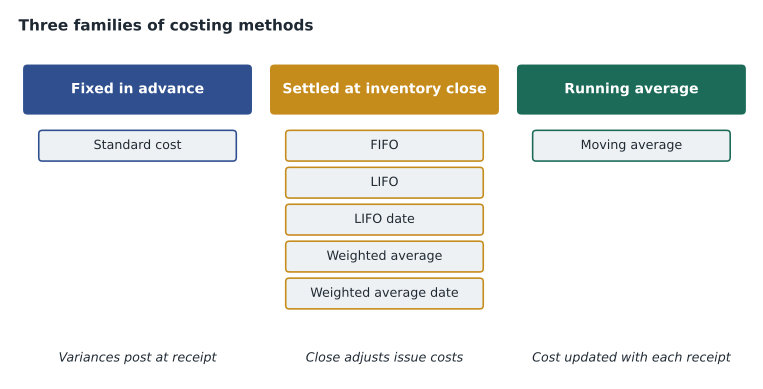
With the methods that need an inventory close, issues post first at an estimated running average cost, and the close later settles each issue against receipts according to the method and posts any adjustment. Lesson 7 covers the close itself. With standard cost and moving average, the cost at issue is final, so the close is not needed to adjust it, although companies still run it regularly for items using the other methods and to close the inventory period.
Some requirements depend on the method. Items with standard cost, for example, need an active cost price in a costing version before they can be transacted, and moving average has its own rules for how cost is handled when stock goes negative, which is a reason to avoid negative inventory for those items. LIFO is not permitted for financial reporting under IFRS, which Cobalt Ridge uses in both countries' financial statements, so it was not considered.
Choosing for each kind of item
Annelise and Ifeoma went through the item families one by one.
| Item family | Method chosen | Reason |
|---|---|---|
| Manufactured pumps | Standard cost | Stable, planned costs; variances show production performance |
| Purchased castings and machined parts used in production | Standard cost | Consistent BOM costing; purchase price variances are reviewed |
| Spare parts bought for resale | Moving average | Cost reflects what was paid without a period-end settlement |
| Seal kits with batches | FIFO | Older batches are used first, and cost should follow them |
| Services | Not stocked | No inventory to value |
The seal kits were the subject of the longest discussion. Teodora noted that FIFO in costing does not force the warehouse to pick the oldest batch; picking is decided by reservation and warehouse rules, and expiry-based picking is set up with batch dates, as lesson 10 explains. FIFO only decides how costs are matched. Ifeoma accepted that, and chose FIFO because the physical and financial order would usually agree.
Other item model group settings
A few other settings shape daily work.
- Post physical inventory and Post financial inventory decide whether product receipts and packing slips post to ledger accounts for received-not-invoiced and shipped-not-invoiced inventory, and whether invoices post to inventory accounts. Most stocked items post both.
- Physical negative inventory allows stock to go below zero when an issue is posted before the matching receipt, which can happen in production when consumption is reported before a receipt is registered. Cobalt Ridge allowed it only for a few consumables.
- Registration requirements and deduction requirements force a receipt to be registered before it can be invoiced, or an issue to be deducted before it can be invoiced, so that physical steps are not skipped.
- Quarantine management sends purchase receipts to the warehouse's quarantine warehouse through quarantine orders, which lesson 9 covers.
- Approved vendor check warns or prevents buying from vendors not on the item's approved list.
- Stocked product, when cleared, means the item is never tracked in inventory, which is how service items are configured.
Standard cost and costing versions
Items using standard cost need a cost price that is active on the transaction date. These prices are held in costing versions. A costing version is a container for prices of one type, standard cost or planned cost, for a set of sites and items, and it controls whether prices can be entered, calculated and activated. Prices in a costing version are first pending and become active only when they are activated with a from-date.
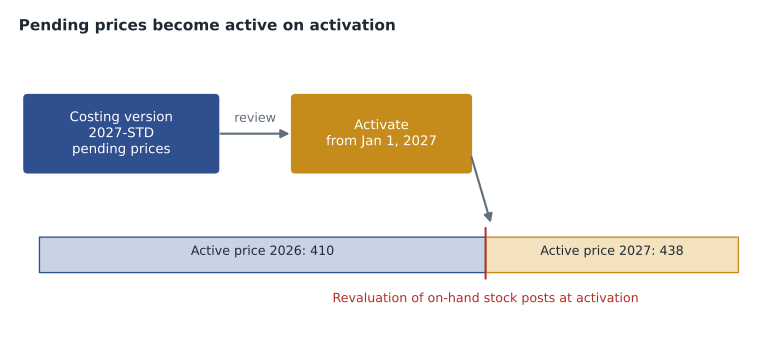
Prices can be entered directly, copied from another version, or calculated. A BOM calculation for a manufactured item rolls up the costs of its components, from their active or pending prices, and the cost of routes and operations, using cost groups that classify each element as material, labor, machine or overhead. The result is a pending price for the manufactured item, with a cost breakdown. Calculations and the costing sheet are taught with production in MSBA-333; here it matters that the result lands as a pending price in a costing version and becomes active only on activation.
| Costing version setting | Purpose |
|---|---|
| Costing type | Standard cost or planned cost |
| Block pending prices | Stops new pending prices being entered or calculated |
| Block activation | Stops pending prices being activated |
| Sites | Limits the version to particular sites, or all sites |
| From date | The default date from which pending prices will be active |
| Fallback principle | Where a calculation looks for component costs if none are in this version |
Planned cost versions hold what-if prices that are never activated. Ifeoma planned to use one for the 2028 budget, calculating pump costs with expected steel prices, without changing anything that affects transactions.
The standard cost update process
Ifeoma's second request was a review step. Costing versions give one naturally. Each autumn, the team will create a standard cost version for the next year, enter purchased component prices from buyer forecasts, calculate manufactured items, and then review the pending prices with Thandeka before activation on January 1. When pending prices are activated, the system revalues on-hand inventory of standard cost items from the old to the new price and posts the difference to a revaluation account, so the ledger and inventory stay consistent.
Worked problem
Introducing a new standard cost
Casting CS-3300 has an active standard cost of 410 dollars. Buyers expect 438 dollars in 2027. There are 120 castings on hand on December 31. What happens when the new price is activated on January 1, 2027?
Show solution
- Create costing version 2027-STD of type standard cost for the HAM and AKR sites, with a from-date of January 1, 2027.
- Enter a pending price of 438 for CS-3300 in that version, and calculate the BOMs of pumps that use it.
- Review the pending prices with Thandeka and correct any errors.
- Activate the pending prices; the price of 438 becomes active from January 1.
- The system revalues the 120 castings on hand by 28 dollars each, a total of 3,360 dollars, and posts the revaluation.
Answer: An inventory revaluation of 3,360 dollars on activation, and every receipt after that date costed at 438 with any difference posted as a purchase price variance.
Activation can be done for individual items, which is useful when a single price must change mid-year, for example after a vendor price increase. Ifeoma's rule was that mid-year changes need Thandeka's approval and are activated on the first day of a month, so that the revaluation lands cleanly in one period.
Variances
With standard cost, any difference between the actual cost of a receipt and the standard is posted as a variance rather than to inventory. The most common is the purchase price variance on vendor invoices for purchased items. For manufactured items, production variances arise when a production order is ended: quantity, price and substitution variances on materials, lot size variances, and production variances on routes. Variances post to accounts set up in the posting profile and can be analyzed by cost group. They are the information Ifeoma was missing in the old system, where variances were lumped into one account with no breakdown.
Item groups and inventory posting
The item model group decides how an item is valued; the item group usually decides where that value is posted. Inventory posting setup, maintained by finance, maps each type of inventory transaction to ledger accounts, and the mapping can be made for a single item, an item group or all items, combined with a customer or vendor dimension where needed. Because the item group level is the most practical, most companies design posting around it.
| Posting type | When it is used | Example account |
|---|---|---|
| Inventory receipt and issue | Financial updates of receipts and issues | Inventory, castings |
| Packing slip and product receipt | Physical updates when physical posting is on | Shipped not invoiced, received not invoiced |
| Cost of goods sold | Sales invoices | Cost of sales, spare parts |
| Revenue | Sales invoices | Revenue, spare parts |
| Purchase price variance | Standard cost invoices | Purchase price variance |
| Cost change variance | Activation of new standard costs | Inventory revaluation |
| Inventory profit and loss | Counting and adjustment journals | Inventory adjustments |
Ifeoma and Thandeka designed eleven item groups, one for each combination of product family and accounting treatment: finished municipal pumps, finished mining pumps, finished distributor units, castings, machined parts, purchased components, seal kits, spare parts for resale, consumables, packaging and services. Each was mapped to inventory, cost of goods sold, revenue and variance accounts. The design meant that the inventory balance sheet account could be reported by item group, and that a new item placed in the right group would post correctly without any extra setup.
The team then tested every posting type in the CONFIG sandbox with one sample item per group: a purchase receipt and invoice, a sales packing slip and invoice, a counting adjustment and, for standard cost items, an activation of a new price. Thandeka checked each voucher against the account design. Two posting lines were wrong on the first pass, both copied from a demonstration company, and were fixed before migration.
Price groups and default prices
The study guide's costing skills also mention price groups, default item prices, and purchase and sales prices in trade agreements. These overlap with procurement and sales, taught in MSBA-331, but the basics live on the released product. Each released product has a default cost price, purchase price and sales price with a price unit, used when no other price applies. Trade agreements override these with prices and discounts for vendors, customers or groups of them, and price groups gather customers or vendors that share a price list. Cobalt Ridge created price groups for municipal, mining and distributor customers, each with its own sales price list for spare parts.
Common mistakes
MistakeChoosing FIFO because the warehouse should pick oldest stock first.
InsteadCosting methods match costs; picking order is set by reservation, batch dates and warehouse rules.
MistakeEntering standard costs and expecting them to apply at once.
InsteadPrices in a costing version are pending until they are activated.
MistakeActivating new standards mid-month without warning finance.
InsteadAgree activation dates; activation revalues on-hand inventory.
MistakeUsing LIFO in a company that reports under IFRS.
InsteadChoose a method permitted by the applicable accounting framework.
Summary and key terms
- The item model group sets the costing method and inventory policies for each released product.
- Standard cost and moving average fix the issue cost at once; FIFO, LIFO and weighted average methods settle issues at inventory close.
- Costing versions hold pending standard or planned prices; activation makes them active and revalues on-hand standard cost inventory.
- Variances record differences from standard for purchases and production.
- Default cost, purchase and sales prices, price groups and trade agreements determine prices on orders.
- Costing method
- The rule that determines the cost of inventory issues, set in the item model group.
- Costing version
- A container for pending and active prices of one costing type.
- Pending price
- A price entered or calculated in a costing version that is not yet active.
- Revaluation
- The adjustment of on-hand inventory value when a new standard cost becomes active.
- Purchase price variance
- The difference between an invoice price and the standard cost of a purchased item.
Practice problems
Work each problem on paper first, then reveal the answer to check.
Which costing methods do not need inventory close to adjust issue costs?
Show answer
Standard cost and moving average.
What is a planned cost version used for?
Show answer
What-if or budget costing that is never activated.
An item with a standard cost of 50 has 40 units on hand. A new standard of 47 is activated. What revaluation posts?
Show answer
A decrease of 3 per unit, 120 in total.
Lesson quiz · 5 questions
Score 60% or more to complete this lesson.
Create a free account to save your progress, take quizzes and earn a certificate.