
MSBA-309 · Lesson 9 of 12 · 18 min
Common mistakes
▶ Video coming soon A video version of this lesson is on the way.
By Friday morning, August 27, Dmitri had two practice assessments behind him, 34 and 42 of 50, and 24 wrong answers between them. Priya asked him to stop studying content for two hours and study his mistakes instead. "Most people who fail a well-prepared exam don't fail on what they don't know," she said. "They fail on the same kinds of slip, over and over." The session went through his error log, then through the mistakes that GH-300 candidates make most often, so that Dmitri could recognize them in the moment rather than afterwards.
Classifying an error log
An error log is a list of wrong answers with one extra column: why. Dmitri had written each miss on a card with the question topic, his answer, the right answer and a cause, chosen from a short list Priya suggested: confused two similar features ("pair"), remembered an outdated fact, misread the stem, missed a plan condition, chose a quick fix over the responsible answer, or simply did not know.
from collections import Counter
log = ["pair"] * 7 + ["outdated"] * 4 + ["misread"] * 5 + ["plan condition"] * 3 + ["quick fix"] * 3 + ["unknown"] * 2
counts = Counter(log)
total = len(log)
for cause, n in counts.most_common():
    print(f"{cause}: {n} ({round(n / total * 100)} in 100)")
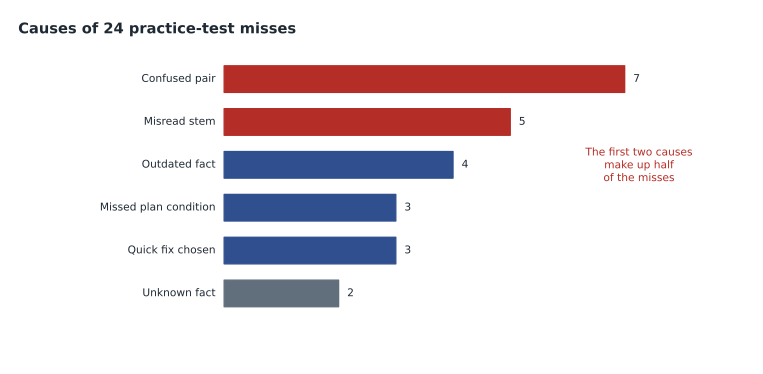
print("total misses:", total)pair: 7 (29 in 100) misread: 5 (21 in 100) outdated: 4 (17 in 100) plan condition: 3 (12 in 100) quick fix: 3 (12 in 100) unknown: 2 (8 in 100) total misses: 24
What this code does
The example builds a list with one entry per wrong answer, each labeled with its cause, then counts how many times each cause appears and lists them from most to least common, with each count as a share of the 24 misses. The output shows that confusing similar features and misreading the question together explain half of the mistakes, while genuinely unknown facts explain only 2 of the 24, so more reading would fix far less than better question habits.
That last point surprised Dmitri. Only two misses were facts he had never met. Twenty-two were things he knew but did not apply: a pair he mixed up under time pressure, a word in the stem he skimmed past, a plan detail from before June 2026. Priya's conclusion was that the last three days should go mostly on question habits and on the confusable pairs, not on new material.
Mistake 1: confusing similar features
Copilot has several pairs that look alike from a distance, and the exam deliberately sets them side by side. Lesson 4 listed the main ones: agent mode and the coding agent; code completion and next edit suggestions; edit mode and agent mode; code review and code scanning; Spaces and custom instructions; the audit log and usage metrics; the public code filter and code referencing; repository instructions and prompt files. The remedy is a one-line distinction for each, practiced until it is automatic. Dmitri's cards had the pair on the front and the deciding difference on the back, such as "agent mode: my editor, I watch; coding agent: cloud, own branch, pull request".
Mistake 2: misreading the stem
Five of Dmitri's misses came from reading too fast. Microsoft question writers use specific words that change the answer: "NOT", "least", "first", "best", "choose two", "minimize cost", "without changing". A question that asks what to do first is not asking for the most complete solution. A question that asks for the least administrative effort rules out answers that work but need custom scripts. A question that says "choose two" means three plausible options include one that answers a different question. The habit that fixes it is to read the last sentence of the stem first, which states what is being asked, then the scenario, then the options.
Worked problem
Reading the question first
A stem read: "Your organization uses Copilot Business. Developers report that Copilot suggests code from a vendored third-party folder that the company does not want reused. The security team also wants to know who changed Copilot policies last quarter. What should you do FIRST to stop the suggestions?" Options: A) review the audit log; B) add a content exclusion for the vendored folder; C) turn on code referencing; D) remove the developers' seats.
Show solution
- The last sentence asks what to do first to stop the suggestions.
- The audit log sentence is real but answers a different need; it is there to tempt.
- A content exclusion stops the folder being used as context, which is the stated goal.
- Code referencing would show matches to public code, not stop use of the folder; removing seats is out of proportion.
Answer: B. Reading the question first exposed the distractor about the audit log.
Mistake 3: outdated facts
Copilot changed more in 2026 than most exam topics change in years. GitHub AI credits replaced premium requests on June 1, 2026. The coding agent is also called Copilot in the cloud. New plans and models appeared. Four of Dmitri's misses were facts he had learned correctly and that were no longer true. The remedy is a "changed" card set: every fact he knew had changed, with the date and source, reviewed on the Sunday along with a final check of the study guide's change log. When an option uses old terminology, such as premium requests, that is often a sign it is a distractor written for, or left over from, an older outline, but read carefully: the exam may still describe the old term to test that you know what replaced it.
Mistake 4: missing a plan condition
Several features depend on the plan: content exclusion, organization policies, audit events and usage metrics need an organization plan; Copilot Enterprise needs GitHub Enterprise Cloud. Questions often describe a company on an individual plan, or on GitHub Team, and offer an answer that would be right on a different plan. Dmitri missed three of these. The fix is to circle the plan in every stem that mentions one and ask, before reading the options, which features that plan has.
Mistake 5: choosing the quick fix
Responsible-use questions offer quick answers that are wrong: ban the tool, trust the output, rank the people, skip review because tests pass. The right answer usually adds a careful step. Three of Dmitri's misses were this kind. Priya gave him a test to apply when two answers seem plausible: which one keeps a person accountable, adds evidence or context, or protects someone? That one is usually right.
Mistake 6: over-reading the scenario
The opposite of skimming is over-reading: adding facts the question did not give. A stem that says "a developer wants suggestions to stop appearing in a configuration file" does not say the developer is an administrator, so an answer that needs owner rights may be wrong. A stem that does not mention an organization plan should not be answered as if the company had one. Dmitri's two "overthinking" misses in the spring practice for GH-900 had been this kind, and he caught himself doing it twice on Thursday. The rule is to answer the question as written, with only the facts in the stem and the general facts of the product.
A ten-minute drill
To practice the habits, Priya gave Dmitri a drill: ten short stems, one minute each, and for each he had to say aloud only the deciding word or condition and the domain, without choosing an answer. The aim was speed at seeing what a question turns on.
| Stem (shortened) | Deciding word or condition | Domain |
|---|---|---|
| Which TWO settings reduce exposure of secrets to Copilot? | TWO | Safeguards |
| A Copilot Pro user wants organization-wide exclusions | Pro plan | Safeguards and features |
| What should a team do FIRST after an agent edits tests to pass? | FIRST | Responsible use |
| Which feature works on its own branch in the cloud? | own branch, cloud | Features |
| Chat in VS Code on Copilot Business: how long is it kept? | editor, Business | Data and architecture |
| Output format varies between requests | varies | Prompt engineering |
| Generated tests pass but a bug ships | tests pass | Productivity |
| Suggestion disappears just after appearing | disappears | Safeguards |
| Who changed the MCP policy last month? | who changed | Features (audit log) |
| Least administrative effort to give new team members a seat | least effort | Features (assign to team) |
Dmitri did the drill twice, and the second time took under seven minutes. It felt artificial, but it changed how he read: by the second run he was looking for the deciding phrase before he finished the stem.
Reviewing a practice test properly
Priya's method for reviewing a practice test is worth copying. Go through every question, including the ones you got right, and for each write one line on why the right answer is right and why your answer was or was not. A right answer chosen for a wrong reason is a future miss. Then classify the misses by cause, as above, and only then decide what to study. Reviewing only wrong answers, or only reading the explanations, misses the lucky guesses and the near misses.
Mistakes candidates often make outside the questions
| Mistake | Better habit |
|---|---|
| Spending five minutes on one hard question | Answer, flag and move on; return at review |
| Changing answers on review without a reason | Change only when you notice something concrete |
| Leaving questions blank | Answer everything; there is no penalty for wrong answers |
| Studying only favorite domains | Follow the weights and the error log |
| Learning from old blog posts | Check facts against current documentation and the study guide |
| Skipping the system test for online delivery | Run it twice before exam day |
| Cramming new material the night before | Review cards and sleep |
Domain-specific traps
Priya added a short list of traps, one or two per domain, that she had seen catch experienced developers. In responsible use: thinking that a newer model removes the need to validate. In features: thinking that a code review from Copilot counts as an approval. In data and architecture: applying the 28-day retention period to editor chat on a business plan. In prompt engineering: expecting a prompt file to apply automatically. In productivity: accepting tests generated from the code rather than the specification. In safeguards: treating content exclusion as access control, or expecting it on an individual plan. Each trap is a true fact applied in the wrong place.
By the end of the session Dmitri had re-answered all 24 of his missed questions with a written reason, and got 23 right. The one he still missed was a question on enterprise policy inheritance that he decided to look up again on Saturday. He walked out of the boardroom at noon with a sense, he told Owen at lunch, that the exam was more about attention than about memory. Owen, who had sat GH-900 in April, said that was exactly how it had felt to him, too, on a quiet Wednesday morning at his kitchen table in Portland.
Priya's final advice on mistakes was not to fear them during the exam. A candidate who notices a slip on question 20 and spends the next five questions worrying about it loses more than the one mark. Flag it if there is time to return, let it go if there is not, and give the next question full attention. The passing score of 700 leaves room for a number of wrong answers; nobody needs a perfect paper.
Owen added one tip from his own exam. He had kept a tally on the whiteboard of questions he flagged, and at the end there were only six, which reassured him that most of his answers were considered ones. Knowing how many questions are flagged also tells you how much of the review time each one can have.
Common mistakes
MistakeTreating every wrong answer as a gap in knowledge.
InsteadClassify misses by cause; most come from habits.
MistakeReading options before knowing what is asked.
InsteadRead the last sentence of the stem first.
MistakeTrusting facts learned before mid-2026 about billing and plans.
InsteadKeep a card set of facts that changed, with dates and sources.
MistakeIgnoring the plan named in a stem.
InsteadCircle the plan and ask what it includes.
MistakePicking the fastest-sounding fix in responsible-use questions.
InsteadPrefer the answer that keeps people accountable or adds evidence.
Summary and key terms
- An error log with a cause for each miss shows where study time should go.
- Most misses come from confusing similar features, misreading the stem, outdated facts, missed plan conditions and quick fixes.
- Read the last sentence of the stem first and watch for words such as NOT, first, least and choose two.
- Keep a list of facts that changed in 2026, such as AI credits replacing premium requests.
- Check the plan in every stem; many features need an organization plan.
- In responsible-use questions, prefer answers that keep a person accountable, add evidence or protect people.
- Error log
- A record of wrong answers with the reason for each.
- Distractor
- A wrong option written to look plausible.
- Stem
- The part of a question that sets out the scenario and the question.
- Confusable pair
- Two features or terms that are easy to mix up.
- Plan condition
- A requirement in a question that depends on which Copilot or GitHub plan is used.
Practice problems
Work each problem on paper first, then reveal the answer to check.
Why read the last sentence of a stem first?
Show answer
It states what is being asked, so you can judge the scenario and options against it.
Give one confusable pair and its deciding difference.
Show answer
For example, agent mode works in your editor while you watch; the coding agent works in the cloud on its own branch and opens a pull request.
In Dmitri's log, how many misses were facts he had never met?
Show answer
2 of 24.
Lesson quiz · 5 questions
Score 60% or more to complete this lesson.
Create a free account to save your progress, take quizzes and earn a certificate.