
MSBA-309 · Lesson 2 of 12 · 19 min
Exam format and question styles
▶ Video coming soon A video version of this lesson is on the way.
Monday afternoon's session was about the container rather than the contents. "People lose marks on things that have nothing to do with Copilot," Priya said. "They misread a question type, run out of time on a case study, or arrive at a test center with the wrong ID." She had Dmitri open the certification page and the exam sandbox side by side, and they worked through delivery, timing, question styles, scoring and the rules around booking, retakes and renewal. None of it is difficult, but all of it is easier to learn on a Monday than to discover on exam morning.
Delivery and booking
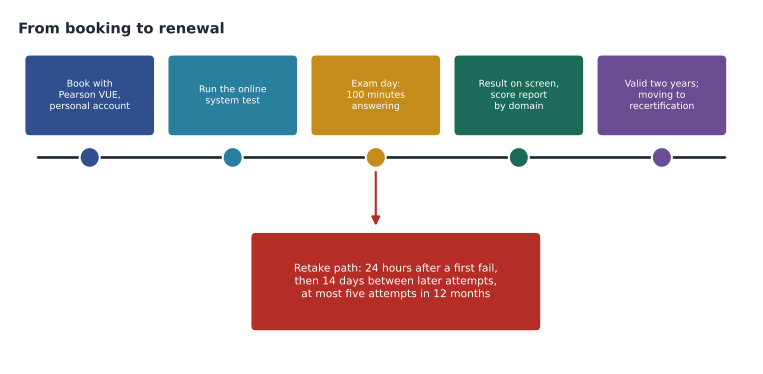
GH-300 is a proctored exam scheduled through Pearson VUE. Candidates can sit it at a test center or online from home or an office, with a remote proctor watching through the webcam. The certification page lists the exam in English, Spanish, Portuguese (Brazil), Korean and Japanese. If your preferred language is not offered, you can ask for 30 extra minutes, and other accommodations, such as for a disability, can be requested through Microsoft's accommodations process before booking. The price is set by the country or region where the exam is proctored, so the page does not list a single figure; the booking screen shows the amount before you pay.
The page makes one practical recommendation that is easy to miss: register with a personal Microsoft account rather than a work or school account. Certification records follow the account. If Dmitri used his Tidewater work sign-in and later left the company, the record and the badge history could be hard to recover. He had used his personal account for GH-900 practice tests in the spring and kept it for GH-300.
Dmitri chose to sit the exam online from home, as Owen had done for GH-900, because the nearest test center to Portland had no Monday morning slots that week. Online delivery has its own rules: a clean desk, no second monitor, a webcam and microphone, a stable connection, and a system test run beforehand on the same computer and network. Check-in opens before the appointment and involves photographing the room and your identification. Priya told him to run the system test on the Wednesday evening and again on the Sunday, so that a failed update or a changed router would show up with time to fix it.
Timing
The certification page gives the exam a duration of 100 minutes. That is the time you have to answer questions. Seat time is longer, because it also includes reading the instructions and agreement screens and any post-exam survey. Microsoft does not publish a fixed number of questions for GH-300, and the count can vary from one exam form to another. For planning, Priya suggested working with a range and a checkpoint rule rather than a single number: if the exam has about 60 questions, 90 minutes of answering leaves 10 for review, and that works out to about a minute and a half each.
questions = 60
total_minutes = 100
review_minutes = 10
per_question = (total_minutes - review_minutes) / questions
print("minutes per question:", per_question)
for n in (15, 30, 45, 60):
    print("after question", n, ": minute", round(n * per_question, 1))
print("review time left:", review_minutes, "minutes")minutes per question: 1.5 after question 15 : minute 22.5 after question 30 : minute 45.0 after question 45 : minute 67.5 after question 60 : minute 90.0 review time left: 10 minutes
What this code does
The example assumes 60 questions and 100 minutes, sets 10 minutes aside for a final review, and divides the remaining 90 minutes by the number of questions to get a target of a minute and a half each. It then works out where the clock should be at each quarter of the exam. The output gives four checkpoints, at minutes 22.5, 45, 67.5 and 90; if you are well behind at a checkpoint, it is time to flag hard questions and move on rather than keep wrestling with them.
The checkpoints are guides, not rules. Short factual questions take seconds and bank time; a scenario with a long code sample or a multi-part question takes longer. The point is to notice early if you are drifting. Dmitri wrote the four minute marks on the whiteboard he would be allowed to use online and planned to glance at the timer only when he reached question 15, 30 or 45.
Question styles
Microsoft exams use a small set of question styles, and the GitHub certification page notes that the exam may include interactive components. The exam sandbox lets you try them before the real thing. For GitHub certifications, the certification page points to a sandbox at GHCertDemo.starttest.com; Microsoft's general sandbox is at aka.ms/examdemo. Neither contains real questions, but both show how answers are selected, how review and flagging work and how the timer behaves.
| Style | What you do | What to watch for |
|---|---|---|
| Multiple choice, one answer | Choose the best option | More than one option may be true; choose the best fit for the scenario |
| Multiple choice, several answers | Choose all that apply, or a stated number | Read whether it says "choose two" or "select all" |
| Drag and drop or ordering | Put steps in order or match items to targets | Every item may not be used; some targets take more than one |
| Drop-down completion | Pick values to complete a statement or snippet | Each drop-down is usually marked separately |
| Scenario sets | Answer several questions about one described situation | Facts in the scenario apply to every question in the set |
| Yes or no series | Judge whether a proposed solution meets the goal | Once answered, you may not be able to return |
The "yes or no series" style needs special care. It presents a goal and a proposed solution and asks whether the solution meets the goal. The next question in the series presents a different solution to the same goal. Microsoft warns that some of these questions cannot be revisited once answered, because seeing later solutions would give hints about earlier ones. Read each one on its own merits, answer it and move on.
Worked problem
Reading a multi-answer stem
A practice question read: "An organization owner wants to prevent Copilot from using two private configuration folders as context, across all repositories. Which TWO actions are needed?" The options were: A) add the paths to content exclusion at the organization level; B) add the paths to .gitignore; C) make sure the organization has a business plan that supports content exclusion; D) turn off the public code filter.
Show solution
- The stem says "TWO", so exactly two answers are expected.
- Content exclusion is the feature that stops files being used as context, so A is one.
- Content exclusion is available on Copilot Business and Enterprise, so C is the second.
- A .gitignore file controls what Git tracks, not what Copilot reads, so B is wrong.
- The public code filter is about suggestions that match public code, so D is unrelated.
Answer: A and C. The number in the stem is a clue: if you find three plausible answers, one of them is probably answering a different question.
Scoring
Results are reported on a scale from 1 to 1,000, and the passing score is 700. The scaled score is not a simple proportion of correct answers; questions can carry different weights, and the scale is set so that 700 represents the required standard on every form. Microsoft's general guidance is that you are not penalized for wrong answers, so a blank answer is always worse than a reasoned guess. Some multi-part questions award partial credit and some do not, and the exam does not tell you which, so treat every part as if it counts.
After the exam you see a pass or fail result and a score report showing performance by domain as bars. The bars show relative strength, not exact marks. Priya pointed out that the domain bars are the most useful part of a failed score report, because they say where to study before a retake, just as the practice assessment breakdown did on Monday morning.
Retakes
Microsoft's retake policy applies to GH-300. If you fail the first attempt, you can retake it after 24 hours. After a second failure and any later ones, you wait 14 days between attempts, and you can take the same exam at most five times in 12 months. Each attempt is booked and paid for separately unless an offer says otherwise. You cannot retake an exam you have passed while the certification is current. If an attempt is disrupted by a technical failure, the policy treats it differently from a failure on the merits, but you need to raise it with Pearson VUE at the time and keep the case number.
Validity and renewal
Renewal is one area where GitHub's certifications differ from Microsoft's role-based ones, and where the rules were changing in 2026. The GitHub Copilot certification page states that GitHub certifications are valid for two years, and that GitHub is moving to Microsoft's recertification process, which will let people keep a certification current without sitting the full exam again. While that change is rolled out, certifications that would expire before the new process is available are extended by six months. Microsoft's own associate certifications, by contrast, expire every year and are renewed by passing a free online assessment on Microsoft Learn. Lesson 12 returns to this, because the details may have moved on by the time you sit the exam.
Rules on exam day
Online and in person, the exam is closed book unless the exam rules say otherwise. Phones, notes, smart watches and second screens are not allowed. For online delivery, the proctor may ask you to show the room again during the exam, and looking away from the screen for long periods, reading questions aloud or someone entering the room can end the session. In a test center you are given a whiteboard or scratch paper; online, a digital whiteboard is provided in the exam interface.
Microsoft introduced access to Microsoft Learn during some role-based exams in 2023, in a restricted browser window, with the time still counting. Whether that is offered for a particular exam, and whether it covers GitHub documentation, depends on the exam's rules at the time. Priya's advice was to prepare as if no reference is available. Looking things up is slow, and a candidate who needs to look up the basics will run out of time.
Flagging and review
Most question styles let you flag a question for review and come back to it from the review screen at the end of a section. Dmitri practiced a simple routine in the sandbox: answer every question on the first pass, even the hard ones, choosing the best guess; flag the ones he was unsure of; and use the review time only on flagged questions. Leaving questions blank to "come back later" risks running out of time with nothing recorded. Changing answers on review is worthwhile only when you have a concrete reason, such as noticing a word in the stem you missed, not a vague second thought.
Planning the week's hours
The session ended with a plan. Dmitri had about 12 hours of study time outside the sessions before the exam. Priya's rule for splitting it was to weight each area by two things at once: how much of the exam it supplies, and how much of it he got wrong on Monday morning. An area that is large and weak gets the most time; an area he aced gets almost none, however large. They used the middle of each weight range as the size and the share of baseline questions missed as the gap.
areas = {
    "Responsible AI": (17.5, 9, 7),
    "Plans and features": (27.5, 16, 10),
    "Data and architecture": (12.5, 7, 4),
    "Prompt engineering": (12.5, 6, 6),
    "Developer productivity": (12.5, 6, 5),
    "Privacy and safeguards": (12.5, 6, 2),
}
hours = 12
priority = {}
for name, (weight, asked, right) in areas.items():
    gap = 1 - right / asked
    priority[name] = weight * gap
total = sum(priority.values())
for name, p in priority.items():
print(f"{name}: {p / total * hours:.1f} h")Responsible AI: 1.6 h Plans and features: 4.1 h Data and architecture: 2.1 h Prompt engineering: 0.0 h Developer productivity: 0.8 h Privacy and safeguards: 3.3 h
What this code does
The example lists each area with three numbers: the middle of its weight range, how many baseline questions it had and how many Dmitri got right. For each area it works out the gap, the share of its questions he missed, and multiplies the gap by the weight to get a priority score. It then shares the 12 hours in proportion to those scores. The output puts most time on plans and features and on privacy and safeguards, and none on prompt engineering, where he made no mistakes.
A pure formula has a blind spot: six perfect answers on prompt engineering do not prove he knows the whole domain, and the real exam will ask different questions. Priya added a floor of half an hour for every area, taken from the largest share, so the final plan was about 3.6 hours on features, 3.3 on safeguards, 2.1 on data and architecture, 1.6 on responsible AI, 0.8 on productivity and 0.5 on prompt engineering. Lesson 11 revisits the plan after the second practice assessment on Thursday.
Common mistakes
MistakeRegistering with a work account.
InsteadUse a personal Microsoft account so the record stays with you.
MistakePlanning around a fixed question count.
InsteadPlan with checkpoints; the count is not published and can vary.
MistakeSkipping the sandbox.
InsteadTry the question styles and the review screen before exam day.
MistakeLeaving hard questions blank to return to later.
InsteadAnswer everything on the first pass, flag and review.
MistakeAssuming GitHub certifications renew exactly like Microsoft associate certifications.
InsteadCheck the current validity and renewal rules on the certification page.
Summary and key terms
- GH-300 is proctored through Pearson VUE, online or at a test center, in five languages; the price depends on the country.
- The exam has 100 minutes of answering time; the number of questions is not published.
- Question styles include single and multiple answer, ordering, drop-downs, scenario sets and yes or no series.
- Scores run from 1 to 1,000 with 700 to pass; wrong answers are not penalized, so answer everything.
- Retakes: after 24 hours for the first, then 14 days, at most five attempts in 12 months.
- GitHub certifications are valid for two years, with a move to Microsoft's recertification process under way.
- Pearson VUE
- The company that delivers and proctors Microsoft and GitHub certification exams.
- Exam sandbox
- A demonstration environment showing the question styles and interface, without real questions.
- Scaled score
- A score from 1 to 1,000 set so that 700 represents the passing standard on every exam form.
- Seat time
- Total time at the exam, including instructions and surveys, longer than the answering time.
- Retake policy
- The rules on how soon and how often a failed exam can be taken again.
Practice problems
Work each problem on paper first, then reveal the answer to check.
Why should you register with a personal Microsoft account?
Show answer
The certification record follows the account; a work account may be lost if you leave the organization.
How long must you wait to retake GH-300 after a first failure?
Show answer
24 hours.
With 60 questions, 100 minutes and 10 kept for review, where should the clock be after question 30?
Show answer
At about minute 45.
Lesson quiz · 5 questions
Score 60% or more to complete this lesson.
Create a free account to save your progress, take quizzes and earn a certificate.