
MSBA-309 · Lesson 11 of 12 · 18 min
A study plan
▶ Video coming soon A video version of this lesson is on the way.
Saturday, August 28 was not a working day at Tidewater, and Priya had said there would be no session. Instead she sent Dmitri a short message on Friday evening asking him to write his own plan for the last two days and send it to her by Saturday noon, with the reasoning. "You will not always have a coach," she wrote. "Planning your own preparation is part of being ready." This lesson follows how he built that plan, and then steps back to the general method: how to plan GH-300 preparation over six weeks for someone starting further back, as Lena Fischer would in the autumn.
Starting from evidence
Dmitri began with the Thursday practice assessment rather than with how he felt. He had scored 42 of 50, eight better than Monday, and the breakdown had moved in the right places.
| Area | Monday | Thursday |
|---|---|---|
| Responsible AI | 7 of 9 | 8 of 9 |
| Plans and features | 10 of 16 | 13 of 16 |
| Data and architecture | 4 of 7 | 6 of 7 |
| Prompt engineering | 6 of 6 | 5 of 6 |
| Developer productivity | 5 of 6 | 5 of 6 |
| Privacy and safeguards | 2 of 6 | 5 of 6 |
| Total | 34 of 50 | 42 of 50 |
Two things were worth noticing. Privacy and safeguards had jumped from 2 to 5 of 6, which reflected Thursday afternoon's session and the hands-on exclusion tasks. And prompt engineering had dropped from 6 to 5, a single question about chat history he had answered too quickly. Neither score was precise enough to read much into on its own; six questions is a small sample, and one question moves the result a lot. Together with the error log from Friday, though, they gave a clear picture: no area was weak any more, features still lost the most marks, and his remaining misses were mostly habits.
Splitting the remaining hours
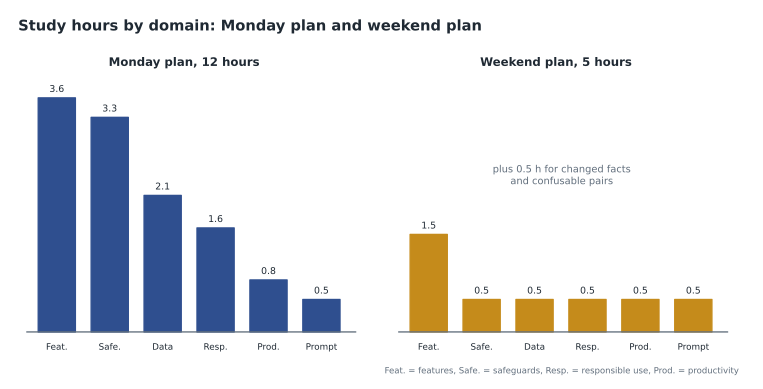
He had about five hours of useful study left: three on Saturday and two on Sunday morning, before the final review session Priya had offered for Sunday afternoon. He used the same method as on Monday, weighting each area by its share of the exam and by the share of Thursday's questions he had missed.
areas = {
    "Responsible AI": (17.5, 9, 8),
    "Plans and features": (27.5, 16, 13),
    "Data and architecture": (12.5, 7, 6),
    "Prompt engineering": (12.5, 6, 5),
    "Developer productivity": (12.5, 6, 5),
    "Privacy and safeguards": (12.5, 6, 5),
}
hours = 5
priority = {name: w * (1 - right / asked) for name, (w, asked, right) in areas.items()}
total = sum(priority.values())
for name, p in priority.items():
print(f"{name}: {p / total * hours:.1f} h")Responsible AI: 0.6 h Plans and features: 1.7 h Data and architecture: 0.6 h Prompt engineering: 0.7 h Developer productivity: 0.7 h Privacy and safeguards: 0.7 h
What this code does
The example repeats Monday's calculation with Thursday's results: for each area it multiplies the middle of the weight range by the share of questions missed, then shares five hours in proportion to those priorities. The output gives features about 1.7 hours and every other area between 0.6 and 0.7, a much more even spread than on Monday, because the large gaps have closed and features is now the only area that stands out.
He rounded the plan to half-hour blocks so it would be easy to follow: an hour and a half on features, half an hour each on the other five areas, and the remaining half hour on the changed-facts cards and the confusable pairs from lesson 9. Since most of his misses were habits rather than gaps, each block was mainly question practice with the habits from lesson 9, not reading.
The weekend plan
| When | What | Why |
|---|---|---|
| Saturday 9:00 to 10:30 | Features: plans and credits, agent mode and the coding agent, policies, audit and metrics | Largest domain and most remaining misses |
| Saturday 10:45 to 11:15 | Safeguards: exclusions and their limits, public code filter and code referencing | Biggest improvement; consolidate it |
| Saturday 11:15 to 11:45 | Data and architecture: retention table, filters, context window | Retention facts are easy to mix up |
| Saturday afternoon | No study; long walk | Rest helps memory more than another hour |
| Sunday 8:30 to 9:00 | Responsible AI scenarios | Keep the scenario habit fresh |
| Sunday 9:00 to 9:30 | Prompt engineering: chat history, few-shot, instruction files | The one dropped question |
| Sunday 9:30 to 10:00 | Productivity: tests, refactoring, documentation checks | Keep it warm |
| Sunday 10:00 to 10:30 | Changed facts and confusable pairs; check the study guide change log | Catch anything updated since Monday |
| Sunday 14:00 | Final review with Priya | Lesson 12 |
Priya replied within the hour with one change: move the study guide check to Saturday morning, first thing, so that if the outline had changed he would have two days to react rather than four hours. He did, and it had not.
How the cards were used
Dmitri's flash cards, about 140 by Saturday, were the backbone of the plan, and the way he used them matters as much as what was on them. He sorted them into three piles each day: cards he answered instantly, cards he answered slowly, and cards he missed. The instant pile was reviewed only every few days, the slow pile daily and the missed pile twice a day. That is a simple form of spaced repetition, in which material you know well is seen less often and material you do not is seen more. By Saturday morning the missed pile held nine cards, most of them on enterprise policy details and the exact limits of content exclusion, and those nine became part of the features and safeguards blocks.
He also wrote every card as a question with a short answer, rather than as a fact to read, because recalling an answer is better practice than recognizing one. "Which plans support content exclusion?" works better than "Content exclusion is on Business and Enterprise", even though the information is the same.
Using Copilot to help you study
It is tempting to use Copilot Chat as a study partner, and it can help: asking it to quiz you on a topic, to explain a feature in plain language, or to contrast two features. Priya allowed it with two rules. First, check every factual claim against the documentation, because Copilot's own knowledge of its plans and limits can lag behind changes and may be confidently wrong, exactly as the responsible-use domain teaches. Second, never use it to find or reproduce real exam questions, which would break the exam agreement every candidate accepts. Dmitri used it mostly to generate scenario stems in the exam's style about features he had already studied, then answered them himself from the documentation.
Preparing as a group
Lena, Owen and the partner liaison developer were all likely to sit GitHub exams in the next year, so Priya suggested a light group structure for the future: a shared card deck in a private repository, reviewed by pull request so that every card cites a source; a monthly hour in which one person presents a domain to the others; and a shared error log of practice-test causes, without names, so the group can see which habits trip people most often. The aim was not a study club but a way for the team's knowledge to stay current as Copilot changed, which would help their daily work as much as their exams.
Rest, sleep and logistics
A plan for the last days before an exam is partly a plan for not studying. Memory consolidates during sleep, and a tired candidate misreads stems, which was already Dmitri's second most common mistake. His plan had no study after Sunday afternoon's review, an early night on Sunday, and a list of logistics for Monday morning: identification ready, the room cleared to the online proctoring rules, the computer restarted and updates paused, the system test passed again on Sunday, water but no notes on the desk, and check-in opening half an hour before the 9:00 appointment.
A six-week plan for someone starting further back
Dmitri's week was short because he had spent four months learning Copilot first. Lena, who planned to sit GH-300 in December 2027, would have the courses but less day-to-day experience, and asked him to share a longer plan. He and Priya wrote a general one based on the same principles: evidence first, weights and gaps, practice over reading, hands-on tasks, and rest at the end.
| Week | Focus | Evidence at the end |
|---|---|---|
| 1 | Read the study guide and mark every skill green, amber or red; take the practice assessment cold | Baseline score and skill map |
| 2 | Largest red areas, usually features and safeguards; hands-on tasks in a test repository | Fewer red skills |
| 3 | Responsible AI and data and architecture; build the confusable pairs cards | Can explain each pair in one line |
| 4 | Prompt engineering and productivity, by doing real tasks with Copilot | Instructions file, prompt file and tests written |
| 5 | Second practice assessment; error log by cause; question habits drill | Score and causes of misses |
| 6 | Targeted review by weight and gap; changed-facts check; sandbox; rest before the exam | Ready, or a decision to move the date |
The last cell matters. If the second practice assessment is well below the level that feels safe, moving the exam date is a sensible decision, not a failure. Microsoft and Pearson VUE allow rescheduling, with rules about how close to the appointment changes can be made, so check those when booking.
Worked problem
Deciding whether to move the date
Suppose a candidate scores 31 of 50 on a second practice assessment five days before the exam, with most misses marked "unknown fact" in two large domains. What should they do?
Show solution
- 31 of 50 is lower than Dmitri's baseline, and only five days remain.
- Most misses are unknown facts rather than habits, so the gap is knowledge, which takes longer to close than habits.
- The misses are concentrated in large domains, so they carry many marks.
- That combination suggests more preparation time would change the result.
Answer: Consider moving the exam, if the rescheduling rules allow it, and use the extra time on the two large domains. A candidate with a similar score but mostly habit-related misses might keep the date and drill question habits.
Dmitri sent his plan to Priya at 11:40 on Saturday, then put his phone in a drawer and walked the trail along the Portland waterfront that Tidewater's first guidebook had described. He noticed, with some amusement, that he was checking the trail conditions against TrailCheck in his head as he went.
Priya's reply to the plan included one more piece of advice that applies to anyone: write the plan down and keep it visible. A plan in your head is renegotiated every hour, usually in favor of the area you enjoy most. A plan on paper, with times and reasons, is easier to follow and easier to judge afterwards. Dmitri taped his to the wall above his desk at home, and ticked off each block as he finished it.
He also wrote down what he would not do: no new courses, no forum threads about which questions people remembered, no third practice assessment late on Sunday. Each of those can feel productive, and each can do harm close to an exam, either by adding confusion or, in the case of remembered questions, by breaking the exam agreement.
Priya also asked him to note, beside each block, the one question he wanted to be able to answer at the end of it. For features it was "which plan, which mode, which policy?"; for safeguards, "what does an exclusion not cover?"; for data, "where is it kept, and on which plan?" A study block with a target question ends when the question can be answered, which stops it drifting into general reading.
Finally, he scheduled the weekend blocks for the times of day when he usually concentrated best, the early morning, and left the afternoons free. Matching hard work to the hours when attention is highest is an easy gain that many study plans ignore.
Common mistakes
MistakePlanning the last days by how you feel about each area.
InsteadPlan from the latest practice results and error log.
MistakeReading new material on the final weekend.
InsteadPractice questions and review cards; most remaining misses are habits.
MistakeReading too much into a one-question change in a six-question area.
InsteadTreat small samples with caution and combine them with the error log.
MistakeStudying late the night before.
InsteadStop early, sleep and prepare the logistics.
MistakeTreating a moved exam date as failure.
InsteadReschedule when the evidence shows more time would change the result.
Summary and key terms
- Base the final plan on the latest practice assessment and the error log.
- Share remaining hours by domain weight and the gaps that remain, then round to simple blocks.
- When gaps close, the plan evens out and most time goes on question habits.
- Check the study guide change log early enough to react.
- Rest and logistics are part of the plan.
- A longer plan follows the same principles: baseline, weighted study, hands-on tasks, second assessment, targeted review, rest.
- Baseline
- A first measure of performance, used to plan and to judge progress.
- Change log
- The study guide section that lists what changed in the skills measured.
- Rescheduling
- Moving an exam appointment, subject to the delivery provider's rules.
- Small sample
- Too few questions for a score to be precise on its own.
- Study block
- A fixed period of study with one focus.
Practice problems
Work each problem on paper first, then reveal the answer to check.
Why did Dmitri's weekend plan spread time more evenly than Monday's?
Show answer
The large gaps had closed, so features was the only area that still stood out.
Why move the study guide check to Saturday morning?
Show answer
So there would be time to react if the outline had changed.
When might a candidate reasonably move the exam date?
Show answer
When the latest evidence shows large knowledge gaps that more time would close.
Lesson quiz · 5 questions
Score 60% or more to complete this lesson.
Create a free account to save your progress, take quizzes and earn a certificate.