
MSBA-205 · Lesson 12 of 12 · 19 min
Case study: governing agents across a large tenant
▶ Video coming soon A video version of this lesson is on the way.
Corvallin is small: 460 people, 44 Copilot licenses in the pilot and a handful of agents. The capstone of Teodor's runbook asks what the same principles look like at ten times the scale, where nobody can know every agent by name. Ines arranged for Teodor to spend an afternoon in November 2026 with a former hospital colleague who now leads AI governance at a large regional health network. The organization in this case study, Wyndhollow Health Network, is fictional, but its problems are typical of large tenants in 2026.
Read the case, work through the tasks yourself, and then compare your answers with the model plan that follows. Every task draws on a lesson in this course.
The case
Wyndhollow Health Network runs three hospitals, 40 clinics and a home-care division, with about 9,500 staff in one Microsoft 365 tenant. Its licensing in November 2026:
- 2,200 office, management and clinical leadership staff on Microsoft 365 E5, of whom 1,800 have Microsoft 365 Copilot.
- 7,300 frontline staff, including nurses, aides and support workers, on F3, all with Copilot Chat but no Copilot license.
- 300 Agent 365 licenses, bought in June 2026 for IT, security, privacy and the AI governance office.
Wyndhollow's Chief Information Officer asked its AI governance lead, Rosamund Achterlonie, for a 'state of agents' report after three problems in the autumn:
- An inventory in October found 640 agents across the agent registry, the Power Platform inventory and Microsoft Foundry: 410 Agent Builder agents, 150 SharePoint agents, 60 Copilot Studio agents and 20 custom engine agents. About 230 had no active owner, and nobody could say which ones were used for clinical work.
- In September, a Copilot Studio agent built by a pharmacy technician to answer medication-stock questions was found to use the technician's own connection to the pharmacy system, so every user of the agent could see stock data for controlled drugs at all three hospitals.
- In October, pay-as-you-go Copilot Chat agents used by frontline staff cost three times their estimate, because a popular SharePoint agent on shift-swap rules was used by thousands of F3 staff and had no spending limit.
Shadow AI discovery, in preview, also suggested that several departments were using AI tools outside Microsoft 365 that nobody had approved.
Your tasks
Prepare a governance plan for Wyndhollow that answers the following. Use the lessons named in brackets.
- Task 1. How should Wyndhollow sort its 640 agents into a manageable order for review? (Lessons 4 and 7)
- Task 2. What approval process and tiers should apply to new agents from now on? (Lesson 4)
- Task 3. How should the pharmacy agent's identity problem be fixed, and prevented for other agents? (Lesson 5)
- Task 4. Which Purview and SharePoint controls should protect clinical data used by agents? (Lessons 6 and 7)
- Task 5. How should agent costs for frontline staff be controlled? (Lesson 9)
- Task 6. What should Wyndhollow monitor, and how should it respond when an agent misbehaves? (Lessons 8, 10 and 11)
Model plan
The model plan below is the one Rosamund and Teodor sketched together. It is not the only correct answer, but it shows how the course's principles scale.
Task 1: Triage the inventory
With 640 agents, the first job is to sort, not to review. The plan uses the same idea as the oversharing priority grid in lesson 7: risk is data sensitivity multiplied by reach, with an extra factor for actions.
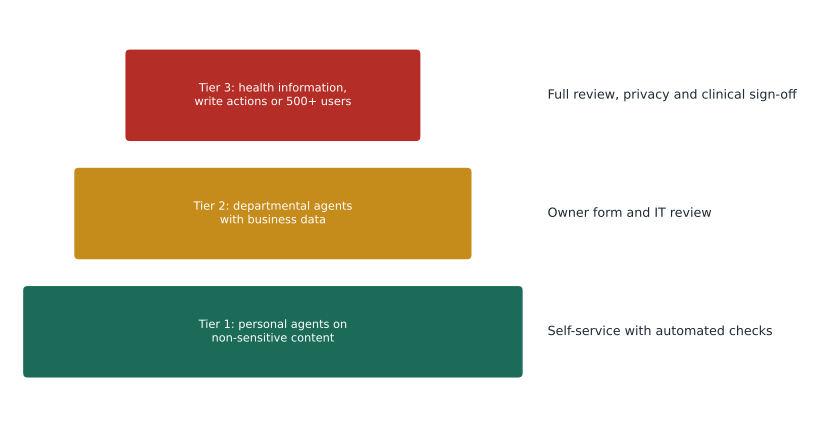
- Tier 3 first (high risk): agents that use clinical or personal health information, take write actions in business systems, or are available to more than 500 users. The inventory put about 45 agents here, including the pharmacy agent and the shift-swap agent.
- Ownerless agents next: all 230 are blocked after a 14-day notice to their last known owner's manager, under the registry's management rules. Agents nobody claims are deleted after the 30-day soft-delete window.
- Tier 2 (departmental agents with business data) are reviewed within 90 days by their owners using a short form.
- Tier 1 (personal agents on non-sensitive content) are left in place, covered by automated checks and the inactivity rules.
Task 2: Tiered approval
A single heavy approval process would either stall the organization or be ignored. The plan uses three tiers, mirroring the inventory:
| Tier | Examples | Approval | Controls |
|---|---|---|---|
| Tier 1: personal | A personal Agent Builder agent over one's own files | None beyond Agent Builder sharing limits | Sharing limited to a few people; inactivity and ownerless rules |
| Tier 2: departmental | A department FAQ agent over a policy library | Owner form and IT review in the registry | Published to the department only; two owners; review every 12 months |
| Tier 3: high risk | Any agent using health information, with write actions, or for more than 500 users | Full checklist, privacy officer and clinical sign-off, AI governance board | Agent identity or end-user auth only; DLP coverage; spending limit; review every 6 months |
The registry's settings enforce the tiers: Agent Builder sharing is limited for Tier 1; publishing to more than one department requires an approved request; and Copilot Studio agents can be built only in managed environments whose data policies block high-risk connectors unless an exception is approved.
Task 3: Fix the identity problem
The pharmacy agent used maker credentials, the anti-pattern from lesson 5. The fix had two parts:
- Immediate: the agent was blocked in the registry, the technician's connection was removed, and an investigation used Purview audit to list who had asked about controlled drugs. The privacy officer assessed the exposure.
- Redesign: the agent was rebuilt with end-user authentication, so each user sees only the stock data the pharmacy system already allows them. An agent identity was not needed, because the agent never acts without a user.
For prevention, the plan adds a check to the Tier 2 and Tier 3 reviews ('whose credentials does each connection use?'), sets the Copilot Studio environments to discourage shared maker connections, and runs a monthly report of agents with shared connections from the Power Platform inventory. For agents that do need their own identity, Wyndhollow creates them from a small number of agent identity blueprints, each with Conditional Access policies that block high-risk agents and limit sign-ins to approved resources, and each agent has a sponsor and a backup sponsor under lifecycle workflows.
Task 4: Protect clinical data
Wyndhollow has E5 for its 2,200 office and clinical leadership staff, so it can use the full Purview toolset for them. The plan:
- Labels: a Clinical label that grants clinical roles full rights and other roles VIEW without EXTRACT, so Copilot and agents cannot quote clinical content to non-clinical users.
- DLP for the Copilot location: a label rule excluding the Highly Confidential label from all Copilot processing, and a sensitive-prompt rule for health numbers and medical record numbers.
- Oversharing: weekly oversharing assessments on the 100 most active sites plus custom assessments on all clinical sites, with restricted content discovery as containment and site access reviews as the fix.
- Agents: Tier 3 agents may only use knowledge sources on sites with completed access reviews, and Agent 365's Purview signals are checked before each six-monthly review.
- Frontline staff: F3 users do not have the same compliance licensing, so agents available to them must not use clinical knowledge sources at all. This is the most important single rule in the plan, because it keeps the largest group of users away from the most sensitive data.
Task 5: Control frontline agent costs
The shift-swap agent was useful and popular; the problem was that nobody had set a limit. The plan applies lesson 9 at scale:
- Separate billing policies for each high-volume frontline agent, each in its own resource group, so costs are visible by agent.
- Spending limits for every usage-billed agent and for the frontline groups as a whole, with Azure budgets for alerts at 50, 75 and 100 percent.
- Auto-apply new services turned off, so no new usage-billed service reaches 7,300 users without a decision.
- A capacity comparison: once three months of frontline usage are known, finance compares pay-as-you-go with prepaid capacity packs or a pre-purchase plan.
- A design review of the shift-swap agent: many questions were the same few, so a well-written page in the staff intranet, linked from the agent's first answer, reduced usage by about a third without reducing usefulness.
Task 6: Monitor and respond
At Wyndhollow's size, monitoring has to be automated and responsibilities clear.
- Usage and adoption: admin center reports by app and by agent for IT; Copilot Analytics dashboards, including the Agent Dashboard, for leaders, with concealed names and minimum group sizes.
- Risk: Agent 365 registry risk signals, Defender alerts involving AI, Purview DLP and insider risk alerts, and a weekly hunting query for jailbreak flags, all routed to the security operations team's existing queue.
- Cost: weekly credit consumption by agent compared with estimates.
- Response: the AI incident playbook from lesson 11, with blocking in the registry as the first containment lever, the privacy officer involved at triage for any health information, and a named person who can approve unblocking.
- Shadow AI: shadow AI discovery and Defender for Cloud Apps findings reviewed monthly, with unapproved tools either brought into governance or blocked.
What Teodor took home
Teodor's notes from the afternoon ended with four points for Corvallin, which he added to the runbook's last page:
- Tier from the start. Corvallin has five agents now; a tier label on each costs nothing and will matter at fifty.
- Frontline staff are the biggest exposure. Corvallin's 340 F3 home-care staff use Copilot Chat. No agent available to them should touch client health information.
- Every usage-billed service gets a limit on day one. The schedulers' Procedures Helper already has one; every future service will too.
- The blocked list is a feature. Wyndhollow blocked 230 ownerless agents and almost nobody noticed. Blocking is cheap, reversible and fast.
Ines presented the runbook to the board's December meeting as the IT team's answer to the second pilot condition. Dr. Ostrander-Bey's comment on the draft was short: the runbook was the first explanation of AI she had read that told her what would happen when something went wrong.
Worked problem
Applying the tiers to Corvallin
Using Wyndhollow's tiers, classify Corvallin's four organization agents: Intake Questions, Procedures Helper, New Hire Guide and Help Desk Triage.
Show solution
- Intake Questions answers intake coordinators' questions and refers medication or care-plan questions to a nurse; it is near clinical work, so Tier 3, with the clinical director's sign-off already recorded.
- Procedures Helper uses the approved procedures library and is used by about 30 schedulers on pay-as-you-go; it uses business data for a department, so Tier 2, with a spending limit.
- New Hire Guide uses HR policies for new staff; Tier 2.
- Help Desk Triage creates tickets (a write action) and will be available to all 460 staff; Tier 3 because of the write action and reach, even though its data is not sensitive.
Answer: Intake Questions and Help Desk Triage are Tier 3; Procedures Helper and New Hire Guide are Tier 2. The tiers match the review effort Corvallin already gave them.
Questions to discuss
If you are using this case study with a group, these questions draw out the trade-offs:
- Wyndhollow blocked 230 ownerless agents after 14 days' notice. What could go wrong with this approach, and how would you reduce that risk?
- The model plan keeps clinical knowledge away from agents for frontline staff. Some frontline staff, such as nurses, use clinical information every day. How would you give them AI help with clinical content safely?
- Tier 3 includes any agent available to more than 500 users. Is reach alone a good reason for a full review? What would you change for a large-audience agent with no sensitive data and no actions?
- How would you explain the tier model to a department head who wants their agent published this week?
Common mistakes
MistakeReviewing hundreds of agents in the order they appear in the registry.
InsteadTriage by sensitivity, reach and actions, and handle ownerless agents in bulk.
MistakeApplying the same heavy approval to every agent.
InsteadUse tiers so review effort follows risk.
MistakeMaking clinical knowledge available to frontline agents because 'Copilot respects permissions'.
InsteadKeep agents for users without compliance licensing away from the most sensitive data altogether.
MistakeFixing a single agent's problem without a preventive control.
InsteadAdd a check, a report or a setting so the same problem cannot recur unnoticed.
Summary and key terms
- At scale, agent governance starts with triage by sensitivity, reach and actions, and with bulk handling of ownerless agents.
- Tiered approval lets low-risk agents move quickly while high-risk agents get full review.
- Maker credentials are the most common identity failure; end-user authentication or agent identities with blueprints and sponsors fix it.
- Labels, DLP for the Copilot location and oversharing assessments protect clinical data; frontline agents should not use it.
- Separate billing policies, spending limits and a design review control frontline agent costs.
- Monitoring of usage, risk and cost feeds an incident playbook whose first lever is blocking the agent.
- Agent risk tier
- A category of agents grouped by the risk they pose, used to set review effort.
- Ownerless agent sweep
- A bulk process to notify, block and delete agents with no active owner.
- Tiered approval
- An approval process whose depth depends on the agent's risk tier.
- Frontline exposure
- The risk created by large numbers of users with Copilot Chat and fewer protective licenses.
- Preventive control
- A setting, check or report that stops a problem from recurring.
Practice problems
Work each problem on paper first, then reveal the answer to check.
What three factors does the model plan use to sort agents for review?
Show answer
The sensitivity of the data the agent uses, how many people it reaches, and whether it takes actions.
Why was an agent identity not needed for the rebuilt pharmacy agent?
Show answer
It never acts without a user, so end-user authentication gives each user exactly their own access.
What single rule in the plan protects clinical data from the largest group of users?
Show answer
Agents available to frontline F3 staff must not use clinical knowledge sources.
Name two ways the plan controls frontline agent costs.
Show answer
Any two of separate billing policies, spending limits, Auto-apply turned off, a capacity comparison and a design review of popular agents.
Lesson quiz · 5 questions
Score 60% or more to complete this lesson.
Create a free account to save your progress, take quizzes and earn a certificate.