
MSBA-120 · Lesson 6 of 12 · 18 min
Risks and how to weigh them
▶ Video coming soon A video version of this lesson is on the way.
Wendell Pike-Amari had been patient through five workshops. At the sixth, Celestine gave him the floor. "I am not against any of this," he began. "I am against finding out what can go wrong from a client complaint. Let us list the risks now, decide which ones matter, and decide what we will do about each."
A business case that lists benefits without risks is not credible, and a risk list that treats every risk as equally serious is not useful. This lesson covers the main risks of generative AI in business, a practical way to weigh them, the controls that reduce them, and the risk that leaders often forget: the cost of doing nothing.
The main risks
Fabrications. Generative AI can produce statements that are fluent, specific and false, such as an invented policy clause, a wrong date or a citation to a document that does not exist. These are often called hallucinations. They happen because a language model generates likely text rather than retrieving verified facts. Grounding the model in the organization's own documents reduces fabrications but does not remove them, so the right control depends on what happens if a fabrication gets through.
Reliability. The same prompt can produce different answers on different occasions, and a solution that works well in testing can behave differently on unusual inputs. Reliability matters most where answers must be consistent, as in advice to clients or decisions about claims.
Bias. Models learn patterns from large amounts of text and can reproduce unfair associations: describing roles in gendered terms, summarizing complaints from some groups less sympathetically, or recommending different treatment for similar cases. In decisions that affect people, such as hiring, lending or claims, bias is both an ethical and a legal risk.
Data exposure and oversharing. An AI assistant that can search everything a user is permitted to see will find documents the user should never have been permitted to see. The AI did not cause the oversharing, but it makes it visible and easy to exploit. Separately, staff who paste confidential information into consumer AI tools outside company control create a data leakage risk.
Security threats to AI. Attackers can try to manipulate AI systems. Prompt injection hides instructions in content the AI reads, such as an email or web page, hoping the AI will follow them, for example by revealing information or taking an unwanted action. The risk grows as agents gain the ability to act on their own.
Intellectual property. Questions arise about whether AI output infringes others' rights and who owns content the AI produces. Microsoft offers a Customer Copyright Commitment that, subject to conditions such as using the built-in safeguards, defends commercial customers against certain copyright claims arising from the output of covered Copilot services.
Regulatory and compliance risk. AI rules differ by jurisdiction and are changing. The European Union's AI Act entered into force in August 2024 with obligations phased in over several years. In the United States, the National Association of Insurance Commissioners adopted a model bulletin on insurers' use of AI systems in December 2023, and a number of states have adopted it. Privacy laws already apply to personal information processed by AI, and sector rules on advice, disclosure and fair treatment still apply when AI writes the words.
Over-reliance and deskilling. When people trust AI output too readily, errors pass unchecked, as the consultant study in lesson 1 showed on the task outside the frontier. Over time, staff who no longer do a task may lose the skill to check it.
Operational and vendor risk. Solutions depend on cloud services, models and pricing that can change. Agents built on one model may behave differently when it is updated. A business that automates a process around an AI service needs a fallback when the service is unavailable.
Reputational risk. A single embarrassing AI response shared publicly can do more damage than a hundred quiet mistakes. Client-facing uses carry the most reputational exposure.
| Risk | Typical example at Quillfield | Most exposed use cases |
|---|---|---|
| Fabrication | A draft letter quotes a deductible that is not in the policy | Client communications, coverage answers |
| Bias | Summaries describe some clients' complaints less sympathetically | Complaint handling, claims notes |
| Oversharing | An assistant surfaces a salary spreadsheet shared with everyone | Any Microsoft 365 Copilot use |
| Prompt injection | A client email contains hidden instructions to an agent | Agents that read external email |
| Regulatory | An automated answer gives advice only a licensed broker may give | Client-facing agents |
| Over-reliance | Agents stop checking AI-written call notes | High-volume, low-attention tasks |
Weighing risks: likelihood and impact
Risk management in most organizations already uses a simple tool: rate each risk for likelihood and impact, usually on a scale of 1 to 5, and multiply or combine them to place the risk on a heat map. The same tool works for AI, as long as it is applied to specific use cases rather than to "AI" in general. Fabrication in a meeting summary that the meeting's own attendees read is likely but low impact; fabrication in a coverage answer given directly to a client is less likely if grounded, but high impact.
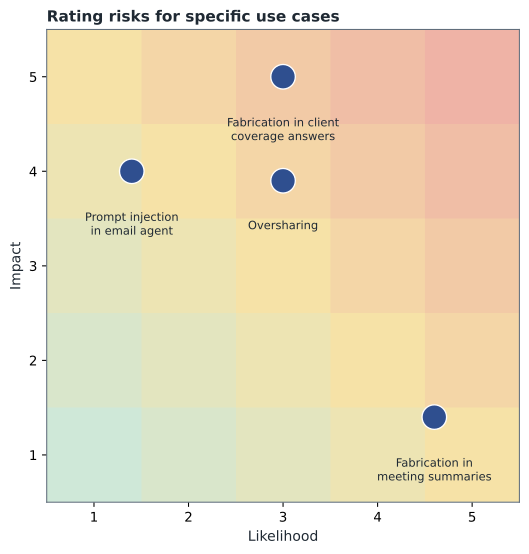
The ratings should be made by people who understand the work and the consequences, not only by technologists. Wendell rated impact; Bram rated likelihood from a technical point of view; Daria and Tomasz checked both against what actually happens in their teams.
Controls
For each significant risk, the team chooses controls that reduce its likelihood, its impact or both. Most AI controls fall into a few families.
- Human review. A person checks output before it is acted on. Review is the most important control for high-impact uses, but it must be designed so it actually happens: reviewers need time, a checklist and accountability.
- Grounding and scope. The AI answers only from approved sources and declines questions outside its scope. Grounding reduces fabrications; scope limits reduce regulatory risk.
- Permissions and data protection. Fix oversharing, apply sensitivity labels to confidential content, and use data loss prevention policies so that sensitive information is protected even when an AI can reach it. Microsoft Purview provides these tools in Microsoft 365.
- Content safety and security controls. Filters for harmful content, protections against prompt injection, and limits on what actions an agent may take without approval.
- Testing and monitoring. Test with realistic and adversarial inputs before launch, sample outputs after launch, and monitor for drift when models change.
- Transparency. Tell users and clients when content is AI-generated where appropriate, and give them a way to reach a person.
- Policy and training. An acceptable-use policy, guidance on what not to paste into AI tools, and training on checking output.
Microsoft builds several protections into its commercial services. For Microsoft 365 Copilot, Microsoft states that prompts, responses and data accessed through Microsoft Graph are not used to train the foundation models, that Copilot respects the user's existing permissions, and that commercial data protection applies to Copilot Chat for users signed in with a work account. These commitments reduce some risks, but they do not remove the need for the organization's own controls, especially on permissions and review.
Worked problem
Choosing controls for a client-facing agent
Quillfield wants an after-hours agent that answers clients' questions about their own policies. Wendell rates fabrication impact at 5 and likelihood at 3 before controls. Choose controls and estimate the residual rating.
Show solution
- Ground the agent only in the client's own policy documents and the firm's published FAQs; this lowers likelihood.
- Limit scope: the agent quotes policy wording and does not give advice on whether coverage applies; anything else is referred to a licensed broker the next business day. This lowers impact.
- Show the source passage with every answer so the client can see where it came from.
- Test with 200 realistic and tricky questions before launch, and sample 50 conversations a week after launch.
- Residual estimate: likelihood 2, impact 3, moving the risk from the red zone to amber.
Answer: Grounding, scope limits, cited sources, testing and sampling together reduce the risk to a level the firm can accept, with ongoing monitoring.
Residual risk and risk appetite
After controls, some risk remains. This residual risk is what leaders actually decide on. An organization's risk appetite is how much residual risk it will accept in pursuit of a benefit. A brokerage may accept a moderate residual risk of minor errors in internal summaries because the benefit is large and the errors are caught downstream, while accepting almost no residual risk of unlicensed advice reaching a client.
Writing the decision down, with the risk, the controls, the residual rating and the person who accepted it, turns an argument into a record. It also makes the decision easy to revisit if the facts change, such as a new regulation or a better model.
The risk of doing nothing
A complete risk assessment includes the risks of not adopting AI. Staff may already be using consumer AI tools on their own, a pattern often called shadow AI, with none of the protections of a managed service. Competitors may offer faster service or lower costs. Skilled people may prefer employers that give them modern tools. These risks do not justify careless adoption, but they mean that "wait and see" is a decision with consequences, not a neutral default.
When Hamish ran an anonymous survey, a third of Quillfield's staff said they had used a free AI chat tool for work at least once in the previous month. Wendell looked at the result for a long time. "So the real choice," he said, "is not whether we use AI. It is whether we use it with controls."
| Option | Main risks |
|---|---|
| Adopt with controls | Residual errors, cost overruns, adoption shortfall |
| Adopt without controls | Data exposure, compliance breaches, reputational damage |
| Do nothing | Shadow AI with no protections, competitive disadvantage, staff frustration |
Building risk into the business case
In the business case, risks appear in three places. The risk register lists each significant risk with its rating, controls, residual rating and owner. The costs include the controls, such as review time, testing and data protection work. And the scenarios reflect risks that could reduce benefits, such as lower adoption or a slower process change. A business case that does all three shows decision-makers that the benefits have been weighed against the downsides by people who understand both.
Who owns which risk
A risk register is only useful if each risk has an owner who will act on it. Quillfield assigned owners by the nature of the risk rather than by who raised it. Data exposure belonged to Bram, who controlled permissions and protection settings. Errors in client communications belonged to the business heads whose teams sent them, Daria and Tomasz, because they controlled the review steps. Regulatory interpretation belonged to Wendell. Cost overruns belonged to Hamish, who watched the consumption reports. Over-reliance and training belonged to the team leaders. Celestine, as executive sponsor, owned the overall risk appetite and chaired a monthly review of the register.
| Risk | Owner | Main control | Review |
|---|---|---|---|
| Data exposure through Copilot | Bram Oosterhuis | Oversharing clean-up, sensitivity labels | Monthly report of broadly shared sites |
| Errors in client letters | Daria Velikova | Broker review with checklist | Weekly sample of 20 letters |
| Unlicensed advice by an agent | Wendell Pike-Amari | Scope limits and referral to a broker | Weekly sample of conversations |
| Consumption overrun | Hamish Quarrington | Budgets and alerts on credits | Monthly against forecast |
| Over-reliance on call notes | Tomasz Rybak | Training and quality sampling | Monthly quality scores |
The register was reviewed again whenever something material changed, such as a new agent going live, a model update announced by the vendor or a regulatory notice. A risk that had been acceptable for an internal pilot was rated afresh before the same capability reached clients, because the impact of an error had changed even though the technology had not.
Common mistakes
MistakeRating the risk of "AI" in general.
InsteadRate risks for specific use cases; the same risk can be minor in one and serious in another.
MistakeRelying on "a human will check it" without designing the review.
InsteadGive reviewers time, a checklist and accountability, and sample to confirm reviews happen.
MistakeAssuming the vendor's commitments cover every risk.
InsteadVendor protections help, but permissions, scope, review and policy are the organization's job.
MistakeTreating "do nothing" as risk-free.
InsteadInclude shadow AI and competitive risks in the comparison.
Summary and key terms
- Main risks include fabrications, reliability, bias, oversharing, prompt injection, intellectual property, regulation, over-reliance, vendor dependence and reputation.
- Weigh risks for specific use cases by likelihood and impact, rated by people who understand the work.
- Controls include human review, grounding and scope, permissions and data protection, security, testing, transparency and training.
- Leaders decide on residual risk against the organization's risk appetite and record the decision.
- Doing nothing has risks too, including shadow AI without protections.
- Fabrication
- A fluent but false statement produced by a generative AI model, also called a hallucination.
- Prompt injection
- Hidden instructions in content an AI reads, intended to make it act against its instructions.
- Residual risk
- The risk that remains after controls are applied.
- Risk appetite
- How much residual risk an organization will accept in pursuit of a benefit.
- Shadow AI
- Staff using AI tools at work without the organization's knowledge or controls.
Practice problems
Work each problem on paper first, then reveal the answer to check.
Why is fabrication a higher risk in a client coverage answer than in a meeting summary?
Show answer
Because its impact is much higher: a client may rely on a false statement, and there may be regulatory consequences, while meeting attendees can spot errors in their own summary.
Name three families of AI controls.
Show answer
Any three: human review, grounding and scope, permissions and data protection, content safety and security, testing and monitoring, transparency, policy and training.
What did Quillfield's survey about free AI tools reveal?
Show answer
That shadow AI was already happening, so the real choice was whether to use AI with controls.
Lesson quiz · 5 questions
Score 60% or more to complete this lesson.
Create a free account to save your progress, take quizzes and earn a certificate.