
MSBA-120 · Lesson 3 of 12 · 18 min
From pilot to scale
▶ Video coming soon A video version of this lesson is on the way.
Quillfield had tried "AI" once before. Two years earlier, a handful of enthusiastic staff had been given access to a chat tool, told to experiment, and asked for feedback after a month. The feedback was warm and vague, nobody measured anything, and when the licenses came up for renewal nobody could say what they had bought. Celestine called it "the pilot that never ended" and did not want to repeat it.
This lesson is about the journey from a first experiment to an AI capability that is part of how the business works. It is a journey many organizations fail to complete. In August 2025, a widely reported study from MIT's Project NANDA, titled "The GenAI Divide", claimed that about 95 percent of the organizations it studied had seen no measurable profit-and-loss impact from their generative AI pilots. Critics questioned the study's methods and its narrow definition of success, and leaders should not treat the figure as precise. But the pattern it described is familiar to anyone who has led technology change: experiments are easy to start and hard to turn into results.
Why pilots stall
Pilots stall for predictable reasons. The use case was never defined, so there is nothing to measure. The pilot group was chosen for enthusiasm rather than for the work, so results do not generalize. The tool works but the surrounding process does not change, so time saved evaporates. Data access, security or compliance questions were postponed and then block expansion. Nobody owns the decision to scale, so the pilot simply continues. And the pilot has no end date, so it never has to produce a verdict.
Each of these is a leadership failure rather than a technical one, and each has a simple counter-measure: a written use case, a representative pilot group, a process change, early involvement of security and compliance, a named owner and a fixed end date with a decision.
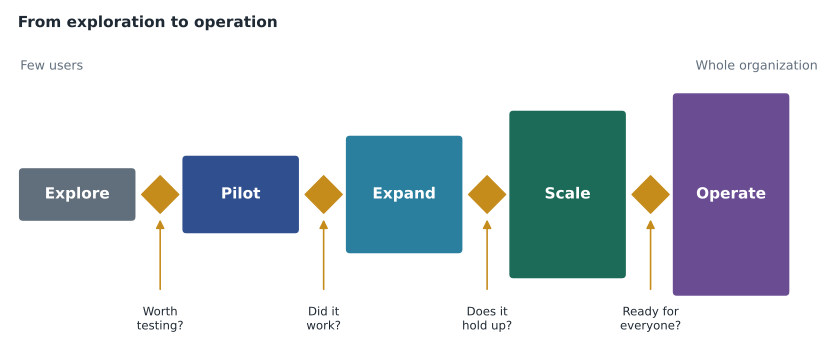
The five stages
Explore. Individuals and small teams try the technology to learn what it can do. Exploration is cheap and useful, but it is learning, not value. Its output is a list of candidate use cases, like the one Quillfield built in lesson 2.
Pilot. A defined group uses the AI for a defined use case for a defined period, with a baseline and success criteria agreed in advance. The pilot answers one question: does this work here, for these people, on this work?
Expand. The use case is extended to more teams or a whole function. Expansion tests whether the pilot result holds when the users are less enthusiastic, the data is messier and the support team is stretched.
Scale. The capability is rolled out across the organization, with training, support, governance and budgets in place. At scale the questions shift from "does it work?" to "how do we run it?"
Operate. The AI capability is part of normal operations: owned, budgeted, monitored, improved and eventually retired or replaced like any other system.
Designing a pilot that produces a verdict
A good pilot plan fits on one page. It names the use case, the pilot group, the comparison group, the duration, the baseline measures, the success criteria, the risks and how they will be controlled, and who will decide what happens next.
| Element | What to write | Quillfield call-notes pilot |
|---|---|---|
| Use case | Who, what, data, change, measure | Contact center agents use AI call summaries instead of typing notes |
| Pilot group | Representative users, not just enthusiasts | 12 agents from two shifts, mixed experience |
| Comparison group | Similar people without the tool | 12 agents on the same shifts |
| Duration | Long enough to get past the novelty | Eight weeks |
| Baseline | Current performance, measured the same way | Average after-call work of 3.1 minutes |
| Success criteria | Agreed before the start | After-call work under 1.5 minutes with note quality scores unchanged or better |
| Risks and controls | What could go wrong and how it is caught | Wrong details in notes: weekly sample review by team leads |
| Decision owner | Who decides and when | Tomasz, at the week 8 review |
Three design choices deserve attention. The first is the pilot group. Enthusiasts produce flattering results that do not survive contact with the rest of the workforce. The second is the comparison group. Without one, any change in the measure could be caused by something else, such as a quieter month. The third is duration. Early weeks often show a novelty effect, either a burst of enthusiasm or a dip while people learn, so a pilot should run long enough for usage to settle, typically six to twelve weeks.
Success criteria should include a quality check, not only speed. If call notes become faster but less accurate, the pilot has failed. Writing the criteria before the start prevents the common habit of choosing whichever measure happens to look good at the end.
Worked problem
Reading a pilot result
At week 8, the 12 pilot agents averaged 1.2 minutes of after-call work, down from 3.1. The comparison group fell from 3.0 to 2.8 minutes, because a new script shortened some calls for everyone. Note quality scores were unchanged in both groups. Did the pilot meet its success criteria, and what is the effect of the AI itself?
Show solution
- Success criteria: under 1.5 minutes with quality unchanged or better. The pilot group reached 1.2 minutes with quality unchanged, so it passed.
- Change in the pilot group: 3.1 minus 1.2 = 1.9 minutes.
- Change in the comparison group: 3.0 minus 2.8 = 0.2 minutes, caused by something other than the AI.
- Effect of the AI: 1.9 minus 0.2 = 1.7 minutes per call.
Answer: The pilot passed. The AI's own effect is about 1.7 minutes per call; the other 0.2 minutes would have happened anyway.
This technique, comparing the change in the pilot group with the change in the comparison group, is called a difference-in-differences comparison. It is one of the simplest ways to avoid crediting AI with improvements it did not cause.
The gates between stages
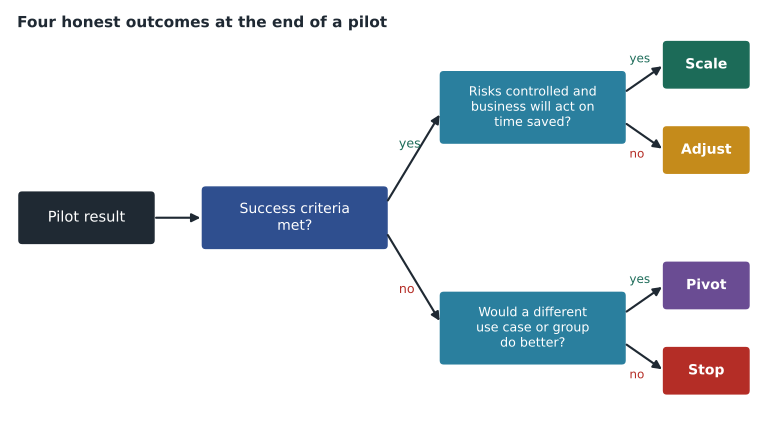
Each move from one stage to the next should be a decision based on evidence. At the end of a pilot, there are only four honest answers. Scale when the result is clear, the risks are controlled and the business will act on the time saved. Adjust and re-run when the result is promising but something specific went wrong, such as poor training or missing data. Pivot when the tool works but a different use case or group would benefit more. Stop when the result does not justify the cost or the risk. Stopping a pilot that did not work is a success of the process, not a failure; it frees money and attention for better use cases.
What changes at scale
Moving from 12 users to 380 changes the work. Several things that were informal in the pilot have to become formal.
Licenses and budgets. A pilot can be funded from a discretionary budget. Scale needs a line in the operating budget, a forecast, and decisions about who gets which license. Lesson 4 covers cost models in detail.
Data and permissions. In a pilot, people use the data they already work with. At scale, an AI assistant that can search everything a user has permission to see will expose oversharing problems: folders shared with "everyone", old sites nobody cleaned up, sensitive files in the wrong place. Microsoft's own deployment guidance for Microsoft 365 Copilot puts data access and oversharing remediation before broad rollout. Lesson 9 returns to data readiness.
Training and support. Enthusiasts teach themselves; most people do not. Scale needs role-based training, short guides for the most common tasks, a place to ask questions, and a network of champions in each team.
Governance. Policies on acceptable use, who may build agents, how agents are approved, and how incidents are handled have to be written and enforced. The companion course on implementation and adoption strategy covers governance in depth.
Measurement. A pilot can be measured by hand. At scale, measurement needs dashboards. In Microsoft 365, Copilot usage and impact reporting is available through tools such as the Copilot Dashboard in Viva Insights and the usage reports in the Microsoft 365 admin center, which show who is using Copilot, in which apps and how often.
Process redesign
The biggest difference between pilots that pay off and pilots that stall is usually whether the process around the AI changed. If agents save two minutes per call but staffing plans, targets and schedules stay the same, the saving disappears into slightly longer breaks between calls. If the contact center adjusts its staffing model, redeploys the freed time to outbound retention calls, or absorbs growth without hiring, the saving becomes real.
Process redesign asks three questions. Which steps does the AI now do or speed up? Which steps can be removed, merged or moved because of that? And what will people do with the time? At Quillfield, the call-notes pilot led Tomasz to change his staffing forecast for the following year and to set up a small outbound team calling clients whose policies were about to lapse. That second decision turned a productivity gain into a growth opportunity.
| Before the pilot | After process redesign |
|---|---|
| Agents type notes for about 3 minutes after each call | AI drafts notes; agents check and correct in under a minute |
| Team leads review a random sample of notes each month | Team leads review a weekly sample focused on AI errors |
| Staffing forecast assumes 3 minutes of after-call work | Forecast updated to about 1.3 minutes; four planned hires removed |
| No outbound calling | Two agents per shift call clients with policies about to lapse |
A portfolio, not a single bet
Most organizations run several pilots at once, at different stages. Treating them as a portfolio helps leaders balance risk: a few quick wins that build confidence and fund the program, a smaller number of strategic bets that could change the business, and a steady flow of new candidates from exploration. A portfolio also makes it normal for some pilots to stop, which keeps the program honest.
By the end of the third workshop, Quillfield had three pilots planned: call notes in the contact center, renewal briefings in personal lines and disclosure checks for compliance, each with a one-page plan, a comparison group and a decision date. Lorne said it was the first AI proposal he had seen that he could actually check.
Expanding before scaling
The expand stage is often skipped, and skipping it is a common cause of trouble at scale. A pilot with 12 agents on two shifts tells the business that the use case works for those people, on that work, with the attention that pilots usually get. Expanding to the whole contact center, or to a second team with different work, tests whether the result holds without the extra attention. Quillfield expanded the call-notes use case to all 45 agents for six weeks before declaring it part of normal operations, and found two problems the pilot had missed: summaries of calls that switched between English and another language were weaker, and night-shift agents had received less training. Both were fixed before the change became permanent.
| Question at the expand gate | Why it matters |
|---|---|
| Does the result hold for less enthusiastic users? | Pilot groups often try harder than everyone else |
| Does it work for different kinds of work or customers? | Edge cases appear only at larger volume |
| Can support and training keep up? | Help requests rise faster than users |
| Are costs in line with the forecast? | Consumption can grow with volume in unexpected ways |
| Are the controls still working? | Sampling and review can slip when they are no longer new |
Each expansion also produced better numbers for the business case. With 45 agents, the measured time saving per call settled slightly below the pilot figure, which is common once the pilot group's extra attention fades. Using the expanded figure made the eventual business case more conservative and more credible.
Common mistakes
MistakeRunning a pilot with no end date.
InsteadSet a fixed duration and a decision meeting with four possible outcomes: scale, adjust, pivot or stop.
MistakeChoosing only enthusiasts for the pilot group.
InsteadChoose a representative group and a similar comparison group.
MistakeMeasuring speed only.
InsteadInclude a quality measure in the success criteria so faster but worse results count as failure.
MistakeScaling the tool without changing the process.
InsteadRedesign the workflow and decide what people will do with the time saved.
Summary and key terms
- Many generative AI pilots stall because the use case, measures, owner or end date were never defined.
- The journey runs through explore, pilot, expand, scale and operate, with an evidence-based decision at each gate.
- A good pilot plan names the group, comparison group, duration, baseline, success criteria, risks and decision owner.
- A difference-in-differences comparison separates the AI's effect from other changes.
- Scale needs budgets, data readiness, training, governance, measurement and, above all, process redesign.
- Pilot
- A time-limited test of a defined use case with a defined group, baseline and success criteria.
- Comparison group
- Similar people who do the same work without the AI, used to isolate its effect.
- Difference-in-differences
- Comparing the change in the pilot group with the change in the comparison group.
- Novelty effect
- A temporary change in behavior or results caused by something being new.
- Process redesign
- Changing the steps, roles, targets and staffing around a task so AI gains become real results.
Practice problems
Work each problem on paper first, then reveal the answer to check.
List the four honest outcomes of a pilot review.
Show answer
Scale, adjust and re-run, pivot, or stop.
A pilot group improves by 5 minutes per task and the comparison group by 1 minute. What is the AI's effect?
Show answer
About 4 minutes per task.
Why does Microsoft's Copilot deployment guidance put data access before broad rollout?
Show answer
Because Copilot can find anything a user is allowed to see, so oversharing problems become visible at scale.
Lesson quiz · 5 questions
Score 60% or more to complete this lesson.
Create a free account to save your progress, take quizzes and earn a certificate.