
MSBA-120 · Lesson 1 of 12 · 20 min
Where AI creates value: productivity, quality, growth
▶ Video coming soon A video version of this lesson is on the way.
The first AI value workshop at Quillfield Insurance Brokers took place in the boardroom of the Omaha head office on a gray Monday morning. Celestine Nwachukwu-Hale, the chief operating officer, had invited the whole leadership team: Lorne Macpherson-Ibe from finance, Daria Velikova from personal lines, Tomasz Rybak from the contact center, Wendell Pike-Amari from compliance, and Hamish Quarrington, the operations analyst who would track the numbers. Celestine wrote one question on the whiteboard before anyone sat down: "Where, exactly, would generative AI make Quillfield better?"
Lorne answered first, as he usually did. "Everyone tells me AI will save time. Saved time is not money unless we do something with it. Show me where the value lands on our income statement, or I will keep treating this as a marketing expense."
That exchange sets up this course. Generative AI is a general-purpose technology: it can help almost anyone who reads, writes, summarizes, searches or reasons with information. That breadth is its strength and its trap. A tool that can help with everything tends to be adopted for nothing in particular, and its benefits spread thinly across thousands of small moments that nobody counts. Leaders who get value from AI do the opposite. They name the specific places where it changes an outcome the business cares about, they measure the change, and they redesign work so the change sticks.
Three kinds of value
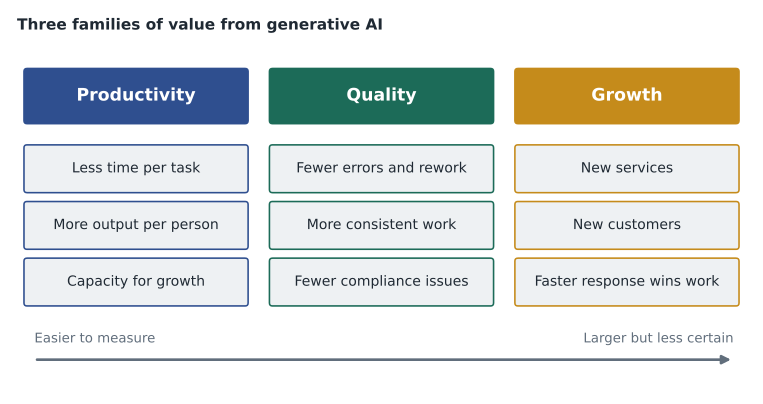
Most of the value organizations report from generative AI falls into three families. Keeping them separate helps, because each is measured differently and each needs a different kind of evidence before a finance team will believe it.
Productivity means producing the same output with less effort, or more output with the same effort. A broker who drafts a renewal letter in four minutes instead of fifteen, an underwriter who gets a summary of a 60-page inspection report instead of reading it end to end, or a contact center agent who no longer types up notes after each call are all productivity gains. Productivity is the easiest kind of value to observe and the hardest to bank, for exactly the reason Lorne gave: the time saved has to be redeployed, avoided as a future cost, or turned into capacity that the business actually uses.
Quality means producing better output: fewer errors, more consistent answers, more complete analysis, better-written communications, faster detection of problems. A claims summary that never forgets to mention the deductible, a policy comparison that checks every exclusion, or a reply to a client that matches the firm's tone guide are quality gains. Quality often shows up indirectly, in fewer complaints, fewer errors and omissions claims, less rework and better audit results.
Growth means doing things the business could not do before, or reaching customers it could not reach. A brokerage that can produce tailored risk reports for small commercial clients at a cost that makes them worth offering, answer clients in more languages, or respond to quote requests outside office hours is creating growth value. Growth is the largest prize and the least certain one, because it depends on customers and competitors as well as on the technology.
A fourth effect is sometimes listed separately: risk reduction, such as catching a compliance problem in a draft before it is sent. In this course, risk reduction is treated as a kind of quality value, because it is measured the same way, through fewer bad outcomes. Lesson 6 looks at the opposite side, the new risks that AI itself introduces.
What the evidence says
Celestine did not want the workshop to rest on vendor slides, so she had Hamish collect the best-known independent studies. Four of them come up again and again in business discussions of generative AI, and each teaches a different lesson.
In a study published in the Quarterly Journal of Economics in 2025, Erik Brynjolfsson, Danielle Li and Lindsey Raymond followed 5,179 customer support agents at a software company as an AI assistant was rolled out to them. On average, agents resolved about 14 percent more issues per hour. The gain was about 34 percent for novice and lower-skilled agents and close to zero for the most experienced ones. The assistant had, in effect, spread the know-how of the best agents to everyone else.
In a 2023 experiment published in Science, Shakked Noy and Whitney Zhang gave 453 college-educated professionals realistic writing tasks, such as press releases and short reports. Those with access to ChatGPT finished about 40 percent faster, and independent graders rated their work about 18 percent higher in quality.
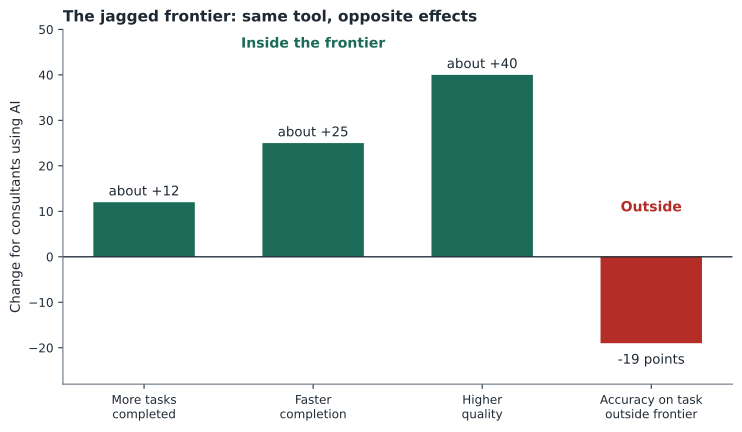
In a 2023 field experiment run with Boston Consulting Group by researchers from Harvard Business School and other universities, about 750 consultants worked on realistic tasks with or without GPT-4. On tasks inside what the authors called the "jagged technological frontier", consultants using AI completed about 12 percent more tasks, about 25 percent faster, with output rated about 40 percent higher in quality. On a task deliberately chosen to fall outside the frontier, a business problem where the AI tended to give a confident wrong answer, consultants using AI were 19 percentage points less likely to reach the correct answer than those working without it.
A 2023 controlled experiment by researchers at GitHub and Microsoft asked developers to write a small web server. Those using GitHub Copilot finished about 56 percent faster than the control group.
| Study | Who and what | Headline result | Lesson for leaders |
|---|---|---|---|
| Brynjolfsson, Li and Raymond (2025) | 5,179 support agents, live work | About 14 percent more issues resolved per hour; about 34 percent for novices | Gains are largest for less experienced staff |
| Noy and Zhang (2023) | 453 professionals, writing tasks | About 40 percent less time; quality about 18 percent higher | Writing-heavy work benefits quickly |
| Dell'Acqua and others (2023) | About 750 consultants | Inside the frontier: faster and better; outside it: 19 points less accurate | AI can make people worse when the task is beyond it |
| Peng and others (2023) | Developers, one coding task | About 56 percent faster | Well-defined tasks show large time savings |
Three patterns stand out. First, the gains are real and often large for the right tasks. Second, they are uneven: they depend on the task and on the person. Third, a tool that helps on one task can hurt on a neighboring one that looks similar, because generative AI produces fluent, confident output whether or not it is correct. Leaders do not need to memorize the percentages, but they should remember the shape of the evidence. It argues for choosing tasks deliberately, training people to recognize where the tool is weak, and checking results rather than assuming them.
The studies also share a limitation. They measure individuals doing tasks, usually over weeks or months. A business cares about outcomes over years: revenue, margin, retention, risk. Turning task-level gains into business-level value is the work of the rest of this course.
From tasks to outcomes
Hamish drew a chain on the whiteboard that the team came back to all morning: task, then workflow, then outcome, then financial result. A task is one piece of work, such as summarizing a policy. A workflow is a sequence of tasks that produces something, such as preparing a renewal. An outcome is what the business wants from the workflow, such as a client who renews on time at the right price. The financial result is what the outcome is worth.
AI usually acts on tasks. Value appears only when the task change travels all the way along the chain. If renewal preparation is faster but the renewal still waits three days in a queue for a manager's signature, the client sees no difference and the business banks nothing. If the faster preparation lets each account manager handle 15 more renewals a month, and the brokerage stops hiring a planned extra account manager, the gain becomes an avoided cost that finance can see.
There are four common ways time saved becomes money:
- Avoided cost: the business does not hire, does not pay overtime or does not buy outside services it would otherwise have needed.
- Redeployed capacity: people spend the freed time on work that earns revenue, such as account managers calling clients who are at risk of leaving.
- Faster cycle time: work that finishes sooner brings revenue forward or prevents loss, as when quotes go out the same day and win more business.
- Higher throughput without more staff: the same team handles growth, so revenue rises while costs stay flat.
Time saved that goes to none of these is still worth something, since people may be less stressed, do more careful work or learn faster, but it should not be counted as financial value in a business case. Lesson 5 shows how to separate the two in a return-on-investment calculation.
Worked problem
Following one task to the income statement
Quillfield's 45-person contact center spends about three minutes after each call writing notes. The center handles about 1,200 calls a day. An AI meeting and call summary feature could cut note-writing to about one minute per call. What is the time saved, and what would have to happen for it to become financial value?
Show solution
- Time saved per call: 3 minus 1 = 2 minutes.
- Time saved per day: 1,200 calls x 2 minutes = 2,400 minutes, or 40 hours.
- Forty hours a day is about five full-time positions at eight hours each.
- Tomasz had planned to hire four agents next year to handle growth in call volume. If the saved time absorbs that growth, the avoided cost is four salaries plus benefits.
- If call volume does not grow and no one is reassigned, the time is still saved but does not reach the income statement.
Answer: About 40 hours a day. It becomes financial value only through a decision, here not hiring the four planned agents or redeploying people to revenue work.
Where generative AI fits, and where it does not
Generative AI is good at a particular kind of work: tasks built from language, images or code, where a draft that a person can check is useful, and where the inputs are available as text or documents. It summarizes, drafts, rewrites, classifies, extracts, translates, explains and answers questions over a body of material. It is weaker at tasks that need exact calculation without tools, guaranteed factual accuracy without checking, up-to-date information it has not been given, or judgment that depends on context the model cannot see.
Other kinds of AI are better for other jobs. A machine learning model trained on Quillfield's own claims history can predict which policies are likely to lapse, something a general-purpose language model cannot do reliably from a prompt. A rules engine can calculate a premium exactly. Robotic process automation can copy data between two systems without any judgment at all. Part of a leader's job is to match the problem to the right tool and resist the urge to use generative AI for everything because it is new.
| Good fit for generative AI | Better fit for something else |
|---|---|
| Drafting client letters, emails and proposals | Calculating a premium exactly (rules or rating engine) |
| Summarizing long documents and calls | Predicting which clients will lapse (trained machine learning model) |
| Answering staff questions from policy wordings | Copying fields between two systems on a fixed schedule (integration or automation) |
| Extracting details from forms and emails | Approving a claim payment (human decision with controls) |
| Translating and adjusting tone | Real-time fraud scoring on every transaction (specialized model) |
Scale and automation as value levers
Two features of generative AI explain why its value can grow faster than with earlier tools. The first is scalability. Once a solution works, serving the next thousand users or documents costs little extra effort compared with building it in the first place. A well-grounded assistant that answers questions about policy wordings can serve every broker in every office the day it is published.
The second is automation. Early uses of generative AI were assistive: a person asks, the AI drafts, the person decides. Increasingly, agents carry out multi-step work on their own, such as reading an incoming email, finding the policy, drafting a reply and filing it for review. Automation can turn time saved into throughput far more directly than assistance can, but it also raises the stakes for quality and control. Lesson 8 is devoted to agents and process automation.
A first map of Quillfield
By the end of the morning, the leadership team had a rough map. Daria saw productivity value in personal-lines renewals and quality value in consistent policy comparisons. Tomasz saw immediate productivity in call notes and possible growth in handling after-hours questions. Wendell wanted quality value in checking client communications for required disclosures, and he insisted that any automation of client advice be treated with care. Lorne agreed to look at numbers if every claim came with a measure, a baseline and a decision that would turn time into money.
Celestine closed by writing three rules on the whiteboard, and they became the ground rules for the rest of the workshop series: name the outcome, measure before and after, and decide in advance what the business will do with the time it saves.
Common mistakes
MistakeCounting every hour saved as money saved.
InsteadTime becomes financial value only through avoided cost, redeployment, faster cycle time or higher throughput, and each needs a decision.
MistakeAssuming AI improves every task it is used on.
InsteadThe evidence shows a jagged frontier: large gains on some tasks and worse results on others. Choose tasks deliberately and check output.
MistakeUsing generative AI where an exact calculation or a trained prediction model is needed.
InsteadMatch the problem to the tool. Generative AI drafts, summarizes and answers; rules engines calculate; trained models predict.
MistakeTreating growth value as certain because productivity value has been shown.
InsteadGrowth depends on customers and competitors; estimate it separately and with wider ranges.
Summary and key terms
- Generative AI value falls into productivity, quality and growth; risk reduction is a form of quality value.
- Independent studies show large gains on well-suited tasks, especially for less experienced workers, and worse results on tasks outside the frontier.
- Value has to travel from task to workflow to outcome to financial result.
- Saved time becomes money through avoided cost, redeployed capacity, faster cycle time or higher throughput.
- Generative AI suits language-based drafting, summarizing, extracting and answering; other tools suit exact calculation and prediction.
- Productivity value
- The same output with less effort, or more output with the same effort.
- Quality value
- Better output: fewer errors, more consistency, more complete work.
- Growth value
- New services, new customers or new revenue the business could not reach before.
- Jagged technological frontier
- The uneven boundary between tasks where AI helps and tasks where it misleads.
- Redeployed capacity
- Time freed by AI that people spend on work that earns revenue or prevents loss.
Practice problems
Work each problem on paper first, then reveal the answer to check.
Name the three families of value from generative AI and give one Quillfield example of each.
Show answer
Productivity (faster renewal letters), quality (consistent policy comparisons), growth (after-hours answers to client questions).
In the customer support study, which group of agents gained the most?
Show answer
Novice and lower-skilled agents, about 34 percent, while the most experienced gained little.
Why did Lorne say saved time is not money?
Show answer
Because time saved only reaches the income statement if the business avoids a cost, redeploys people, speeds up revenue or absorbs growth without hiring.
Lesson quiz · 5 questions
Score 60% or more to complete this lesson.
Create a free account to save your progress, take quizzes and earn a certificate.