
MSAZ-289 · Lesson 2 of 12 · 21 min
Question types, case studies and labs
▶ Video coming soon A video version of this lesson is on the way.
Walt's first look at the exam sandbox, on the afternoon of November 10, surprises him. He had pictured a long list of four-option questions. Instead, the demonstration shows screens where answers are dragged into boxes, statements that need a yes or a no each, a code listing with drop-down lists inside it and a case study with tabs of background reading. Elena tells him that this is the point of the sandbox: on exam day, the format should be the one thing that does not use up any thought.
This lesson describes the formats a Microsoft role-based exam can use, how each one is scored, and a working method for each. It also covers case studies, which deserve special care, the review screen and the sections that cannot be revisited, and what the certification page means when it says the exam may have interactive components.
Why the formats matter
Every format tests the same thing in the end: whether the candidate can make the right decision about Azure SQL. But each format puts different pressure on the reader. A four-option question lets a candidate eliminate wrong answers. A drag-and-drop ordering question gives no partial safety net if one step is in the wrong place. A yes-or-no series asks three separate judgments about the same scenario and may not allow a return. Knowing the format in advance means knowing which method to use the moment the screen appears.
Multiple choice, single answer
The most familiar format gives a question and several options, of which one is correct. On DP-300 the stem is often a short scenario with a requirement and a constraint, such as 'You need to minimize cost' or 'You must ensure the solution supports cross-database queries'. The reliable method is to read the last sentence of the stem first, so the question is clear, then read the scenario looking for every constraint, then judge each option against all of them. Options on associate exams are rarely silly. A wrong option is usually a real service or setting that fails one constraint.
Multiple choice, more than one answer
Some questions ask for two or three answers, and the stem says how many: 'Each correct answer presents a complete solution' or 'Each correct answer presents part of the solution. Choose two.' The two phrasings are different. 'A complete solution' means each chosen option works on its own; the question asks for every option that would work. 'Part of the solution' means the chosen options work together; neither is enough alone. Reading that phrase carefully decides the method. For complete solutions, test each option independently. For parts of a solution, look for the set that together meets every requirement.
Drag and drop
Drag-and-drop questions come in two common forms. In the matching form, items on one side are placed into targets on the other, such as matching recovery requirements to the HA/DR feature that meets each one. Some items may be used once, more than once or not at all, and the instructions say which. In the sequence form, the candidate builds a list of steps in the correct order from a larger pool, for example the steps to configure a customer-managed key for transparent data encryption. The pool often contains a step that sounds right but is not needed. The method is to write the sequence in your head from experience first, then find the steps that match it, rather than starting from the pool.
Hot area
A hot area question shows an image or a code listing with places to click or drop-down lists to choose from. A common DP-300 form shows a partial T-SQL statement, an Azure CLI command or a Bicep fragment, with drop-down lists where key words or values belong: the encryption type in a column definition, the sku in a deployment, the frequency in a schedule. The method is to read the whole listing before touching any list, because a later line often fixes the meaning of an earlier choice. Lesson 9 practices reading T-SQL this way.
Yes or no series
A yes-or-no series presents one scenario followed by several statements, each to be marked yes or no. A common variant gives a goal and a proposed solution, and asks: does the solution meet the goal? The same scenario is then repeated with a different proposed solution. In many Microsoft exams, once a candidate answers one question in such a series and moves on, they cannot return to it. The exam warns about this on the screen before the series starts. The method is to judge each proposed solution only against the stated goal, not against the solution you would have chosen. A solution can meet the goal and still be more expensive than another; the question asks only whether it meets the goal.
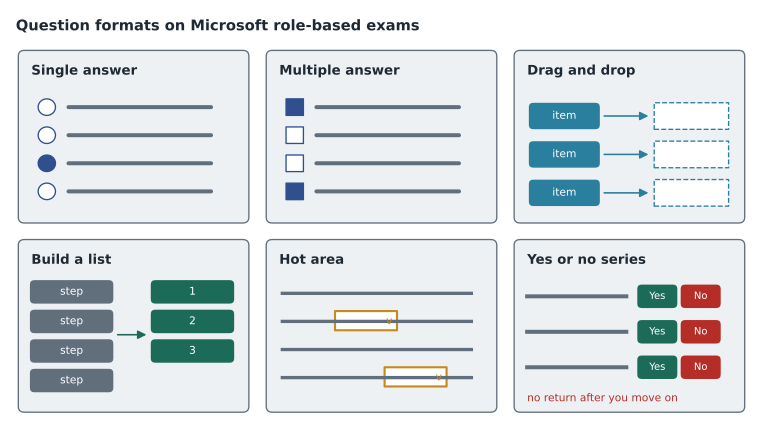
| Format | What it asks | Method |
|---|---|---|
| Single answer | One best option | Read the final sentence first, then test each option against every constraint |
| Multiple answer | Two or more options | Check whether each answer is a complete solution or part of one |
| Drag and drop (match) | Place items into targets | Note whether items can be reused; fill the certain targets first |
| Build a list (sequence) | Ordered steps from a pool | Recall the procedure first, then match it to the pool |
| Hot area | Choose values inside an image or listing | Read the whole listing before choosing any value |
| Yes or no series | Does each proposal meet the goal? | Judge only against the stated goal; expect no return |
Case studies
A case study is a section of the exam built around one long scenario. The background is split into tabs, often named something like Overview, Existing environment, Requirements and Technical requirements, with a set of questions about it. A case study can describe several databases, network rules, compliance needs, budget limits and planned changes. The questions draw on different parts of it, and some requirements appear in only one tab. A case study section is usually separate from the rest of the exam: once it is finished, the candidate cannot go back to it, and it may have its own review screen.
Case studies punish two habits. The first is reading every tab in full before looking at the questions, which takes a long time and fills memory with details that may not matter. The second is reading only the question and guessing which tab matters, which misses the requirement hidden in the Technical requirements tab. Elena teaches a middle path. Skim the tabs once for structure, about two minutes, noting where the requirements live. Then read each question, and for each one go back to the requirements tab and check the specific constraints. Requirements in case studies often use exact words like 'must', 'minimize', 'ensure' or 'prevent', and those words carry the marks.
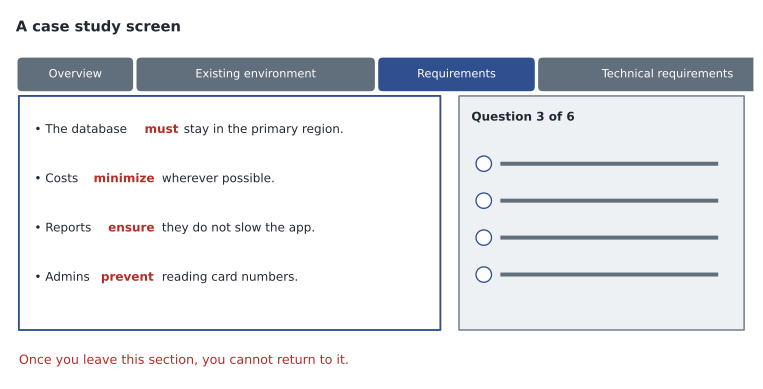
Review screens and sections
Most of the exam allows a candidate to mark a question for review and come back to it before ending the section. The review screen lists every question with its status: answered, unanswered or marked. Marking is useful when a question takes too long: answer it with the best current choice, mark it, and move on. Returning later with a fresh mind often settles it. Questions in a no-return series and in completed case studies cannot be reopened, so marking them does not help; they should be finished properly the first time.
Walt asks how many sections there will be. The structure can differ between sittings, so Elena does not give a number. What she teaches instead is to read every instruction screen that appears between sections, because that is where the exam says whether the next part can be revisited.
Interactive components and labs
The certification page says the DP-300 exam may have interactive components. Microsoft has used performance-based labs on some exams in the past, where the candidate carried out tasks in a live environment. Whether a given sitting includes anything of that kind is not something the study guide promises, and the safest preparation is the same either way: practice the tasks in the outline in a real Azure subscription, not only on paper. Walt has a sandbox subscription from MSAZ-280 with a test Managed Instance, a serverless database and a SQL Server VM. Elena asks him to do at least one task from each outline bullet there before May, using the portal, T-SQL and the command line, because a person who has done a task recognizes it in any format.
Can candidates look things up?
In 2023 Microsoft announced that candidates in role-based exams could open Microsoft Learn documentation during the exam, in a restricted browser window inside the exam interface. The clock keeps running while the window is open. Reports since then have varied on how it works for particular exams and delivery methods, so Elena tells Walt to read the current exam rules on the exam page and in Pearson VUE's instructions when he books, and to treat any such access as a fallback for a single fact, not a study method. Searching documentation during an exam is slow; a candidate who needs to look up half the answers will run out of time.
How distractors are built
Wrong options on an associate exam are written to be tempting, and they usually fall into a few families. Some name a real feature that solves a neighboring problem: dynamic data masking offered where the requirement is that data be unreadable even to administrators, which only Always Encrypted achieves. Some name the right feature with the wrong scope: a database-level firewall rule where every database on the server must be covered. Some meet the requirement but break a constraint stated earlier, such as a Business Critical tier where the stem says to minimize cost and General Purpose meets the recovery goal. Some are outdated: a tool that has been retired, such as the Azure Data Studio migration extension, which reached the end of its life on February 28, 2026.
Recognizing the family helps. When two options look right, ask which one fails a constraint and which one fails nothing. When an option looks right but feels too easy, check its scope. When an option names a tool Walt knows from years ago, check whether it is still current. Elena keeps a page in Walt's study notebook titled 'Why it was wrong', where each missed practice question gets one line naming the family of the distractor that caught him. After a month, the page shows a pattern, and patterns can be fixed.
Worked problem
Complete solution or part of a solution?
A question reads: 'You need to ensure that a contractor can read only the Sales schema in a database. Each correct answer presents a complete solution. Which two actions should you perform?' The options are: A. GRANT SELECT ON SCHEMA::Sales to the contractor's user; B. Add the contractor to db_datareader; C. Create a role, GRANT SELECT ON SCHEMA::Sales to the role, add the contractor to the role; D. GRANT SELECT on each table in Sales to the contractor's user. Which two?
Show solution
- 'Complete solution' means each chosen option must work alone.
- A works: SELECT on the schema covers every table in it, now and later.
- B fails: db_datareader allows reading every table in every schema.
- C works: the role carries exactly the schema permission.
- D reads only the current tables, so it fails if a table is added later, and it is the weaker answer compared with A and C, which cover future tables too.
Answer: A and C. Each is a complete, least-privilege solution. B grants too much, and D is fragile because new tables in Sales would not be readable.
Common mistakes
MistakeAll questions on the exam can be revisited before submitting.
InsteadCase study sections and some yes-or-no series cannot be revisited once you move on; read the instruction screens.
MistakeIn a case study, read every tab in full before looking at the questions.
InsteadSkim the structure, then check each question against the specific requirements.
MistakeA solution in a yes-or-no series is wrong if a cheaper one exists.
InsteadJudge only whether it meets the stated goal.
Mistake'Part of the solution' means each chosen option works on its own.
InsteadIt means the options work together; 'complete solution' means each works alone.
MistakeDocumentation access during the exam replaces study.
InsteadIf available, it is slow and the clock keeps running; treat it as a fallback for one fact.
Summary and key terms
- Microsoft role-based exams use single-answer and multiple-answer multiple choice, drag and drop, build-a-list, hot area and yes-or-no series questions.
- Read the stem's final sentence first, then test options against every constraint.
- 'Complete solution' and 'part of the solution' call for different methods.
- Case studies have tabs of background and are usually a separate section that cannot be revisited.
- Marking questions for review helps only where a section allows a return.
- The certification page says DP-300 may have interactive components; practice tasks in a real subscription and try the exam sandbox.
- Case study
- An exam section built around a long scenario split into tabs, with a set of questions about it.
- Hot area
- A question where answers are chosen by clicking areas or using drop-down lists inside an image or listing.
- Yes or no series
- A set of questions on one scenario where each proposed solution is judged against a goal, often without return.
- Build a list
- A drag-and-drop question that asks for steps in the correct order from a larger pool.
- Review screen
- An exam screen listing questions as answered, unanswered or marked for review.
- Complete solution
- Wording that means each chosen option meets the requirement on its own.
Practice problems
Work each problem on paper first, then reveal the answer to check.
What does 'Each correct answer presents part of the solution' mean?
Show answer
The chosen options must work together; none is sufficient on its own.
Why should you read the instruction screen before a yes-or-no series?
Show answer
It says whether you can return to the questions after answering them.
What is a good first step when a case study opens?
Show answer
Skim the tabs for about two minutes to see where the requirements are.
In a hot area question with a code listing, why read the whole listing first?
Show answer
Later lines often fix the meaning or value of an earlier choice.
What should you do with a question that is taking too long, in a section that allows review?
Show answer
Choose the best current answer, mark it for review and move on.
Lesson quiz · 5 questions
Score 60% or more to complete this lesson.
Create a free account to save your progress, take quizzes and earn a certificate.