
MSAZ-289 · Lesson 12 of 12 · 20 min
Exam day and renewal
▶ Video coming soon A video version of this lesson is on the way.
Walt plans to book his exam in late January, for Friday, May 14, 2027, at 09:00 at a Pearson VUE test center in Des Moines. He chose a test center over an online exam because his house has a teenager, a dog and an unreliable upstairs connection, and because he wants the exam to feel separate from home. This last lesson covers choosing the delivery method, what happens on the day, how results and the badge arrive, and how to keep the certification once it is earned. None of it is technical, and all of it can cost an exam if it goes wrong.
Test center or online
Both delivery methods use the same exam. At a test center, Pearson VUE provides the computer, a quiet room and a proctor; the candidate brings identification and leaves everything else in a locker. Online delivery, through Pearson VUE's OnVUE system, lets the candidate sit at home or at work with a webcam, a microphone, a stable internet connection and a private, quiet room with a clear desk. The online proctor watches through the camera throughout, and the system check software must be run on the same computer beforehand.
| Consideration | Test center | Online (OnVUE) |
|---|---|---|
| Equipment | Provided and maintained by the center | Candidate's own computer, webcam, microphone and connection |
| Room | Quiet testing room shared with other candidates | Private room, clear desk, no one entering |
| Check-in | At the desk with identification | Photos of the room and identification through the app |
| Risk | Travel and weather | Connection, noise and interruptions |
| Scheduling | Center opening hours | Wider choice of times |
For an online exam, the rules about the room are strict. The desk must be clear apart from the computer; a second monitor must be disconnected; no one may enter the room; and the candidate must stay in view of the camera. Speaking aloud, reading the questions under one's breath or looking away for long periods can lead the proctor to end the exam. Walt's colleague Sunil sat an exam online last year and had to show the proctor the space under his desk with the webcam. For a person who thinks better when moving, a test center is often easier.
Booking, rescheduling and identification
Exams are booked from the exam page on Microsoft Learn, signed in with the account that holds the certification profile, which leads to Pearson VUE's scheduling site. The name on the profile must match the name on the identification exactly enough for the proctor to accept it; Walt's passport says Walter James Hadley, so he updates his profile to that before booking. Pearson VUE requires government-issued identification with a photo and signature, and some locations require a second piece; the confirmation email states the rule for the location. Rescheduling or canceling should be done well ahead; Microsoft's policy has been that changes made at least 24 hours before the appointment carry no fee, and Walt will check the rule in his confirmation.
Accommodations, such as extra time for a documented need, a separate room or assistive technology, are requested through Microsoft Learn before booking and can take some time to approve. A candidate who will sit in a language that is not their first language can request 30 extra minutes if the exam is not offered in their preferred language.
On the day
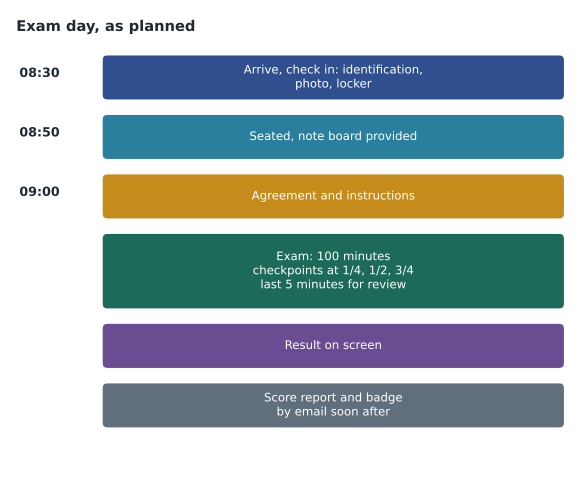
At a test center, Walt plans to arrive 30 minutes early. Check-in includes showing identification, having a photo taken and putting personal items in a locker, including his phone and watch. The center gives him a note board or erasable sheet and a marker. Before the first question, the exam shows a non-disclosure agreement and some introductory screens; the agreement must be accepted to continue, and the exam rules say how long the candidate has to accept it.
The time shown on the screen is the exam time. When the exam begins, Walt will note the number of items and write his three checkpoints on the note board, as practiced in lesson 11. He will read each section's instructions, especially before case studies and no-return series, mark hard items and move on, and keep his five-minute review reserve. If something goes wrong with the computer, he raises his hand at once; at a test center the proctor can pause and log the problem, and online the candidate contacts the proctor through the chat. A Pearson VUE case number recorded at the time is what makes a waiver of the retake waiting period possible later.
Results and the badge
A result appears on screen as soon as the exam ends, and a score report follows in the candidate's Microsoft Learn profile and Pearson VUE account. The report shows the scaled score, the pass mark of 700 and a bar for each skill group that describes relative performance. A passing candidate receives the certification in their Learn profile, along with a digital badge that can be shared, and the certification appears on their transcript. For a failed attempt, the skill group bars are the starting point for the next study block, read together with the candidate's own notes from the exam.
Elena asks Walt to write down, on the way home, what surprised him: a topic that appeared more than expected, a format that slowed him, a type of distractor that caught him. It is useful whatever the result. If he passes, it helps the next person Elena coaches; if he does not, it is the most accurate study guide he will ever have.
Renewal
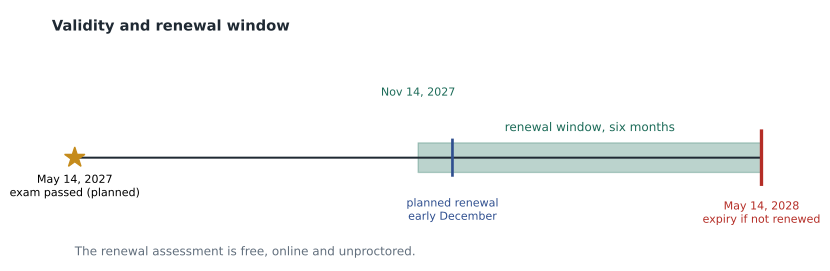
Associate certifications are valid for 12 months and can be renewed for free with an online renewal assessment on Microsoft Learn. The window opens six months before the expiry date. The assessment is unproctored, can be taken at any time in the window, covers the current skills with an emphasis on recent changes, and can be retaken: immediately after a first failed attempt, then with at least 24 hours between later attempts, as many times as needed before the certification expires. If it expires, the only way back is to pass the exam again.
For Walt, a pass on Friday, May 14, 2027 would give an expiry on Sunday, May 14, 2028, and a renewal window opening around Sunday, November 14, 2027. Elena's advice is to renew early in the window rather than at the end, so that a failed attempt leaves months to study rather than days. Microsoft also sends email reminders, but she wants the date in his calendar as well.
After the exam
The certification is not the end of the work. Harrow & Finch's databases will move to Azure through 2027, and what Walt learned for the exam is what he will use on the StockLine migration, the failover group tests and the elastic jobs for the store databases. Elena's last piece of advice is to keep the outline spreadsheet: when the renewal assessment comes, the bullets he found hard are the ones to check for changes first. Hana Sato, who plans to sit DP-800 in June 2027, has already asked to borrow it.
The day before and the morning
Walt's checklist for Thursday, May 13 is short. Confirm the appointment time and address in the Pearson VUE confirmation email. Put his passport and a second identification in his jacket. Check the route and the parking near the test center, and allow for traffic. Eat a normal dinner and go to bed at the usual time; an extra hour of study at midnight costs more in attention the next morning than it adds in knowledge. On Friday morning, eat breakfast, leave early, and do not open his notes in the car park. Elena's view is that the last thing he reads before the exam stays loudest in his head, and it is better for that to be the exam's own instructions.
For an online exam, the list would add running the system test on the same computer the day before, closing every other program, connecting the computer to the network by cable if possible, telling the household that the room is off limits for two hours, and starting check-in 30 minutes before the appointment, because the room photos and identification check take time.
Handling nerves
Many experienced professionals are more nervous about exams than their skill justifies, and Walt is one of them. Two simple habits help. The first is to start the exam by answering, not by reading everything: the first few items settle the nerves once the first answers are chosen. The second is to treat a run of hard items as normal. Item difficulty varies, and three hard items in a row say nothing about the result; the next three may be easy. When a question feels impossible, Walt will do what he practiced: eliminate what he can, choose, mark, move on.
Breathing slowly for a few seconds before each case study helps too. A case study is a change of pace, and starting it calmly is worth the half minute.
If the result is a fail
A fail is information, not a verdict. Walt's plan if it happens is already written: read the skill group bars that evening, write down every topic he remembers struggling with, and book a retake for about two weeks later rather than the next day, after a focused review of the weakest group. The retake policy allows a second attempt after 24 hours, but a rushed retake usually repeats the first result. Dana Whitcombe's budget covers one retake, so the cost question is already answered. Elena reminds him that many people who pass associate exams did not pass the first time, and that the second attempt starts from a much better position because the format is no longer a mystery.
Sharing the result
Once the badge arrives, Walt can add it to his professional profile and his Harrow & Finch staff record, and the certification appears on his Microsoft Learn transcript, which he can share with a link if an employer or client asks for proof. The transcript is also where he will see the renewal date. Elena asks one more thing: that he spends half an hour in the week after the exam updating the DBA runbook binder with anything the exam taught him that Harrow & Finch's own procedures were missing. In her experience, that is the moment when exam study turns into better work, which was the point of the whole plan.
He also plans a short note to Elena, Hana and Ines listing the three resources that helped most, so the next person in the clinic starts with a shorter list.
Worked problem
Working out the renewal window
A candidate passes DP-300 on Friday, May 14, 2027. The certification is valid for 12 months and the renewal window opens six months before expiry. When does the certification expire, when does the window open, and how many days long is the window?
Show solution
- Expiry: 12 months after May 14, 2027 is May 14, 2028.
- Window opens six months before expiry: November 14, 2027.
- Days from November 14, 2027 to May 14, 2028: 16 days left in November, then 31 + 31 + 29 + 31 + 30 days for December to April (2028 is a leap year), then 14 days in May.
- \[16 + 31 + 31 + 29 + 31 + 30 + 14 = 182 \text{ days}\]
Answer: The certification expires on May 14, 2028, the window opens on November 14, 2027, and it lasts 182 days. Renewing in early December leaves more than five months for any second attempt.
Common mistakes
MistakeAny photo identification is accepted at check-in.
InsteadPearson VUE requires government-issued identification with a photo and signature, and the name must match the profile.
MistakeA second monitor can stay connected for an online exam if it is switched off.
InsteadExtra monitors must be disconnected; the desk must be clear.
MistakeThe renewal assessment is a proctored exam with a fee.
InsteadIt is free, online and unproctored.
MistakeAn expired certification can be renewed with the assessment.
InsteadOnce expired, the exam must be passed again.
MistakeA technical problem during the exam can be reported after going home.
InsteadReport it at once so a Pearson VUE case is created; that case is needed for any waiver.
Summary and key terms
- Choose a test center or online delivery by weighing equipment, room, risk and scheduling; online rules on the room and behavior are strict.
- Book with the account that holds the certification profile; the name must match government-issued photo identification.
- Arrive early, accept the non-disclosure agreement, write checkpoints on the note board, and report any technical problem at once.
- Results appear at once; the score report shows the scaled score and skill group bars; passing adds the certification and a badge.
- Renew free with the online assessment in the six months before expiry; an expired certification needs the exam again.
- OnVUE
- Pearson VUE's online proctored exam delivery system.
- Non-disclosure agreement
- The agreement, shown at the start of the exam, not to share exam content.
- Score report
- The report of the scaled score and relative performance by skill group after an exam.
- Renewal window
- The six months before expiry when the renewal assessment can be taken.
- Digital badge
- A shareable online credential issued when a certification is earned.
Practice problems
Work each problem on paper first, then reveal the answer to check.
What kind of identification does Pearson VUE require?
Show answer
Government-issued identification with a photo and signature, with a name matching the profile.
What must be done at once if the computer fails during the exam?
Show answer
Tell the proctor so the problem is logged and a Pearson VUE case is created.
When does the renewal window open?
Show answer
Six months before the certification's expiry date.
What happens if the certification expires before renewal?
Show answer
The candidate must pass the exam again.
Why did Walt choose a test center?
Show answer
His home is noisy and his connection unreliable, and he wanted the exam separate from home.
Lesson quiz · 5 questions
Score 60% or more to complete this lesson.
Create a free account to save your progress, take quizzes and earn a certificate.