
MSAZ-110 · Lesson 1 of 12 · 20 min
What AI is and what it is not
▶ Video coming soon A video version of this lesson is on the way.
On Monday, November 2, 2026, Maya Castillo leaves the contact center floor at Harrow & Finch's head office in Des Moines and walks upstairs to a small meeting room. Maya leads a team of fourteen customer service agents who answer phone calls, emails and chats about orders, returns, deliveries and the occasional question about which grout to use in a shower. For the past month her team has been hearing rumors that "the AI" is coming. Some agents are excited; two have asked her, quietly, whether their jobs are safe.
Waiting in the room is Arjun Mehta, an AI engineer who joined Renata Kowal's cloud team in October after eight years building machine learning systems at a software firm. Project Skylight has moved most of the company's servers toward Azure, and the next step is a pilot that Arjun has been asked to lead: a customer service assistant called Ask Finch that would answer common questions in the website chat and hand anything difficult to a person. Arjun wants Maya on the project from the first day. "You know what customers actually ask," he says. "I know how the models work. Neither of us can build this alone."
He also suggests she work toward the Microsoft Azure AI Fundamentals certification, exam AI-901, so that she can hold her own in design meetings. This course follows Maya through Arjun's weekly "AI hour" workshops in November and December 2026, covering the concepts half of the exam. The follow-on course, MSAZ-111, covers building with Microsoft Foundry.
A working definition of artificial intelligence
Arjun starts with a definition, and he chooses a modest one. Artificial intelligence is software that performs tasks we normally associate with human intelligence: recognizing what is in a picture, understanding and producing language, making predictions from patterns, or deciding what to do next toward a goal. The key word is tasks. Today's AI systems are very good at particular tasks and have no general understanding of the world in the way a person does.
What makes AI different from ordinary software is how the behavior is produced. A traditional program follows rules that a developer wrote: if the order is more than thirty days old, refuse the return. An AI system learns patterns from examples. Nobody writes a rule that says "a cat has pointed ears"; instead, a model is shown many thousands of labeled pictures and adjusts itself until it tells cats from dogs reliably. The result is software that can handle messy, varied input that rules could never cover, but whose behavior is statistical rather than guaranteed.
The family of terms
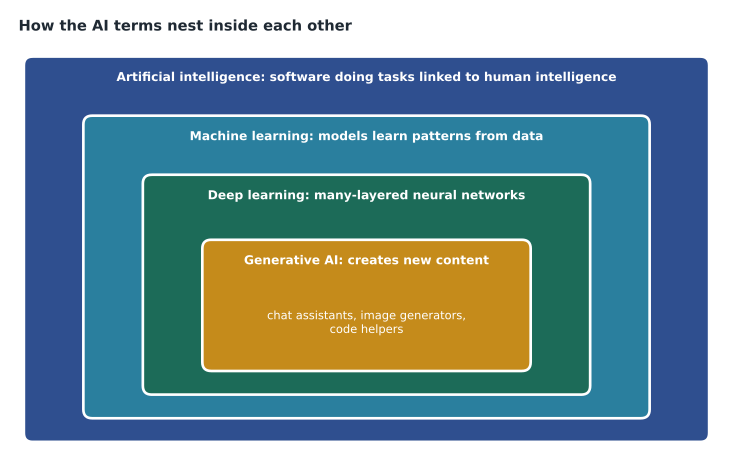
Maya has heard all of these words used as if they meant the same thing. Arjun draws four nested boxes to separate them.
| Term | What it means | Harrow & Finch example |
|---|---|---|
| Artificial intelligence | The broad field of software that performs tasks associated with human intelligence. | Everything in this course. |
| Machine learning | An approach in which models learn patterns from data instead of following hand-written rules. | Predicting how many patio sets each store will sell in May. |
| Deep learning | Machine learning that uses neural networks with many layers, suited to images, sound and language. | Recognizing products on a shelf photo. |
| Generative AI | Deep learning models that create new content, such as text, images, audio or code, in response to a prompt. | Drafting a reply to a customer email. |
Generative AI is the part that has captured public attention since 2022, and it is the heart of the AI-901 exam. But it is not the only kind of AI, and for many business problems it is not the best kind. Forecasting sales or flagging a suspicious transaction is usually done better, more cheaply and more predictably by a traditional machine learning model than by a chat model.
What AI is good at
Arjun lists the strengths that matter for the contact center. AI can read and summarize large amounts of text quickly, so an agent can get the gist of a long email chain in seconds. It can handle many conversations at once at any hour. It can recognize patterns across thousands of cases that no person could hold in their head, such as which product questions spike after a particular television advertisement. It can translate, transcribe and convert speech to text. And modern language models are flexible: the same model can answer a returns question, rewrite a paragraph in plainer words and classify an email as urgent, without being trained separately for each task.
What AI is not
Then he lists the limits, because he says they matter more. A language model does not know facts the way a database does. It produces the most likely continuation of the text it has been given, based on patterns in its training data. Usually that continuation is correct. Sometimes it is fluent, confident and wrong, a problem called fabrication or, informally, hallucination. A model trained on data up to a certain date also knows nothing about what happened afterwards unless it is given that information.
AI is not neutral by default. Models learn from data produced by people, and they can absorb the gaps and biases in that data. AI is not accountable: when a system makes a mistake, a person or an organization is still responsible for it. And AI is not magic. It needs good data, clear goals, careful testing and ongoing monitoring, the same disciplines as any other system, plus a few new ones.
"What would a wrong answer cost here?" is the question Arjun asks about every idea. If Ask Finch tells a customer the wrong store hours, the cost is an annoyed customer. If it tells a customer the wrong way to wire a light fixture, the cost could be a fire. The answer to that question decides how much checking, human review and restriction a system needs.
# Arjun's quick sort of AI ideas by the cost of a wrong answer (1 = low, 3 = high)
ideas = {
    "Summarize a long email thread for an agent": 1,
    "Answer store-hours questions in chat": 1,
    "Draft product descriptions for staff to edit": 1,
    "Suggest which team should handle an email": 2,
    "Explain the returns policy to customers": 2,
    "Give electrical wiring instructions": 3,
}
for idea, cost in sorted(ideas.items(), key=lambda kv: kv[1]):
    review = {1: "spot checks", 2: "clear limits and easy handoff", 3: "keep out of scope"}[cost]
print(f"{cost} {idea:45s} -> {review}")1 Summarize a long email thread for an agent -> spot checks 1 Answer store-hours questions in chat -> spot checks 1 Draft product descriptions for staff to edit -> spot checks 2 Suggest which team should handle an email -> clear limits and easy handoff 2 Explain the returns policy to customers -> clear limits and easy handoff 3 Give electrical wiring instructions -> keep out of scope
What this code does
Gives each proposed AI idea a score for how much harm a wrong answer would cause, from 1 (low) to 3 (high), and sorts the list by that score. Each idea is matched to the level of human oversight it needs, from occasional spot checks to clear limits with an easy handoff to a person. The point is that riskier uses need more safeguards before launch.
Maya notices that the highest-risk idea is not something the company should build at all. Arjun agrees: the first version of Ask Finch will refuse wiring and plumbing instructions and point customers to the product manual, a licensed electrician or a store associate.
Narrow AI and the idea of general intelligence
Every AI system in use today is what researchers call narrow AI: it performs a defined range of tasks, however wide that range has become. Large language models are much more general than earlier systems, because one model can write, summarize, translate and reason through simple problems. But they still fail in ways a person would not, such as miscounting the letters in a word or confidently citing a policy that does not exist. Artificial general intelligence, a system that matches people across essentially all intellectual tasks, is a research goal and a subject of debate, not a product you can deploy in Azure.
For the exam and for work, the useful habit is to describe exactly what a system does. "The model classifies incoming emails into six categories with about nine correct answers in ten on our test set" is a description. "The AI understands our customers" is not.
How AI arrives at Harrow & Finch
Arjun explains that the company will not train large models from scratch. Training a modern language model takes enormous amounts of data and computing power, and only a handful of organizations do it. Harrow & Finch will use models that others have trained, through Microsoft Foundry, Microsoft's platform for building AI applications and agents on Azure. Foundry was known as Azure AI Foundry until a rename announced in late 2025, and the ready-made services it offers, for speech, language, vision and document processing, are now grouped as Foundry Tools. Older material calls them Azure AI services or Cognitive Services.
Using a ready-made model means the company's work is mostly about choosing the right model, giving it the right instructions and information, connecting it safely to company systems, testing it and watching how it behaves. Those are the topics of this course and the next.
az cognitiveservices account list --output tableThree questions before any AI project
Before the first workshop ends, Arjun gives Maya three questions that the AI review group will ask about every idea, and that she should ask too. First, what exactly is the task, described so that a test could check it? Second, what data or documents would the system need, and is the company allowed to use them that way? Third, who checks the output, and what happens when the system is unsure or wrong? Ideas that cannot answer all three are not ready to build. Maya realizes that her team already answers the third question every day: when a new agent is unsure, they ask a senior colleague. Ask Finch will need the same habit built in, as a clean handoff to a person.
The AI-901 exam and this course
AI-901 is Microsoft's Azure AI Fundamentals exam. Microsoft's study guide, with a skills outline dated April 15, 2026, groups the exam into two areas: identifying AI concepts and capabilities, weighted at about 40 to 45 parts in 100, and implementing AI solutions by using Microsoft Foundry, weighted at about 55 to 60. The study guide states that a score of 700 or more is needed to pass. Several training providers report that AI-901 replaced the older AI-900 exam, which they say retired on June 30, 2026; check Microsoft Learn for the current status before you book.
Unlike older fundamentals exams, AI-901 expects some hands-on familiarity: the study guide mentions Python syntax, REST APIs, software development kits and command-line tools. This course, MSAZ-110, covers the first area, the concepts, with small Python examples you can run in the browser. MSAZ-111 covers the second area, building apps and agents in Foundry. MSAZ-190 reviews all four Microsoft fundamentals exams and explains booking and exam day.
Maya writes three words on the first page of her notebook: tasks, patterns, accountability. AI performs tasks, it learns patterns, and people remain accountable. The rest of the course fills in the detail.
Common mistakes
MistakeAI, machine learning and generative AI are the same thing.
InsteadGenerative AI is a kind of deep learning, which is a kind of machine learning, which is one approach to AI.
MistakeA language model looks up facts, so its answers are always correct.
InsteadA language model predicts likely text; it can produce fluent answers that are wrong unless it is grounded in reliable information.
MistakeIf the AI makes a mistake, nobody is responsible.
InsteadThe organization that deploys an AI system remains accountable for what it does.
Summary and key terms
- Artificial intelligence is software that performs tasks associated with human intelligence, such as recognizing images, understanding language and making predictions.
- Machine learning learns patterns from examples instead of following hand-written rules.
- Deep learning uses many-layered neural networks; generative AI is deep learning that creates new content.
- AI is strong at handling varied input, summarizing, translating and working at scale, but its behavior is statistical, not guaranteed.
- Language models can fabricate answers, can reflect bias in their data and do not know events after their training data unless told.
- The cost of a wrong answer decides how much review and restriction an AI system needs.
- AI-901 covers AI concepts and building AI solutions with Microsoft Foundry; this course covers the concepts.
- Artificial intelligence
- Software that performs tasks normally associated with human intelligence.
- Machine learning
- An approach in which models learn patterns from data rather than following written rules.
- Deep learning
- Machine learning with neural networks of many layers.
- Generative AI
- AI that creates new content such as text, images, audio or code from a prompt.
- Fabrication
- A fluent but false answer produced by a model; often called hallucination.
- Narrow AI
- AI that performs a defined range of tasks, which describes every system in use today.
- Microsoft Foundry
- Microsoft's Azure platform for building AI applications and agents, formerly Azure AI Foundry.
Practice problems
Work each problem on paper first, then reveal the answer to check.
How does an AI system's behavior differ from that of a traditional program?
Show answer
A traditional program follows rules a developer wrote; an AI system learns patterns from examples, so its behavior is statistical.
Order these from broadest to narrowest: deep learning, artificial intelligence, generative AI, machine learning.
Show answer
Artificial intelligence, machine learning, deep learning, generative AI.
What is fabrication in a language model?
Show answer
A confident, fluent answer that is not true.
Why might a traditional machine learning model be a better choice than a chat model for sales forecasting?
Show answer
It is usually more accurate, cheaper and more predictable for structured prediction tasks.
Who is accountable when an AI system makes a mistake?
Show answer
The people and organization that built and deployed it.
What are the two areas of the AI-901 skills outline?
Show answer
Identifying AI concepts and capabilities, and implementing AI solutions by using Microsoft Foundry.
Lesson quiz · 5 questions
Score 60% or more to complete this lesson.
Create a free account to save your progress, take quizzes and earn a certificate.