
MEC-250 · Lesson 9 of 12 · 24 min
Nonferrous alloys: light metals, copper and superalloys
Steel is cheap, strong, stiff and tough, and it makes up most of the mass of a Kestrel gearbox. But the gearbox also contains an aluminum housing, bronze bushings, a copper-alloy cooling coil in the oil reservoir, and, in the forestry harvester line, a titanium sensor bracket exposed to sap and road salt. Each was chosen because it does something steel cannot do well enough: save weight, resist corrosion, conduct heat, run against a steel shaft with little lubrication. This lesson surveys the main nonferrous alloy families and the one heat treatment, precipitation hardening, that makes several of them strong.
Why choose a nonferrous alloy?
Steels have three weaknesses. They are dense, at about 7.85 Mg/m³. Ordinary steels rust. And their properties change at low temperature, where ferritic steels become brittle, and at high temperature, where they lose strength and creep. Nonferrous alloys address these weaknesses at a higher price per kilogram. Aluminum, magnesium and titanium alloys are light. Copper alloys conduct heat and electricity and resist many corrosive environments. Nickel and cobalt alloys keep their strength at temperatures where steels would creep away. Choosing among them, as Lesson 12 shows, means comparing properties per unit mass and per unit cost, not just absolute values.
Aluminum and its alloys
Aluminum has a density of 2.70 Mg/m³, about a third that of steel, an FCC structure that keeps it ductile and tough at low temperatures, and a thin, tenacious oxide film that protects it from corrosion in most atmospheres. It conducts heat and electricity well and is easily cast, extruded, rolled and machined. Its weaknesses are a low melting point of 660 °C, which limits service temperatures to roughly 150 to 200 °C for most alloys, a modulus of only about 70 GPa, and the lack of a fatigue limit. Pure aluminum is soft, with a yield strength of a few tens of megapascals, so engineering use depends on alloying.
Wrought alloys are identified by a four-digit system based on the main alloying element: 1xxx for commercially pure aluminum, 2xxx copper, 3xxx manganese, 5xxx magnesium, 6xxx magnesium and silicon, and 7xxx zinc. Cast alloys use a similar three-digit system with a decimal, such as 356.0 for an aluminum–silicon–magnesium alloy. A temper designation follows a hyphen: F means as fabricated, O annealed, H strain hardened (for alloys that cannot be heat treated, such as 3xxx and 5xxx), and T a thermal treatment, with T4 meaning solution treated and naturally aged and T6 meaning solution treated and artificially aged. The alloys of the 2xxx, 6xxx and 7xxx series, and many casting alloys, can be strengthened by heat treatment; the others are strengthened by solid solution and cold work.
| Alloy and temper | Main additions | Typical yield (MPa) | Typical use |
|---|---|---|---|
| 1100-O | ≥99 % Al | 35 | Foil, heat-exchanger fins |
| 3003-H14 | Mn | 145 | Sheet, cooking utensils |
| 5052-H32 | Mg | 195 | Marine sheet, fuel tanks |
| 6061-T6 | Mg, Si | 275 | Extrusions, brackets, frames |
| 7075-T6 | Zn, Mg, Cu | 500 | Aircraft structure, high-stress fittings |
| A356.0-T6 (cast) | Si, Mg | 170–210 | Gearbox housings, wheels |
Precipitation hardening
Precipitation hardening, also called age hardening, produces a very fine dispersion of second-phase particles that obstruct dislocations, as introduced in Lesson 5. It needs an alloy whose solubility for the solute falls sharply with temperature, so that a single phase at high temperature becomes two phases at low temperature. The aluminum–copper system is the classic example: aluminum dissolves up to 5.65 wt% copper at 548 °C but almost none at room temperature, where the equilibrium structure is α aluminum plus coarse particles of the intermetallic \(\text{CuAl}_2\), called θ.
The treatment has three steps. In solution treatment, the alloy is heated into the single-phase α region, around 500 to 540 °C for aluminum–copper alloys, and held until the solute dissolves completely. It is then quenched, usually in water, to room temperature, trapping the solute in a supersaturated solid solution. Finally, in aging, it is held at a moderate temperature, typically 120 to 200 °C for artificial aging, or at room temperature for natural aging. The supersaturated solute clusters into tiny zones only a few atoms thick (Guinier–Preston zones), which develop into a sequence of transition precipitates, each coherent or partly coherent with the matrix and very effective at blocking dislocations, before the equilibrium θ phase forms.
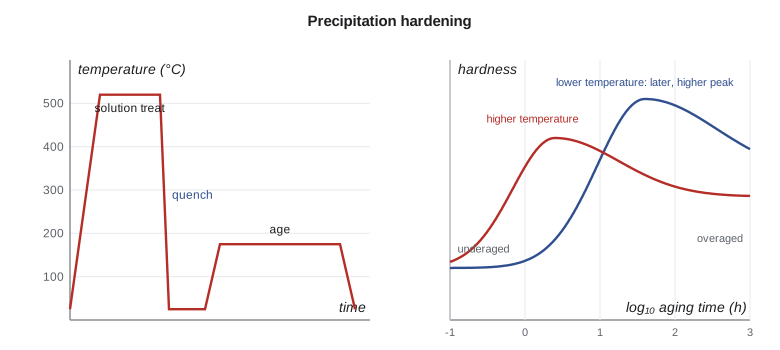
Hardness and strength rise with aging time to a maximum and then fall as the precipitates coarsen and become fewer and further apart, which lets dislocations bow between them more easily. This decline is overaging. Higher aging temperatures reach the peak sooner but give a lower peak; lower temperatures take longer but reach a higher peak. Because precipitate growth depends on diffusion, the time to peak follows an Arrhenius law. The same physics explains why precipitation-hardened aluminum parts lose strength if they are used too hot for too long, and why a weld in 6061-T6 has a soft zone where the heat overaged or dissolved the precipitates.
Worked problem
Equilibrium θ fraction and aging time
(a) Estimate the mass fraction of θ (about 53 wt% Cu) in an Al–4 wt% Cu alloy at equilibrium at room temperature, where α contains about 0.1 wt% Cu. (b) An alloy reaches peak hardness in 8 h at 175 °C. If the activation energy is 130 kJ/mol, estimate the time to peak at 160 °C.
Show solution
- (a) Lever rule: \(W_\theta = (4.0 - 0.1)/(53 - 0.1) = 0.074\), about 7 percent by mass.
- (b) \(t \propto \exp(Q/RT)\), so
- \[t_{160} = 8\exp\!\Big[\frac{130\,000}{8.314}\Big(\frac{1}{433.15} - \frac{1}{448.15}\Big)\Big] = 8\,e^{1.21} = 27\ \text{h}\]
Answer: A small change in aging temperature has a large effect on cycle time. Heat treaters use lower temperatures and longer times when the highest strength is needed, and higher temperatures when throughput matters more. At equilibrium only 7 percent of the alloy is θ, but as fine transition precipitates even a smaller fraction can triple the yield strength.
# Nonferrous alloys: specific properties, precipitate fraction and aging time
import math

alloys = [  # name, density Mg/m3, E GPa, typical yield MPa
    ("Q&T Cr-Mo steel (shaft)", 7.85, 205, 840),
    ("Al 6061-T6 (wrought)",     2.70,  69, 276),
    ("Al 7075-T6 (wrought)",     2.81,  72, 503),
    ("Al A356-T6 (cast)",        2.68,  72, 185),
    ("Mg AZ91 (die cast)",       1.81,  45, 150),
    ("Ti-6Al-4V (annealed)",     4.43, 114, 880),
    ("Tin bronze (cast)",        8.80, 100, 140),
    ("Ni alloy 718 (aged)",      8.19, 200, 1030),
]
print(f"{'alloy':26s} {'yield/rho':>9s} {'E/rho':>7s} {'sqrt(E)/rho':>11s}")
print(f"{'':26s} {'kN m/kg':>9s} {'MN m/kg':>7s} {'(beam)':>11s}")
for name, rho, E, sy in alloys:
    print(f"{name:26s} {sy / rho:9.0f} {E / rho:7.1f} {math.sqrt(E) / rho:11.2f}")

# Equal-stiffness beam of a given length: mass ratio relative to steel scales with rho / sqrt(E)
rs, Es = 7.85, 205
print("\nmass of an equally stiff beam (same length and width), relative to steel:")
for name, rho, E, sy in alloys[1:6]:
    print(f"  {name:26s} {(rho / E ** (1 / 3)) / (rs / Es ** (1 / 3)):.2f}  (plate)   "
          f"{(rho / math.sqrt(E)) / (rs / math.sqrt(Es)):.2f}  (square section)")

# Lever rule for an Al-4 wt% Cu alloy at room temperature (theta = CuAl2, about 53 wt% Cu)
C0, Ca, Ct = 4.0, 0.1, 53.0
print(f"\nAl-4Cu at room temperature: {100 * (C0 - Ca) / (Ct - Ca):.1f} % theta phase by mass at equilibrium")

# Aging: time to peak hardness follows an Arrhenius law, t ~ exp(Q/RT)
Q, R = 130e3, 8.314
t_ref, T_ref = 8.0, 175 + 273.15          # peak in 8 h at 175 C (illustrative)
print("\naging temperature    time to peak hardness")
for Tc in (150, 160, 175, 190, 205):
    T = Tc + 273.15
    t = t_ref * math.exp(Q / R * (1 / T - 1 / T_ref))
print(f" {Tc} C {t:7.1f} h")alloy yield/rho E/rho sqrt(E)/rho
kN m/kg MN m/kg (beam)
Q&T Cr-Mo steel (shaft) 107 26.1 1.82
Al 6061-T6 (wrought) 102 25.6 3.08
Al 7075-T6 (wrought) 179 25.6 3.02
Al A356-T6 (cast) 69 26.9 3.17
Mg AZ91 (die cast) 83 24.9 3.71
Ti-6Al-4V (annealed) 199 25.7 2.41
Tin bronze (cast) 16 11.4 1.14
Ni alloy 718 (aged) 126 24.4 1.73
mass of an equally stiff beam (same length and width), relative to steel:
Al 6061-T6 (wrought) 0.49 (plate) 0.59 (square section)
Al 7075-T6 (wrought) 0.51 (plate) 0.60 (square section)
Al A356-T6 (cast) 0.48 (plate) 0.58 (square section)
Mg AZ91 (die cast) 0.38 (plate) 0.49 (square section)
Ti-6Al-4V (annealed) 0.69 (plate) 0.76 (square section)
Al-4Cu at room temperature: 7.4 % theta phase by mass at equilibrium
aging temperature time to peak hardness
150 C 62.9 h
160 C 26.8 h
175 C 8.0 h
190 C 2.6 h
205 C 0.9 hThe program shows something important about the light alloys. Aluminum, magnesium and titanium all have about the same modulus-to-density ratio as steel, about 25 MN·m/kg, so a light alloy saves no weight in a bar loaded in tension for a given stiffness. The saving comes in bending and in panels, where stiffness depends on thickness cubed and a lighter material can be made thicker. For a stiff panel of the same width, aluminum weighs about half as much as steel. That is why Kestrel's cast housing is aluminum, while its shafts, loaded in torsion and bending at high stresses in a tight space, remain steel.
Magnesium
Magnesium is the lightest structural metal, at 1.74 Mg/m³, two-thirds the density of aluminum. Its HCP structure limits ductility at room temperature, so most magnesium parts are die castings, such as transmission cases, steering wheel cores, laptop frames and power tool housings. Common alloys such as AZ91, with about 9 percent aluminum and 1 percent zinc, combine good castability with moderate strength. Magnesium is chemically active and corrodes readily, especially in contact with steel in salty water, so parts need careful coating and isolation. Fine chips and powder can ignite, which matters for machining and dust control.
Titanium
Titanium alloys combine a density of 4.43 Mg/m³ with strengths comparable to alloy steels and outstanding corrosion resistance, especially in chlorides and seawater. They also keep their strength up to about 400 to 550 °C. Titanium is HCP (alpha) at room temperature and transforms to BCC (beta) above about 882 °C, and alloying elements stabilize one phase or the other. The workhorse alloy Ti-6Al-4V, an alpha–beta alloy, accounts for about half of all titanium used and serves in aircraft structure, jet engine fans, medical implants and high-performance racing parts. Its drawbacks are cost, poor wear resistance, a tendency to gall against itself, and difficult machining because it conducts heat poorly and reacts with cutting tools. Kestrel uses it only where corrosion and weight both matter, such as the harvester sensor bracket.
Copper and its alloys
Copper has the second-highest electrical conductivity of any metal and very high thermal conductivity, so it is used for wiring, bus bars, motor windings and heat exchangers. Pure copper is soft and ductile; its alloys are stronger. Brasses, copper–zinc alloys with up to about 40 percent zinc, are easily machined and formed and used for fittings, valves and fasteners. Bronzes were originally copper–tin alloys; the term now includes aluminum bronzes and silicon bronzes as well. Tin bronzes and leaded bronzes make excellent bearing and bushing materials, because they run well against steel, embed small dirt particles, and tolerate marginal lubrication. Beryllium copper can be precipitation hardened to strengths over 1000 MPa while keeping good conductivity, for springs and non-sparking tools, although beryllium dust is toxic and machining must be controlled. Cupronickels, copper–nickel alloys, resist seawater and are used for marine piping and condenser tubes.
Nickel, cobalt and the superalloys
Nickel is FCC at all temperatures, tough at cryogenic temperatures, and resistant to many corrosive environments. Nickel-based superalloys are the materials of the hottest parts of jet engines and gas turbines, where metal temperatures exceed 1000 °C, well above 0.7 of their absolute melting point. Their strength at temperature comes from a high volume fraction of an ordered intermetallic precipitate, gamma prime, \(\text{Ni}_3(\text{Al,Ti})\), which unlike most precipitates becomes stronger as temperature rises over part of its range. Solid solution strengthening by heavy elements such as tungsten, molybdenum and rhenium, and coarse grains or single crystals to suppress grain-boundary creep, complete the design. Turbine blades also have internal cooling passages and ceramic thermal barrier coatings. Cobalt alloys have similar uses and good wear resistance. Simpler nickel alloys, such as alloy 625 and alloy 718, are used for chemical plant, oil and gas equipment and high-temperature fasteners.
Other nonferrous metals
Zinc alloys are cast at low temperatures with excellent dimensional accuracy, for small housings and hardware; zinc is also the main coating for galvanized steel. Lead, once common in bearings and solders, is now restricted because of toxicity. Tin is the base of lead-free solders and bearing babbitts. Refractory metals, including tungsten, molybdenum, niobium and tantalum, have very high melting points and are used for lamp filaments, furnace parts and rocket nozzles. Precious metals such as gold, silver and platinum serve in electrical contacts, catalysts and sensors, where their corrosion resistance justifies their cost.
Mixing metals: galvanic corrosion
When two different metals touch in the presence of an electrolyte, such as rainwater with road salt, they form a galvanic cell. The more active metal becomes the anode and corrodes faster, while the more noble metal, the cathode, is protected. The galvanic series in seawater ranks common alloys from active (magnesium, zinc, aluminum, carbon steel) to noble (stainless steel in the passive state, titanium, graphite, gold). The farther apart two metals are, the stronger the effect, and a small anode coupled to a large cathode corrodes fastest. At Kestrel, stainless steel bolts in an aluminum housing are isolated with coatings and sealant, and the titanium bracket on the harvester is fastened with isolating washers so that it does not attack the steel frame around it.
Common mistakes
MistakeAssuming a light alloy always saves weight.
InsteadFor stiffness in tension, light alloys give little saving; the gain comes in bending and panels.
MistakeUsing 6061-T6 strength values in a welded joint.
InsteadWelding overages or dissolves the precipitates near the weld; use reduced welded properties.
MistakeThinking longer aging always gives higher strength.
InsteadBeyond the peak, precipitates coarsen and strength falls (overaging).
MistakeFastening dissimilar metals without considering galvanic corrosion.
InsteadCheck the galvanic series, isolate joints and avoid small anodes on large cathodes.
MistakeUsing aluminum where it will operate above about 150 to 200 °C for long periods.
InsteadPrecipitation-hardened aluminum loses strength by overaging; consider titanium or steel.
Summary and key terms
- Nonferrous alloys address the density, corrosion and temperature limits of steel at higher cost.
- Aluminum alloys are designated by series and temper; 2xxx, 6xxx and 7xxx can be heat treated.
- Precipitation hardening needs decreasing solubility: solution treat, quench, then age.
- Strength peaks with aging time, then falls as precipitates coarsen; time to peak follows an Arrhenius law.
- Magnesium is the lightest structural metal; titanium combines high specific strength with excellent corrosion resistance.
- Copper alloys provide conductivity, corrosion resistance and good bearing behavior.
- Nickel superalloys use γ′ precipitates and single crystals to resist creep at very high temperatures.
- Temper designation
- The suffix describing the processing condition of an aluminum alloy, such as T6.
- Solution treatment
- Heating into a single-phase region to dissolve solute atoms.
- Aging
- Holding a supersaturated solid solution at a moderate temperature to form fine precipitates.
- Overaging
- Loss of strength when precipitates coarsen beyond the peak.
- Specific strength
- Strength divided by density.
- Brass
- An alloy of copper and zinc.
- Bronze
- A copper alloy with tin or other elements such as aluminum or silicon.
- Superalloy
- A nickel-, cobalt- or iron-based alloy designed for strength at high temperatures.
- Galvanic corrosion
- Accelerated corrosion of the more active metal in a couple of dissimilar metals.
Practice problems
Work each problem on paper first, then reveal the answer to check.
Explain why 5052 aluminum cannot be strengthened by aging.
Show answer
Magnesium stays in solid solution and does not form a useful precipitate sequence; 5xxx alloys are strengthened by solid solution and cold work.
Using the program, which alloy in the list has the highest specific strength?
Show answer
Ti-6Al-4V, at about 199 kN·m/kg.
An alloy peaks in 8 h at 175 °C (Q = 130 kJ/mol). Estimate the time to peak at 190 °C.
Show answer
About 2.6 h.
Why are tin bronzes used for bushings that run against steel shafts?
Show answer
They run well against steel, embed dirt and tolerate marginal lubrication.
A steel bolt holds a magnesium bracket outdoors. Which metal corrodes, and how can it be prevented?
Show answer
The magnesium; coat it and isolate the joint with insulating washers and sealant.
Why do superalloy turbine blades often have no grain boundaries at all?
Show answer
Single crystals eliminate grain-boundary sliding and cavitation, the main high-temperature creep mechanisms.
Lesson quiz · 5 questions
Score 60% or more to complete this lesson.
Create a free account to save your progress, take quizzes and earn a certificate.