
MEC-250 · Lesson 3 of 12 · 27 min
Crystal defects and diffusion
Rosa Delgado runs Kestrel's metallurgical lab, a small room with a cut-off saw, a mounting press, polishing wheels and two microscopes. She cut a slice from Amira's broken shaft a few millimeters behind the fracture, mounted it in resin, polished it to a mirror finish and examined it before etching. Even unetched, the section showed rows of tiny gray streaks lying along the shaft axis: manganese sulfide inclusions, stretched out when the bar was rolled. After etching, the microstructure appeared, a mosaic of grains a few tens of micrometers across. Both features are crystal defects, departures from the perfect lattice of Lesson 2. Defects sound like faults, but they are what make materials useful. Without them, metals could not be strengthened, alloyed or heat treated, and gears could not be carburized.
No crystal is perfect
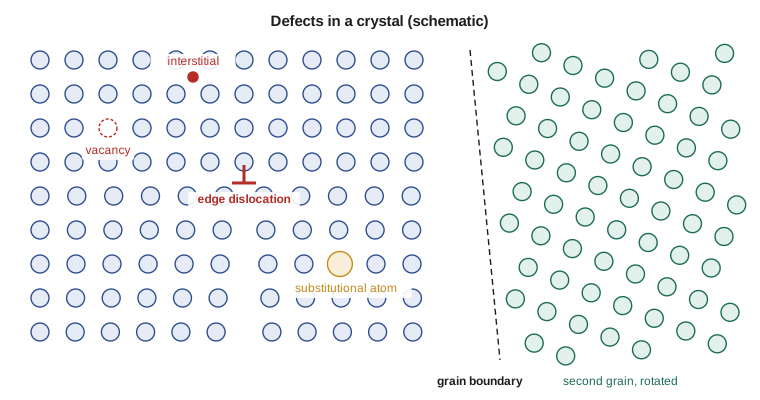
Defects are classified by their dimensions. Point defects are disturbances around a single lattice site: vacancies, interstitial atoms and impurity atoms. Line defects are dislocations, one-dimensional disturbances that run through the crystal. Planar defects are two-dimensional: external surfaces, grain boundaries, twin boundaries and stacking faults. Volume defects include pores, cracks and inclusions of a foreign phase. Each kind affects different properties. Point defects control diffusion and solid solution strengthening, dislocations control plastic deformation, grain boundaries control strength and toughness, and volume defects often control fracture and fatigue.
Vacancies and self-interstitials
A vacancy is a lattice site from which an atom is missing. Vacancies are not mistakes of processing; they exist in equilibrium in every crystal above absolute zero, because a few empty sites increase the entropy of the crystal enough to lower its free energy. The equilibrium fraction of vacant sites rises steeply with temperature:
Here \(N\) is the number of atomic sites, \(Q_v\) the energy to form one vacancy, \(k = 8.617 \times 10^{-5}\ \text{eV/K}\) the Boltzmann constant and \(T\) the absolute temperature. For copper, \(Q_v\) is about 0.9 eV. At room temperature the vacancy fraction is around \(10^{-15}\), but near the melting point it reaches a few times \(10^{-4}\): roughly one site in three thousand is empty. These vacancies are what allow atoms to move through a solid metal, as we will see shortly.
A self-interstitial is an atom of the host crystal squeezed into a space between normal sites. Because the spaces are much smaller than the atoms, self-interstitials cause large distortion and are far rarer than vacancies. They become important mainly in materials exposed to radiation, such as reactor components.
Impurities and solid solutions
No commercial metal is pure, and most are deliberately alloyed. Foreign atoms can be accommodated in two ways. In a substitutional solid solution, solute atoms replace host atoms on lattice sites, as nickel does in copper or chromium does in iron. In an interstitial solid solution, small solute atoms fit into the spaces between host atoms, as carbon, nitrogen and hydrogen do in iron. A solid solution keeps the crystal structure of the host; if the solute exceeds its solubility limit, a second phase forms.
For substitutional solutions, the Hume-Rothery rules describe when extensive solubility is possible. The atomic radii should differ by less than about 15 percent, the crystal structures should be the same, the electronegativities should be similar, and the valences should be similar. Copper and nickel satisfy all four and dissolve in each other completely, at every composition. Interstitial solubility is limited by size. Carbon is soluble up to about 2.1 percent by weight in FCC austenite, whose interstitial holes are relatively large, but only about 0.022 percent in BCC ferrite, whose holes are small even though the BCC structure has more empty space overall. This difference, as Lesson 8 shows, is the basis of the heat treatment of steel.
Compositions are given either in weight percent, used in specifications and on mill certificates, or in atom percent, used in theory. To convert, divide each weight percent by the atomic mass to get relative numbers of moles, then normalize.
Worked problem
Weight percent to atom percent
A shaft steel contains 0.40 wt% carbon (A = 12.01 g/mol); treat the rest as iron (A = 55.85 g/mol). What is its carbon content in atom percent?
Show solution
- In 100 g of steel there are \(0.40/12.01 = 0.0333\) mol of carbon and \(99.60/55.85 = 1.783\) mol of iron.
- \[\text{at\% C} = \frac{0.0333}{0.0333 + 1.783} \times 100 = 1.83\ \text{at\%}\]
Answer: Because carbon atoms are so much lighter than iron atoms, the atom fraction is more than four times the weight fraction. Roughly one atom in 55 is carbon, and those few atoms control almost every property of the steel.
Dislocations
A dislocation is a line around which atoms are misaligned. The easiest type to picture is an edge dislocation: an extra half-plane of atoms inserted partway into the crystal, ending along a line. Atoms above the line are squeezed together and atoms below are pulled apart. In a screw dislocation, the planes of atoms spiral around the line like the thread of a screw. Most real dislocations are mixed, with edge character in some places and screw character in others.
Each dislocation is characterized by its Burgers vector \(\mathbf{b}\), the closure failure of a circuit of atom-to-atom steps drawn around the line. For an edge dislocation, \(\mathbf{b}\) is perpendicular to the line; for a screw dislocation, it is parallel. In metals, \(\mathbf{b}\) usually points along a close-packed direction and has a length of one interatomic spacing. Annealed metals contain about \(10^{10}\) to \(10^{12}\) meters of dislocation line per cubic meter; heavily cold-worked metals contain up to \(10^{16}\). Dislocations move under shear stress and their motion is what we observe as plastic deformation. That is the subject of Lesson 5.
Grain boundaries and other planar defects
A grain boundary separates two grains with different orientations. Within a few atomic diameters of the boundary, atoms are less regularly packed than in the grains, so the boundary has an energy per unit area and is a fast path for diffusion and a preferred site for precipitation and corrosion. Boundaries also block dislocation motion, so fine-grained metals are stronger and usually tougher than coarse-grained ones, an effect quantified in Lesson 5.
A twin boundary is a special boundary across which the atoms are arranged as mirror images. Twins form during deformation in some metals, such as HCP magnesium and titanium, and during annealing in FCC metals such as brass and austenitic stainless steel, where they appear as straight-sided bands across grains. A stacking fault is an error in the stacking sequence of close-packed planes, and the ease with which stacking faults form affects how FCC metals work harden.
Grain size is measured on polished and etched sections. A common method, the ASTM grain size number \(G\), counts grains per square inch at 100× magnification: \(N = 2^{G-1}\). Larger \(G\) means finer grains. Structural and gear steels are often specified as fine-grained, typically \(G = 5\) or finer, because coarse grains reduce toughness and can lead to cracking during heat treatment. Grain size can also be reported as an average intercept length in micrometers, which is the form used in most research.
Volume defects: pores and inclusions
Castings may contain gas pores and shrinkage cavities. Sintered parts made from powders contain residual porosity. Steel contains non-metallic inclusions, small particles of oxides, sulfides and silicates left from steelmaking. Manganese is added to steel partly to tie up sulfur as manganese sulfide, which is less harmful than iron sulfide, but MnS inclusions are soft at rolling temperatures and are drawn into long stringers parallel to the rolling direction. Stringers have little effect on strength along the bar, but they reduce ductility and toughness across it and can act as fatigue crack starters. Rosa noted the stringers in the shaft and recorded their size and spacing against the steel specification. Whether they played a part in the failure would depend on where the crack started, a question for Lesson 6.
Diffusion: how atoms move in solids
Diffusion is the movement of atoms through a material. It is the mechanism of carburizing, nitriding, homogenizing castings, sintering powders, precipitation hardening and high-temperature creep. In solids, atoms move by jumping from one site to a neighboring one. In vacancy diffusion, an atom jumps into an adjacent vacancy, so atoms and vacancies move in opposite directions; this is how substitutional atoms and the host atoms themselves move, and it depends on the vacancy concentration. In interstitial diffusion, a small atom jumps from one interstitial site to another. Because interstitial sites are mostly empty, interstitial diffusion is much faster. Carbon diffuses in iron millions of times faster than iron does.
The flux \(J\), the amount of material crossing unit area per unit time, is proportional to the concentration gradient. This is Fick's first law:
The diffusion coefficient \(D\), in m²/s, measures how fast atoms move. The negative sign says that atoms flow down the concentration gradient, from high to low concentration. When the concentration profile does not change with time, the process is steady-state diffusion, as in the leakage of hydrogen through the wall of a steel pressure vessel or the purification of hydrogen through a thin palladium sheet.
Diffusion coefficients increase very rapidly with temperature, because a jump requires an atom to overcome an energy barrier, and the fraction of atoms with enough thermal energy follows an Arrhenius law:
Here \(D_0\) is a constant, \(Q_d\) the activation energy for diffusion in J/mol, and \(R = 8.314\ \text{J/(mol·K)}\). Typical values for carbon in FCC iron are \(D_0 = 2.3 \times 10^{-5}\ \text{m}^2/\text{s}\) and \(Q_d = 148\ \text{kJ/mol}\). At 930 °C this gives \(D = 8.6 \times 10^{-12}\ \text{m}^2/\text{s}\). For iron in FCC iron, the activation energy is nearly twice as large, and the diffusion coefficient at the same temperature is about five orders of magnitude smaller.
Non-steady diffusion and carburizing
Most practical diffusion problems are not steady. When carbon diffuses into a gear tooth, the concentration at each depth rises with time. Fick's second law describes this:
For a solid much thicker than the diffusion depth, with an initial uniform concentration \(C_0\) and a surface held at \(C_s\) by the furnace atmosphere, the solution is
where erf is the Gaussian error function, available in every spreadsheet and programming language. The important conclusion is that a given concentration is reached at a depth proportional to \(\sqrt{Dt}\). To double the case depth at a fixed temperature takes four times as long. Raising the temperature increases \(D\) and is the usual way to shorten cycles, limited by grain growth and furnace wear.
Worked problem
Carburizing time for a gear
Kestrel's gear steel contains 0.20 wt% C. The furnace holds the surface at 1.00 wt% C. The specification calls for 0.45 wt% C at a depth of 0.75 mm. How long is needed at 930 °C, where \(D = 8.63 \times 10^{-12}\ \text{m}^2/\text{s}\)?
Show solution
- Left side: \((0.45 - 0.20)/(1.00 - 0.20) = 0.3125\), so \(\operatorname{erf}(z) = 0.6875\) with \(z = x/(2\sqrt{Dt})\).
- From an error function table or the program below, \(z = 0.714\).
- \[t = \frac{1}{D}\Big(\frac{x}{2z}\Big)^2 = \frac{1}{8.63\times10^{-12}}\Big(\frac{0.75\times10^{-3}}{2(0.714)}\Big)^2 = 3.19\times10^{4}\ \text{s} \approx 8.9\ \text{h}\]
Answer: The same depth takes about 13 hours at 900 °C and about 6.2 hours at 960 °C. In US practice the depth would be specified as about 0.030 in; the arithmetic is identical once the depth is converted to meters. Real carburizing cycles usually include a boost stage followed by a diffuse stage, but the square-root dependence on time still governs the result.
# Point defects and diffusion: vacancy fraction, D(T) and carburizing case depth
import math

k = 8.617e-5        # Boltzmann constant, eV/K
R = 8.314           # gas constant, J/(mol K)

# 1. Equilibrium vacancy fraction in copper (formation energy about 0.9 eV)
Qv = 0.90
print("T (C)   vacancy fraction")
for Tc in (25, 500, 800, 1000, 1080):
    T = Tc + 273.15
    print(f"{Tc:5d}   {math.exp(-Qv / (k * T)):.2e}")

# 2. Composition: 0.40 wt% carbon in iron, as atomic percent
wC, AC, AFe = 0.40, 12.011, 55.85
nC, nFe = wC / AC, (100 - wC) / AFe
print(f"\n0.40 wt% C = {100 * nC / (nC + nFe):.2f} at% C")

# 3. Diffusion coefficients, D = D0 exp(-Q/RT)
data = {'C in FCC iron': (2.3e-5, 148e3), 'C in BCC iron': (1.1e-6, 87.4e3),
        'Fe in FCC iron': (5.0e-5, 284e3)}
# (BCC values at these temperatures are extrapolations, shown only to compare mobilities)
print("\n                  D at 900 C      D at 930 C      D at 1000 C  (m2/s)")
for name, (D0, Q) in data.items():
    vals = [D0 * math.exp(-Q / (R * (Tc + 273.15))) for Tc in (900, 930, 1000)]
    print(f"{name:16s}  " + "  ".join(f"{v:.3e}" for v in vals))

# 4. Carburizing: semi-infinite solid, constant surface carbon
#    (Cx - C0)/(Cs - C0) = 1 - erf(x / (2 sqrt(D t)))
def inverse_erf(y):
    lo, hi = 0.0, 3.0
    for _ in range(60):
        mid = (lo + hi) / 2
        lo, hi = (mid, hi) if math.erf(mid) < y else (lo, mid)
    return (lo + hi) / 2

C0, Cs, Cx, x = 0.20, 1.00, 0.45, 0.75e-3      # wt%, wt%, wt%, m
D0, Q = data['C in FCC iron']
ratio = (Cx - C0) / (Cs - C0)
z = inverse_erf(1 - ratio)
print(f"\ntarget: {Cx} wt% C at {x * 1000} mm; (Cx-C0)/(Cs-C0) = {ratio:.4f}, so z = {z:.4f}")
for Tc in (900, 930, 960):
    D = D0 * math.exp(-Q / (R * (Tc + 273.15)))
    t = (x / (2 * z)) ** 2 / D
    print(f"  at {Tc} C: D = {D:.3e} m2/s, time = {t / 3600:5.2f} h")

# 5. Carbon profile after 4 h at 930 C
D = D0 * math.exp(-Q / (R * 1203.15)); t = 4 * 3600
print("\ndepth (mm)  carbon (wt%) after 4 h at 930 C")
for xm in (0, 0.25, 0.5, 0.75, 1.0, 1.25, 1.5):
    c = C0 + (Cs - C0) * (1 - math.erf(xm / 1000 / (2 * math.sqrt(D * t))))
print(f" {xm:5.2f} {c:.3f}")T (C) vacancy fraction
25 6.11e-16
500 1.36e-06
800 5.93e-05
1000 2.74e-04
1080 4.44e-04
0.40 wt% C = 1.83 at% C
D at 900 C D at 930 C D at 1000 C (m2/s)
C in FCC iron 5.913e-12 8.632e-12 1.947e-11
C in BCC iron 1.412e-10 1.765e-10 2.854e-10
Fe in FCC iron 1.131e-17 2.337e-17 1.113e-16
target: 0.45 wt% C at 0.75 mm; (Cx-C0)/(Cs-C0) = 0.3125, so z = 0.7142
at 900 C: D = 5.913e-12 m2/s, time = 12.95 h
at 930 C: D = 8.632e-12 m2/s, time = 8.87 h
at 960 C: D = 1.237e-11 m2/s, time = 6.19 h
depth (mm) carbon (wt%) after 4 h at 930 C
0.00 1.000
0.25 0.693
0.50 0.453
0.75 0.306
1.00 0.236
1.25 0.210
1.50 0.202The program's last table shows the carbon profile after four hours at 930 °C. The surface carbon is 1.0 percent, it falls to about 0.45 percent at half a millimeter, and the core value is reached by about 1.5 mm. After quenching, the high-carbon surface becomes hard martensite and the low-carbon core becomes a tougher structure, exactly the combination a gear tooth needs: wear and contact-fatigue resistance at the surface, and resistance to tooth breakage in the core.
Common mistakes
MistakeThinking vacancies are only caused by poor processing.
InsteadAn equilibrium fraction of vacancies exists in every crystal and rises steeply with temperature.
MistakeAssuming more open space in BCC means more room for carbon.
InsteadBCC's empty space is divided into small holes; FCC's larger holes dissolve far more carbon.
MistakeUsing Celsius temperatures in the Arrhenius equation.
InsteadAlways use kelvin.
MistakeExpecting case depth to double when carburizing time doubles.
InsteadDepth scales with the square root of time; doubling depth needs four times as long.
MistakeTreating inclusions as harmless because they are tiny.
InsteadElongated inclusions reduce transverse ductility and can start fatigue cracks.
Summary and key terms
- Defects are classified as point, line, planar and volume defects.
- Vacancies exist in equilibrium; their fraction is exp(−Q_v/kT).
- Solid solutions are substitutional or interstitial; the Hume-Rothery rules govern substitutional solubility.
- Dislocations are line defects characterized by a Burgers vector; their motion produces plastic deformation.
- Grain boundaries strengthen metals and are fast diffusion paths; grain size is reported as an ASTM number or mean intercept.
- Fick's first law gives the steady flux; D follows an Arrhenius law with temperature.
- For carburizing, (C_x − C₀)/(C_s − C₀) = 1 − erf(x/2√(Dt)), and depth scales with √(Dt).
- Vacancy
- An empty lattice site.
- Interstitial
- An atom located between the normal lattice sites.
- Solid solution
- A crystal containing dissolved solute atoms while keeping the host structure.
- Dislocation
- A line defect around which atoms are misaligned.
- Burgers vector
- The vector describing the magnitude and direction of lattice distortion of a dislocation.
- Grain boundary
- The interface between two grains of different orientation.
- Inclusion
- A small particle of non-metallic material, such as an oxide or sulfide, within a metal.
- Diffusion coefficient
- The constant D in Fick's laws, measuring how fast atoms move.
- Activation energy
- The energy barrier that atoms must overcome to diffuse.
Practice problems
Work each problem on paper first, then reveal the answer to check.
Calculate the vacancy fraction in copper at 900 °C, taking Q_v = 0.90 eV.
Show answer
About 1.4 × 10⁻⁴.
Convert 18 wt% Cr in iron to atom percent (A: Cr 52.00, Fe 55.85 g/mol).
Show answer
About 19.1 at%.
Does carbon form a substitutional or interstitial solid solution in iron? Why?
Show answer
Interstitial; carbon atoms are much smaller than iron atoms.
Using D₀ = 2.3 × 10⁻⁵ m²/s and Q = 148 kJ/mol, find D for carbon in FCC iron at 1000 °C.
Show answer
About 1.95 × 10⁻¹¹ m²/s.
A 0.5 mm case takes 4 h. Roughly how long does a 1.0 mm case take at the same temperature and carbon levels?
Show answer
About 16 h.
Edit the program to find the time at 930 °C for 0.40 wt% C at 1.0 mm.
Show answer
z ≈ 0.81 and t ≈ 12 h.
Lesson quiz · 5 questions
Score 60% or more to complete this lesson.
Create a free account to save your progress, take quizzes and earn a certificate.